
In oral and maxillofacial surgery, the shift toward subspecialty training is no longer subtle. In the US, OMFS fellowship programs grew from 7 in 2013 to 28 in 2021, while applicants rose from 8 to 31 over the same period, according to a review of fellowship pathways in head and neck surgical oncology and related training growth published in PMC. That changes the career conversation. A fellowship in oral surgery is no longer just an optional extra for a small academic niche. For many surgeons, it's become the clearest route to complex case work, better referral alignment, and a more defined professional identity.
Patients feel that shift too, even if they never use the word “fellowship.” They notice it when one surgeon handles a straightforward third molar case well, and another surgeon is the person everyone calls for recurrent TMJ pathology, craniofacial anomalies, sleep-related airway surgery, or composite reconstruction after tumor ablation. Referring clinics notice it when a surgeon doesn't just operate well, but also knows when not to operate, how to sequence care, and how to work inside a multidisciplinary plan.
A good residency makes you safe, broad, and capable. A good fellowship changes how you think, what you attract, and which cases your community trusts you to own.
The Rise of Subspecialization in Oral Surgery
OMFS fellowship growth has been strong over the last decade, as noted earlier, and that trend reflects a real change in what communities ask surgeons to do.

The field is narrower at the top and broader at the edges than it used to be. An oral surgeon may still practice full scope, but the difficult referrals now often involve virtual planning, medically complex patients, airway concerns, joint disease, tumor reconstruction, or long treatment sequences shared with orthodontists, sleep physicians, ENT, pain teams, and pediatric specialists. Residency gives a strong base for that work. It does not always provide enough repetition to build a practice around one of those categories.
That distinction matters for career planning. A surgeon who wants to be the local referral point for TMJ salvage, complex sleep surgery, craniofacial cases, or oncologic reconstruction needs more than exposure. That surgeon needs a recognizable concentration of training, a referral story that makes sense to other doctors, and the judgment to decide which patients should stay in a multidisciplinary pathway instead of going straight to the operating room.
Referring clinics feel this shift early.
A non-surgical clinic may do an excellent job identifying sleep-disordered breathing, chronic TMJ dysfunction, or facial asymmetry, yet still struggle to place the referral correctly. Sending every difficult case to a general OMFS practice can work for routine pathology and extractions. It can break down when the patient needs staged imaging, splint therapy, medical sleep management, arthrocentesis versus arthroscopy judgment, or coordinated planning with orthodontics and ENT. In that setting, the difference is not just operative skill. The difference is whether the surgeon can enter the case as a clinical partner and help direct the next step.
I have seen that referral gap most clearly with TMJ and airway patients. A clinic sends a patient with years of failed conservative TMJ care, limited opening, headaches, malocclusion, and MRI findings that do not match the symptom story. A broad OMFS evaluation may correctly rule out a straightforward surgical fix, but the case still needs someone comfortable sorting inflammatory disease, internal derangement, occlusal change, behavioral pain drivers, and the threshold for joint surgery. The same pattern shows up in sleep care. A patient with CPAP intolerance, obesity, nasal obstruction, and maxillomandibular deficiency does not need a surgeon who only asks, "Can I operate?" The patient needs a surgeon who can work with sleep medicine and orthodontic or ENT colleagues to decide whether surgery belongs in the plan at all.
That is why subspecialization keeps growing. It serves surgeons who want a clearer professional identity, and it serves referring clinics that need more precise referral targets for hard cases.
Fellowship is not a universal requirement for a good oral surgery career. Many excellent surgeons build respected practices without it. But in parts of OMFS where case selection, multidisciplinary timing, and complication management carry as much weight as the operation itself, fellowship often marks the point where a surgeon becomes the person other clinicians trust with the hardest consults.
Residency vs Fellowship What Is the Difference
Residency is designed to produce a safe, board-eligible oral and maxillofacial surgeon. Fellowship is designed to make that surgeon unusually capable in a narrow clinical lane where referral judgment, complication management, and multidisciplinary coordination carry as much weight as the operation itself.
That distinction matters for career planning. It also matters for the dentists, sleep physicians, ENTs, orthodontists, and pain clinics deciding where to send difficult patients.
What changes after residency
By the end of residency, a surgeon should be able to diagnose routine and urgent OMFS problems, operate safely across the core scope of practice, and manage perioperative issues without missing the bigger picture.
What residency usually does not provide is sustained repetition in one high-complexity niche. A resident may see TMJ disease, orthognathic cases, pathology, trauma, and airway surgery. A fellow in a focused program sees the same problem set often enough to develop pattern recognition that changes decisions before the incision, during the operation, and in follow-up.
That is the practical difference.
What fellowship adds
A good fellowship sharpens three things that are hard to build in general training alone.
First, it improves case selection. The fellow learns which patients benefit from surgery, which patients need more workup, and which patients should be managed with another service leading care.
Second, it improves communication with referral partners. In TMJ and sleep surgery, that matters every week. A surgeon with advanced training can give a non-surgical clinic a more useful answer than "yes" or "no." The answer may be staged orthodontics, another sleep study, more conservative joint management, or a surgical plan coordinated with medical colleagues. For clinics referring patients for oral surgery options for sleep apnea, that kind of specificity makes referral patterns more efficient and patient care more coherent.
Third, it improves ownership of a service line. Fellowship pushes a surgeon toward running difficult consults, managing complications, and becoming the person a practice or hospital calls when the case sits outside routine OMFS volume.
Side by side comparison
| Training stage | Primary goal | Scope | Typical outcome |
|---|---|---|---|
| Residency | Build broad OMFS competence | Full-scope exposure across core domains | Safe, board-eligible surgeon with a strong general base |
| Fellowship | Build advanced judgment in a defined niche | Narrow, repeated focus in one area | Surgeon prepared for complex referrals, multidisciplinary planning, and a more specialized practice |
The costs and gains of fellowship
The gains are easy to see. Fellowship can strengthen your credibility with referral sources, make hospital recruitment easier, and help you build a practice around harder cases that fewer surgeons want or feel prepared to manage.
The costs are significant.
- Time: You extend training and delay full attending income.
- Income path: A focused fellowship can narrow your early job options if you want a broad private-practice role right away.
- Lifestyle: Call can be heavier, faculty expectations are high, and your schedule is rarely your own.
- Career fit: A poorly chosen fellowship can push you toward a patient population, case mix, or academic track that does not match the practice you want.
I usually tell residents to ask a simple question. Do you want fellowship because the title sounds good, or because you want to spend a meaningful part of your career handling a specific category of difficult referrals better than a general OMFS surgeon typically can?
That answer should guide the decision.
Exploring Key Oral Surgery Fellowship Programs
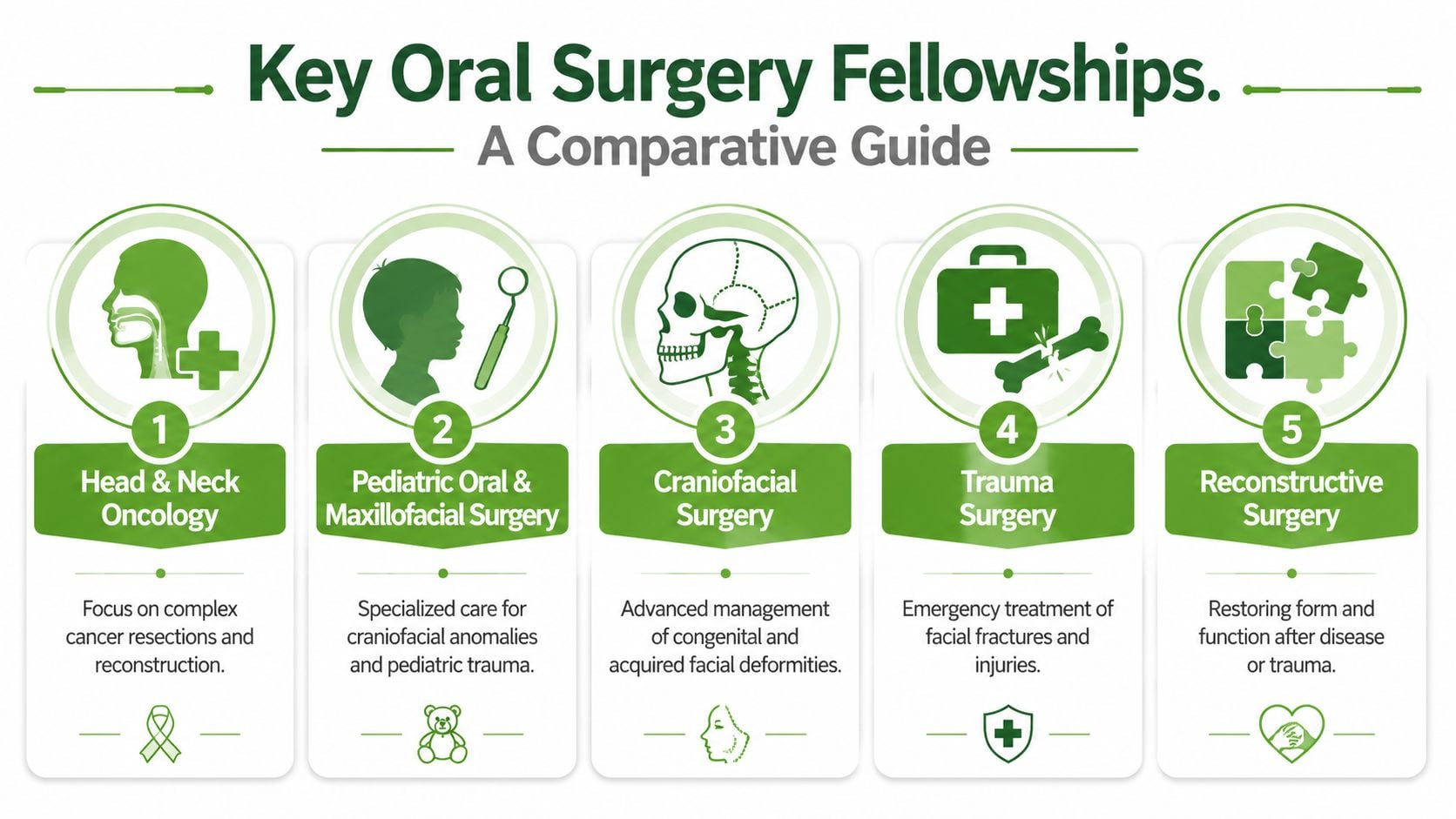
Not all fellowships in oral surgery produce the same surgeon. Some are built around cancer and reconstruction. Others center on congenital deformity, facial aesthetics, TMJ disease, or broad private-practice surgical volume. The smart way to evaluate programs is to start with the clinical problem, then ask what kind of training produces real expertise in that problem.
Head and neck oncology and reconstruction
This track is for surgeons who want major ablative and reconstructive care. The cases are medically serious, multidisciplinary, and often life-defining for patients. You work with cancer resection, airway issues, neck disease, soft tissue deficits, bony reconstruction, and long perioperative arcs.
The appeal is clear. The work is high consequence and technically demanding. The downside is just as clear. The schedule can be punishing, the patient burden is heavy, and you need to be comfortable operating as one member of a larger oncologic team rather than as a solo decision-maker.
Pediatric craniomaxillofacial and craniofacial training
This route suits surgeons drawn to congenital differences, growth, airway, and long-term facial development. CODA-accredited OMS fellowships are structured to prevent simple overlap with residency and may mandate 150 to 300 advanced cases annually per fellow in areas such as pediatric craniomaxillofacial surgery, according to the CODA OMS fellowship standards.
That volume matters because pediatric craniofacial work isn't just small anatomy. It's timing, growth prediction, speech implications, airway consequences, family counseling, and the discipline to think years ahead rather than one operation at a time.
TMJ surgery and orofacial pain related training
Many surgeons and referring clinicians encounter confusion regarding this specific topic. TMJ fellowships do exist, but their public descriptions are often sparse compared with oncology or cosmetic programs. That makes it harder to judge who is trained in advanced joint surgery versus who has only intermittent exposure.
The technical side is substantial. TMJ surgery fellowships can include arthroscopy, open arthroplasty, condylotomy, and total joint replacement, with reported goals of 80 to 90 percent pain reduction in appropriate surgical pathways. In high-volume centers, fellows may manage 100 to 200 TMJ surgeries annually, and that higher-volume environment is associated with lower revision rates, as described in the AAOMS fellowship overview.
For a referring clinic, that matters. Chronic TMD, internal derangement, degenerative joint disease, and mixed pain presentations require more than operative skill. They require restraint, staging, imaging judgment, and comfort working after conservative therapy has been tried.
A surgeon who knows arthroscopy but doesn't understand pain behavior, airway interaction, or rehabilitation can still become a poor partner for a complex TMJ practice.
Airway and sleep related surgical pathways
Airway surgery in OMFS doesn't always sit inside a neatly labeled “sleep fellowship,” but airway-centered experience often overlaps with craniofacial, pediatric, orthognathic, and TMJ training. These surgeons may treat skeletal contributors to obstruction, developmental anatomy, and related facial imbalance.
For patients evaluating more advanced options, this broader discussion often connects to procedures used in oral surgery for sleep apnea. The important point is that good airway surgery isn't just about moving bone. It's about selecting the right patient, understanding nasal and oral function, and fitting surgery into a wider treatment plan.
Cosmetic and full-scope private practice fellowships
These can be excellent when they're honest about their purpose. A strong private-practice fellowship can sharpen dentoalveolar efficiency, implant planning, orthognathic assistance, facial cosmetics, anesthesia workflow, and consult skills. That can be ideal for the surgeon who wants broad private-practice excellence rather than a narrow academic identity.
Selecting a program based solely on its name is ineffective. Reputation carries less weight than the diversity of cases, faculty involvement, surgical independence, and whether the curriculum aligns with the practice you want.
Inside a Fellowship A Look at Training and Research
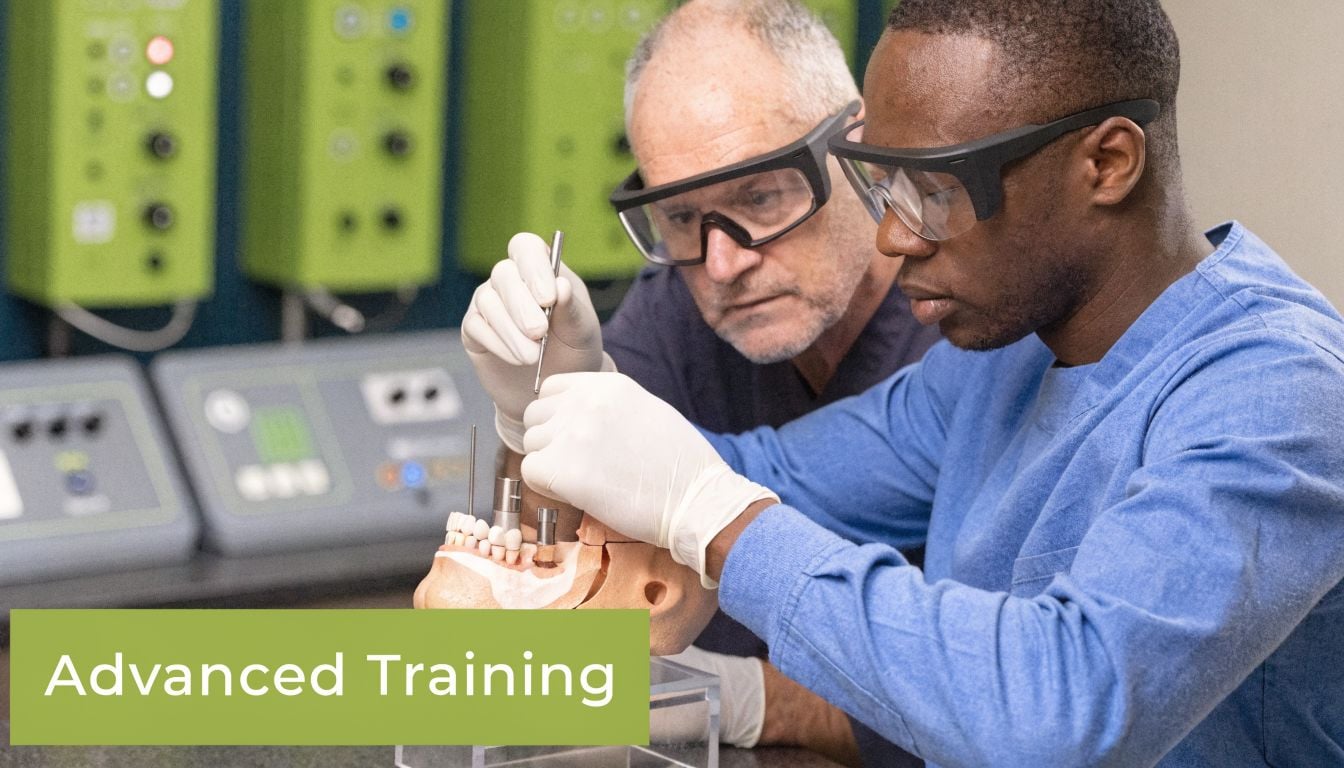
A fellowship feels different from residency on day one. The service expects more from you because you've already completed specialty training. Faculty don't want a beginner. They want someone who can move quickly, prepare carefully, and improve from one case to the next without being carried.
What the week usually feels like
Most fellows spend their time across clinic, operative days, hospital responsibilities, consults, call, and case review. The balance changes by program. An oncology fellow may spend more time in inpatient care, flap monitoring, and multidisciplinary planning. A TMJ or craniofacial fellow may spend more energy on imaging review, operative sequencing, and longer outpatient follow-up arcs.
The common thread is repetition with accountability. You're not there to collect observations. You're there to be shaped by volume, critique, and difficult decision-making.
A useful way to judge a program is to ask whether faculty progressively trust the fellow with real responsibility. If the fellow is only retracting, dictating, and watching the attending make every hard choice, the educational yield is limited.
Research is not optional
The academic side often surprises applicants who think fellowship is purely operative. It isn't. A fellowship trains a surgeon to contribute to the field, not just consume it.
In a study of North American craniofacial surgery fellowship faculty, investigators analyzed 102 faculty members from 29 programs and found a median career publication count of 37 and a median H-index of 10.0, according to the PubMed study on academic productivity in craniofacial fellowship faculty. Those figures don't mean every fellow must become a career researcher. They do mean the culture of many fellowships expects scholarly output, presentations, writing, and thoughtful review of outcomes.
Mentor's advice: If you hate writing, don't ignore that before fellowship. You'll still need to present cases clearly, defend decisions, and contribute something durable to the literature or to quality improvement.
For surgeons planning to offer deeper sedation or hospital-based procedural care after training, understanding perioperative systems also matters. That includes workflow, patient selection, and the clinical discipline behind oral surgery anesthesia.
What good programs teach beyond surgery
A serious fellowship should improve more than your hands.
- Clinical judgment: You learn who benefits from surgery, who needs more workup, and who should stay out of the operating room.
- Complication management: You stop thinking in perfect-case terms and start planning for revision, salvage, and follow-through.
- Communication: Difficult consults, family meetings, and multidisciplinary discussions become part of daily life.
- Professional identity: You begin to define what colleagues will call you for.
Later in training, many surgeons find it helpful to watch how fellows describe their own experience and workflow. This gives a sense of the pace and expectations:
The fellows who thrive usually share one trait. They don't chase cases blindly. They chase understanding.
Navigating the Oral Surgery Fellowship Application
Fellowship applicants usually overestimate what gets them an interview and underestimate what gets them ranked. Programs expect good grades, solid case logs, and credible letters. What separates candidates is clearer career intent, better judgment about fit, and evidence that they can function inside a referral network where surgeons, orthodontists, sleep physicians, ENTs, and general dentists all depend on each other.
That matters even more in areas like TMJ and sleep apnea. A fellowship director is not only asking whether you can operate. They are asking whether you understand when surgery fits, when conservative care should continue, and how you will work with the clinics sending those patients to you.
Start with fit, not name recognition
Residents still chase brand names too often. The better question is whether the fellowship will prepare you for the practice you want.
If your long-term goal is TMJ surgery, look hard at the true joint volume, revision exposure, imaging conferences, and multidisciplinary planning. If you want to build a sleep surgery practice, ask how often fellows work with sleep medicine, ENT, and dental sleep teams, and whether they see the full pathway from airway evaluation to postoperative follow-up. If your future includes trauma call, reconstructive work, or hospital privileges tied to complex facial injury care, relevant exposure matters more than prestige alone. Some applicants who want broad operative experience also benefit from seeing how a service handles facial trauma surgery and referral-based acute care in actual clinical practice.
Before you apply, define three things in plain language:
- The cases you want more of
- The practice setting you want after training
- The referral relationships you want to build
That third point gets missed. Fellowship is not only about technical repetition. It often determines which physicians and dental colleagues will trust you with difficult problems later.
Build an application that shows judgment and staying power
Programs already know you want more training. They need to see that you will use it well.
A strong application shows pattern recognition. Your case log should not read like a spreadsheet dump. It should show progression in responsibility, the harder decisions you made, and the complications or limitations you recognized. In interview season, I paid more attention to how a resident explained one imperfect case than to a long list of routine ones.
The same rule applies to letters. Choose faculty who can describe how you think, how you respond when a case changes course, and how you function with consultants, nursing staff, and anesthesia. A famous signature helps less than a detailed letter from someone who has watched you manage pressure.
Your personal statement should also do real work. Explain why this fellowship fits the practice you intend to build, who you want to serve, and what gaps in your current training you are trying to close. Generic statements about loving surgery are easy to forget. Residents who need help with structure often improve their draft by reviewing guidance on Crafting impactful personal statements.
Research matters, but not only for academic applicants. Even in private practice, scholarship signals discipline, follow-through, and the ability to examine outcomes. That matters in subspecialty care where referral partners want a surgeon who can defend decisions, not just perform procedures.
Interview like someone a team would trust with complex referrals
Fellowship directors are screening for reliability. In subspecialty training, your technical ceiling matters, but your judgment under stress matters more.
Be ready to discuss specific cases in a straightforward way. Explain what you saw, what options you considered, what you chose, and what you would do differently now. If your exposure to a target area is limited, say so directly and explain how you addressed that gap through electives, research, call experience, or mentorship. Evasive answers are a problem.
Inquire about the ways the program functions. How are complications reviewed? When do fellows gain autonomy? Which services refer in most often? How much time is spent in multidisciplinary clinics? Where do graduates end up, and what kind of practices are they able to build?
Those answers tell you whether the fellowship will help you become a true regional resource or just add another credential.
The applicants who match well usually present a coherent professional direction. They understand that fellowship training can shape both sides of the referral relationship. It prepares the surgeon for more complex care, and it gives non-surgical clinics a specialist they can trust with patients who need coordinated management for TMJ disease, sleep-disordered breathing, trauma, and other problems that sit between diagnosis, long-term management, and surgery.
How a Fellowship Shapes Your Career and Practice
The biggest effect of a fellowship in oral surgery shows up after training, not during it. The year changes who refers to you, what hospitals expect from you, and how narrowly or broadly your practice takes shape.
Some surgeons use fellowship to enter academics. Others use it to become the subspecialty resource inside a large private group or hospital system. Some use it to build a referral base around a clearly defined problem set such as facial trauma, TMJ disease, pediatric craniofacial care, or oncologic reconstruction.

What changes in your professional position
A fellowship often gives you more than another line on a CV. It gives your community a reason to call you for a particular category of problem. That can alter your caseload, your surgical confidence, and your role in treatment planning.
It also sharpens your judgment about referral boundaries. Surgeons with focused training usually become better at triage. They know which cases they should own, which need another subspecialist, and which should remain in conservative care.
That matters in adjacent fields too. Complex post-injury reconstruction, for example, often depends on a surgeon with focused experience in facial trauma surgery, not just broad oral surgery comfort.
Why referring clinics look for fellowship training
Referring providers do not require every oral surgeon to possess fellowship training. They do require clarity. However, the field still faces a significant challenge in this area.
Public fellowship resources often give detailed visibility to oncology or cosmetic pathways while offering very little detail about TMJ and orofacial pain-oriented training. The OFS Institute fellowship page highlights this gap qualitatively, noting minimal public detail on TMJ and pain-focused pathways and the difficulty that creates for prospective fellows and referring clinics trying to identify surgeons trained in multidisciplinary pain and airway management through this overview of the training gap.
That gap has practical consequences.
- For surgeons: It becomes harder to signal meaningful expertise in TMJ and airway-related collaboration.
- For clinics: It becomes harder to distinguish a surgeon who understands multidisciplinary care from one who mainly offers isolated operative services.
- For patients: Care can become fragmented when referral decisions rely on reputation alone instead of clearly defined training.
The best referral partnerships don't form around credentials alone. They form around shared judgment, clear communication, and respect for conservative care before and after surgery.
What works and what doesn't
What works is a surgeon who understands both the procedure and the care pathway. That includes diagnostic restraint, image interpretation, postoperative follow-up, and comfort co-managing patients with sleep physicians, dentists, ENTs, therapists, orthodontists, and pain-focused clinicians.
What doesn't work is the surgeon who sees every dysfunction as a mechanical problem with a mechanical solution. TMJ pain, airway complaints, and facial pain syndromes often overlap with behavior, musculature, breathing pattern, sleep quality, and medical comorbidity. Fellowship training can help, but only if the surgeon uses that training in a collaborative way.
Answering Your Top Questions About OMFS Fellowships
A small difference in training can change an entire referral pattern. In practice, that matters to two groups at once. The surgeon deciding how to build a career, and the non-surgical clinic deciding who can co-manage TMJ, airway, facial pain, or sleep-related cases with sound judgment.
Do you need an MD for every fellowship
No. Fellowship requirements vary by institution, hospital privileges, and the type of cases the service manages. Some programs accept qualified OMS graduates without an MD. Others expect dual-degree training or a credential set that fits a specific hospital system.
Read the actual requirements. Do not rely on hearsay from applicants in a different subspecialty or region.
Are fellowships paid
Usually yes, but the core issue is how the position is structured. A stipend can look reasonable on paper and still be a poor fit if the fellow carries heavy call, limited benefits, difficult licensure logistics, or little protected educational time.
I advise residents to calculate the year realistically. Look at salary, housing costs, call frequency, moonlighting restrictions, research expectations, and what the fellowship will let you do five years later that residency alone may not.
Are international opportunities available
Yes. International opportunities exist, particularly through visiting and short-term fellowship models at selected centers. The value is not just exposure to different operative techniques. It is seeing how other teams organize trauma, deformity, TMJ, and airway care across specialties.
That perspective can be useful later if you want to build referral relationships with sleep physicians, physical therapists, ENTs, orthodontists, or restorative dentists who expect coordinated care instead of a procedure-only mindset.
Is fellowship worth it if you want private practice
Sometimes. It depends on the practice you want to build and the referral base you want to earn.
If your goal is a broad office-based practice focused on dentoalveolar surgery, implants, and routine pathology, a fellowship may not improve your return enough to justify the extra year. If you want to attract orthognathic, TMJ, craniofacial, trauma, reconstructive, or airway-related referrals, advanced training can strengthen your credibility with both patients and referring clinics.
The trade-off is straightforward. You delay full earning power for a year or more, but you may gain a narrower and more defensible position in the market.
What should applicants ask a program before ranking it
Ask who owns the cases. Ask how often fellows operate as primary surgeon versus first assist. Ask how faculty teach, how feedback is given, and whether the service treats fellows as trainees or staffing support.
Then ask where graduates end up. If a program claims to prepare fellows for academic leadership, complex private practice, or multidisciplinary TMJ and sleep surgery, the alumni pattern should reflect that.
For referring clinics, those same questions matter in a different way. A surgeon's fellowship title means less than whether that training produced good judgment, clear communication, and respect for conservative care before surgery is recommended.
If you're dealing with TMJ pain, facial tension, sleep-related breathing problems, or you're a clinician looking for a thoughtful referral partner, Pain and Sleep Therapy Center focuses on collaborative, root-cause care. The team works across TMJ disorders, facial pain, airway concerns, and non-surgical treatment pathways while helping patients and providers understand when specialty surgical referral may be appropriate.