
Every child is different, but most cleft palate surgeries happen between 9 and 15 months of age to balance speech development with facial growth. In some infants with isolated cleft palate, newer evidence suggests surgery at 6 months may improve speech outcomes compared with waiting until 12 months.
If you're reading this after a new diagnosis, you're probably holding two thoughts at once. You want the clearest answer possible, and you also want someone to tell you that your child can do well.
Both can be true. There is a real timeline for care, and there is also room for your child's team to adapt that timeline based on feeding, growth, airway stability, and the exact type of cleft. The age for cleft palate surgery is not picked at random. It is chosen to protect how your child breathes, speaks, eats, and grows over time.
For many parents, the hardest part is that cleft treatment doesn't feel like one event. It feels like a long road with specialist visits, planning, surgery, healing, and follow-up. The good news is that this road is well established, and today's recommendations are better than they used to be.
Your Guide to the Cleft Surgery Timeline
A parent often first hears the diagnosis during pregnancy or soon after birth. The first questions are usually immediate and practical. How will my baby feed? When will surgery happen? Will my child talk normally? Will this affect breathing or sleep later on?
Those questions matter because cleft care is rarely a one-day fix. It works best when a team coordinates the plan early. That team may include a craniofacial surgeon, pediatrician, feeding specialist, speech-language pathologist, ENT, orthodontic professionals, and anesthesia providers. Parents don't need to map all of that alone.
A clear timeline helps. Lip repair, if needed, usually comes earlier. Palate repair comes later because the surgeon is working with a different structure and a different developmental goal. The palate has to do more than close a gap. It has to help the muscles of the soft palate function in a way that supports speech, swallowing, ear health, and pressure control between the mouth and nose.
Why timing has changed
Care has moved earlier over time, and that matters. A decade-long cleft surgery study on PubMed found that the median age for cleft palate surgery decreased from 70 months to 28 months, reflecting a major shift toward earlier intervention, even though many children still missed the ideal timing window.
Practical rule: Earlier care is not about rushing. It's about giving a child the best chance to develop normal function before difficult compensations become ingrained.
That same principle shapes the way families prepare for surgery. Before the operation itself, teams look at feeding, weight gain, airway safety, other medical conditions, and readiness for anesthesia. If you want a better sense of how surgical teams think about sedation and safety in children, this overview of oral surgery and anesthesia is a helpful starting point.
What parents can expect early on
In the first months, most families move through a sequence like this:
- Early assessments: The team confirms the type of cleft and checks feeding, hearing, growth, and breathing.
- Surgical planning: Providers decide whether lip repair, palate repair, or both are needed and in what order.
- Readiness checks: Your child's general health matters as much as the calendar.
- Long-term coordination: Even after a successful repair, follow-up for speech, ears, teeth, and facial growth continues.
That can sound like a lot. In practice, a structured plan often makes parents feel more grounded. Once you know which milestones matter, the path becomes much less frightening.
Understanding Cleft Lip vs Cleft Palate Repair Timing
Cleft lip and cleft palate are related, but they are not the same surgery and they are not done for the same reason. Parents often hear the terms together and assume the repairs happen at the same time. Usually, they don't.
A cleft lip repair focuses on the lip, nose shape, and the muscle ring around the mouth. A cleft palate repair focuses on closing the opening in the roof of the mouth and restoring the muscles that need to lift and seal during speech and swallowing.
Why these surgeries are usually staged
Lip repair often comes first because it addresses the visible opening and helps oral function earlier. Palate repair usually waits until later infancy so the tissues are larger and the surgeon can repair the palate with better control while still protecting speech development.
Clinicians often also look at basic readiness signs before infant surgery. For lip procedures, many teams still use the familiar "Rule of 10s" idea as a readiness benchmark. The point isn't the phrase itself. The point is safety. Babies need to be stable enough for anesthesia and healing.
Here is the practical difference:
| Aspect | Cleft Lip Repair (Cheiloplasty) | Cleft Palate Repair (Palatoplasty) |
|---|---|---|
| Main goal | Restore lip shape and muscle continuity | Close the palate and rebuild muscle function for speech and swallowing |
| Typical timing | Earlier in infancy, once the baby is medically ready | Later in infancy, usually within the accepted palate window |
| Why timing matters | Supports feeding and facial form | Supports speech, airway function, ear health, and oral pressure control |
| What surgeons are balancing | Growth, feeding, anesthesia readiness | Speech benefit versus facial growth effect |
| What follow-up often focuses on | Scar healing and facial symmetry | Speech, resonance, hearing, dental development, and airway monitoring |
The goals are different
A lip repair changes appearance and improves function around the mouth. A palate repair changes how the mouth and nose work together. That second issue is less visible, but it is often more influential over the long term.
Children use the palate every time they build oral pressure for speech sounds. They also rely on proper palate function to help separate the oral and nasal spaces during swallowing and speaking. If that muscular system isn't working well, a child may struggle with hypernasal speech, air escape, and compensatory speech habits that become hard to unlearn later.
The best timeline is not the earliest possible date. It's the date that matches the child's anatomy, health, and developmental needs.
This is why families should be cautious about comparing their child's plan to another child's schedule. Two children may both have a "cleft," yet need very different timing and very different follow-up.
The Optimal Age Window for Cleft Palate Surgery
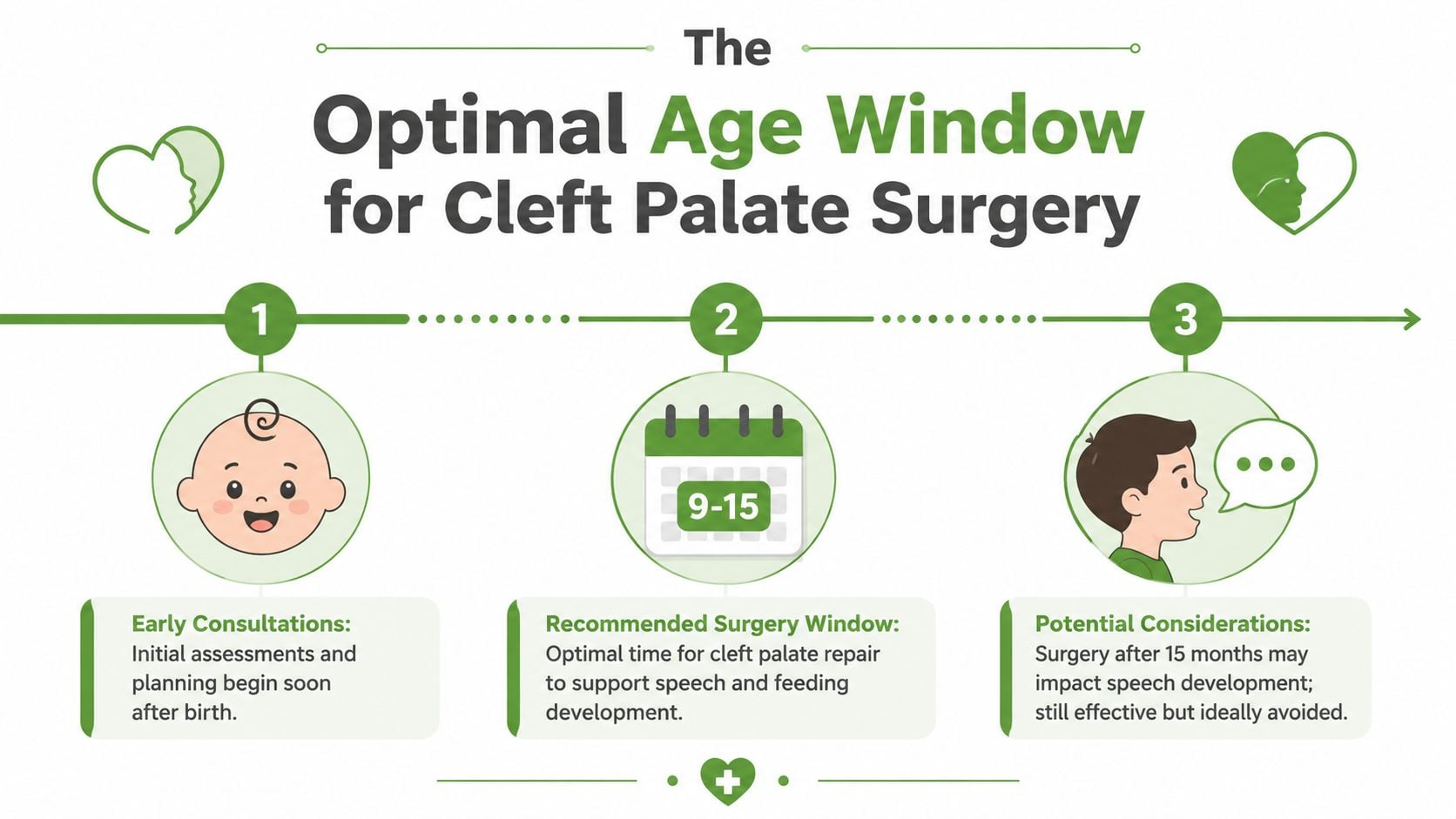
For most children, the age for cleft palate surgery falls into a fairly well accepted window: 9 to 15 months. That range exists because surgeons are trying to protect two important things at the same time. They want the palate repaired early enough to support speech, but not so early that surgery creates unnecessary restriction in facial growth.
Why 9 to 15 months is the sweet spot
Think of the upper jaw and palate like a house under construction. The facial structures need enough early growth to give the surgeon workable tissue and a stable framework. But the soft palate muscles also need to be repaired before the child develops more advanced speech patterns.
If surgeons wait too long, the child may begin learning speech with the wrong mechanics. If they operate too early in a way that creates significant scar tension, facial growth can be affected. That is the core trade-off.
A StatPearls review on palatoplasty timing states that the optimal timing for palatoplasty is between 9 and 15 months, and that delaying repair beyond 18 months can lead to velopharyngeal insufficiency in 20 to 30% of children.
What happens if surgery is too late
Velopharyngeal insufficiency, often shortened to VPI, means the soft palate doesn't close well enough against the back of the throat during speech. When that seal is weak, too much air escapes through the nose. Speech may sound nasal, and some sounds become difficult to produce clearly.
Children do not just wait passively for surgery. They are developing movement patterns every day. If the palate isn't functioning properly during that period, some children learn workarounds that can persist even after a technically successful repair.
Common concerns with delayed repair include:
- Speech pattern formation: A child may learn compensatory sound production that speech therapy later has to undo.
- Resonance problems: Air may escape through the nose when the child tries to make pressure consonants.
- Middle ear effects: Poor palate muscle function can contribute to ear problems that need coordinated ENT follow-up.
- More complex care later: Delays can mean more therapy, more evaluation, and sometimes additional procedures.
What happens if surgery is too early
Parents sometimes assume earlier is always better. It isn't always that simple. Early closure may improve speech conditions, but it can also increase the risk that scar tissue affects how the upper jaw grows.
That doesn't mean early surgery is wrong. It means timing has to fit the child, the cleft type, the surgical plan, and the goals of care. In practice, surgeons aim for the best balance, not a one-size-fits-all date.
A good surgical date supports what the child is about to do developmentally, not just what the calendar allows.
When families understand that balance, the recommendation makes more sense. The age for cleft palate surgery is really a decision about long-term function. Speech is part of it. So are facial growth, breathing mechanics, and how the mouth develops as an integrated system.
Why Your Child's Surgical Timeline Might Differ
Some children fit neatly into the typical timing window. Others don't, and that isn't automatically a problem. A surgical schedule can shift because of feeding challenges, weight gain, airway concerns, associated conditions, or the exact anatomy of the cleft.

The child matters more than the guideline
Two babies can be the same age but have very different surgical readiness. Surgeons look at whether the child is growing steadily, tolerating feeds, staying medically stable, and handling airway demands safely. Some infants need time to build weight or stabilize other health concerns before anesthesia makes sense.
Specific syndromes or airway patterns can also shift the schedule. Children with Pierre Robin Sequence, for example, may need a different timeline because jaw position and airway issues can complicate decision-making. In those cases, the team may prioritize breathing and feeding stability before moving forward with palate closure.
A tongue posture or latch issue may also affect how the team looks at early function. In some infants, related oral restrictions complicate feeding mechanics, which is one reason careful evaluation for issues such as posterior tongue-tie treatment can be part of a broader pediatric oral function discussion.
Newer evidence on earlier repair
There is one area where the conversation has changed in an important way. A 2023 NIDCR report on a randomized clinical trial found that for infants with isolated cleft palate, surgery at 6 months led to a 40% reduction in speech sound difficulties by age five compared with surgery at 12 months, without increased surgical complications.
That doesn't mean every child should now have surgery at six months. It does mean parents should know the evidence exists, especially if their child has an isolated cleft palate and is otherwise healthy enough for earlier repair.
Questions that often change the date
When teams personalize timing, they usually weigh issues like these:
- Overall health: Babies with additional medical needs may need more preparation before surgery.
- Airway stability: Breathing and sleep concerns can affect when surgery is safest.
- Growth and feeding: A child who struggles to feed may need closer support before proceeding.
- Cleft type: Isolated cleft palate is not the same as combined cleft lip and palate.
- Family logistics: Access to specialty care and follow-up can influence the practical plan, though it shouldn't drive the medical ideal.
The most helpful question for parents isn't "What age is everyone else doing this?" It's "What timing gives my child the best functional outcome with the safest path to surgery?" That question usually leads to a better conversation.
Beyond Surgery Long-Term Growth, Speech, and Airway Health
The repair itself is a major milestone, but it isn't the end of cleft care. Palate function reaches into many areas of development. It affects how a child builds speech sounds, manages nasal airflow, swallows, sleeps, and grows through the face.

A repaired palate helps create a healthier platform for oral pressure control. That matters for clear consonants, but it also matters for the coordination of lips, tongue, cheeks, and soft palate during everyday function. When those systems work together well, children have a better chance of developing stable breathing and swallowing patterns instead of compensatory ones.
Speech is only one part of the picture
Parents are right to focus on speech, because that is one of the clearest long-term outcomes tied to timing. But the palate also contributes to middle ear function and facial development. If function is weak or delayed, a child may need more layered support over time from speech therapy, ENT care, orthodontics, and airway-focused providers.
A large PMC analysis of more than 71,000 cleft cases found that delaying palate repair beyond 18 months was associated with a 2.5 times higher rate of surgical complications and a 30% increased need for secondary speech surgeries. The same source notes that adults with unrepaired clefts have a 40% risk of obstructive sleep apnea.
Those numbers don't mean every child with a delayed repair will develop long-term airway problems. They do show why timing should be viewed through a broader health lens. The question is not only "When will the palate be closed?" The question is also "What does that timing mean for the child's breathing, muscle function, and growth years later?"
Root-cause follow-up matters
After surgery, children often need ongoing monitoring in several areas:
- Speech and resonance: Providers listen for nasal air escape, unclear pressure sounds, and compensatory habits.
- Breathing pattern: Nasal breathing, oral posture, and airway comfort deserve attention as the child grows.
- Jaw and facial growth: The balance between scar healing and growth becomes more visible over time.
- Sleep quality: Restless sleep, mouth breathing, snoring, and fatigue shouldn't be brushed off.
For families wanting to understand how oral muscles influence breathing, swallowing, posture, and long-term facial development, this introduction to orofacial myology explains why function matters long after the surgical incision has healed.
This short video gives a useful overview of the broader care journey:
What supports long-term outcomes
The children who do best usually aren't the ones who only had surgery. They are the ones whose teams kept watching function after surgery.
After the palate is repaired, the next job is making sure the child uses that anatomy well.
That may include speech therapy, ENT follow-up, orthodontic guidance later in childhood, and airway-oriented support if breathing patterns remain inefficient. A successful repair creates opportunity. Follow-up helps the child fully use it.
Common Questions from Parents About Cleft Surgery
How do we feed our baby before surgery
Feeding is one of the earliest stress points for parents, and it often improves with coaching. Most babies with cleft palate need specific bottle systems or feeding strategies because suction can be difficult. Ask your team to watch a full feed, not just describe one. Small adjustments in positioning, pacing, and nipple flow can make a big difference.
What does recovery usually look like
Most parents notice that the first days are about comfort, hydration, and protecting the repair. Your surgeon will give precise instructions about feeding texture, pain control, and what to keep out of the mouth while healing happens. Expect your child to seem fussier than usual for a short time. That is normal, but your team should tell you exactly when to call.
Will my child still need speech therapy after surgery
Sometimes yes. Surgery repairs structure. Therapy helps a child use that structure efficiently, especially if compensatory habits started before repair. That doesn't mean the operation failed. It means speech is a learned motor skill, and some children need help refining it.
Why don't surgeons just operate as early as possible
Because earlier is not automatically better in every case. A clinical discussion of cleft timing and growth trade-offs notes that while most surgeons aim for repair between 9 and 12 months to support speech onset, earlier repair can sometimes interfere with maxillary growth and may increase the need for later orthodontic or surgical treatment.
Should we be thinking about teeth and jaw growth already
Yes, but without panic. Cleft care is staged over years, and dental development is part of that story. Families often find it helpful to understand how early monitoring connects with later bite development, arch form, and jaw guidance. This resource on pediatric dental health and orthodontic timing gives a practical overview of why early orthodontic evaluations matter.
What should we ask our cleft team at the next visit
Bring specific questions. These are usually the most useful:
- About timing: Why is this age the best age for cleft palate surgery for my child specifically?
- About function: What are you watching in feeding, breathing, and speech readiness?
- About follow-up: Which specialists should stay involved after repair?
- About growth: How will you monitor jaw development and future orthodontic needs?
- About home care: What signs after surgery mean healing is on track, and what signs need a phone call?
Parents don't need to become surgeons. But they do need a team that explains the reasoning clearly and treats the child as a whole person, not just an operation on a schedule.
If your child has feeding issues, oral posture concerns, mouth breathing, tongue restriction questions, snoring, or other airway-related symptoms alongside a cleft history, Pain and Sleep Therapy Center offers root-cause evaluation focused on pediatric oral function, breathing, TMJ, and sleep-related health. Their interdisciplinary approach can help families understand how palate function fits into the bigger picture of lifelong orofacial development.