If you're searching for oral surgeons in charlotte nc that accept medicaid, you're probably not doing it casually. Usually there's pain, swelling, a broken tooth, an impacted wisdom tooth, a biopsy referral, or a specialist saying you need a surgeon before things get worse. Then you start calling offices and get the same frustrating answers: they don't take Medicaid, they aren't accepting new patients, or they can't tell you whether your specific procedure is covered until someone reviews your chart.
That frustration is real. The hard part isn't just finding a name online. It's finding a practice that is taking new Medicaid patients, performs the procedure you need, and can move your case through referral and authorization without weeks of confusion.
The Challenge of Finding a Medicaid Oral Surgeon in Charlotte
Charlotte patients run into the same wall over and over. North Carolina expanded dental access for many adults, but access on paper doesn't always translate into a scheduled surgical appointment. A critical challenge persists for the more than 600,000 North Carolinians who gained oral health benefits through Medicaid expansion, because only about 45% of the state's dentists, including oral surgeons, accept Medicaid patients, which contributes to wait times that can stretch for months, especially in urban areas like Charlotte, according to this Charlotte Medicaid dental access overview.

That low participation rate shapes everything downstream. It means the list of possible offices is smaller. It means front desks are busier. It means some offices limit the types of Medicaid cases they accept. It also means a referral from a general dentist doesn't guarantee you'll land with a surgeon quickly.
Why this feels harder than it should
Oral surgery sits in an awkward space between dental care and medically necessary specialty care. Routine cleanings and fillings are one conversation. Surgical extractions, impacted teeth, jaw pathology, and TMJ-related surgical questions are another. Many patients don't realize that a practice may accept Medicaid for some dental services but not for every surgeon, sedation setup, or hospital-based procedure.
That disconnect creates false leads. A directory entry may look promising, but the office may have changed its intake status, narrowed which procedures it bills, or stopped taking new Medicaid surgical referrals.
Practical rule: Treat every online listing as a lead, not a confirmed appointment option.
What tends to work better
Patients usually get farther when they stop looking for one perfect list and start using a verification process. The offices that can help are often identified only after you cross-check the official directory, third-party listings, and the office's own scheduling response.
A more realistic approach is:
- Build a short list first. Don't rely on one provider name.
- Confirm the exact procedure. "Oral surgery" is too broad to be useful on a call.
- Expect delays and document everything. Write down names, dates, and what each office told you.
- Keep your referral papers ready. Offices are more responsive when you can send records fast.
Charlotte patients often think they're doing something wrong when the search drags on. Usually, they aren't. They're dealing with a narrow network, moving directory information, and procedure-specific coverage rules.
First Step Understanding Your Medicaid Dental Benefits
Before you call a single office, get clear on what you're asking Medicaid to cover. That sounds basic, but it saves time. Many phone calls go nowhere because the patient asks whether the office "takes Medicaid" instead of asking whether Medicaid may cover the specific oral surgery service involved.
Routine dentistry isn't the same as oral surgery
General dental care usually covers everyday services such as exams, preventive care, and standard restorative work when those benefits apply. Oral surgery is different. The closer your case gets to medical necessity, specialty treatment, imaging, sedation planning, pathology, or jaw-related function, the more documentation matters.
Common situations that may lead to an oral surgery referral include:
- Surgical extractions: Especially impacted or complicated teeth.
- Biopsy or lesion evaluation: When tissue needs specialist review.
- Infection management: If a dentist believes a surgeon should handle it.
- Jaw and facial issues: Cases involving function, trauma, or more advanced anatomy.
- TMJ or airway-related surgical questions: These are often the most documentation-heavy.
The recent expansion matters, but details still matter more
North Carolina's broader adult dental coverage created meaningful access for many people who previously had limited options. That helps. But coverage still doesn't mean every office will accept every case, and it doesn't mean approval is automatic for specialized care.
What helps most is having your details organized before you call:
- Your Medicaid card and plan details
- The exact reason for referral
- Any x-rays or imaging your dentist already took
- A written referral if your dentist provided one
- A short symptom timeline, such as pain, swelling, difficulty chewing, locking, or sleep-related concerns
Patients who describe their condition clearly usually get better answers than patients who ask only about insurance.
Ask your regular dentist better questions
If a general dentist referred you out, call back and ask for specifics if the referral was vague. You want language that helps the specialist's office decide whether to book you.
Ask questions like these:
- What is the exact procedure being requested?
- Is this urgent, routine, or dependent on specialist review?
- Do you have x-rays you can send today?
- Are there notes explaining why a general dentist can't do this in-office?
- If this relates to TMJ, airway, or sleep concerns, what has already been tried?
That last point matters. Complex cases move more smoothly when records show what conservative care came first. Even before pre-authorization starts, offices often want enough information to determine whether you're in the right place.
Using Official Directories to Build Your List
Start with the official North Carolina Medicaid referral resources, then use third-party sites as backups for discovery, not proof. In Mecklenburg County, the official NC DHHS referral list may show limited entries such as East Charlotte Dental Clinic, while third-party listings may also surface names like Elizabeth Smith, DDS or Eugenia Perkins, DDS as open to new Medicaid patients, which is why checking multiple sources matters, as noted by this Charlotte-area provider summary.
Build a workable list, not a giant one
A focused list of offices to call and track provides a more effective approach. The goal is not to collect every possible result. The goal is to identify a handful of realistic options and verify them thoroughly.
Use this process:
- Search the official NC Medicaid dental referral directory for Mecklenburg County and oral surgery-related categories.
- Write down each office name, provider name, address, and phone number exactly as listed.
- Check whether the listing says new patients are accepted.
- Look at third-party directories to see whether additional Charlotte-area providers appear to be open to Medicaid patients.
- Create one tracking sheet with columns for office, phone, date called, who you spoke with, referral needed, and next step.
How to read conflicting listings
Conflicting directory information is common. An office may appear in one place and not another. A provider may be listed, but not be the surgeon who handles your procedure. A booking platform may suggest availability while the office itself says Medicaid slots are limited.
That isn't necessarily dishonesty. It's usually a timing problem, an insurer data lag, or a difference between general dental intake and specialist surgical intake.
Don't throw out a lead just because one listing looks odd. Verify it by phone.
Use outside resources carefully
If you're curious why provider visibility online can look inconsistent, this breakdown of how practices attract new dental patients online helps explain why some offices appear prominently in search results even when insurance details are incomplete. Visibility and network participation aren't the same thing.
If your case involves TMJ, facial pain, airway concerns, or sleep-related issues alongside a potential surgery referral, reviewing the clinical backgrounds on our provider team page can also help you understand what kind of records and specialty language may matter before a surgeon ever reviews your file.
A practical shortlist example
Your list might include:
- Officially listed clinic options in Mecklenburg County
- Third-party listed dentists or oral surgery-adjacent providers who indicate openness to Medicaid patients
- Hospital-affiliated oral and maxillofacial programs for more complex cases
- Community dental settings that can sometimes redirect you more effectively than a general Google search
Keep the list short enough that you can call every office and follow up. A messy list creates missed callbacks and duplicate effort.
The Critical Verification Call What to Ask
A provider name on a directory is only the start. In North Carolina, for a provider to remain listed as accepting new patients, they must show ongoing acceptance by submitting claims for at least five new Medicaid beneficiaries each quarter, which is why calling to confirm current status is essential, according to the NC Medicaid dental referral guidance.
That rule explains why yesterday's accurate listing can become today's dead end. It also explains why a front desk answer like "we take Medicaid" is incomplete.
The phone script that gets better answers
When you call, don't start with a broad insurance question. Start with your need.
Try this:
"Hi, I have North Carolina Medicaid and my dentist says I need an oral surgeon for [your procedure or issue]. Are you accepting new Medicaid patients for oral surgery right now?"
Then ask the follow-ups that matter:
- Is the specific surgeon who would see me participating with Medicaid?
- Do you accept Medicaid for this type of procedure?
- Do I need a referral before you will schedule me?
- What records should my dentist send?
- Do you schedule a consultation first, or do you review records before booking?
- Are there any parts of care that might not be covered, such as certain facility or sedation arrangements?
- Who can I speak with if my case involves TMJ, airway, or sleep-related issues along with oral surgery?
Medicaid Verification Checklist
| Question | Why It's Important to Ask |
|---|---|
| Are you accepting new Medicaid patients for oral surgery right now? | A directory listing may not reflect the office's current intake status. |
| Does the surgeon who would see me participate with Medicaid? | A practice may include multiple providers with different participation rules. |
| Do you accept Medicaid for my specific procedure? | Coverage and billing can differ between simple and complex surgical services. |
| Do you require a referral before scheduling? | This prevents wasted calls and delays. |
| What records do you need from my dentist? | Sending the right x-rays and notes early speeds up review. |
| Will I need a consultation before the procedure is approved? | Some offices must evaluate you first before discussing scheduling. |
| Are any parts of treatment potentially billed separately? | This helps avoid surprise costs tied to non-covered components. |
| Who handles authorization questions in your office? | You need a direct contact when paperwork stalls. |
What doesn't work well
A few common mistakes slow people down fast:
- Asking only "Do you take Medicaid?" That invites a vague answer.
- Not writing down the staff member's name. If you call back, you'll want continuity.
- Assuming "accepting Medicaid" means "accepting new Medicaid patients." Those are not the same thing.
- Skipping the procedure question. Extractions, pathology, jaw surgery, and TMJ-related cases may be handled differently.
If the person answering seems unsure, ask whether a treatment coordinator or billing coordinator can confirm surgical Medicaid participation. Polite persistence helps.
Managing Paperwork Referrals and Pre-authorizations
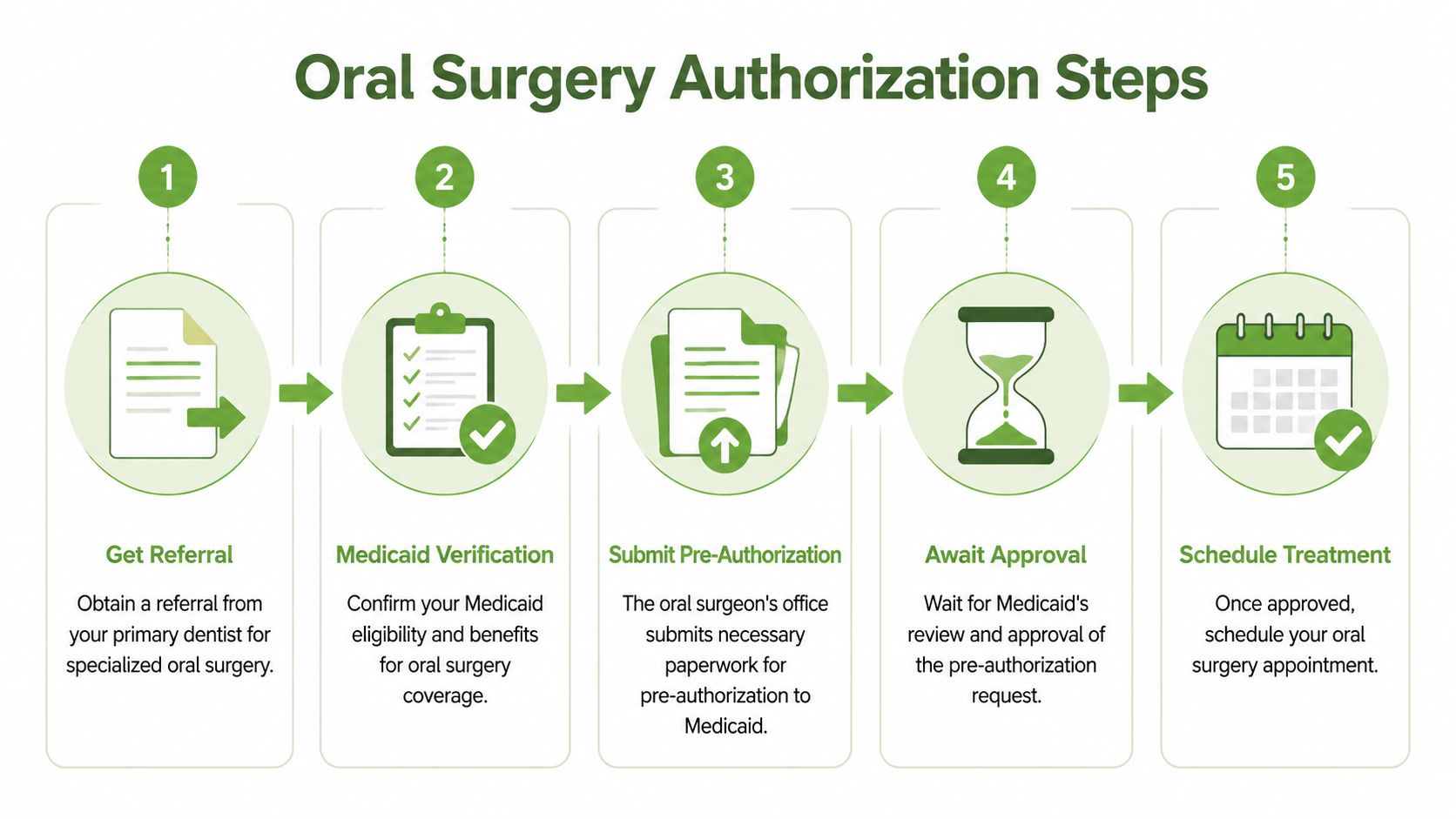
Once an office says yes, the next bottleneck is paperwork. For complex cases tied to TMJ or sleep apnea-related surgery, successful Medicaid pre-authorization often requires 3 to 4 weeks and detailed clinical justification, including imaging such as a CBCT scan and proof that conservative treatment has failed, according to this summary of oral surgery coordination requirements.
What referral and pre-authorization actually mean
A referral is the clinical handoff. It tells the surgeon why you're being sent and often includes x-rays, notes, and the suspected diagnosis.
A pre-authorization is the insurer review step for certain procedures. It asks whether Medicaid agrees the service is medically necessary based on the documentation submitted.
Those are related, but they aren't the same thing.
What helps approvals move more smoothly
The strongest authorization packets usually include a clean story. The records should show what the problem is, why a specialist is needed, and what has already been tried.
That often means gathering:
- Referral notes from your general dentist
- Relevant imaging, which may include x-rays and more advanced scans when appropriate
- Symptom history, especially pain, locking, functional limits, swelling, or sleep-related complaints
- Conservative treatment history, such as appliances, medications, therapy, or monitoring when those were already attempted
- Medical context, if your condition crosses into airway, sleep, joint, or facial pain concerns
If prior authorization feels opaque, this plain-English Simbie AI guide to insurance pre-approvals is a useful overview of how these reviews typically work and why documentation quality matters.
Your role in the process
Patients often assume the office will handle everything. The office handles a lot, but your follow-through still matters.
Do these three things:
- Call your general dentist and confirm records were sent.
- Call the surgeon's office and confirm records were received and readable.
- Ask who will contact you if Medicaid requests more information.
A surprising number of delays happen because records were "sent" but never matched to the correct patient file.
For providers coordinating complex referrals, this patient referral resource shows the kind of organized intake information that tends to support faster specialist review.
When cases are more complicated
TMJ and airway-related cases often need extra explanation because the procedure isn't just about a tooth. The chart may need to show jaw dysfunction, failed conservative care, imaging findings, sleep-related symptoms, or a broader medical reason for treatment. If those pieces are missing, the office may need to go back and gather more before Medicaid can make a decision.
When You Can't Find an In-Network Surgeon
Sometimes you do everything right and still can't secure an appointment with an in-network oral surgeon quickly. That doesn't mean you're out of options. It means you need a wider search strategy.
Practical backup paths
Consider these alternatives:
- Community dental clinics: These may help with urgent evaluations, extractions, triage, or referrals to specialists who still see Medicaid patients.
- Hospital-affiliated oral and maxillofacial surgery programs: Larger systems may be better equipped for medically complex cases, especially when sedation, trauma, pathology, or coordination across specialties is involved.
- Academic dental centers: Teaching institutions can be a strong option when private-network availability is limited.
- Your referring dentist's professional network: A direct doctor-to-doctor referral often gets more traction than a patient calling cold.
These aren't inferior choices. In some cases, they're the most practical route for patients with more complicated needs.
If the issue is cost, ask better questions
When an office is out-of-network or uncertain on procedure-level coverage, ask for specifics instead of ending the call.
Ask:
- Can you give me a written estimate for the consultation and likely next steps?
- Is there a cash-pay evaluation option while coverage is being clarified?
- Do you offer payment arrangements for non-covered portions?
- If you can't see me, can you recommend a Medicaid-friendly oral surgery referral source?
Learning how practices document and submit requests can also help you prevent costly claim denials when you or your referring office are trying to salvage a difficult case.
Don't overlook non-surgical support
Not every patient who is sent to an oral surgeon ends up needing surgery right away. Some need a more careful workup first, especially when the symptoms involve jaw pain, muscle tension, headaches, bite strain, sleep-disordered breathing, or airway dysfunction. In those situations, getting clear on the diagnosis can keep you from bouncing between offices that are solving different problems.
If you're worried about affording specialty care outside strict Medicaid network pathways, reviewing available payment plan options can help you understand whether a staged approach is possible while you continue searching for covered care.
A good fallback plan usually includes one immediate path for symptom control, one referral path for specialty review, and one administrative path for continued insurance verification. That keeps you moving instead of waiting in limbo.
If you're dealing with TMJ pain, facial pain, headaches, jaw dysfunction, snoring, or sleep-related breathing concerns and you're not sure whether surgery is the right next step, Pain and Sleep Therapy Center offers specialty evaluation focused on root-cause diagnosis and non-surgical care when appropriate. For patients who need coordinated specialty records, conservative treatment documentation, or guidance before pursuing a surgical referral, that kind of focused assessment can make the next step much clearer.