The night before surgery, most patients are trying to hold two thoughts at once. One is hope: maybe this will finally fix the bite that never felt right, the jaw strain that made meals tiring, or the breathing problem that followed them into sleep. The other is worry: what is recovery after double jaw surgery going to feel like when the anesthesia wears off and the swelling starts?
That mix is normal.
Double jaw surgery is a major event, but recovery is rarely as chaotic as people fear when they understand the timeline and know what to do each day. The hard part is that standard instructions often stop at basics like ice, rest, and soft foods. Those matter. They just aren't the whole story. A strong result also depends on how well your muscles adapt, how you protect your airway, how you rebuild normal chewing and swallowing, and how quickly you address problems before they turn into setbacks.
The patients who usually feel most steady aren't the ones who expect an easy week. They're the ones who expect a structured process. They prepare a resting space before surgery. They organize medications and liquid nutrition. They accept that the first few days are about comfort and hydration, not productivity. Then they shift into a more active phase: gentle mobility, careful oral hygiene, sleep support, and gradual return to function.
That is how I want you to think about this recovery. Not as a passive waiting period, but as a guided rehabilitation process with clear phases, real trade-offs, and practical ways to make each phase smoother.
Your Journey Begins A Patient-Centered Introduction
If you've already had surgery, you're probably reading this with a swollen face, a dry mouth, and a phone full of questions. If your procedure is still ahead of you, you're likely trying to picture life on the other side of it. In both cases, what helps most is a realistic frame: recovery after double jaw surgery is demanding early, then steadily more manageable.
Patients often tell me the hardest part isn't only discomfort. It's the uncertainty. They wonder whether swelling means something is wrong, whether numbness will interfere with speaking, whether they'll feel like themselves again, and whether they should be doing more or less on a given day. Those are good questions because this recovery rewards the right kind of effort.
A useful way to think about healing is to separate bone healing, muscle adaptation, and functional retraining. The surgeon moves the jaws into a healthier position. After that, the rest of your system has to catch up. Your lips, cheeks, tongue, airway, bite pattern, and jaw joints all need time and guidance to work efficiently in that new position.
Recovery goes better when you stop measuring progress only by swelling and start measuring it by function. Better hydration, easier swallowing, cleaner speech, calmer joints, and more comfortable nasal breathing all count.
That is why the best aftercare isn't only about getting through the first week. It also includes nutrition that you can tolerate, exercises that improve mobility without provoking strain, and attention to breathing and sleep quality. Many patients are surprised by how much these details affect comfort.
Here is the reassuring part. The roughest window is short. The slower parts of recovery tend to be predictable. And when patients know what to expect, they usually handle it far better than they imagined.
The First 72 Hours Navigating the Immediate Aftermath
This is the survival phase. Keep your goals simple: control swelling, stay hydrated, take medications correctly, rest, and protect your airway.

What the first days usually feel like
The first surprise for many patients is that pain isn't always the dominant issue. Pressure, tightness, congestion, drooling, fatigue, and swelling often feel more noticeable. Swelling typically peaks around 48 to 72 hours, and the same postoperative guide notes that 70% of swelling is gone by week four and 90% by week eight, while final refinement can continue for 6 to 12 months in subtle ways, as described in Apex Surgical's jaw surgery instructions.
You may also feel groggy, emotionally flat, or unusually dependent on other people. That's common after anesthesia, limited sleep, and a sudden change in routine.
Set up your recovery space before you need it
Your home setup matters more than is commonly understood. Create one place where you can rest without having to repeatedly get up and search for supplies.
Keep these within reach:
- Pillows for elevation so your head stays raised while resting
- Ice packs or soft gel packs rotated throughout the day
- A medication checklist with dose times written down
- Water, electrolyte drinks, and liquid nutrition that don't require effort to prepare
- A cup, syringe, or squeeze bottle if lip numbness makes drinking messy
- Tissues and lip balm because dry lips and saliva management can be surprisingly annoying
Practical rule: If an item will matter at 2 a.m., put it next to you before surgery day.
Use cold therapy with discipline
Cold helps most during the early swelling phase. Apply ice packs in short sessions with breaks, rather than pressing them on continuously for hours. The point is steady swelling control, not skin irritation.
Keep your head raised even when napping. That simple step can reduce throbbing and facial fullness. Patients who lie flat often feel worse.
Hydration comes before calories
Many people focus on food too early. In the first day or two, hydration is the priority. Sip constantly rather than trying to drink a large amount at once.
A workable full-liquid menu often includes:
| Time of day | Better choices |
|---|---|
| Morning | Protein shake, thinned yogurt drink, smooth meal replacement |
| Midday | Broth, blended soup strained smooth, electrolyte drink |
| Afternoon | Smoothie without seeds or chunks |
| Evening | Cream soup, drinkable yogurt, additional protein shake |
Choose foods that slide easily, don't require chewing, and don't leave gritty residue in the mouth.
Medication timing matters
Take prescribed medications on schedule, especially in the first couple of days. Waiting until discomfort becomes intense is a mistake. It is harder to catch up once pain, tension, and swelling build on each other.
If you're reviewing your surgical plan and sedation questions before or after the procedure, it's helpful to understand what your team uses and why. This overview of oral surgery anesthesia explains the basics in patient-friendly language.
What helps, and what doesn't
What helps:
- Small frequent sips instead of forcing full glasses at once
- Brief walks to the bathroom or around the room if your surgeon allows it
- Written tracking of medication, fluids, and symptoms
- Accepting help for the first few days
What doesn't:
- Talking too much because it increases dryness and fatigue
- Salty, spicy, or textured liquids that sting irritated tissues
- Lying flat
- Trying to “test” your jaw by chewing or opening wider than instructed
If these first 72 hours feel long, that doesn't mean recovery is going badly. It means you're in the most intense part, and that part does pass.
Your Week-by-Week Recovery Roadmap Weeks 1 to 6
The next six weeks are where patients start to feel human again, then get frustrated because they still don't feel normal. That's the right expectation. Most of the crisis feeling fades before full function returns.
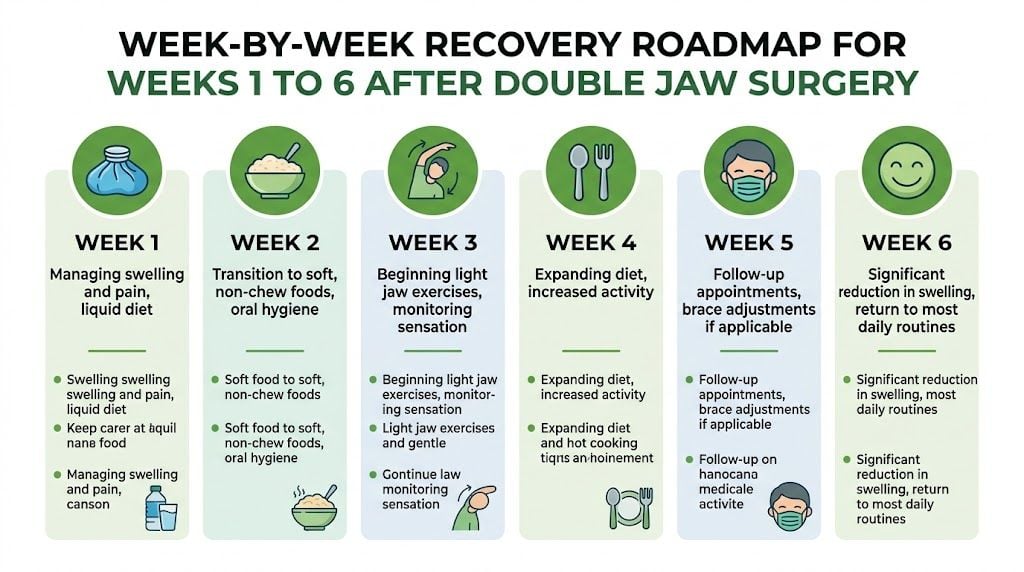
A detailed patient-reported study of bimaxillary surgery found that over 75% of patients reported resolution of most major problems like significant pain and reliance on medication within the first week, while eating and mouth opening recovered more slowly, with most patients needing about 6 to 8 weeks to feel relatively normal in those areas, according to the 2008 orthognathic surgery recovery study.
Weeks 1 to 2 The foundation of healing
By now, you're still swollen, but daily life should start to feel more organized. This is when routine becomes your best friend.
Your main jobs are:
- Keep calories coming in even if eating feels tedious
- Protect oral hygiene without being aggressive
- Walk a little more each day
- Avoid the trap of doing too much because you had one better morning
A lot of patients are shocked by how tiring simple tasks feel. Showering, changing clothes, or sitting upright for a meal can wear you out. That isn't weakness. It's energy being redirected toward healing.
Diet during weeks 1 and 2
You may still be on full liquids, or your surgeon may begin allowing very soft, non-chew foods. The safest question isn't "Can I eat this?" It's "Does this require pressure from my teeth or jaw muscles?"
Better choices usually include:
- Smooth scrambled eggs if approved
- Mashed potatoes or sweet potatoes thinned enough to swallow easily
- Greek yogurt, pudding, cottage cheese if tolerated
- Blended soups
- Oatmeal or cream of wheat prepared soft and smooth
A useful support tool is a practical list of soft foods for TMJ. It isn't a surgical protocol, but it can help patients find meals that are easy to tolerate without overworking healing tissues.
Oral care and swelling control
During this critical phase, patients either protect their recovery or create avoidable setbacks. Food residue, dry mouth, and hesitation around brushing can make the mouth feel unpleasant fast.
Use whatever rinse your surgeon prescribed. Brush gently with a soft brush if you've been cleared to do so. Slow, careful cleaning is better than avoiding the area out of fear.
Clean tissue heals better. Most patients feel more comfortable after gentle oral hygiene, not worse.
Swelling is still present in this phase, but it should begin to soften. Your face may look uneven from side to side on some days. That can be unsettling, but day-to-day asymmetry during early recovery is common.
Weeks 3 to 6 Turning the corner
This phase feels better physically but harder mentally. You can do more, so you're tempted to expect more. The problem is that function lags behind comfort.
You may return to work or school during this window if your job is sedentary and your surgeon agrees. Some patients feel ready sooner than others. Fatigue, speech effort, facial stiffness, and eating logistics still matter.
What usually improves in this window
By weeks 3 to 6, many patients notice progress in several areas:
| Area | Common change |
|---|---|
| Energy | More stable through the day, fewer crashes |
| Appearance | Swelling begins to look less dramatic in photos |
| Speech | Clearer articulation as stiffness decreases |
| Diet | Wider range of soft foods |
| Confidence | More comfort leaving the house and seeing people |
What often still lags:
- Chewing confidence
- Mouth opening
- Lip and chin sensation
- Patience
Begin function, not force
If your surgeon has approved exercises, this is often the stage to start gentle jaw mobility work. The goal is not to push hard. It is to restore smooth movement without provoking muscle guarding.
Think of rehab this way:
- Frequency beats intensity. Short, regular efforts are better than one aggressive session.
- Mild stretch is fine. Sharp pain is not.
- Symmetry matters. Watch for opening that shifts to one side or a bite that suddenly feels different.
A simple daily check can help:
- Can you sip and swallow with less effort?
- Is speech easier by evening than it was last week?
- Does opening feel tight but gradually freer, or tight and worsening?
Those answers tell you more than a mirror does.
A realistic social and emotional picture
Patients often expect to feel grateful and relieved once the hardest swelling eases. Sometimes they do. Sometimes they just feel tired, irritable, and impatient with the soft-food routine.
That's normal too.
Your face may still look puffy. Your bite may feel unfamiliar. Friends may say you look fine before you feel fine. Let that mismatch exist without assuming something is wrong. The body often recovers in layers. Comfort improves first. Function follows. Confidence comes after both.
Advanced Healing Strategies for Optimal Function
Once the surgical sites are stable, recovery after double jaw surgery stops being just a question of healing bones. It becomes a question of teaching the mouth, tongue, joints, and airway how to work well in their new position.

This is the part many patients don't hear enough about. A well-positioned jaw can still feel awkward if the surrounding muscles keep using old patterns. That is why supportive therapies can make a meaningful difference in comfort and long-term function.
Why retraining matters
Before surgery, your body adapted to the old structure. You may have compensated with tongue thrust, mouth breathing, jaw clenching, guarded chewing, or neck tension. Surgery changes the framework, but it doesn't instantly erase those habits.
That is where orofacial myofunctional therapy can help. The focus is not cosmetic. It is functional. The work targets tongue posture, lip seal, swallowing, nasal breathing, and efficient muscle coordination so the new bite does not feel like a foreign system.
Patients often do better when they think of this as physical therapy for the lower face and airway rather than as a set of random exercises.
Airway and sleep deserve more attention
A major gap in typical advice is the airway. Postoperative swelling, nasal congestion, and altered oral posture can temporarily change how you breathe at night. The University of Illinois recovery guidance notes that jaw repositioning can temporarily affect snoring or sleep apnea, making early intervention with breathing exercises such as Buteyko or myofunctional therapy important for restoring nasal breathing and oral posture, as described in their page on jaw surgery recovery.
That matters because poor sleep slows everything. Patients who mouth-breathe all night often wake with more dryness, more throat irritation, and more fatigue. They also tend to feel more anxious about their recovery.
If your nights are getting worse instead of better, don't brush it off as “just swelling.” Breathing quality during sleep affects pain tolerance, energy, and healing capacity.
For patients interested in broader recovery-support habits, this guide on how to recover faster offers useful general ideas on rest, inflammation control, and healing routines.
What these therapies look like in practice
A functional support plan often includes several pieces rather than one magic exercise.
- Tongue posture training helps reduce strain on the jaw and encourages a stable oral resting position.
- Swallow retraining can reduce compensatory facial tension that developed before surgery.
- Buteyko-based breathing work supports calmer, quieter nasal breathing and can help patients who feel air hunger or habitual mouth opening.
- Gentle muscle release and posture work may reduce the neck and facial guarding that often follows surgery.
This short video gives a helpful visual introduction to the kind of recovery support many patients benefit from during the functional phase:
What works and what doesn't
What works is consistency and timing. You want exercises that match your healing stage and address a specific problem, such as poor lip seal, guarded opening, or noisy sleep.
What doesn't work is guessing. Patients often find a jaw stretch online, overdo it, then wonder why the joint feels irritated. The right program should fit your surgical instructions and your current function, not somebody else's.
In Charlotte, one option for this type of structured support is the Pain and Sleep Therapy Center, which offers airway-focused care, Buteyko breathing, and orofacial myofunctional therapy for patients dealing with postoperative jaw tension, nasal breathing problems, or sleep-related symptoms.
The Long Haul Recovery from 3 to 12 Months
By the three-month mark, most patients stop thinking about recovery every hour. That is a big milestone. It is also where people can get fooled into believing all healing is finished. It isn't.

A month-by-month overview from orthognathic surgeon Shilen Patel notes that initial recovery takes about six weeks, while full bone healing and functional normalization extend from 6 to 12 months, and that months 1 through 3 often bring noticeable improvement in mouth opening, speech clarity, and relief from pre-existing TMJ pain or sleep apnea symptoms, as outlined in his orthognathic surgery recovery timeline.
Months 3 to 6
This is often the most encouraging stretch. You may be eating a much wider range of foods, speaking without thinking about it, and spending less time managing your face and jaw.
Still, a few issues commonly continue:
- Residual stiffness in the morning
- Areas of numbness or altered sensation
- Tenderness with firmer foods
- Orthodontic adjustments if braces or aligner finishing is still underway
The practical mistake here is rushing back to tough, chewy, or crunchy foods just because your appetite has returned. Your bite may feel good before your tissues are ready for that load.
Diet progression needs judgment
Many patients want a clear date when they can eat anything. Recovery doesn't work that way. Readiness depends on bone stability, muscle control, and comfort.
A useful way to decide whether a food is appropriate:
| Ask yourself | If the answer is yes |
|---|---|
| Do I need to tear it with my front teeth? | Wait longer |
| Do I need strong side-to-side chewing? | Wait longer |
| Does it make my joints tense up before I even swallow? | Not yet |
| Can I chew it gently without bracing my face? | It may be reasonable if your surgeon agrees |
That is why a photo of someone eating steak at four months isn't a universal milestone. It is an example of eventual return, not a deadline.
Months 6 to 12
This is the polishing phase. Bones continue consolidating. Subtle swelling keeps fading. Sensation may continue to shift in the lips, chin, or cheeks. Your face also starts to feel less like a “new face” and more like your own.
The final stage of recovery is often less about pain and more about adaptation. You stop monitoring every sensation and start trusting the new bite.
This is also when some patients fully appreciate what changed. They notice less strain while chewing. They wake with less facial fatigue. They stop posturing their jaw to find a comfortable position. If surgery was done partly to improve breathing, they may recognize that sleep feels steadier.
The emotional adjustment is real
Even when the result is positive, it can take time to accept a changed bite and appearance. Patients sometimes feel guilty for needing that time. They shouldn't.
A new bite changes how your teeth meet, how your lips rest, even how your expression feels in photos. That adjustment period is not vanity. It is part of integrating a major structural change into daily life. If you give yourself time, the unfamiliar usually becomes ordinary.
Proactive Recovery Regenerative Therapies and Complication Signs
Most postoperative plans are reactive. Ice when swollen. Call if something looks wrong. Advance diet when told. That is necessary, but it leaves out an important truth. Some patients need support not because surgery failed, but because the joints, muscles, and airway are slow to adapt.
A realistic concern is long-term TMJ dysfunction after surgery. Coastal Virginia OMFS highlights that up to a third of patients have a delayed return to normal activities because of persistent oral function issues, which is one reason therapies that support muscle and joint adaptation deserve more attention in recovery care, as noted in their article on realistic recovery time from jaw surgery.
Why a proactive plan makes sense
When the jaws are repositioned, the TMJs and surrounding muscles have to accept a new working pattern. Some patients adapt smoothly. Others develop muscle guarding, joint irritation, headache patterns, or persistent chewing fatigue.
That doesn't mean everyone needs extra treatment. It means waiting until symptoms are severe is usually the least efficient approach.
A more proactive approach may include:
- Regenerative support for irritated joints or surrounding tissues when healing stalls or TMJ symptoms remain active
- Cold laser therapy for soft tissue comfort and inflammation management
- Targeted movement and muscle retraining so stiffness does not become a habit
- Airway-focused therapy when mouth breathing or poor sleep is keeping inflammation high
For patients exploring non-surgical support options, this page on regenerative medicine for joint pain gives a clear overview of how these approaches are used in clinical practice.
Signs that deserve a call to your surgeon
Most recovery issues are minor. A few are not. Patients do better when they know the difference.
Call your surgical team promptly if you notice:
- Fever or chills that feel out of proportion to routine postoperative fatigue
- Pus, foul drainage, or worsening bad taste from the mouth or incision area
- A sudden bite change after things had been feeling stable
- Pain that is sharply worsening rather than gradually improving
- Bleeding that seems active or persistent
- Trouble breathing, escalating throat tightness, or inability to manage secretions
- Rapid swelling on one side, especially if it feels tense or is accompanied by increasing pain
Signs that are often normal but still worth monitoring
Not every unpleasant symptom is a complication. These issues are common enough that patients often panic unnecessarily:
| Symptom | Usual meaning |
|---|---|
| Lip or chin numbness | Often part of normal nerve recovery |
| Uneven swelling | Common during early and mid recovery |
| Tight opening | Expected as tissues heal and muscles guard |
| Emotional ups and downs | Very common after major surgery |
The key difference is trend. Normal recovery may be slow or uneven, but it generally moves forward. A complication usually declares itself by getting worse, not merely by lingering.
What patients regret most
They usually don't regret resting too much for a few days. They regret ignoring an obvious concern, pushing diet too fast, skipping exercises once they were cleared, or assuming sleep problems would settle on their own.
If something feels off, ask early. You are not bothering your surgeon by reporting a real change. You are doing your job in the recovery partnership.
Embracing Your New Beginning A Final Word
Recovery after double jaw surgery is a long arc, not a single event. The first days ask for patience and basic survival skills. The next several weeks ask for discipline with food, sleep, hygiene, and gradual movement. The later months ask for a different kind of patience, the kind that trusts steady progress even when the changes are subtle.
The patients who do best usually share one mindset. They don't treat recovery like downtime. They treat it like rehabilitation. They keep follow-up appointments. They protect their sleep. They notice how they breathe, swallow, chew, and hold tension in the face and neck. They ask for help when something isn't improving.
That matters because the goal isn't only a healed jaw. It is a jaw that functions well. It is a calmer TMJ system, more efficient chewing, more stable nasal breathing, and less strain carrying into sleep.
The emotional side deserves care too. It can be hard to sit with swelling, temporary limitations, and a changing face, even when surgery was the right decision. If that adjustment feels heavier than expected, outside support can help. Some patients benefit from counseling during medical recovery, and a service like Vernon counselling shows the kind of support that can be valuable when healing becomes emotionally draining.
Stay steady. Recovery isn't linear, but it is workable. When you respect the phases and support the full system, not just the bones, you give yourself the best chance of a comfortable, durable result.
If you're navigating recovery after double jaw surgery and want help with TMJ pain, facial muscle tension, nasal breathing, or sleep-related issues that continue after the surgical phase, Pain and Sleep Therapy Center offers evaluation and non-surgical support options focused on function, comfort, and airway health.