There's no single cleft palate surgery cost. A realistic starting point is the historical U.S. hospital charge average of $19,227 per procedure, while more recent provider payments can run from $1,739.0 under Medicaid to $5,492.2 per facility under commercial insurance for primary cleft lip and palate repair, and those numbers are only the beginning.
If you've just heard your child needs cleft palate repair, the money questions can hit just as hard as the medical ones. You're not only trying to understand one surgery, you're trying to understand a care path that can stretch across years, with different bills arriving from different places and at different times.
Your Guide to Understanding Cleft Palate Surgery Costs
A diagnosis often leaves parents staring at a calendar, a stack of referrals, and a question that feels impossible to answer cleanly. What is cleft palate surgery cost, really? The honest answer is that there isn't one fixed price, because the bill depends on the hospital, the surgeon, the anesthesia team, the insurance contract, and the child's exact surgical plan.
A helpful way to think about it is this, the first surgery is like the down payment on a much larger care journey. The U.S. historical average hospital charge of $19,227 per procedure is a useful benchmark, but recent provider payment data show much lower or higher allowed amounts depending on payer structure, and those figures still don't include everything a family may encounter later in care (NIDCR summary of U.S. cleft palate surgery charges, provider payment comparison study).
Start with the most likely financial categories
Most families see several distinct charges rather than one all-in invoice. There's the surgeon's fee, the anesthesia fee, the facility charge, and then the surrounding costs that come with pre-op visits, post-op medicines, and follow-up.
Practical rule: if a quote sounds unusually simple, ask what it leaves out.
That question matters because cleft palate surgery is rarely a one-touch event. The surgical repair sits inside a broader treatment plan, and the billing reflects that reality more than a single price tag ever could.
The pages on how cleft palates are repaired can help you understand the medical side while you sort out the financial side. Once the basic repair is clear, the bill starts to make more sense, because you can see which charges go to expertise, which go to the operating room, and which belong to the child's recovery.
Deconstructing the Initial Surgery Bill
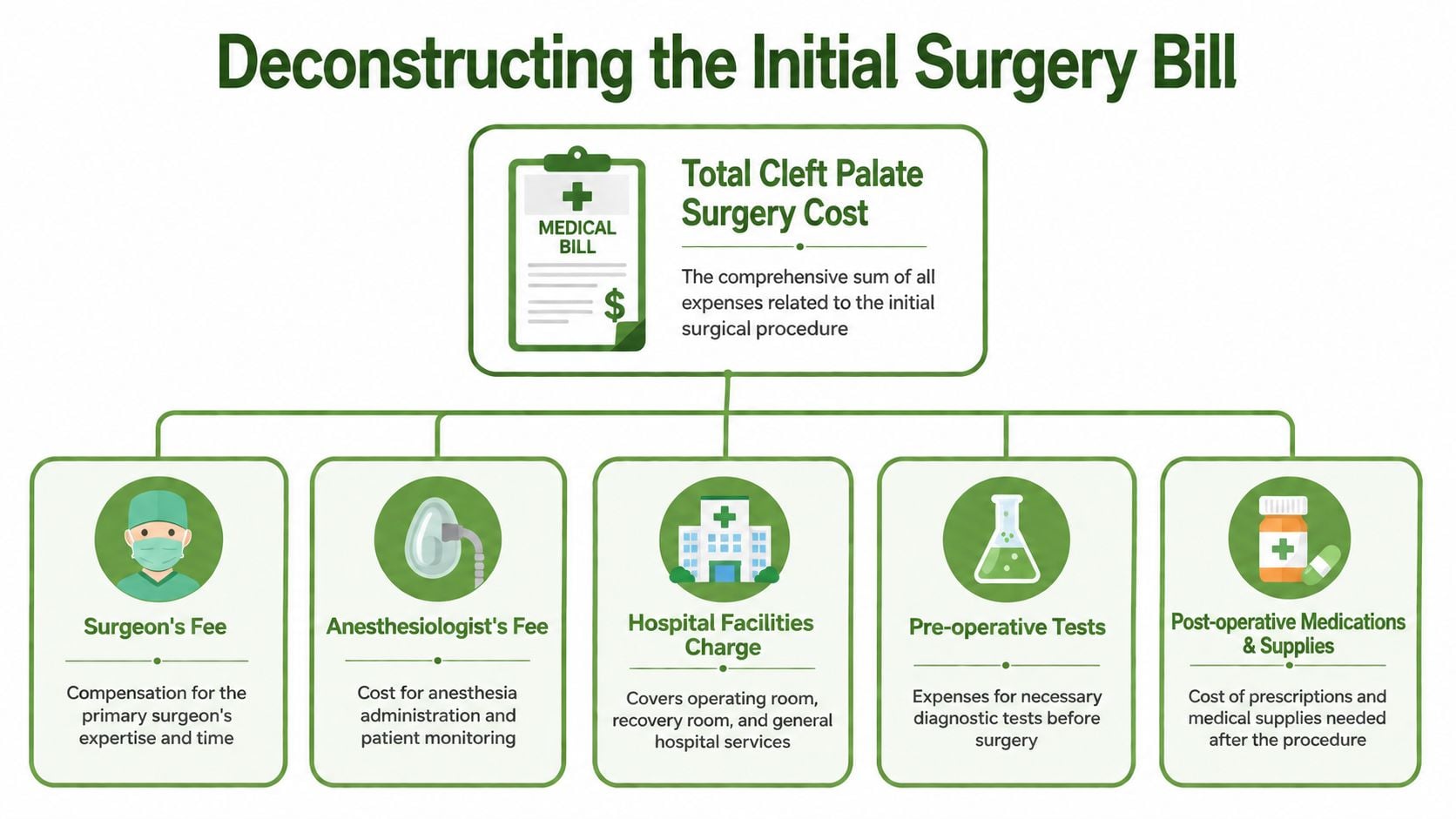
The first surgical invoice is a bundle of professional services, facility use, and support care, and that matters when families try to understand what they are being asked to pay.
What's usually inside the bill
The surgeon's fee covers the specialist's planning, operative skill, and time in the operating room. The anesthesiologist's fee pays for medication delivery and close monitoring so the child stays safe during surgery and wakes up appropriately afterward.
The hospital or facility charge is often the least intuitive part for parents, and sometimes the largest. It includes the operating room, recovery area, nursing support, equipment, and, in some cases, overnight observation if the team keeps the child for monitoring. Pre-op testing can also show up separately, especially when the surgeon requests labs or imaging before the repair.
Families often see very different estimates because the billing rules change by setting. A PubMed analysis reports that commercial insurance and Medicaid can reimburse the same kind of repair at very different levels, which helps explain why two families may receive quotes that do not look remotely alike (PubMed analysis).
Surgical approach changes the total
The operation itself can also change the math. In one U.S. cost-utility analysis for unilateral cleft lip and palate, single-stage repair had a lower average total cost than staged repair, US$80,405 versus US$109,473. The lower cost came from both intraoperative and postoperative savings, which shows that operating-room time and recovery needs can drive expense more than the label on the procedure.
A shorter path is not automatically the right one medically, but when a team can safely reduce stages, families may avoid some downstream cost.
The invoice is only the starting point. Travel to the surgical center, parking, time away from work, postoperative medicines, speech therapy, and later orthodontic care can all shape the true financial burden around the repair, even when the operation itself is well covered.
Key Factors That Influence the Final Price
The final number often turns on details that have nothing to do with your child's worth and everything to do with how U.S. healthcare bills. Geography, insurance contracts, and provider networks can all change what lands on the family statement.

Insurance status is one of the biggest swings
The clearest cost difference in the verified data is payer type. Commercial rates and Medicaid rates can sit in very different lanes for the same repair, which is why two families can compare notes and feel like they're talking about different countries. That's not because one child's surgery is more legitimate than another's, it's because the billing system assigns different reimbursement rules.
Location and hospital reputation also matter, even when the procedure name is the same. A large academic center, a children's hospital, and a smaller regional facility may each price the operation differently because of overhead, staffing, and case complexity. Families who need a highly specialized cleft team may decide that expertise is worth a longer drive or a more complicated authorization process.
The care team and the plan affect cost too
The cleft's complexity can change how much time the team needs in the OR and how much support follows after surgery. More complicated anatomy can mean more planning, more follow-up, and a longer recovery path, which often translates into more line items.
The outside costs can be just as real as the medical ones. Travel, parking, missed work, meals, and child care aren't always on the hospital bill, but they absolutely belong in the family budget. In many cases, the financial stress isn't one number, it's the pile of small expenses that keeps growing around the procedure.
Later in the day, after you've collected the estimates, it helps to compare them side by side instead of reacting to the biggest number first. If one hospital includes more of the pre-op work and another bills it separately, the quotes may look different even when the actual care is similar.
The key is to ask what the estimate covers, not just what it totals. A clean estimate can still hide out-of-pocket surprises if it doesn't name anesthesia, facility fees, or follow-up visits.
Navigating Insurance Coverage and Medicaid
Insurance can feel like a second diagnosis, one that arrives in forms, portals, and phone menus. The fastest way to reduce surprise billing is to verify benefits before the surgery date is set, not after.
Start with the basics: ask whether the surgeon, anesthesiologist, hospital, and any assistant providers are in-network. Then ask how the plan handles deductibles, copayments, coinsurance, and the out-of-pocket maximum for the year. Those terms sound administrative, but they determine whether the family pays a modest share or absorbs a much bigger portion up front.
Questions to ask before authorization
Use a short checklist and get names, dates, and reference numbers when possible.
- Is cleft palate repair covered as medically necessary? Get the answer in writing if you can.
- Are all providers in-network? Don't assume the hospital status covers every specialist involved.
- Does the plan require prior authorization? If yes, ask who submits it and how long approval usually takes.
- What codes will be billed? Ask the care team's billing office for the expected procedure names or codes.
- Are pre-op visits and post-op visits billed separately? Some plans split these out.
- Will anesthesia be handled by a separate group? This is a common place for unexpected charges.
- How are appeals handled if coverage is denied? You want the process before there's a denial.
If you're comparing private coverage with public programs, the difference can be meaningful. A Medicaid-accepting practice may reduce the direct family burden for a child who qualifies, and the internal directory at oral surgeons in Charlotte NC that accept Medicaid can be useful for understanding how payer acceptance is often discussed in practice settings.
How Medicaid fits into the picture
For families who qualify, Medicaid can be a critical safety net because it often covers congenital conditions with broader medical necessity than parents expect. That doesn't make the process automatic, though. You still need referrals, prior approvals, and the right provider enrollment.
The most useful habit is to treat every approval like a checkpoint, not a guarantee. A surgery can be authorized and still leave families with separate facility, anesthesia, or follow-up bills if the whole team wasn't included in the original review.
Financial Aid and Charitable Support Options
When coverage gaps remain, the next question is where to find help that doesn't depend on one insurance card. That's where hospital assistance, nonprofit support, and payment flexibility become part of the plan, not a last resort.
Many hospitals have financial assistance programs that reduce charges based on household income and documented need. The exact rules vary, but it's always worth asking the billing office for the application before balances grow. If a family waits until a bill is overdue, the options can narrow fast.
Places families often overlook
Nonprofit cleft organizations can sometimes connect families to free care, donated surgical support, or local treatment networks. Smile Train and AmeriFace are names many parents hear when they begin looking for outside help, and state children's special health programs may also fill gaps for qualifying families. The important thing is to ask early, because these programs may need medical records, income details, or surgeon documentation.
If cash flow is the immediate barrier, a payment plan can also help bridge the gap while approvals are pending. The clinic information on payment plans is a reminder that many practices try to spread cost rather than force a family into one large bill.
Don't wait for the final invoice to ask for help. Once bills are split across providers, it gets harder to negotiate from a place of calm.
Families should also keep every denial letter, appeal note, and estimate in one folder. That paper trail matters when you're applying for aid, requesting a reconsideration, or proving that the surgery was medically necessary.
The most effective financial safety net usually has more than one layer. A family might use insurance for the surgery itself, hospital assistance for the facility balance, and nonprofit aid for travel or related needs.
Planning for the Long-Term Financial Journey
Cleft palate care doesn't end when the child leaves the recovery room. It often continues through speech therapy, orthodontics, dental follow-up, and occasional additional surgeries, which is why the full financial picture is spread across years, not days.
The biggest costs often arrive later
A Canadian cohort found the median lifetime cost of cleft lip/palate care from birth to maturity was $73,398, with major expense categories including provider costs ($25,715), hospital surgical and outpatient costs ($22,643), and community orthodontic costs ($14,917) (Canadian lifetime cost study). That pattern matters because it shows that orthodontic treatment and provider follow-up can take a large share of the budget, even when surgery itself is covered.
Families should think in phases. Early childhood may bring speech assessments and hearing-related follow-up, later childhood often brings braces or other dental work, and adolescence may include revision procedures or orthodontic finishing. The exact sequence varies, but the need for planning doesn't.
The broader household budget matters too. A useful companion resource on first-year baby expenses can help parents remember that cleft care sits on top of ordinary infant and child costs, not instead of them.
Build a budget for recurring care
A practical cleft-care budget should include the obvious and the easy-to-forget items. That means speech therapy co-pays, orthodontic visits, travel, parking, and time away from work, along with the medical bills themselves.
Budget rule: if a service repeats, treat it like a recurring expense, not a one-time surprise.
That mindset helps families avoid the trap of assuming the first surgery is the final big cost. In reality, the path is usually more gradual, and that can be helpful if the family plans for it early.
Psychological support belongs in the plan too. Children often need help adjusting to repeated procedures and social questions, and parents sometimes need help managing their own stress while coordinating appointments across specialties. Long-term planning works better when emotional support is treated as part of care, not an extra.
Common Questions and Finding Your Care Team
Parents usually ask the same practical questions once the first estimate arrives. Travel costs are often hard to reimburse unless a program specifically offers help, so it's smart to ask every hospital, nonprofit, and insurer whether lodging, mileage, or meal support is part of the package. Separate bills from multiple providers are also common, which is why it helps to ask for a single billing contact who can explain who is charging for what.
Another common question is whether one surgeon can handle everything. Often the answer is no, because cleft care works best as a team. A cleft surgeon, orthodontist, speech therapist, audiology support, and primary pediatrician may all play a role at different points.
For families, the best next step is to ask for a coordinated treatment plan in writing. That plan should name who is leading care, who handles follow-up, and when the next decision point arrives. When a clinic communicates clearly, it's easier to avoid missed appointments and avoidable financial surprises.
A specialized, collaborative practice such as Pain & Sleep Therapy Center can also be a helpful part of the broader conversation when airway, jaw, or orofacial function overlaps with a child's care needs. If you're trying to build the right team, start by asking your cleft surgeon's office for referrals, then match the referrals to your insurance and your child's follow-up schedule.
If you're facing a cleft palate repair right now, gather the estimate, ask for every provider's network status, and request the long-term care plan before you sign anything. Then take that list to your pediatrician, cleft team, and insurer so you can compare options and protect your family from avoidable costs.