
You've probably already typed a version of this search after a rough diagnosis, a scary X-ray, or a conversation that left you with more questions than answers. Maybe your jaw hurts after an accident, your bite feels off, you're waking up tired because you snore, or a surgeon told you that part of your mouth or jaw can't just be “fixed” with a filling or brace. Oral facial reconstruction sits in that space where function, appearance, and relief all meet, and the terminology can feel blurry until someone separates the actual patient paths from the marketing language.
If you need help finding the right kind of revision or reconstruction specialist, a practical starting point is to find a revision surgery specialist who understands when appearance, scar tissue, and prior surgery complicate the picture.
When a Search for Oral Facial Reconstruction Actually Starts
A parent hears, “Your child isn't feeding well, and we need to look at the tongue and airway together.” A car accident leaves someone with a broken jaw, a changed bite, and trouble speaking clearly. A cancer survivor is told that removing a tumor will also mean rebuilding part of the mouth so eating and speech can work again. Those are all normal reasons people end up searching for oral facial reconstruction, even if they don't use that exact phrase at first.
The symptom cluster usually comes first
The journey toward oral facial reconstruction often begins not with a search for a procedure, but with pain, breathing problems, chewing trouble, speech changes, jaw asymmetry, or a face that suddenly looks or functions differently after trauma or disease. Sometimes the concern is obvious, like a fracture or a missing portion of bone. Other times it's subtle, like chronic mouth breathing, a jaw that feels unbalanced, or a bite that no longer closes the way it used to.
Practical rule: if the problem affects how you breathe, chew, swallow, speak, or open and close your mouth, you're not just dealing with cosmetics.
The four real reasons people usually land here
The search often falls into one of four categories. Trauma means injury, such as a fracture or soft tissue damage. Cancer or defect reconstruction means rebuilding after tumor removal or another structural loss. Bite and airway problems include jaw position issues, sleep-related breathing concerns, and dysfunction that affects function first. Elective contour work is different, because the goal is usually shape or balance rather than repair of damage.
That last category is where confusion starts. People often mix up true reconstructive care with cosmetic jawline enhancement, even though the decision path, risks, and goals are very different. In consumer content, those categories get blurred together, but they shouldn't be. A surgeon planning repair after injury is solving a functional problem, while a patient considering contour changes is usually looking at a different type of care altogether.
For a broader clinical overview of how face and jaw problems are categorized, the specialty of oral and maxillofacial surgery is also described in the context of the mouth, jaws, face, and neck in this surgical center overview.
What Oral Facial Reconstruction Actually Means
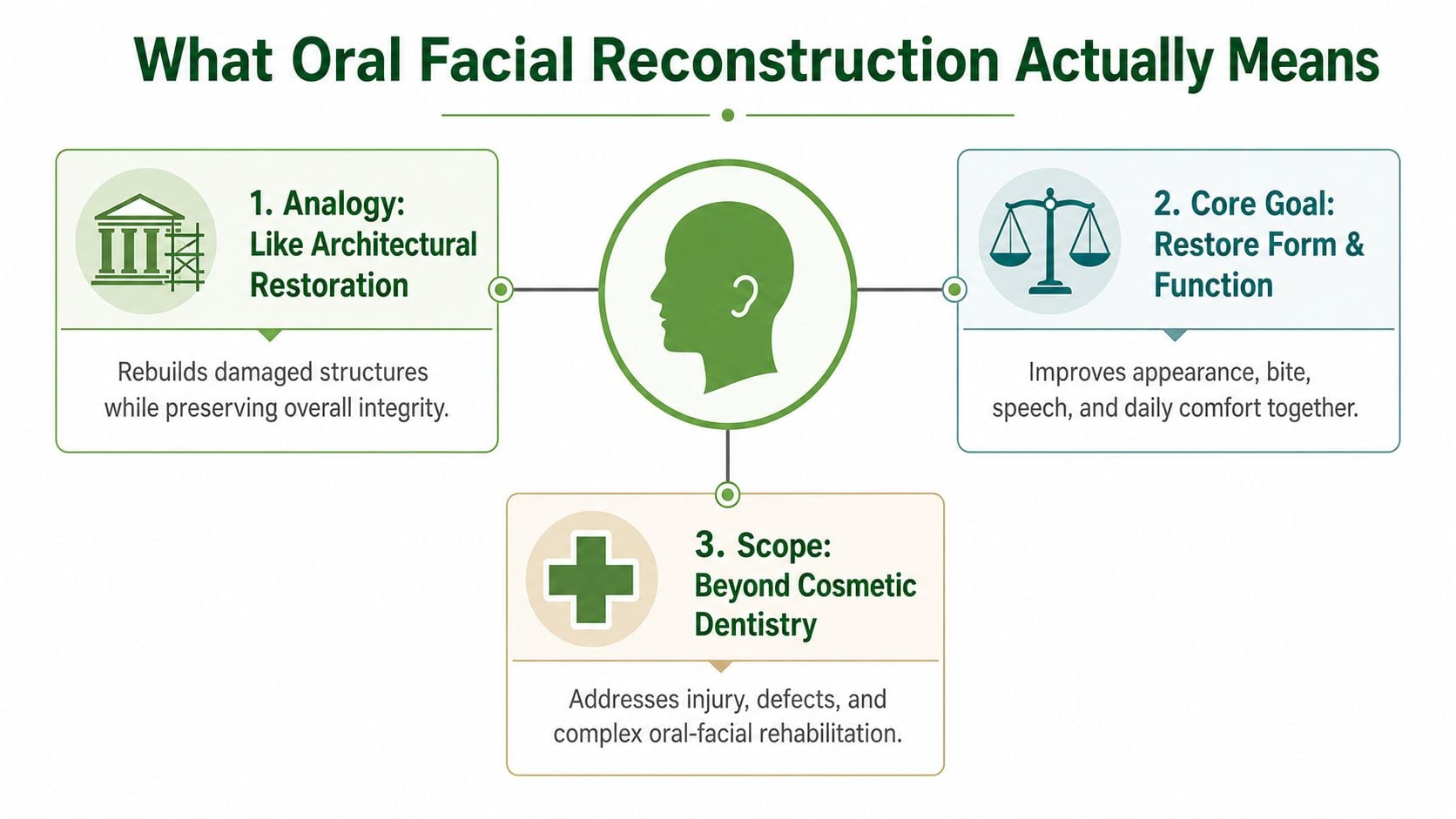
Repairing a house after storm damage focuses on restoring its structural integrity, while repainting the walls for a different color is a cosmetic change. Reconstruction aims to make a structure usable again. Cosmetic work alters the appearance of a structure that is already functional. Though the two can overlap, they represent distinct types of projects.
The field covers one connected system
Oral facial reconstruction involves the mouth, jaws, face, and neck as a functional unit, not as separate body parts that never affect one another. That matters because chewing, speech, breathing, and facial symmetry all depend on how those structures fit together. The specialty is defined around that broader region, including facial injuries, deformity, and malignancy-related defects, so the work is not just cosmetic, it's biomechanical too. The goal is to restore how the system works in real life, not only how it looks in a mirror.
The historical roots of that thinking go back a long way. The Edwin Smith Papyrus, dated to about 1500 BCE, records 48 trauma cases, and 33 of them, almost 70%, concern the head and neck, including the mandible, nose, ear, lip, throat, and neck, according to this history of oral surgery review. That doesn't mean modern surgery existed then, of course. It does show that surgeons have been thinking about repair of the face and jaw for thousands of years.
Reconstructive goals and aesthetic goals are different
Reconstructive care tries to restore form and function after injury, disease, or congenital difference. That can mean bringing back the ability to chew, improving airway space, restoring speech mechanics, or rebuilding tissue so the mouth can heal and seal properly. Aesthetic care tries to reshape something that is already structurally intact, often for balance or personal preference.
The distinction sounds simple, but in practice it gets blurry. A person might want a more even jawline and also need help with bite function, or a trauma patient might care greatly about appearance after the urgent repair is complete. That's why good planning starts with function first and appearance second, even when both matter.
A useful mental map is this. Trauma changes structure suddenly. Cancer or defect cases remove tissue that used to be there. Bite and airway cases are about fit and mechanics. Elective contour cases are about shape in a usually non-emergency setting.
The Diagnostic Workup Before Any Treatment Plan
Many assume the first appointment focuses on surgery. A good specialist often begins earlier, because an incorrect plan can overlook the actual issue. If the jaw hurts, the airway is tight, or the bite feels unstable, the examination must address more than just “where is the pain.”
What a careful first visit usually includes
The first step is a detailed symptom history. That means asking when the problem started, whether it changes with sleep or chewing, and whether there's clicking, locking, grinding, snoring, headache, numbness, or trouble swallowing. A functional exam follows, including jaw opening, muscle tenderness, bite alignment, and how the lips, tongue, and teeth work together.
Airway screening matters because a jaw that looks fine on paper may still be part of a breathing problem. If a person has snoring, mouth breathing, fatigue, or suspected sleep-disordered breathing, the treatment path can change. For readers who also have facial pain or jaw tension, this oro-facial pain overview can help separate muscle pain, joint pain, and bite-related discomfort.
Clinical insight: a narrow airway or unstable bite can shift the entire plan, even when the visible complaint seems like “just the jaw.”
Imaging and planning tools are chosen in layers
A routine first visit may begin with standard radiographs, then move to more detailed imaging if the case is complex. In modern reconstruction, surgeons increasingly use CBCT, CAD/CAM, virtual surgical planning, and 3D printing to simulate osteotomies, contour reconstruction plates, and check implant positions before entering the operating room, as described in this review of modern oral and maxillofacial reconstruction. That kind of planning is especially useful when occlusion, facial contour, and bone position all need to line up.
The point of this workup isn't to overcomplicate things. It's to avoid treating the wrong layer first. A patient who thinks they need jaw surgery may need an airway workup, a TMJ assessment, or a coordinated plan across specialties before anyone cuts bone.
A simple reference for the first visit
| What the clinic looks at | Why it matters |
|---|---|
| Symptoms and sleep history | Shows whether function, breathing, or pain is the main issue |
| Jaw and muscle exam | Helps separate joint, muscle, and bite problems |
| Bite and posture review | Shows whether the teeth and jaw fit together well |
| Imaging and digital planning | Clarifies structure before any irreversible step |
Treatment Lanes From Conservative Care to Full Reconstruction
Treatment works best when it's matched to the problem, not when one favorite technique is forced onto every case. A tiny defect, a TMJ flare, and a large post-cancer reconstruction all live in different lanes. Good care starts by asking what the tissue needs, then choosing the least invasive plan that can still do the job.
Conservative and rehabilitative care
This lane is for people whose main issue is function, muscle balance, or breathing mechanics rather than major tissue loss. It can include oral appliances, myofunctional therapy, posture and breathing retraining, and orthodontic care. These options make the most sense when the goal is to improve how the jaws, tongue, and airway work together instead of replacing missing tissue.
They are not magic fixes for every case. A severe fracture, a large defect, or a cancer-related resection usually needs more than exercises or an appliance. But conservative care can be the right first step when the underlying problem is coordination, muscle tension, or a bite pattern that needs guidance rather than reconstruction.
Regenerative and supportive options
This lane sits between conservative care and surgery. In some practices, it can include PRF injections, prolotherapy, and cold laser therapy to support healing and reduce irritation. These tools are generally aimed at helping tissue recover or at supporting painful, inflamed, or strained structures.
They are best understood as adjuncts, not substitutes for a reconstruction that a defect truly requires. If the skeleton is missing support, regeneration alone won't rebuild what isn't there. If the main issue is tissue irritation, though, a less invasive plan may make sense before anyone discusses major surgery.
Surgical reconstruction
This is the lane for trauma repair, orthognathic surgery, bone grafting, patient-specific implants, and free vascularized flaps. In oral cavity reconstruction, free vascularized flaps are typically used when the defect is too large, deep, or functionally complex for primary closure or a local flap, while local flaps are more useful for small to medium oral defects, according to this review of oral cancer reconstruction.
| Defect size | Preferred method | Main goal |
|---|---|---|
| Small | Primary closure or local flap | Seal the area and preserve nearby tissue |
| Medium | Local flap | Restore lining, mobility, and support |
| Large or composite | Free vascularized tissue | Replace missing structure with durable blood supply |
For facial injury cases, the surgical path often starts with stabilization and repair, then moves to refinement later if needed. If the concern is a jaw fracture or major facial injury, this facial trauma resource shows how that lane is approached in practice.
Recovery, Function, and What Outcomes Really Mean
Recovery is not just swelling going down. It's the gradual return of chewing, speaking, sleeping, and moving the jaw without guarding or pain. That's why outcome discussions should focus on function first, then appearance second.

What the early, middle, and late phases often feel like
Early recovery usually means swelling, diet changes, and careful pain control. The mouth can feel tight, and speech may sound different for a while. That's normal after major work, especially when bone, soft tissue, or both were involved.
Mid-recovery is where function starts to come back. People notice better chewing range, less pain with movement, and easier breathing if airway space was part of the problem. Late recovery is slower and less visible. It often includes neuromuscular retraining, orthodontic finishing, and scar maturation.
Realistic expectation: the face may look “done” before the function feels fully settled.
A plain example of the recovery arc
A patient who had jaw reconstruction after tumor removal may leave the hospital with a soft diet, a lot of fatigue, and a face that looks and feels unfamiliar. By the next phase, the focus shifts to speaking more clearly, opening the mouth a bit more comfortably, and learning how to chew safely again. Later, the team may refine the bite, adjust appliances, or continue therapy so the rebuild supports daily life, not just the photo at discharge.
That's why outcome language should be specific. Chewing comfort, airway quality, sleep, speech clarity, and facial symmetry matter more than a vague promise that the face will “look better.” If you're comparing broader restorative options, comprehensive dental reconstruction can help you see how multi-step rehab is discussed when teeth and bite are part of the picture.
Which Specialist Should You Actually See
A lot of confusion comes from asking the wrong first question. Instead of “Who does oral facial reconstruction?”, it often helps to ask, “What problem is most dominant right now?” The answer points you toward the right referral.
Match the symptom cluster to the specialist
TMJ pain, headaches, and facial muscle tension often belong with a TMJ-focused clinician, especially when the jaw joint or muscle system seems to be driving the symptoms. Snoring, mouth breathing, and sleep apnea concerns often fit best with a dental sleep medicine or airway-centered practice that can screen the airway before anyone jumps to surgery. Tongue-tie and pediatric feeding issues usually need a collaborative pediatric team, because feeding, oral posture, and growth all interact.
Trauma and post-cancer defects belong with oral and maxillofacial surgery, because those cases involve reconstruction of damaged or removed structures. Bite and jaw position problems may be best handled by orthodontics, orthognathic surgery, or a coordinated team when the jaw itself is part of the issue. The broad specialty of oral and maxillofacial surgery is described as covering the mouth, jaws, face, and neck, including facial trauma and reconstructive surgery, in this clinical overview.
Where coordination matters most
Airway-centered practices often work as triage points, not as one-stop surgery shops. That's useful because some people need a conservative plan, some need regenerative support, and some need a surgical referral. A clinic that understands TMJ, sleep, and oral function can help sort out which path is most appropriate instead of defaulting to the most invasive option.
If you live in or near South Florida and want to see how facial reconstruction is framed for local patients, facial reconstruction for West Palm Beach patients shows how a surgical practice explains that referral territory. The important part is not the city, though. It's whether the team can connect the dots between symptoms, imaging, and the right next specialist.
Questions Patients Ask Before Committing
How do you know if reconstruction is really needed? Start with function. If the problem is a large defect, facial trauma, cancer removal, bite instability, or airway compromise, reconstruction is more likely to be part of the answer. If the issue is mainly muscle tension, mild bite discomfort, or breathing-related strain, conservative or regenerative care may be enough to try first.
What should push you to a specialist instead of waiting? Trouble breathing, repeated jaw locking, major bite change, numbness, obvious facial asymmetry after injury, or a wound that isn't behaving normally deserve a proper workup. Those are not “wait and see” symptoms.
How do you judge a clinic's experience? Ask whether they treat both function and aesthetics, whether they coordinate with orthodontics or sleep medicine when needed, and whether they explain the plan in terms you can repeat back. If the conversation stays focused only on appearance, keep asking better questions.
What do non-surgical options look like? They're usually about reducing strain, improving posture and oral habits, supporting breathing, and calming inflamed tissues before anything more invasive is considered. That's where a careful, airway-aware clinic can be useful, especially when the primary issue turns out to be a cluster of TMJ, sleep, and bite symptoms rather than a single isolated defect.
If you're trying to figure out whether your symptoms point toward TMJ care, airway evaluation, or a surgical referral, schedule a conversation with Pain and Sleep Therapy Center and bring your symptoms, prior imaging, and questions. A calm, stepwise assessment can save you from chasing the wrong treatment path.