For years, patients were told that wisdom teeth were a problem waiting to happen. The usual question wasn’t whether they should come out. It was when.
That advice is too simple.
As an orofacial pain specialist, I look at wisdom teeth differently. I don’t only ask whether a third molar is impacted or painful today. I ask how it fits into the larger system: the bite, the jaw joints, the muscles of chewing, the tongue, and the airway. A tooth can be quiet and still matter. It can also look suspicious on an X-ray and never cause trouble if it’s positioned well, cleans easily, and is monitored properly.
So, does everyone need their wisdom teeth removed? No. Some people clearly benefit from extraction. Others do better with observation, hygiene support, and follow-up imaging. The right answer depends on pathology, function, and risk, not habit.
The Myth of Routine Wisdom Tooth Removal
Routine wisdom tooth removal became so common that many families still treat it like a rite of passage. Teenager gets braces off, then wisdom teeth come out. That sequence feels normal, but normal practice isn’t the same as evidence-based care.
The data has shifted. A large analysis discussed in Frontiers in Dental Medicine found that while approximately 85% of people may eventually have wisdom teeth removed, that often reflects problems that show up later, not proof that every healthy third molar should be removed early. The same report noted a meaningful generational change: among Americans who turned 20 after 2015, 29% had their wisdom teeth extracted. It also described major variation between practices, with some extracting in fewer than 10% of patients and others in 60% or more.
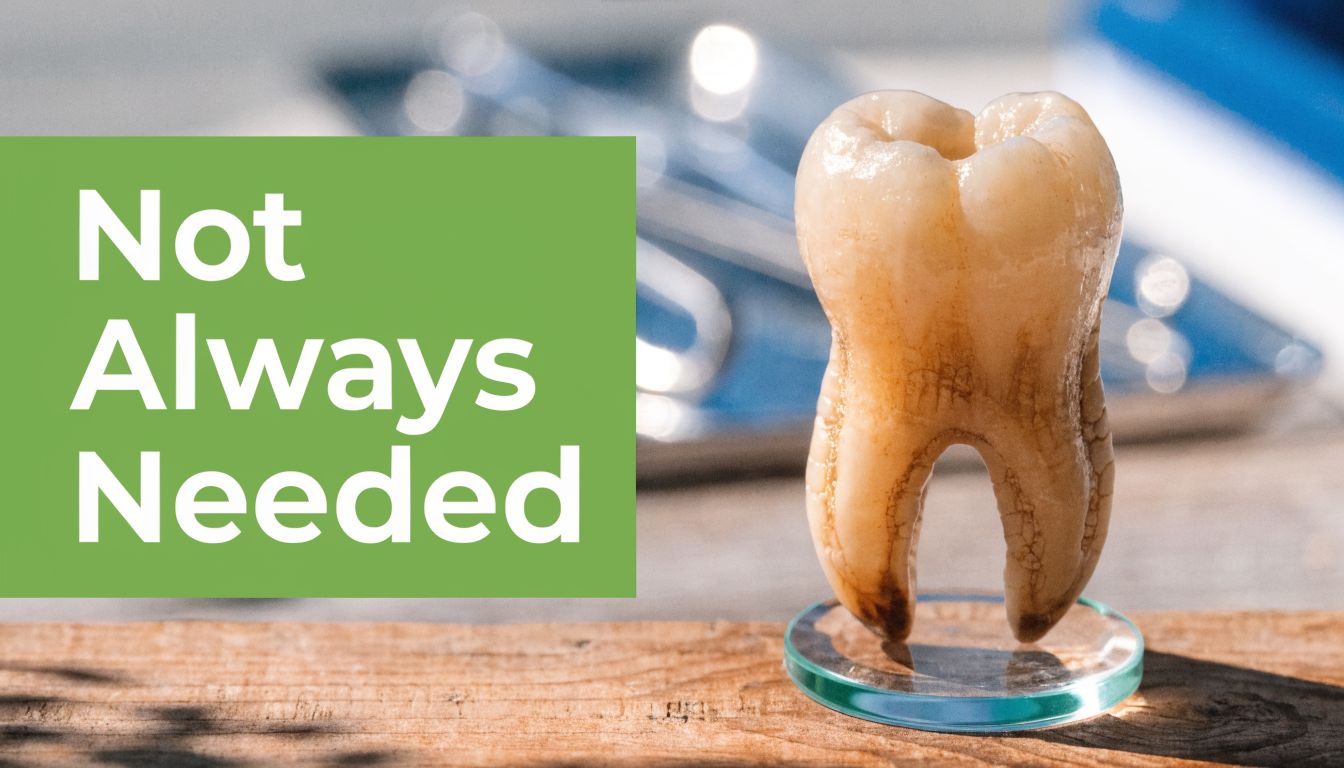
That kind of variation matters. When one office almost never recommends removal and another recommends it routinely, the conversation shouldn’t end with, “That’s just what we do.” It should turn toward anatomy, symptoms, cleaning access, and future risk.
What prophylactic removal gets wrong
Prophylactic removal means taking a tooth out before it causes a defined problem. Sometimes that’s appropriate. Sometimes it isn’t.
A healthy, fully erupted wisdom tooth that can be cleaned, has healthy surrounding gum tissue, and isn’t damaging the second molar may be a tooth worth keeping. By contrast, a partially erupted tooth under a gum flap is a different story entirely because it tends to trap debris and create inflammation.
Clinical reality: The better question isn’t “Do wisdom teeth belong in the mouth?” It’s “Is this specific tooth healthy, functional, and maintainable?”
Patients who want a broader overview of why wisdom teeth removal is sometimes necessary often benefit from reviewing the common reasons extraction is recommended, then comparing those reasons to their own scan and symptoms.
A modern approach
A modern decision process looks like this:
- Assess position: Is the tooth fully erupted, trapped, tilted, or pressing into the tooth in front of it?
- Assess tissue health: Is there recurrent gum inflammation, swelling, bad taste, or food packing?
- Assess function: Is it changing the bite, straining the jaw, or contributing to pain patterns?
- Assess maintainability: Can the patient keep it clean consistently?
If those answers are favorable, removal may not be the best first move.
Clear Signs Your Wisdom Teeth Need to Come Out
There are situations where the decision is straightforward. If a wisdom tooth is actively causing damage, persistent infection, or structural risk, extraction stops being a philosophical debate and becomes a practical treatment.
Think of it this way. A strangely parked car isn’t automatically dangerous. But a car that’s blocking traffic, scraping the car next to it, and leaking fluid has to be moved. Wisdom teeth work the same way. Odd position alone isn’t enough. Pathology is the deciding factor.
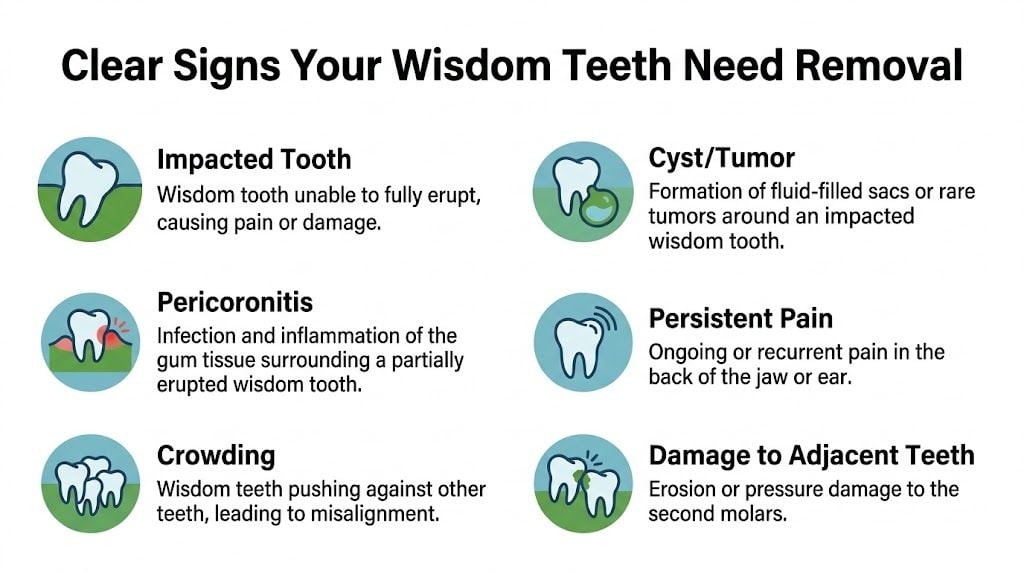
Red flags that usually justify removal
Recurring pericoronitis: If a partially erupted wisdom tooth repeatedly causes swollen, infected gum tissue, it usually won’t solve itself long term. You may get temporary relief with irrigation and local care, but the anatomy keeps recreating the problem.
Damage to the second molar: When a third molar leans into the tooth in front of it, it can create decay, root damage, or bone loss in a tooth that is often more valuable to keep.
Cystic or other pathologic change: A sac or lesion associated with an impacted tooth changes the risk calculation fast. In that situation, watchful waiting is rarely the conservative choice.
Decay that can’t be predictably restored: Some wisdom teeth sit so far back, or erupt in such poor alignment, that restoring them doesn’t make functional sense.
Persistent pain tied to the tooth: Pain in the back jaw, around the ear, or under the gum can come from many sources. But when imaging, exam findings, and symptom pattern point to the wisdom tooth, removal may be the cleanest solution.
Problems that often masquerade as “just jaw pain”
Patients often assume wisdom tooth pain feels like obvious tooth pain. It doesn’t always. It may show up as:
- A sore throat on one side
- Pain with chewing tougher foods
- Tenderness behind the last visible molar
- A bad taste that comes and goes
- Pain radiating toward the ear
If a wisdom tooth is creating repeated inflammation, it can trigger muscle guarding in the jaw. Patients then report “TMJ pain” even though the original irritant is farther back.
What doesn’t count as an automatic reason
Not every abnormality means extraction. A tooth that’s merely present, or a tooth that looks crowded on a scan but isn’t inflamed, decayed, or harming neighboring structures, may still be monitored. That’s where careful exam, imaging, and symptom correlation matter more than assumptions.
How Wisdom Teeth Affect TMJ and Sleep
The standard wisdom tooth discussion usually stops at infection, crowding, and impaction. For patients with jaw pain, headaches, clenching, poor sleep, or facial tension, that misses a major piece of the puzzle.
A third molar doesn’t act in isolation. It sits at the end of the dental arch, near the attachment patterns of the chewing muscles, near the back of the bite, and close to an area where tissue crowding can affect tongue posture. A retained tooth can look “fine” in a narrow dental sense while still contributing to a functional problem.

A patient-facing review from Newton Dental Associates points to an under-addressed issue: retained wisdom teeth, present in 35% to 65% of adults, may alter jaw mechanics and worsen facial pain. That same review notes that standard advice often fails to answer whether “healthy” retained wisdom teeth might affect oral posture or nasal breathing.
How a wisdom tooth can aggravate TMJ symptoms
Sometimes the problem is direct. A partially erupted or poorly angulated third molar creates local inflammation. The jaw muscles respond by tightening to protect the area. That guarding can create a chain reaction: reduced opening, temple pain, morning soreness, and joint irritation.
Sometimes the problem is indirect. A back tooth contact can change how the jaw closes, especially if the tooth erupts in a way that disturbs the bite. The patient then clenches around an interference night after night. That repeated compensation can overload the temporalis and masseter muscles.
Common clues include:
- Pain that increases with chewing
- Tenderness near the angle of the jaw
- One-sided headaches
- Clicking or locking that worsens during a flare
- Morning jaw fatigue
Why airway patients need a different conversation
Airway health changes the decision. If there’s already limited tongue space, nasal obstruction, poor oral posture, or a history of sleep-disordered breathing, a cramped posterior dental arch deserves more attention than it usually gets.
The issue isn’t that every retained wisdom tooth causes sleep apnea. That would be too broad. The issue is that posterior crowding, soft tissue irritation, and altered tongue posture can matter in patients who already struggle with snoring, unrestorative sleep, or breathing instability. In those cases, the question becomes functional: is the tooth neutral, or is it adding to the burden?
For readers looking at this through an airway and jaw-function lens, TMJ and sleep therapy care is often built around that exact overlap rather than treating teeth, joints, and breathing as separate silos.
Here’s a useful clinical explanation of the broader relationship:
A root-cause mindset
When a patient says, “My wisdom teeth don’t hurt, so they can’t be involved,” I’m careful with that assumption. Pain isn’t the only signal that matters. The more relevant questions are:
| Functional question | Why it matters |
|---|---|
| Does the tooth change how the jaw closes? | Bite strain can drive muscle overuse and joint irritation. |
| Is there repeated soft tissue irritation? | Low-grade inflammation can trigger guarding and referred pain. |
| Does it reduce clean space for the tongue and back of the arch? | That can matter in patients with airway or oral posture problems. |
A tooth can be dentally quiet and functionally noisy.
Monitoring Healthy Wisdom Teeth A Safe Alternative
Observation gets dismissed too often as “doing nothing.” In reality, monitoring is active care when it’s done correctly.
A wisdom tooth is a good candidate for retention when it is fully erupted, vertically positioned, surrounded by healthy tissue, and accessible enough to clean well. Guidance summarized in this clinical review on third molars supports retaining asymptomatic, non-impacted wisdom teeth in appropriate cases, and notes that teeth with favorable eruption and tissue conditions are stronger candidates for continued observation rather than automatic surgery.
What a healthy retained wisdom tooth looks like
The teeth most likely to stay stable share a few features:
- Fully erupted into function: A tooth trapped halfway under gum tissue behaves very differently from one that has erupted cleanly.
- Vertical or near-vertical position: A tooth that isn’t pushing forward or sideways is less likely to damage the second molar.
- Cleanable anatomy: If a toothbrush, floss aid, or irrigation tool can access the area, long-term maintenance is more realistic.
- No current signs of disease: No recurrent swelling, foul taste, deep gum pocketing, or decay.
That’s the ideal. It doesn’t mean risk disappears. It means the risk can often be managed.
What proper monitoring includes
Good observation has structure. It usually involves:
- Periodic clinical exams to look for tissue inflammation, food trapping, and tenderness.
- Imaging when indicated to reassess root position, eruption pattern, and neighboring bone levels.
- Hygiene coaching so the patient knows exactly how to clean the distal area behind the second molar.
- Symptom tracking for subtle changes in chewing pain, jaw tightness, or one-sided discomfort.
Practical rule: If a patient can’t keep a wisdom tooth clean, the tooth isn’t truly asymptomatic. Hygiene failure often becomes pathology later.
Where advanced imaging helps
Two-dimensional X-rays don’t always tell the whole story. In selected cases, CBCT imaging clarifies whether a tooth is merely present or structurally risky. It can show root orientation, relationship to surrounding bone, and whether the tooth’s position is likely to irritate adjacent structures or complicate future surgery.
That matters because a “safe to watch” decision should be based on anatomy, not optimism. When the scan and the exam agree that a tooth is healthy and maintainable, retention can be a sound, evidence-based option.
What to Expect from Extraction and Its Alternatives
When extraction is necessary, surgery can be the right call. But it shouldn’t be treated as the only tool available for every wisdom tooth-related complaint.
Some patients need the tooth removed because the pathology is clear. Others have early inflammation, muscle guarding, or jaw pain around a borderline tooth and may benefit from conservative care first. The art is knowing which category the patient is in.

The standard surgical path
A routine extraction pathway usually includes imaging, anesthesia planning, removal of erupted or impacted teeth, and a recovery period focused on swelling control, site protection, and gradual return to normal chewing.
For many people, that process is straightforward. But surgery still has trade-offs. Recovery limits eating and activity for a period, and patients with existing jaw dysfunction may be more sensitive to prolonged mouth opening, post-op guarding, or changes in bite comfort. If you want practical guidance on the food side of healing, this overview of what to eat after wisdom teeth removal is useful.
Where conservative treatment fits
A conservative approach does not remove a tooth that clearly needs extraction. It’s for the cases in between. The patient has irritation, low-grade inflammation, or jaw symptoms that may be connected to the area, but the anatomy doesn’t make surgery the only immediate answer.
According to this published review on third molar management, expert guidance increasingly favors retaining healthy wisdom teeth, and several regenerative options show promise for early inflammatory cases. The review reports that PRF injections can resolve up to 85% of early inflammatory symptoms, while cold laser therapy at 810nm and 4J/cm² can accelerate wound healing by 40%. It also notes potential TMJ-related surgical complications, including transient disc displacement in 5% to 10% of cases.
Non-surgical options that may help
These aren’t substitutes for removing a diseased tooth. They are tools for stabilizing tissue and function when surgery is uncertain, premature, or part of a broader pain picture.
- Platelet-Rich Fibrin or PRF: Used to support healing and calm early inflammatory tissue responses.
- Cold laser therapy: Often used to reduce irritated tissue burden and support local recovery.
- Orofacial myofunctional therapy: Useful when poor tongue posture, mouth breathing, or dysfunctional swallow patterns contribute to pressure and crowding in the back of the mouth.
- Targeted TMJ care: Sometimes the patient’s dominant symptom isn’t the tooth itself. It’s the muscle and joint response around it.
What works and what doesn’t
What works: matching the intervention to the problem. If the issue is recurrent infection under a gum flap, massaging the jaw won’t solve it. If the issue is muscle guarding around a mildly inflamed but maintainable tooth, immediate surgery may not be the most elegant first step.
What doesn’t work: pretending every painful back jaw problem is “just TMJ,” or assuming every third molar belongs in an extraction tray. Both are shortcuts.
Questions to Ask Your Dentist or Specialist
Good decisions come from better questions. If you’ve been told you need your wisdom teeth out, don’t stop at “why?” Ask for specifics tied to your anatomy, symptoms, and goals.
The economics matter too. A summary of wisdom tooth extraction trends from Greater Washington OMFS notes that costs can range from about $700 for a single impacted tooth to more than $3,000 for all four teeth, and that removal is concentrated around ages 18 to 21. That same overview also reports that women are more likely to have extractions than men, with one cited split of 65.6% versus 34.4%. Those numbers shouldn’t decide treatment, but they should encourage a more thoughtful conversation.
Bring these questions to the consult
- What exact pathology are you seeing? Ask whether the reason is impaction, decay, cystic change, damage to the second molar, recurrent soft tissue infection, or something else.
- Is this recommendation based on symptoms, imaging, or both? A good answer should connect the scan to what you’re feeling.
- If we keep this tooth, what is the realistic risk? Ask what the provider expects to happen if the tooth is monitored rather than removed now.
- Could this tooth be contributing to my jaw pain, headaches, or bite strain? That question matters if your main complaint isn’t toothache.
- Do you see any airway or tongue-space concerns? This is especially relevant if you snore, wake tired, or have a narrow-feeling bite.
Don’t skip the practical topics
Patients often forget to ask about logistics until the end. Put them on the table early.
- What kind of anesthesia would be used, and why? If you’re comparing options, a good primer on oral surgery anesthesia choices can help you understand what to ask.
- If surgery is recommended, what would recovery likely involve in my case?
- If surgery isn’t urgent, how would you monitor the tooth?
- Are there conservative treatments worth trying first for inflammation or TMJ symptoms?
- How does my age affect the timing decision?
- What will the total cost include?
The best consult ends with clarity, not pressure. You should understand why the tooth stays, why it goes, or why it needs close follow-up.
Your Wisdom Tooth Questions Answered
Patients usually leave with a few unresolved worries. These are the ones I hear most often.
Quick Guide Common Questions and Answers
| Question | Answer |
|---|---|
| Do wisdom teeth always cause crowding after braces? | Not always. Crowding has multiple causes. A wisdom tooth can contribute in some mouths, but it isn’t an automatic explanation for every orthodontic relapse. |
| If a wisdom tooth isn’t hurting, can it still be a problem? | Yes. A tooth can trap debris, irritate gum tissue, affect the bite, or add to jaw strain without causing obvious tooth pain. |
| Is it safer to remove wisdom teeth early? | Sometimes. Earlier treatment can be simpler in selected patients, but “earlier” isn’t the same as “necessary.” The indication still matters. |
| Can non-surgical treatment replace extraction? | It can help in borderline or inflammatory cases, especially when the main issue is surrounding tissue irritation or muscle response. It won’t fix a tooth with clear pathology that requires removal. |
| Are costs worth discussing before I decide? | Absolutely. Fees, sedation choices, and the number of teeth involved can change the plan. If you want a location-specific example of how practices break down fees, this guide to Wisdom Tooth Removal NZ Cost shows the kinds of questions patients should ask about pricing and what’s included. |
One final answer to the big question
So, does everyone need their wisdom teeth removed? No. Some wisdom teeth should come out promptly. Some should be watched closely. Some can stay for years without causing meaningful trouble.
The mistake is treating all third molars as if they behave the same way. They don’t. The right decision comes from matching the tooth to the patient, then matching the treatment to the actual problem.
If you’re dealing with jaw pain, facial tension, headaches, snoring, or sleep-disordered breathing and you suspect your wisdom teeth may be part of the picture, Pain and Sleep Therapy Center offers root-cause evaluation focused on TMJ function, airway health, and non-surgical options when appropriate.