If chronic joint pain has become a constant, unwelcome part of your life, you know how frustrating temporary fixes can be. Regenerative medicine for joint pain offers a completely different way of thinking. Instead of just masking symptoms, it’s about rebuilding and repairing damaged tissue from the inside out.
The goal is to give your body the raw materials and instructions it needs to truly heal itself for good.

Tired of Living With Joint Pain?
Are you exhausted by treatments that only seem to put a bandage on the problem? Conventional medicine often relies on pain medication or invasive surgery—options that feel like patching a leaky roof over and over again without ever stopping the rain.
Think of regenerative medicine as providing your body with a new blueprint and a crew of expert builders to fix the roof properly. This approach gets to the heart of the issue by kickstarting your body's natural repair mechanisms, encouraging them to get to work on damaged cartilage, ligaments, and tendons.
Shifting Focus From Symptoms to Solutions
The philosophy here isn't just to manage pain but to resolve its source. This is a game-changer for persistent pain in complex joints like the jaw, neck, and face. Conditions like temporomandibular joint (TMJ) dysfunction, for example, often involve degenerated tissue that traditional methods just can't fix. You can learn more about how we address this in our detailed guide on TMJ treatment options.
And the need for better solutions has never been more clear. Chronic joint pain from osteoarthritis affects over 32.5 million Americans, creating an almost unbelievable $136 billion annual healthcare burden in the U.S. alone. This isn't just a number; it represents millions of people looking for treatments that do more than just quiet the noise.
This isn't about temporary relief; it's about creating lasting change. The core idea is to empower your body to heal from within.
A New Philosophy for Healing
Instead of fighting your body's inflammation signals with drugs, regenerative techniques work with them. We introduce concentrated healing factors directly to the site of injury, which essentially tells your body: "Hey, this spot is a top priority. Send in the repair crew now."
This signals a fundamental shift in how we view chronic pain. It reframes it not as a life sentence to be managed, but as a problem your body has the potential to solve—if it gets the right kind of help. By activating this internal healing process, we can restore function, reduce pain, and help you get your life back without relying on surgery or a lifetime of medication.
How Your Body Heals Itself From The Inside Out
To really get what regenerative medicine is all about, you first have to appreciate the amazing healing system your body already has. When you get a paper cut, you don't have to think about making it heal. A whole series of events just kicks into gear—platelets show up to stop the bleeding, inflammation signals that there's a problem, and growth factors start rebuilding the damaged skin.
Regenerative medicine for joint pain taps into that very same process. It’s not about putting a foreign substance into your body to numb the pain. Instead, it’s about amplifying and directing your body’s own repair crew right to the source of the trouble. We're essentially giving that internal crew the support, materials, and focus they need to get the job done right.
Think of your injured joint as a construction site where the project has completely stalled. The workers (your cells) are worn out, the supply lines have been cut, and the original blueprints are long gone. It’s a mess, and that disarray is what's causing your chronic pain and lack of function.
Activating Your Internal Repair Crew
Regenerative therapies are like the new project manager showing up to get things moving again.
For instance, Platelet-Rich Fibrin (PRF) is like bringing in an elite crew of specialists with a fresh truckload of premium materials. We're delivering a concentrated dose of your own platelets and growth factors, all held within a natural fibrin scaffold that acts as a brand-new, crystal-clear blueprint for the repair job.
Prolotherapy works a little differently. It’s more like sending out a high-priority, five-alarm fire signal that pinpoints the exact location of a weak ligament or tendon. This alert calls your body’s best repair teams directly to the scene, kicking off a focused inflammatory and healing response to strengthen the area from the ground up.
And then you have therapies like cold laser therapy, which act as a power boost. Think of it as bringing portable generators to the construction site. The light energy gives your cells the extra juice they need to carry out their repair duties faster and more effectively, which helps cut down inflammation and speed up the rebuilding process.
The core idea is simple but powerful: we create the perfect conditions for your body to heal itself. We aren’t trying to override your biology; we're working right alongside it.
By collaborating with your body's own systems, these treatments help rebuild damaged tissue from the inside out. This is a completely different approach from just managing symptoms. The goal here is to restore the joint's integrity and function for good, leading to lasting relief.
The Science Of Guided Healing
This inside-out strategy is backed by a growing body of evidence showing it to be remarkably effective. Studies have found that regenerative medicine for joint pain can have a success rate of around 80% in repairing joints and cartilage. That's a huge step up from the temporary relief offered by many traditional methods.
For a condition like knee osteoarthritis, treatments like PRP injections use your body's own growth factors to calm inflammation and encourage tissue to regenerate. This often leads to significant pain reduction and better function that can last for six to twelve months or even longer—a stark contrast to the few weeks of relief you might get from a corticosteroid injection. You can dig into more of the data and see how regenerative medicine is changing patient outcomes on californiapain.com.
This data really gets to the heart of why the regenerative model is so different. Instead of just hitting the mute button on the "fire alarm" of pain, it aims to actually put out the fire by repairing the underlying damage. This focus on true healing is what sets regenerative medicine for joint pain apart as a more forward-thinking solution for chronic conditions.
Your Regenerative Treatment Options Explained
Now that we've covered the big idea behind regenerative medicine—helping the body heal itself—let's open up the toolbox and look at the therapies we use. Each one has a unique way of nudging your body’s internal repair crews into action, making them a better fit for different kinds of joint problems.
Think of it like a skilled carpenter. They don't just use a hammer for every job. They have saws for cutting, drills for fastening, and sanders for finishing. In the same way, we select the right regenerative tool based on your specific condition, whether it's a loose ligament, worn-down cartilage, or persistent inflammation.
The goal is always to create a plan that’s right for you. Sometimes that means using a single therapy, but often we combine them to create a more powerful, layered approach to healing your joint pain.
Prolotherapy: Triggering The Natural Rebuild
Prolotherapy is one of the foundational treatments in our field. The name comes from "proliferative therapy," which is a fancy way of saying it stimulates the growth of new, healthy tissue right where you need it most.
Here's how it works: we inject a natural irritant solution—usually a simple dextrose (sugar water) mixture—directly into a weakened ligament or tendon. This creates a mild, controlled inflammatory response. While "inflammation" might sound like a bad thing, in this context, it's the critical first step in the body's healing cascade.
This controlled inflammation is like sending up a flare signal. It alerts your body's immune system, which then rushes growth factors and healing cells to the area. These cells get to work repairing and strengthening the weak connective tissues, which in turn makes the joint more stable and less painful.
- Best For: Prolotherapy is a fantastic tool for chronic pain caused by ligament laxity (looseness). When ligaments get stretched or injured, they can't support the joint properly, leading to instability and pain in places like the neck, back, or jaw.
- What It Feels Like: Most patients feel a temporary fullness or soreness at the injection site, almost like a deep muscle ache. This is a good sign—it means the healing process has officially kicked off.
Platelet-Rich Fibrin: The Ultimate Repair Scaffold
If Prolotherapy is the emergency signal, then Platelet-Rich Fibrin (PRF) is the elite construction crew that shows up with its own advanced building materials. This therapy harnesses a powerful concentration of your body’s own healing components, all from a simple blood draw.
The process is surprisingly straightforward. We draw a small amount of your blood and spin it in a centrifuge. This separates the blood into its different parts, letting us isolate the platelet-rich fibrin matrix. What we get is a golden, gel-like substance packed with platelets, growth factors, white blood cells, and even stem cells, all suspended in a natural fibrin scaffold.
When we inject this into a damaged joint, the fibrin scaffold acts like a three-dimensional net. It holds all those healing cells right where they need to be, allowing them to release their growth factors slowly over time. This provides a long-lasting signal for tissue regeneration.
PRF doesn't just kickstart healing; it provides a biological blueprint for it. The fibrin matrix actually guides the repair process, helping rebuild everything from cartilage to soft tissue in a more organized and robust way.
Cold Laser Therapy: Energizing Your Cells For Healing
The third key tool in our toolbox is Cold Laser Therapy, also known as low-level light therapy (LLLT). Unlike the powerful lasers used in surgery, this therapy uses very specific wavelengths of light to stimulate cellular activity without ever cutting or burning tissue.
Think of your cells as tiny batteries. When a joint is injured or chronically inflamed, these batteries get drained and can't do their job effectively. Cold laser therapy acts like a cellular charger, delivering light energy directly to the mitochondria—the powerhouses inside your cells.
This energy boost supercharges their natural healing processes, leading to some impressive benefits:
- Increased production of ATP (cellular energy)
- Reduced inflammation and swelling
- Improved blood circulation to the area
- Accelerated tissue repair
Because it’s completely non-invasive and painless, cold laser therapy is an excellent standalone treatment for reducing pain and inflammation. We also frequently use it alongside Prolotherapy or PRF to speed up recovery and enhance the overall results. You can learn more about how we use light to activate healing with cold laser therapy in our dedicated guide.
This diagram helps visualize how each therapy calls on your body’s repair crews in its own unique way.
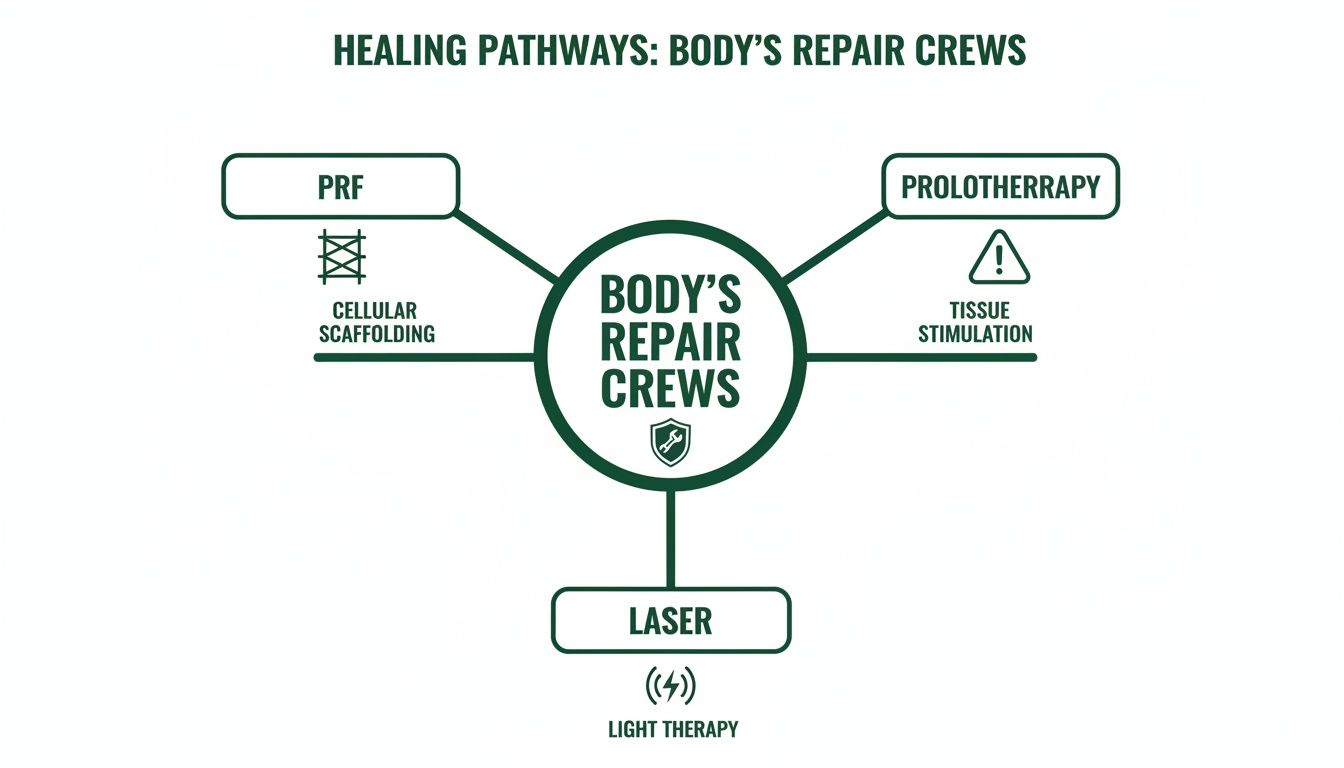
As you can see, PRF provides a physical scaffold for new tissue, Prolotherapy sends a chemical alert to kick things off, and laser therapy delivers an energy boost to fuel the entire process. Together, they work toward the common goal of rebuilding and strengthening your joint.
Comparing Regenerative Therapies for Joint Pain
To make it easier to see how these treatments differ, we've put together a quick comparison table. This can help you understand which approach might be best suited for your specific type of joint pain.
| Therapy | How It Works | Best For | Typical Treatment |
|---|---|---|---|
| Prolotherapy | Injects a natural irritant (dextrose) to create a mild inflammatory response, signaling the body to send healing cells to repair weak ligaments and tendons. | Chronic pain from ligament laxity, joint instability (e.g., in the back, neck, jaw, or SI joint). | A series of 3-6 injection sessions, spaced 4-6 weeks apart. |
| Platelet-Rich Fibrin (PRF) | Injects a concentration of your own platelets, growth factors, and stem cells held in a fibrin matrix to provide a scaffold for new tissue growth. | Moderate to severe joint arthritis, cartilage damage, tendon tears, and more complex soft tissue injuries. | Often 1-3 injection sessions, spaced 6-8 weeks apart, depending on the condition. |
| Cold Laser Therapy (LLLT) | Uses specific wavelengths of light to reduce inflammation, improve circulation, and energize cells, accelerating the body's natural healing processes. | Acute injuries, widespread inflammation, nerve pain, and enhancing recovery after injections. | A series of 6-12 short, painless sessions, often 2-3 times per week. |
While each therapy has its strengths, remember that they are often most powerful when used in combination. A personalized treatment plan ensures you're getting the right signals to the right tissues at the right time.
Are You A Good Candidate For Regenerative Medicine?
While regenerative medicine offers incredible potential for healing joint pain, it's important to understand what it really is: a biological process, not an overnight fix.
I like to use a simple analogy: think of it like planting a garden. We provide the very best seeds (your own concentrated healing cells) and create the perfect soil conditions in your joint. But the real growth happens over time, and it takes patience and care to see the results.
This means the ideal candidate is someone ready to be an active partner in their own healing. You aren't just a passive recipient of a procedure; you're committing to a process. This partnership between you and our team is often the secret ingredient to unlocking the best possible outcome.
Who Benefits Most From These Therapies?
Pinpointing the right candidates is crucial for success. In my experience, the people who respond best to regenerative treatments share a few common traits. They're often dealing with nagging, chronic joint pain that just hasn't gotten better with traditional approaches like physical therapy or temporary fixes like pain medication.
Most often, the ideal candidate is looking to avoid or at least delay a more invasive procedure, like a total joint replacement. They want a solution that gets to the root cause of the pain instead of just silencing the alarm bells.
Here are a few common scenarios where someone is likely a strong candidate:
- Chronic Ligament or Tendon Injuries: People with stubborn issues like tennis elbow, Achilles tendinopathy, or chronic ligament sprains that leave a joint feeling unstable are often perfect candidates.
- Mild to Moderate Osteoarthritis: If you're in the earlier stages of joint degeneration, you'll likely see significant benefits. There’s still enough healthy tissue for our treatments to work with and repair.
- Desire to Avoid Surgery: Patients who are highly motivated to find a less invasive alternative to a major operation often find that regenerative medicine aligns perfectly with their health goals.
- Overall Good Health: It makes sense, right? If you're generally healthy, your body has a stronger baseline healing capacity, which gives the entire process a head start.
The most critical factor is a commitment to the full treatment plan. Regenerative healing is a cumulative process. Real success depends on completing the recommended series of treatments and following through with supportive care, like targeted exercises or lifestyle adjustments.
Understanding Who May Not Be A Good Fit
Just as important as knowing who can benefit is being completely transparent about who might not. Regenerative medicine for joint pain isn't the right path for everyone, and setting honest expectations is a core part of our commitment to you.
Certain health conditions can unfortunately interfere with the body's natural ability to heal, which can make these treatments less effective. The therapies work by kicking off and supporting a controlled inflammatory healing response. If your body's systems are already compromised, this process might not unfold the way we want it to.
Here are a few conditions that might make you a less-than-ideal candidate:
- Active Infections: Any systemic or localized infection has to be fully resolved before we can start. A procedure could risk spreading the infection, and we’d never take that chance.
- Certain Cancers: Patients with active cancers, particularly blood-based cancers like leukemia or lymphoma, are generally not candidates for these treatments.
- Severe Autoimmune Disorders: Conditions like unmanaged rheumatoid arthritis or lupus, where the immune system is dysregulated, can sometimes complicate the healing process. This requires a careful, case-by-case evaluation.
- Low Platelet Counts: Since treatments like PRF depend on a high concentration of your own platelets, anyone with a bleeding disorder or abnormally low platelet count may not get the desired result.
- Use of High-Dose Corticosteroids: Recent or long-term use of high-dose steroids can suppress your body's natural healing ability, working directly against the goals of regenerative therapy.
Setting Realistic Timelines And Expectations
One of the most important things to grasp is that true, structural healing takes time. This is a fundamental difference from a cortisone shot, which gives you fast (but temporary) relief by shutting down inflammation. Regenerative therapies work with your body's natural healing cycle, which means the timeline is much more gradual.
You’ll likely feel some initial soreness after a procedure—that's a good thing! It’s a sign that the healing cascade has officially begun. Most people start to notice a real, meaningful improvement in their pain and function within 4 to 6 weeks of their first treatment.
But the work isn't done yet. The tissue rebuilding process continues for several months under the surface. The peak benefits are often seen 3 to 6 months after your full series of treatments is complete. Patience really is a virtue here. When you understand and respect this biological timeline, you can fully appreciate the lasting repairs your body is making from the inside out.
Our Approach To Regenerative Healing
At Pain and Sleep Therapy Center, we see regenerative medicine for joint pain as something much bigger than a single procedure. A Platelet-Rich Fibrin (PRF) injection isn't a magic bullet; it's a powerful tool we use within a thoughtful, comprehensive strategy for your long-term health. We believe true healing comes from addressing the why behind your pain, not just masking the what.
This philosophy means we look at the whole picture. Think of your joint pain like a weed in a garden. You can keep trimming it down (which is like managing symptoms), but it’s just going to grow back. Our goal is to get to the root of the problem and pull it out for good.

Connecting The Dots For Lasting Relief
Your body is an interconnected system. It's amazing how a problem in one area—like an improper swallow or breathing pattern—can set off a chain reaction of strain that eventually shows up as jaw or neck pain. This is exactly why our treatment plans often combine multiple disciplines.
A regenerative therapy might be the catalyst for healing damaged tissue, but we often pair it with other supportive treatments to fix the underlying mechanical issues. By doing this, we make sure the joint isn't just patched up—it's protected from being damaged again in the future.
Our entire process is built around this root-cause philosophy:
- Comprehensive Diagnostics: We always start with a deep dive, using advanced tools to figure out what's really causing your joint dysfunction.
- Personalized Treatment Blueprint: Using what we find, we map out a detailed plan that combines regenerative injections with other targeted therapies.
- Functional Correction: We bring in techniques designed to restore proper function and take the stress off the joint for good.
- Ongoing Partnership: Healing is a journey, not a one-time fix. Our team is here to support and guide you every step of the way.
Building Your Personalized Treatment Plan
Imagine building a house. You wouldn't just start putting up walls without a solid foundation, right? It's the same with your healing plan. We build it on a foundation of precise diagnostics and functional correction. This is where our deep expertise in conditions of the jaw, head, and neck really comes into play.
For instance, a patient might come to us with chronic TMJ pain. We could use PRF injections to help repair the damaged joint capsule, and that would certainly help. But our investigation might also show that poor tongue posture and a mouth-breathing habit are putting constant, daily strain on that very same joint.
In our clinic, you are not just getting a procedure; you are gaining a dedicated partner in your recovery. We combine advanced regenerative treatments with foundational therapies to create a plan that addresses your pain from every angle.
To truly fix the problem, we would also bring in orofacial myofunctional therapy to retrain the muscles of the face and tongue. We might also work on breathing exercises to restore proper nasal breathing. By addressing these root causes, we create the perfect environment for the PRF treatment to succeed and deliver lasting change. You can explore the advanced technology we use to diagnose and treat these complex issues.
More Than A Treatment—A Partnership
This integrated approach is what sets our clinic apart. We don’t just treat symptoms; we work to rebuild function from the ground up. By looking beyond the immediate site of pain, we identify and correct the habits and imbalances that got you here in the first place.
This means your care plan is truly yours—designed specifically for your unique anatomy, history, and goals. When you work with us, you become an active partner in a process designed to deliver not just temporary relief, but a genuine, sustainable return to health.
Common Questions About Regenerative Joint Therapy
It’s completely natural to have questions as you think about your options. This last section is here to give you straightforward answers to the queries we hear most often from patients just like you. We’ve set it up as a simple Q&A to help you find what you need quickly and clear up any lingering concerns.
How Does This Differ From Cortisone Shots?
This is a fantastic question because it gets right to the core of the two different treatment philosophies.
Think of a cortisone shot as a powerful fire extinguisher. It’s fantastic at putting out the immediate flames of inflammation and giving you very fast, often dramatic, pain relief. The problem? It does absolutely nothing to fix what started the fire in the first place.
Cortisone is a potent anti-inflammatory that basically just silences your body's alarm system. While the relief is welcome, it’s temporary, and the underlying tissue damage is still there. Worse, studies show that repeated cortisone injections can actually weaken cartilage and tendons over time, potentially making the joint even less stable in the long run. It’s a short-term fix that can sometimes lead to long-term problems.
Regenerative medicine is the complete opposite. Instead of silencing the alarm, it’s like sending in a construction crew to rebuild the damaged structure. We’re not masking the problem; we are actively helping your body repair it.
This approach uses your body's own healing ingredients to fix the source of the pain. The goal isn’t just to manage symptoms—it’s to create genuine, lasting tissue repair for a true long-term solution.
Is The Treatment Painful and What Is The Downtime?
We believe in being completely upfront about what you can expect. The procedures, whether it’s PRF or Prolotherapy, do involve injections, so you’ll feel some discomfort right at that moment.
Afterward, it’s very common to feel some temporary soreness, stiffness, or even see a little swelling in the joint. It might sound like a side effect, but it's actually a great sign. This mild inflammatory response is exactly what we want to see—it’s your body’s healing cascade kicking into high gear.
Many patients say it feels a lot like the muscle soreness you’d get after a really good workout. It’s a productive ache, a sign that positive changes are happening under the surface.
The best part is that there’s really no significant "downtime." Most people head right back to their normal daily activities, like work or school, almost immediately. We'll likely just ask you to hold off on strenuous, high-impact exercise for a week or two to give the area the best possible chance to heal without being disturbed.
How Many Sessions Will I Need to See Results?
It’s important to understand that regenerative medicine is a process, not a one-and-done event. Real, durable healing takes time. It happens layer by layer as your body builds new, healthy tissue, so your treatment plan will almost always involve a series of sessions.
For most joint conditions, we find that a series of 3 to 6 treatments delivers the best, most lasting results. These appointments are usually scheduled 4 to 6 weeks apart. That spacing is deliberate—it gives your body plenty of time to respond to a treatment before we build on that progress in the next session.
Think of it like building a brick wall. Each treatment is like laying another solid row of bricks. It’s the cumulative effect that creates a strong, stable, and resilient structure. Because the goal is to create permanent repairs with your own biological materials, the results can be incredibly long-lasting—especially when we also fix the underlying mechanical issues that led to the joint damage in the first place.
Are These Treatments Covered by Insurance?
This is a very practical and important question. Right now, most insurance carriers classify regenerative therapies like PRF and Prolotherapy as “investigational.” In plain English, that means they are typically not covered by most health insurance plans.
We are always transparent about the investment involved and will go over everything with you during your consultation. It helps to think of it not just as a cost, but as an investment in your long-term health and quality of life. The main goal here is to help you avoid far more invasive and expensive procedures, like surgery, down the road.
Plus, a successful treatment can reduce or even eliminate the need for a lifetime of pain medications, which come with their own costs and potential side effects.
While insurance may not cover these procedures, you're investing in a solution that aims to permanently fix the problem, potentially saving you from future medical bills and a diminished quality of life.
To make this care accessible, we offer flexible payment options and will work with you to find a plan that fits your budget. We truly believe everyone deserves a chance to address the root cause of their pain.
At Pain and Sleep Therapy Center, we’re committed to providing answers and creating personalized plans that lead to real, lasting relief. If you're ready to move beyond temporary fixes and invest in your long-term joint health, we invite you to schedule a consultation with our team. Learn more about our approach and take the first step toward a pain-free life by visiting us at https://pscharlotte.com.