You may be looking at regenerative therapy because you're tired of cycling through the same pattern. Your jaw hurts, your face feels tight, your headaches keep returning, or your sleep still isn't restorative even though you've already tried appliances, exercises, medications, or repeated visits elsewhere. Then you search cost, and the answers online feel scattered. One page gives a per-injection number. Another talks about stem cells in broad terms. Very few explain what you'd be paying for if your problem involves TMJ strain, facial pain, airway tension, or sleep-related dysfunction.
That confusion is reasonable. Regenerative therapy cost isn't usually a simple sticker price. In a pain or sleep case, the fundamental question isn't just “How much is one visit?” It's “What is the total cost of care, what does that include, and is it worth it for my specific problem?”
Patients often come in with that exact concern. They've heard terms like Prolotherapy, PRF, or cold laser. They want something less invasive than surgery and more lasting than another short-term fix, but they don't want to commit to an expensive treatment plan they don't fully understand. That's the right instinct.
Some of the same pricing questions come up in other PRP uses too. If you're trying to understand how patients weigh self-pay treatment against uncertain outcomes, this outside guide on whether to evaluate PRP for hair loss offers a useful example of how people think through value, repeat sessions, and expectations.
Understanding the Investment in Your Health
Regenerative care sits in an unusual place in medicine. It often appeals to patients who are trying to avoid bigger interventions, yet it usually requires more upfront decision-making because pricing can vary so much. That makes many people uneasy, especially if they've already spent money on treatments that gave only partial relief.
In orofacial pain and sleep medicine, cost conversations need to be more honest than “this injection costs X.” A patient with mild ligament laxity in one TMJ isn't the same as a patient with long-standing jaw instability, muscle guarding, airway strain, poor sleep quality, and referred facial pain. The treatment goal may look similar on paper, but the depth of care can be very different.
What patients are really asking
Individuals aren't asking for a bargain. They're asking for clarity.
They want to know:
- What am I paying for: the procedure alone, or the evaluation, planning, and follow-up too?
- Will this be one treatment or a process: because those are two very different financial commitments.
- Is this trying to mask symptoms or improve tissue function: because that changes how people judge value.
Practical rule: A treatment can look affordable per visit and still become expensive if it isn't aimed at the right diagnosis.
That's why regenerative care should be framed as an investment in a treatment strategy, not just a line-item procedure. In our field, the aim is often to support healing in irritated joints, overloaded attachments, or damaged connective tissues that may be contributing to pain, dysfunction, and poor sleep quality.
Why root-cause care changes the cost discussion
A quick pain fix and a repair-oriented plan are priced differently because they ask different things of the clinician and the patient. Root-cause care usually involves more precise diagnosis, tighter case selection, and better definition of what success should look like. That tends to produce more meaningful decisions.
When a patient understands the plan, the cost becomes easier to judge. They can weigh it against continued medication use, repeated splint adjustments, recurring therapy visits, or the possibility of surgery later. That's the conversation worth having.
What Are Regenerative Therapies for Pain and Sleep
Before cost makes sense, the treatment itself has to make sense. In this setting, regenerative therapies are used to support healing and function in tissues that may be irritated, strained, or slow to recover. For jaw pain, facial pain, and some sleep-related problems, that may involve joints, ligaments, tendon attachments, inflamed soft tissue, or the muscular patterns wrapped around them.
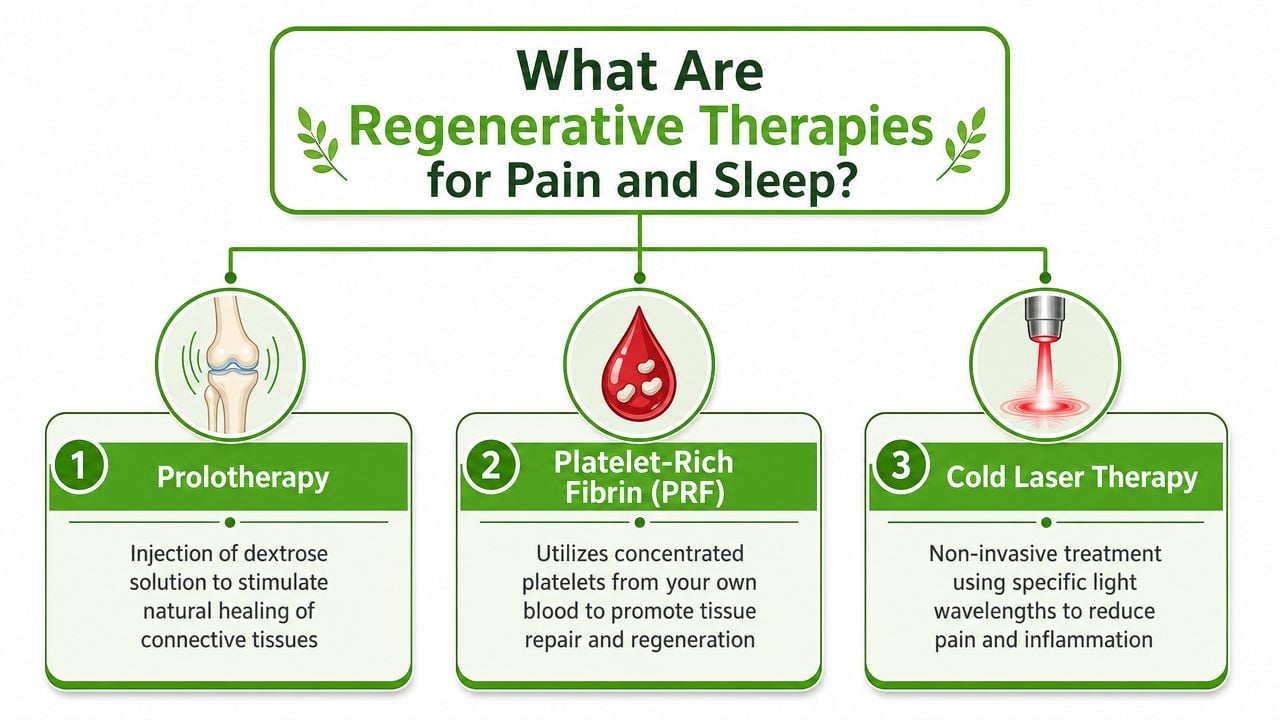
Here's the big picture:
Prolotherapy
Prolotherapy is an injection-based treatment that places a solution, commonly dextrose-based, into targeted areas where connective tissue needs healing support. The simple way to think about it is this: the treatment tries to wake up a tissue that has stayed irritated, weak, or mechanically unstable for too long.
For TMJ-related cases, that may matter when ligaments and supporting structures aren't doing their job well. If the joint is unstable, nearby muscles often compensate. That can contribute to clenching, guarding, headaches, and facial fatigue.
What works well with Prolotherapy is proper case selection. It can be useful when the problem is structural irritation or instability. What doesn't work is using it as a generic pain shot without understanding why the tissue is overloaded in the first place.
Platelet-Rich Fibrin and PRF
Platelet-Rich Fibrin, or PRF, uses a sample of your own blood. That sample is processed so the healing components can be concentrated and placed where repair support is needed. I often explain PRF as calling in your body's own repair crew, then sending that crew to a very specific address.
PRF appeals to many patients because it uses their own biology rather than a synthetic drug. In a pain practice, the appeal isn't novelty. It's precision. The goal is to place a biologically active material in tissue that has reason to heal but may need a stronger local signal.
Later in treatment planning, some patients also want to understand broader regenerative options for joint and soft tissue care. This overview of regenerative medicine for pain gives a useful clinic-level summary of where these treatments fit.
For patients who also need movement support while reducing joint irritation, low-impact exercise matters. This guide on no-impact cardio for arthritis is helpful because it shows how people can stay active without continuously aggravating painful tissues.
A short video can make these concepts easier to picture in real life:
Cold laser therapy
Cold laser therapy is different from injection-based treatments. It uses specific light wavelengths to influence tissue activity without cutting, heating, or physically penetrating the tissue. Patients usually like it because it's non-invasive and easy to tolerate.
In practical terms, cold laser is often used to calm irritation, support tissue recovery, and reduce pain sensitivity in a targeted area. In a jaw or facial pain case, that can make it easier for a patient to move, chew, or participate in exercise-based rehabilitation.
The treatment itself is only part of the value. The real value comes from matching the right tool to the right tissue problem.
Cold laser usually works best as part of a broader plan. It's less likely to solve a mechanically unstable joint by itself. It may, however, help lower the inflammatory noise around a problem while other therapies address the underlying load or dysfunction.
Key Factors That Influence Your Treatment Cost
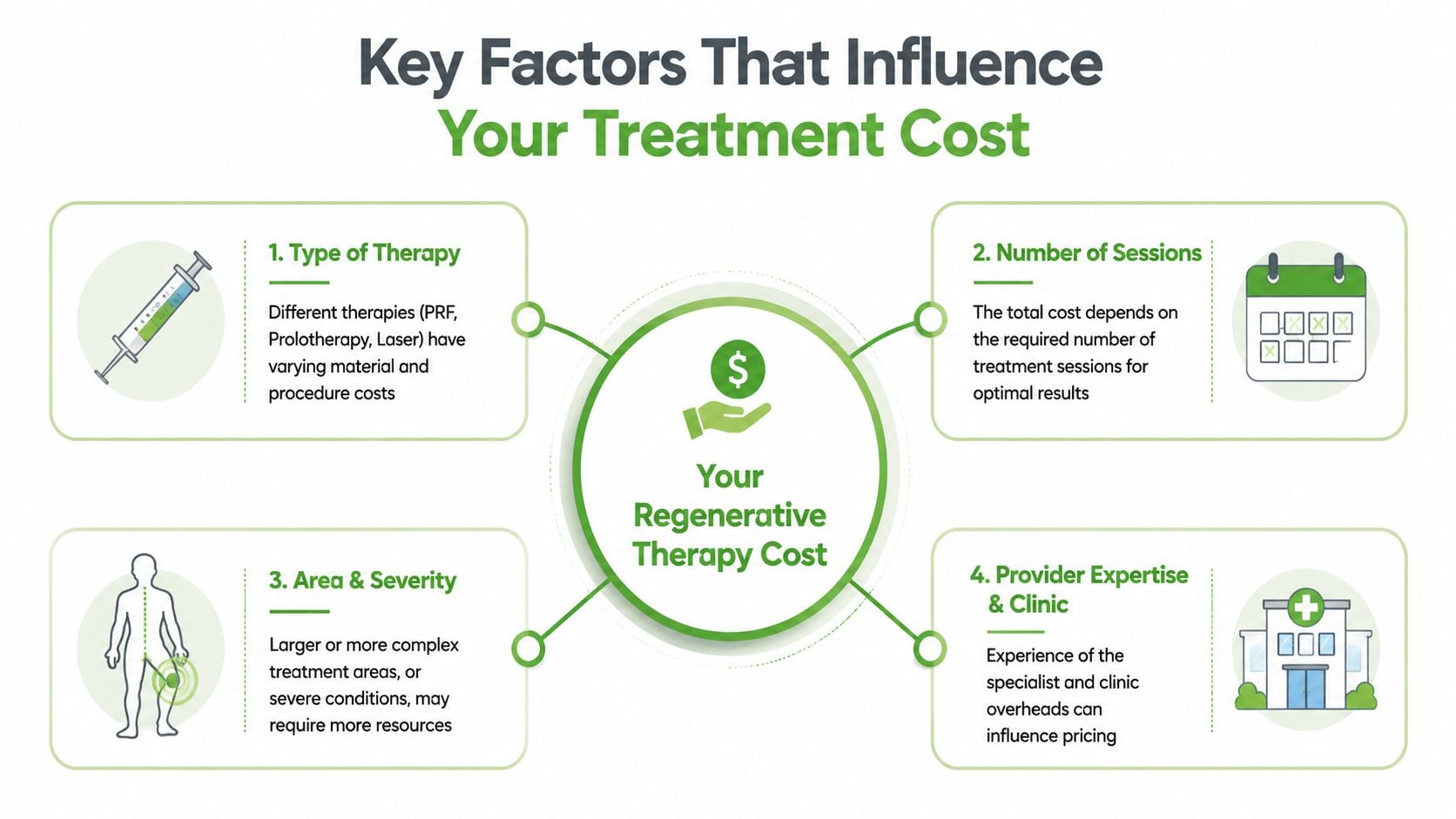
The reason regenerative therapy cost feels hard to pin down is simple. The quoted number often reflects only part of the care. A patient may compare one clinic's price to another and assume they're looking at the same thing when they aren't.
Patient-facing pricing guides note that PRP often falls in a range of about $500 to $2,500 per session, but they also warn that the quote can be misleading if it doesn't define what's included, such as consultation, imaging, package structure, or follow-up care, as outlined in this discussion of insurance and self-pay for regenerative therapies.
Scope matters more than the headline number
One patient may need treatment focused on a single painful region. Another may need care for both TMJs, surrounding muscle overload, and a follow-up plan that tracks response over time. Those are not financially equivalent situations.
When you review an estimate, ask whether it includes:
- Consultation and diagnostic work: not every quote includes the work needed to decide whether regenerative care is appropriate.
- Procedure complexity: some cases are straightforward, others require more planning and precision.
- Follow-up visits: a lower initial fee may exclude the visits that help determine if treatment is working.
- Bundled versus separate services: packages can lower the apparent per-session cost, but only if you understand what's in them.
The main drivers of price
A personalized estimate usually changes based on several variables:
Type of therapy
Prolotherapy, PRF, and cold laser don't carry the same material, preparation, and procedural demands.
Number of areas treated
A single site is different from a plan involving multiple joints or tissues.
Number of sessions needed
Some patients respond with a short series. Others need a staged approach.
Severity and chronicity
Tissue that has been irritated for years often requires a more thoughtful plan than a newer flare-up.
Provider experience
In regenerative medicine, precision matters. The clinician's ability to identify the pain generator and match treatment to the anatomy directly affects value.
What patients should compare
The smartest way to compare clinics isn't “Who has the cheapest injection?” It's “Who has the clearest estimate?”
A low quote without scope can become more expensive than a higher quote that already includes the parts patients actually need.
That's especially true in orofacial cases, where treatment often sits inside a broader diagnostic picture that may involve bite forces, muscular compensation, airway issues, and sleep-related stress on the system.
Typical Regenerative Therapy Cost Ranges
Once the scope is clear, price ranges become easier to interpret. Across patient-facing and industry pricing guides, basic PRP is often estimated at roughly $500 to $2,500 per session, with a single PRP injection commonly cited at $500 to $2,000 and a three-treatment PRP series around $2,000, according to this regenerative injection therapy cost guide.
For more advanced regenerative care in the United States, pricing can rise significantly. That same guide places some stem-cell or cellular orthopedic treatments around $5,000 to $8,000, while expanded mesenchymal protocols may reach $15,000 to $50,000+. A broader market guide also places a single course of regenerative therapy at $5,000 to $30,000, depending on whether treatment is localized or more systemic. Those ranges highlight why the label “regenerative” by itself doesn't tell you much about actual cost.
Regenerative therapy cost at a glance
| Therapy | Typical Cost Per Session | Common Number of Sessions |
|---|---|---|
| PRP | $500 to $2,500 | Often more than one session |
| Single PRP injection | $500 to $2,000 | One treatment may be quoted separately |
| PRP series | About $2,000 | Three-treatment package |
| Stem-cell-based orthopedic care | $5,000 to $8,000 | Varies by case |
| Expanded mesenchymal protocols | $15,000 to $50,000+ | Varies by complexity |
| Broader regenerative therapy course | $5,000 to $30,000 | Depends on localized versus systemic care |
Those numbers are useful for orientation, not for self-diagnosis. In a TMJ, facial pain, or sleep-related case, a clinic should still translate the quote into your actual plan. That means identifying whether the estimate is built around one intervention, a short series, or a broader care pathway.
What this means for Prolotherapy and cold laser planning
Not every therapy has a widely published consumer price range tied to your exact diagnosis. When public data isn't specific, the safest approach is to ask for a written estimate that separates procedure cost from total care cost. That's especially important if the plan involves combining injections with laser support, exercise-based rehabilitation, or follow-up reassessment.
If you're comparing options specifically for injection-based ligament and joint support, this guide on how much Prolotherapy costs can help you frame the questions to ask before committing.
Cost-Effectiveness vs Surgery or Lifelong Medication
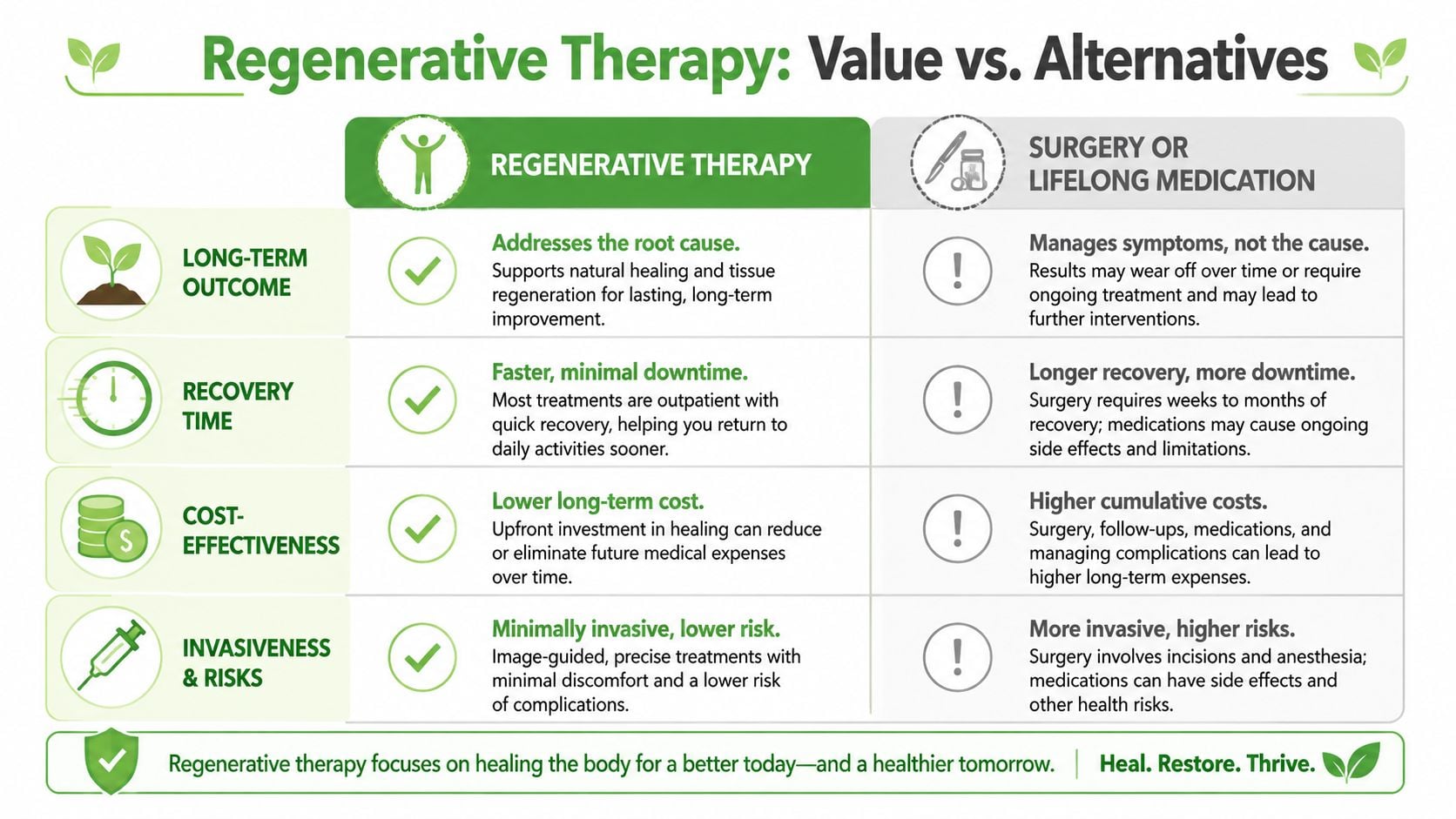
Most patients focus on the fact that regenerative therapy is usually self-pay. That's understandable, but it's only half the financial picture. The more useful question is whether the plan is cost-effective over time.
A neutral review of regenerative medicine points to exactly that issue. The key question isn't just price today, but value over 1 to 3 years, especially when compared with the recurring costs of medications, splints, and repeated physical therapy for chronic pain conditions, as discussed in this review of regenerative medicine and cost-effectiveness.
When surgery is the comparison
In jaw and facial pain care, surgery isn't the right comparison for every patient, but when it is, the trade-off isn't just financial. Surgery carries recovery time, disruption to daily life, and the emotional weight of a more invasive path. Some patients need it. Others are trying to avoid reaching that point if conservative and regenerative options still make sense.
If a patient is already considering a major structural intervention, it helps to understand that decision in context. For some cases, learning about double jaw surgery clarifies just how different the commitment can be compared with a non-surgical plan.
When medication is the comparison
For many chronic pain patients, the alternative isn't surgery. It's ongoing management. That may include medication, splints, repeat therapy visits, lifestyle modifications, and periodic flare-up care. Each item may feel manageable on its own. Over time, though, those costs stack up financially and personally.
What often doesn't work is treating regenerative care as “expensive” while treating years of fragmented symptom management as if it were free. Even when the monthly cost seems smaller, the total burden may be substantial if the underlying tissue problem never improves.
A useful way to think about it is the same way patients evaluate other self-pay health decisions. This guide on is GLP-1 worth the cost shows the broader principle well: upfront expense only makes sense when it's weighed against long-term benefit, adherence, and realistic alternatives.
Short-term affordability and long-term value are not the same thing.
What makes regenerative care worth it
Regenerative treatment tends to be most worth the cost when three things are true:
- The diagnosis is clear: the clinician knows what tissue problem is being targeted.
- The expected benefit is durable enough to matter: not perfect, but meaningful.
- The alternative path is ongoing spending without real progress: repeated symptom control with no change in function.
That doesn't mean regenerative care is always the better financial choice. It means the decision should be based on total burden, not on the invoice from a single day.
Your Personalized Estimate at Pain and Sleep Therapy Center
A meaningful estimate starts with diagnosis, not pricing menus. In a clinic focused on TMJ disorders, facial pain, and sleep-related breathing problems, the same symptom can come from very different sources. Jaw pain may involve joint strain in one patient, muscle overuse in another, and airway-related clenching or sleep disruption in someone else. If the diagnosis changes, the treatment plan changes. Cost should change too.

What a real estimate should include
For an orofacial pain or sleep patient, an estimate should answer practical questions, not just clinical ones. Patients should know what is being treated, why that therapy was chosen, whether the plan is staged, and what follow-up will be necessary to judge response.
A useful personalized estimate usually covers:
- The diagnosis being targeted: not just a symptom label like “jaw pain.”
- The therapy selected: such as Prolotherapy, PRF, cold laser, or a combination.
- Expected sequence of care: whether this is a one-time procedure or a short series.
- What's included in the quoted amount: visits, procedures, and reassessment details.
- What may change the estimate later: for example, if response is partial and the plan needs adjustment.
Why customized pricing is the safer approach
Generic online pricing often fails patients. It may help you understand the broad market, but it won't tell you whether your case is simple, layered, or not a good fit for regenerative care at all. That's one reason a reputable clinic should be willing to slow the process down and define the plan carefully.
For patients exploring options in Charlotte, Pain and Sleep Therapy Center evaluates regenerative care within the broader context of TMJ function, facial pain patterns, and sleep-related contributors rather than treating price as a stand-alone transaction. That distinction matters because a cheaper treatment aimed at the wrong problem isn't cost-effective.
Payment planning matters too
Even when a patient is a good candidate, affordability still matters. Clear financial planning helps people make better decisions and reduces the pressure to rush into care.
Ask whether the office offers:
- Structured payment discussions: so you understand the full commitment before treatment starts
- Third-party financing options: which some practices use for staged care
- In-house payment arrangements: when available
- Written estimates: to reduce surprises later
Good financial communication isn't separate from good clinical care. It's part of it.
Frequently Asked Questions About Therapy Costs
Is regenerative therapy usually covered by insurance
Most of the time, no. Patient-facing pricing guides note that most insurance companies do not cover regenerative medicine procedures like cellular therapies, and a broader market summary says the global regenerative medicine market was worth USD 48.17 billion in 2025 and is projected to reach USD 360.84 billion by 2034, with a 25.56% CAGR, while North America held 43.01% of the market in 2025, according to this overview of how much regenerative medicine costs. In plain terms, demand has grown even though reimbursement remains limited, so many patients still pay out of pocket.
Why do some patients need more sessions than others
Because the diagnosis, tissue quality, chronicity, and treatment goals aren't the same. One patient may need focused support for a localized issue. Another may need a staged plan because the pain has been present longer, involves more than one structure, or sits alongside muscle guarding and dysfunctional movement patterns.
Why can two clinics quote very different prices for “the same” treatment
They may not be quoting the same thing. One fee may cover only the procedure itself. Another may include consultation, planning, repeat visits, or a package structure. That's why patients should ask for the scope in writing before comparing costs.
The safest comparison is not treatment name against treatment name. It's total plan against total plan.
Are lower-cost regenerative clinics always a better deal
Not necessarily. In regenerative medicine, lower cost can reflect lower overhead, but it can also reflect less diagnostic depth, less follow-up, or a more generic treatment model. For complex jaw and facial pain cases, that trade-off matters because precision drives value.
How should I decide whether the cost is worth it
Use a practical filter:
- Look at total care, not one visit
- Compare against the costs you're already carrying
- Ask what success would realistically mean for you
- Make sure the diagnosis is specific before paying for treatment
If the plan is clear, the target is appropriate, and the likely benefit would reduce your long-term burden, the investment may make sense. If the diagnosis is vague and the quote is vague, wait.
If you're weighing treatment options and want a clearer picture of what care would involve, Pain and Sleep Therapy Center offers evaluation for TMJ disorders, facial pain, and sleep-related issues with a focus on individualized diagnosis, transparent planning, and non-surgical options when appropriate.