
You wake up already clenching. By midmorning, your temples feel tight, your jaw tracks unevenly when you chew, and the base of your neck starts to harden into that familiar band of tension. If that sounds like your normal day, you're not dealing with “just stress.” You may be dealing with overloaded muscles and restricted fascia across the jaw, face, tongue, and neck.
Most guides to myofascial release techniques stay broad. They talk about foam rolling the hips or loosening the back. That's useful, but it doesn't help much when the pain sits under your cheekbone, behind your molars, or along the front of your throat. The craniofacial region is different. It's smaller, more sensitive, closely tied to breathing, swallowing, oral posture, and the way the jaw joint moves.
That's why the technique has to change. Pressure that feels fine on a calf or upper back is often too aggressive for the masseter, temporalis, suprahyoid region, or the side of the neck. The goal here isn't to mash tissue. It's to reduce guarding, restore glide, and help your nervous system stop treating these areas like they're under constant threat.
If your symptoms are already affecting chewing, speaking, sleep, or headaches, it also helps to understand what coordinated care can look like. For people exploring comprehensive TMJ care in Katy, it's useful to see how jaw treatment often works best when muscle work, joint care, and habit retraining are addressed together.
Your Guide to Easing Facial and Neck Tension
Jaw and facial pain rarely stay in one spot. A tight masseter can feed temple pain. Neck tension can pull on jaw mechanics. Tongue posture and mouth breathing can keep the whole system overactive. That's why effective myofascial release techniques for this region need to be specific, gentle, and connected to function.
What this work is trying to change
In practice, I think of craniofacial release as a way to improve three things at once:
- Tissue mobility: Restricted layers need to glide better.
- Muscle tone: Overworked muscles need to stop bracing.
- Movement patterning: The jaw, tongue, neck, and rib cage need to work together more efficiently.
When those pieces improve, people often notice simpler daily changes. Their bite feels less guarded. They stop pushing the jaw forward to open. They can turn the head without dragging tension into the side of the face.
Practical rule: In the jaw and neck, less force usually works better than more force.
Why this guide focuses on the face, jaw, and airway
The face and neck aren't just sites of pain. They're part of a pressure system that influences nasal breathing, tongue position, swallowing mechanics, and sleep quality. If the tissues under the jaw stay stiff and the neck stays over-recruited, it becomes harder to maintain relaxed lips, a stable tongue posture, and easy nasal breathing.
That's where many general MFR articles fall short. They explain release as if the whole body responds the same way. It doesn't. The tissues around the jaw and airway ask for more precision and better clinical judgment.
This guide stays focused on what patients usually need most:
- Gentle self-care you can do safely
- Clear reasons behind each movement
- Real trade-offs, including when a technique is too much
- The link between fascial tension and myofunctional habits
If a technique increases clenching, sharp pain, dizziness, or guarding, it isn't the right input for your body that day. Good MFR should make movement feel easier, not more defended.
Understanding Fascia and Its Role in Facial Pain
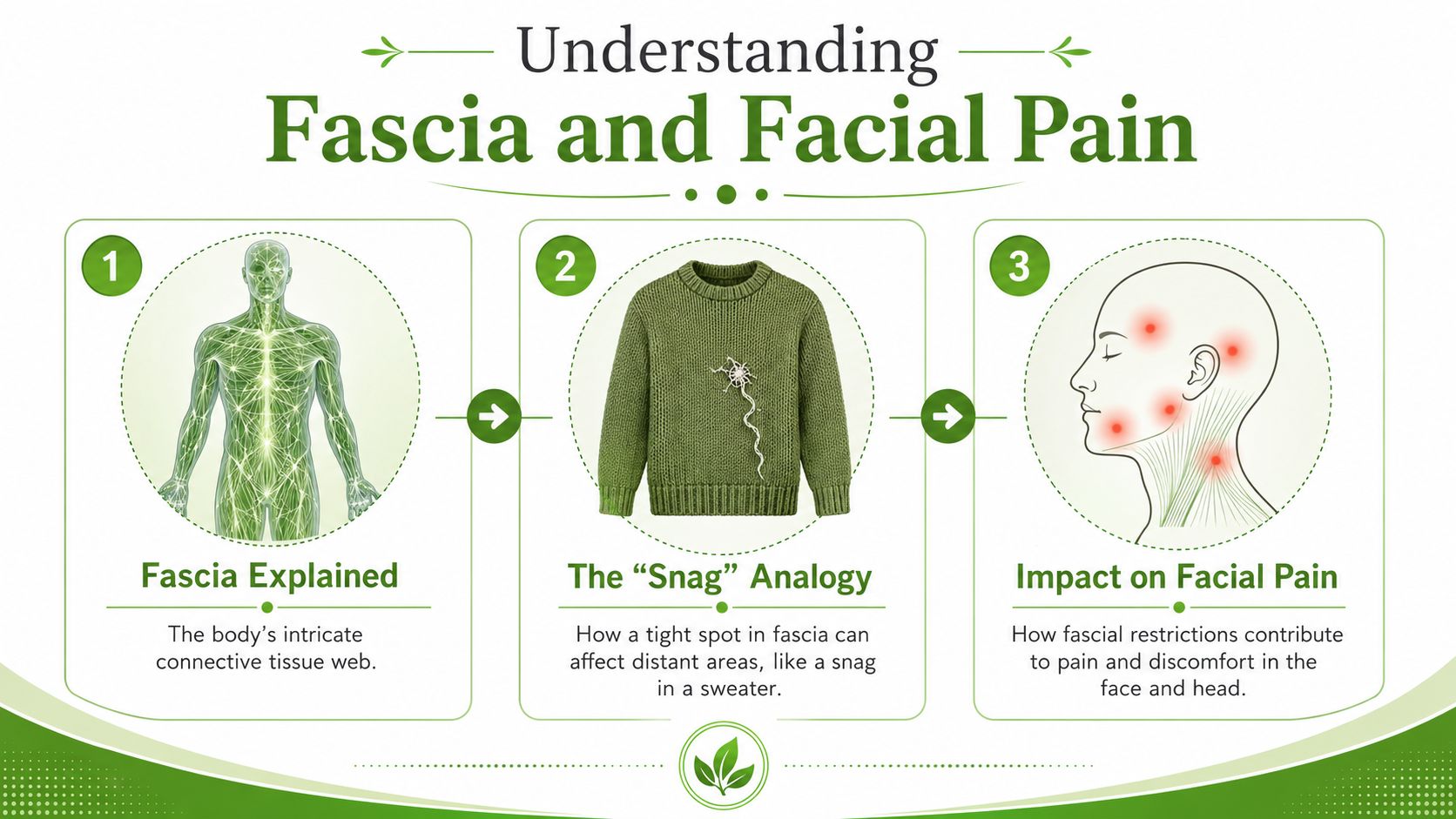
Fascia is the connective tissue web that wraps and links muscles, nerves, and other structures. In the face and neck, that web matters because small restrictions can create symptoms that seem bigger and farther away than the original problem.
The sweater snag model
A simple way to understand fascia is to think about a snag in a sweater. You pull one small thread near the shoulder, and the fabric puckers somewhere else. The problem looks local, but the pull spreads.
That's often how facial pain behaves. A restriction near the jaw can feed temple pressure. Tight tissue under the chin can change how the mouth opens. A guarded neck can make the jaw feel unstable even when the joint itself isn't the only issue.
This is one reason people chase symptoms for so long. They rub the place that hurts, but the larger tension pattern stays unchanged.
Why stress and breathing habits matter
Clenching, forward head posture, mouth breathing, and shallow upper chest breathing all increase load in the craniofacial system. The jaw elevators stay overused. The front of the neck works too hard. The tongue and hyoid region lose some of their relaxed, functional coordination.
For people also dealing with broader pain patterns, these solutions for muscle pain syndromes can help clarify how trigger points and fascial restriction often overlap.
The nervous system piece
Myofascial release isn't only about stretching tissue. The neurophysiological mechanism matters. Research in a review on MFR for chronic low back pain describes how stimulating mechanoreceptors in the skin and fascia can modulate muscle tone through spinal reflex pathways, reduce sympathetic nervous system activity, and enhance parasympathetic regulation, contributing to pain relief and improved function in conditions such as low back pain and TMJ-related problems, as discussed in this Frontiers review on myofascial release.
That matters clinically because many jaw and neck symptoms are driven by guarding. If your nervous system interprets touch as threat, tissue won't let go. If it interprets touch as safe, tone often drops.
The best release often feels like a slow softening, not a dramatic stretch.
How restrictions show up in daily life
Common patterns include:
- Jaw opening that shifts or feels crooked
- Temple headaches after chewing or computer work
- Pain under the cheekbone or at the angle of the jaw
- Neck tightness that returns every evening
- A sense that swallowing, tongue rest posture, or nasal breathing takes effort
These symptoms don't prove a single cause. But they do tell you the face, jaw, tongue, and neck are behaving as a connected system. That's exactly why craniofacial MFR needs to be integrated with the way you breathe and use your mouth, not performed like a random massage routine.
Gentle Self-Care Myofascial Release Techniques
The safest home program is simple. Use your fingers or a soft massage ball. Work slowly. Stay under your pain threshold. Keep the jaw unclenched and the tongue resting lightly on the roof of the mouth if that feels comfortable. If that tongue position increases tension, let the tongue relax instead.

A key technical point for self-treatment comes from expert methodology on MFR. For self-application, hold steady pressure on tender points for 30 to 90 seconds while using deep abdominal-thoracic breathing, as described in this PubMed review of myofascial interventions. The goal is not to grind. The goal is to wait for the tissue to stop resisting.
Masseter release for jaw clenching
The masseter is the thick chewing muscle on the side of the jaw. It often feels dense or ropey in people who clench at night or brace during stress.
To find it, place your fingers on the side of your face between the cheekbone and jaw angle. Gently bite down, then relax. You'll feel the muscle contract and soften.
Now use two or three fingertips and sink in lightly. Stay on one tender point. Let your shoulders drop. Breathe in through the nose if possible, and exhale without forcing the jaw open. Hold until the spot softens, your pain eases slightly, or the tissue feels less guarded.
What you should feel is pressure with gradual softening. What you should not feel is sharp, electric, or tooth-like pain.
Temporalis release for temple pressure
The temporalis fans across the side of the skull above the ear. It commonly contributes to tension headaches and jaw fatigue.
Use the pads of your fingers, not your nails. Start near the temple and make tiny sustained contacts rather than rubbing aggressively. If you find a spot that feels familiar, stay there and breathe. Then move a little higher and slightly backward.
This area responds best to patience. Fast circles often irritate it. Slow, sustained holds usually calm it down.
Clinical cue: If your eyebrows lift, teeth press together, or shoulders hike up, you're using too much effort.
Under-jaw release for floor-of-mouth and suprahyoid tension
This region deserves extra caution. The tissue under the jaw influences swallowing, tongue movement, and airway comfort, but it's also sensitive.
Use the flat pads of your fingers under the jawline, not deep poking. Angle slightly upward into the soft tissue just behind the chin or farther back toward the jaw corners. The pressure should be mild. Think “melt in,” not “dig in.”
If you feel the urge to swallow repeatedly, back off. If you notice easier nasal breathing or less neck effort afterward, that's a good sign the input was appropriate.
Side-of-neck release for overworked stabilizers
Many people with TMJ pain overuse the side of the neck when opening the mouth, chewing, or holding posture at a screen. Work this area gently.
Turn your head slightly away from the side you're treating. Use your opposite hand to contact the side of the neck with broad fingers. Avoid pressing on the front of the throat. Stay on muscular tissue only.
Hold one point, breathe low into the ribs, and let the neck soften around your fingers. Then shift slightly up or down. The release often feels subtler here than it does in the jaw.
If you need more guided movement after this, these jaw and neck exercises pair well with gentle release work.
Upper shoulder release for neck-driven jaw tension
The upper trapezius and nearby tissues often keep feeding craniofacial pain. If the shoulders stay raised, the neck and jaw rarely relax for long.
You can use your opposite hand to squeeze the muscle gently near the top of the shoulder, or place a tennis ball between your upper back and a wall. Lean in only enough to feel contact. Don't pin yourself into the wall.
Stay still on one dense spot and breathe. A small head nod or slow exhale can help the tissue let go. This isn't a rolling exercise. It's a sustained release.
Adding breath and oral posture
MFR works better when you stop feeding the pattern you're trying to reduce. During these holds:
- Keep the lips softly together if that feels easy
- Breathe through the nose when possible, without straining
- Let the teeth stay apart
- Drop the shoulders and widen the rib cage
- Avoid jutting the chin forward
These cues come directly from myofunctional principles. They reduce the background tension that keeps the jaw and neck on alert.
A short visual demo can help if you're learning by watching movement and hand placement.
What a good response looks like
You don't need a dramatic release for the technique to be useful. Positive signs include:
- The jaw opens with less effort
- Your bite feels less guarded
- Temple pressure eases
- The tongue rests more comfortably
- Neck rotation feels freer
A bad response looks different. More clenching, lingering soreness, sharp pain, dizziness, or a headache spike means the treatment was too aggressive, too long, or done in the wrong place.
Essential Guidelines for Safe and Effective MFR
Good self-care isn't about bravery. It's about choosing the right dose. The face and neck will usually tell you quickly when you've crossed the line from therapeutic pressure into irritation.
When not to work on an area
Avoid self-release over tissue that is clearly irritated or medically unsafe to treat. That includes:
- Open skin or infection: Wait until the area has healed.
- Acute injury: Fresh strains, recent trauma, or sudden swelling need proper assessment first.
- Severe unexplained pain: If pain is new, intense, or accompanied by numbness or other unusual symptoms, get evaluated.
- Front-of-throat pressure: Don't compress the airway or major sensitive structures in the anterior neck.
If you're unsure whether a spot is muscle, glandular tissue, or something else, don't guess.
The hold-time debate matters
There's a popular belief that longer sustained pressure is always better. That isn't supported cleanly by the evidence. A clinical review notes that MFR often produces short-term improvements, but the evidence base is weak and doesn't definitively support any specific hold duration or pressure intensity. It also challenges the idea that 90+ seconds is universally required and suggests patient-specific factors are key, as discussed in this review on myofascial release duration and technique claims.
That's important in craniofacial care. Some people respond well to a longer quiet hold. Others flare if they stay too long on one point. The right dose is the one that decreases guarding without provoking more of it.
If a point feels more irritated with each breath, don't stay there just because a rule says you should.
Useful tools and how to use them
You don't need a drawer full of gadgets. A few simple tools are enough.
| Tool | Best use | Caution |
|---|---|---|
| Fingertips | Jaw, temples, under-jaw region | Best for delicate areas |
| Tennis ball | Upper shoulder, upper back near wall | Use low pressure |
| Lacrosse ball | Dense shoulder tissue in experienced users | Usually too intense for face and neck |
| Mirror | Monitoring jaw and head position | Helps prevent chin jutting |
For denser points that feel more like trigger point irritation than broad fascial drag, some people also benefit from a more focused approach like trigger point therapy. The two methods overlap, but they aren't identical. Fascial release usually asks for broader contact and softer waiting.
How to know you're doing enough
Use these decision rules:
- Better during or after: Continue.
- Brief tenderness, then easier movement: Usually acceptable.
- Sharp pain, guarding, nausea, dizziness, or headache increase: Stop.
- Next-day soreness that feels bruised or inflamed: Reduce pressure next time.
The body doesn't hand out prizes for aggressive self-treatment. In the jaw and airway region, precision beats force almost every time.
Clinician-Delivered MFR Versus At-Home Care
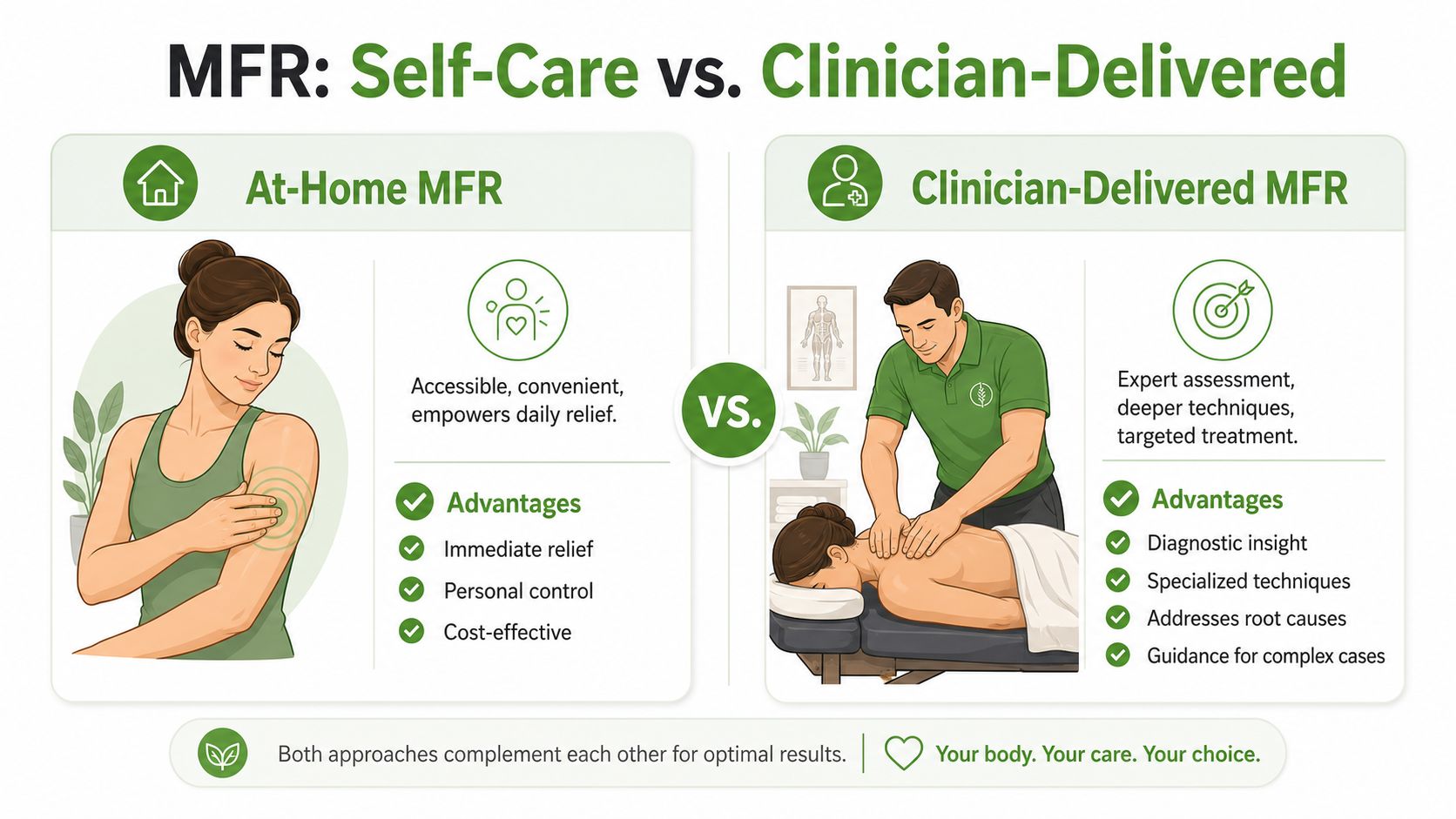
Home care is valuable because you can do it consistently. Clinical care is valuable because someone trained can assess what you feel, what structures are involved, and what should not be touched.
That difference matters more in the craniofacial region than people expect. Jaw pain may involve the masseter, temporalis, suprahyoids, cervical fascia, oral posture, breathing mechanics, joint loading, or a mix of them. Self-care can calm a pattern. A clinician can sort out the pattern.
Where self-care shines
At-home work has clear strengths:
- Frequency: You can treat early tension before it builds.
- Body awareness: You learn what your clenching and posture patterns feel like.
- Maintenance: It helps keep gains from therapy from fading between visits.
For many people, daily low-intensity work is more useful than occasional aggressive sessions.
Where professional care does more
A clinician can do things that self-treatment can't do well:
- Differentiate tissues: Muscle, fascia, joint irritation, and referred pain can feel similar to a patient.
- Reach complex regions safely: Some areas are hard to access or too sensitive to guess on.
- Integrate care: MFR can be paired with movement retraining, breathing work, oral posture changes, and joint-specific treatment.
If you're trying to understand which type of provider may fit your case, this overview from the LifeWorks Integrative Health clinic can help frame the broader comparison.
What the evidence supports
Professional myofascial work is not magic, but it isn't just comfort care either. A meta-analysis of randomized controlled trials found that myofascial release had a statistically significant, moderate effect on improving joint range of motion in athletes, with a pooled effect size of 0.53, indicating a meaningful clinical difference compared with control groups, according to this ROM meta-analysis on myofascial release.
That doesn't prove every jaw patient will get the same result. It does support the idea that targeted MFR can change function, not just sensation.
Side-by-side comparison
| Feature | At-home MFR | Clinician-delivered MFR |
|---|---|---|
| Access | Immediate and convenient | Requires scheduling |
| Precision | Limited by your anatomy knowledge | Guided by trained assessment |
| Pressure control | Easy to overdo or underdo | More refined and adaptable |
| Best use | Daily maintenance, early symptom control | Persistent, complex, or unclear cases |
| Integration | Usually isolated | Can be combined with broader treatment planning |
Home care is a tool. It isn't a full diagnostic process.
The strongest approach is often both. Patients do gentle, regular self-release and habit correction at home. Clinicians handle the deeper assessment, finer adjustments, and the harder problems that don't resolve with simple care.
When to Consult the Pain and Sleep Therapy Center
Self-treatment makes sense when symptoms are mild, familiar, and responsive. It's time to get help when the pattern becomes persistent, confusing, or tied to sleep and airway concerns.
Signs you shouldn't keep troubleshooting alone
Seek professional evaluation if you notice:
- Jaw locking, catching, or significant clicking
- Pain that keeps returning despite careful home care
- Headaches, ear symptoms, or facial pain that seem linked to jaw use
- Clenching so strong that your muscles never fully settle
- Snoring, mouth breathing, waking unrefreshed, or suspected sleep-disordered breathing
- Trouble coordinating tongue posture, swallowing, or nasal breathing
These are the cases where MFR may still help, but it usually works best as one part of a bigger plan.
Why an airway lens matters
Jaw pain and airway dysfunction often overlap. People who struggle to maintain nasal breathing or a balanced tongue posture may recruit the neck and jaw in ways that keep tissue irritated. In those cases, fascial release without functional retraining only goes part of the way.
That's why evaluation from an orofacial pain specialist can be so useful. The right clinician can determine whether the main driver is muscular overload, joint strain, oral posture, breathing pattern, sleep-related collapse, or a combination.
What comprehensive care often includes
For more complex cases, treatment may combine:
- Targeted manual therapy
- Orofacial myofunctional therapy
- Breathing retraining
- Jaw movement retraining
- Oral appliance evaluation when indicated
- Other regenerative or conservative options based on the case
That integrated model matters because the jaw doesn't function in isolation. It lives in a system that includes the tongue, neck, rib cage, and airway.
If jaw, face, neck, or sleep-related symptoms keep interfering with your day, Pain and Sleep Therapy Center offers specialized evaluation for TMJ disorders, facial pain, airway issues, and functional breathing concerns. Their team focuses on root-cause care, combining precise diagnosis with treatments that may include myofascial release, orofacial myofunctional therapy, breathing retraining, and other non-surgical options suited to the way your body is functioning.