
Prolotherapy usually costs $150 to $600 per session, and a full treatment course often lands around $600 to $3,600. Those numbers are real-world starting points, but your actual cost depends on how many sessions you need, what the quote includes, and whether the clinic bundles or itemizes parts of care.
If you're reading this, there's a good chance you're already doing the math in your head. You may be dealing with jaw pain, joint instability, headaches, tendon pain, or a nagging problem that hasn't improved enough with rest, medication, or standard therapy. The hard part isn't just asking, How much does prolotherapy cost? It's figuring out what you'll really spend from start to finish, and whether two quotes that sound similar are comparable.
Most patients get tripped up by the same issue. They see a single session price online, assume that's the whole expense, and then discover later that prolotherapy is usually delivered as a treatment series. That doesn't make the treatment overpriced. It means the financial decision should be based on the episode of care, not the first syringe.
Understanding the Real Cost of Prolotherapy
When patients ask about cost, they usually want one clean number. Prolotherapy doesn't work that way in real practice.
In major U.S. patient-facing references, prolotherapy commonly falls around $150 to $600 per session, and because 4 to 6 treatments spaced 4 to 6 weeks apart are often recommended, a full course can run about $600 to $3,600 before extra services are added, according to WebMD's prolotherapy overview.
The first quote is rarely the full answer
A per-session price is only one piece of the decision. If a clinic advertises a lower number, that may reflect a simpler injection visit, a smaller treatment area, or a quote that doesn't include the full process around the procedure.
Patients often compare prolotherapy the way they compare a haircut or a dental cleaning. That's understandable, but it's the wrong frame. A better comparison is a rehabilitation plan. One visit matters less than the complete course required to give the tissue a chance to respond.
Practical rule: Ask for the cost of the likely treatment plan, not just the cost of today's appointment.
What patients should focus on instead
The useful question isn't only, "What's the session fee?" It's this:
- How many treatments are commonly recommended for my condition
- How far apart those visits are likely to be
- What is included in the quoted price
- What may be billed separately
- What happens if I improve sooner, or need more support than expected
That last point matters. Some people need a straightforward series. Others need a more individualized plan based on symptom pattern, tissue quality, pain source, and response after the first few visits.
The goal is cost clarity, not sticker shock. A transparent practice should be able to help you understand the likely total commitment before you begin.
Prolotherapy Price Ranges A Detailed Breakdown
A single prolotherapy session is the headline number. The treatment plan is the number that affects your budget.
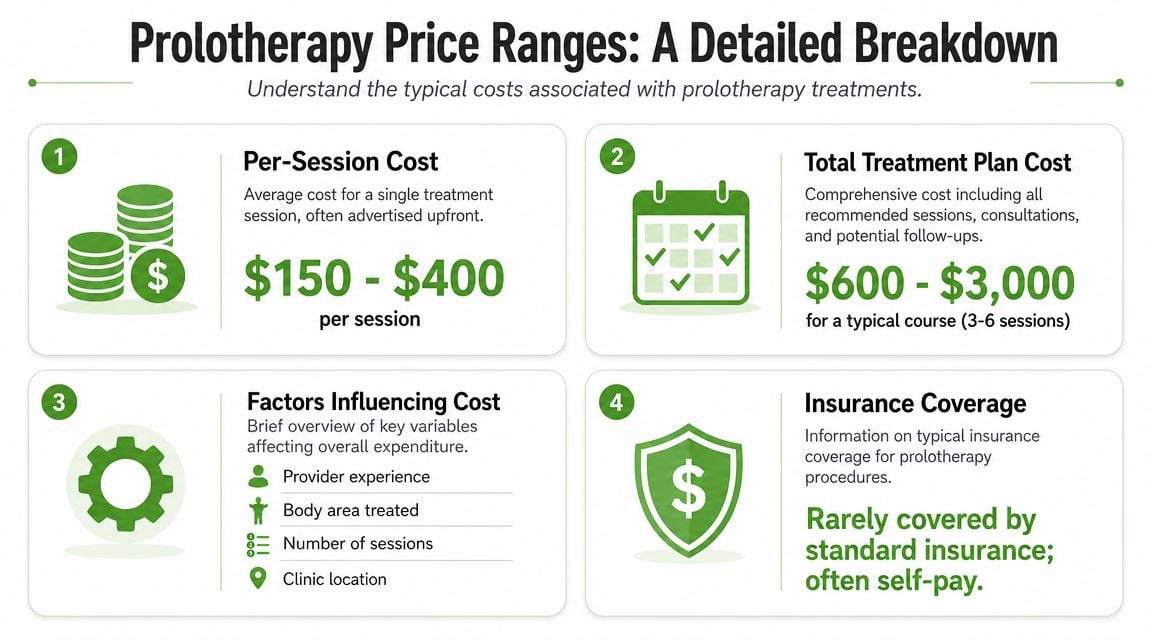
Many patients make the same budgeting mistake. They look at one quoted visit the way someone might price a single physical therapy appointment, when what they really need to evaluate is the full rehab plan. Prolotherapy is similar. The biology unfolds over time, so most chronic pain cases aren't approached as one injection and done.
The Arthritis Foundation notes that the final cost is driven by the complete treatment protocol, not just a single injection, and that most clinics recommend a series of 4 to 6 treatments spaced 4 to 6 weeks apart for chronic conditions in order to pursue optimal, lasting results, as described in the Arthritis Foundation's prolotherapy guidance.
Why the per-session number can mislead
A lower session fee can still lead to a higher real-world spend if the treatment plan is longer or if common add-ons appear later. That's why the "cheapest" quote isn't automatically the least expensive option.
Think about these two examples:
- Clinic A gives a modest-looking session price, but the evaluation, imaging guidance, and follow-ups are separate.
- Clinic B gives a higher session quote, but it may include more of the surrounding care.
Those quotes may not represent the same service.
The smartest comparison is not price per injection. It's price for a comparable plan of care.
A short visual overview can help clarify the difference between sticker price and treatment cost:
How to think about the treatment course
Patients usually do better when they budget for prolotherapy the way they'd budget for a process, not a procedure.
Start with the likely series
Ask what number of visits is commonly recommended for your diagnosis.Clarify the time frame
Spacing matters because treatment often unfolds over months, not days.Separate medical need from marketing language
A low advertised price may describe only one narrow part of care.Calculate the all-in commitment
Include evaluation, procedure visits, any imaging guidance, and follow-up.
If you approach prolotherapy this way, pricing becomes much easier to compare, and the decision becomes less emotional.
What Factors Determine Your Final Prolotherapy Cost
Two patients can both be told they need prolotherapy and still receive very different quotes. That doesn't always mean one clinic is overpriced. Often, it means the scope of care is different.
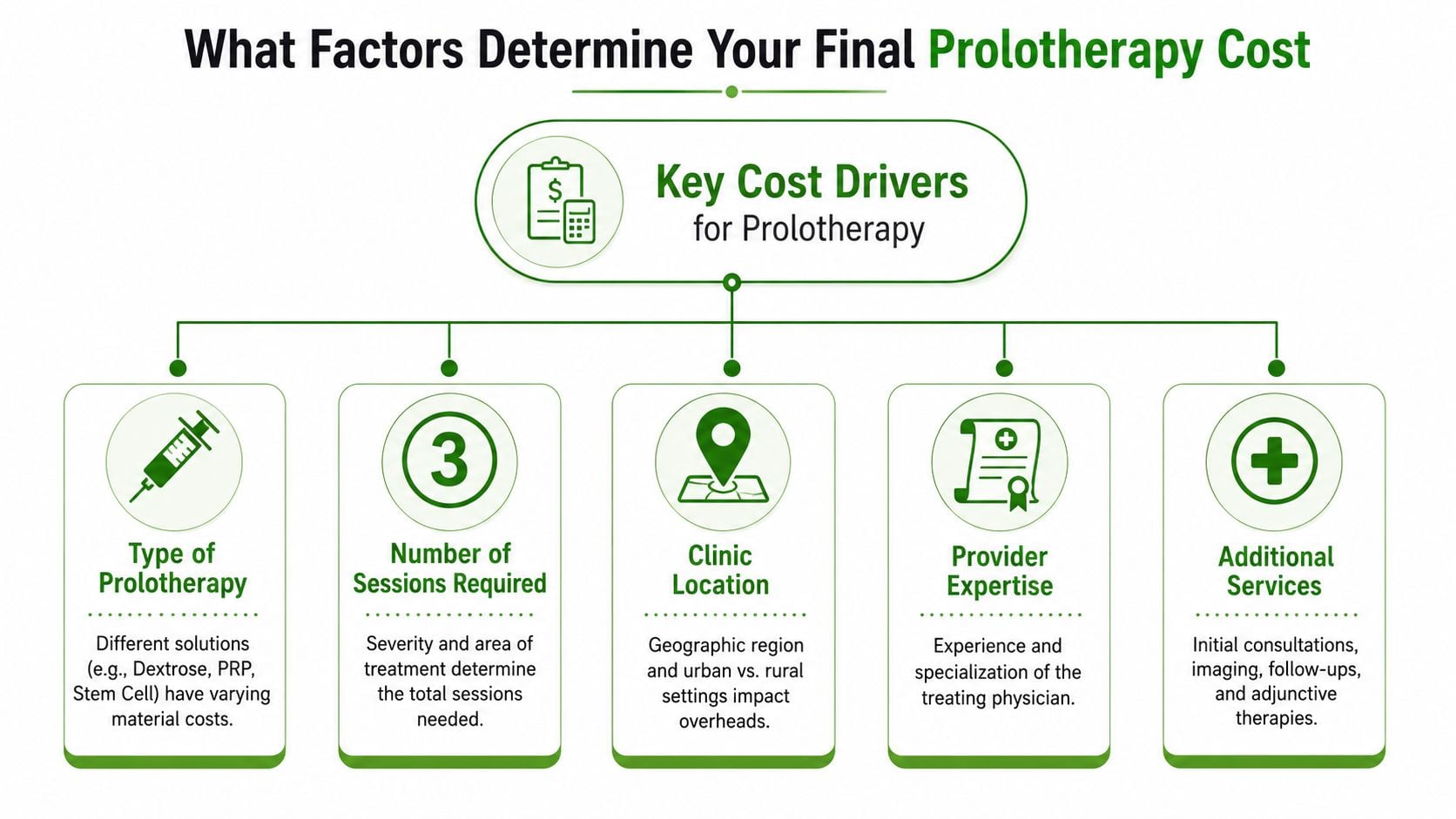
One of the most useful pricing insights from the patient side is this: the true total cost often includes more than the injection itself. The initial evaluation, ultrasound guidance, and follow-up visits may be bundled or separately billed, which is why this prolotherapy FAQ from the Fascia Institute emphasizes comparing what is included in a quote, not just the headline price.
The treatment area changes the quote
A small, straightforward treatment zone is different from a more complex pattern of pain. In practice, final pricing often changes based on how many structures need attention and how technically demanding the injection plan is.
For example, a localized problem can be simpler than pain that involves multiple connected areas. Patients exploring options for broader musculoskeletal issues often benefit from reading about related regenerative medicine for back pain because it shows how treatment planning can expand when pain doesn't come from a single isolated structure.
Bundled versus itemized pricing
Many patients often get confused.
A bundled quote may include:
- Evaluation and planning
- Procedure visit
- Imaging guidance
- Routine follow-up
An itemized quote may break those into separate charges.
Neither approach is automatically wrong. The problem starts when patients compare a bundled quote from one office with an injection-only quote from another office and assume they are equal.
What to ask: “What exactly is included in this price, and what might I receive a separate bill for?”
Provider approach and technical decisions
Some cost differences come from how a clinician practices, not from unnecessary markup.
A quote may vary based on:
- Precision tools used during the procedure such as ultrasound guidance
- Complexity of the exam and diagnostic workup
- The clinician's training and procedural focus
- Whether treatment is integrated with other supportive care
These differences matter because prolotherapy is technique-sensitive. If the problem is poorly localized or the treatment target isn't clear, a cheaper injection can become a more expensive disappointment.
Questions that protect you from surprise bills
Bring these questions to any consultation:
| Question | Why it matters |
|---|---|
| What is included in this quote? | It tells you whether you're comparing apples to apples. |
| Is imaging guidance included? | Some clinics bundle it, others bill it separately. |
| Is this price for one area or multiple areas? | Scope changes cost. |
| Are follow-up visits included? | They may or may not be part of the package. |
| If I need a series, what is the likely total range? | This is the number most patients really need. |
The best quotes are clear, specific, and easy to explain. If the pricing feels vague at the consultation stage, it usually won't feel clearer later.
Will Insurance Cover Prolotherapy Treatment
In most cases, no. Patients should generally expect prolotherapy to be a self-pay treatment.
Cleveland Clinic's patient guidance states that most payers do not cover prolotherapy and describes the typical cost as $150 to $500 per session, which you can review in Cleveland Clinic's prolotherapy treatment page. That coverage reality is one reason patients often focus so heavily on price before they schedule.
Why insurance usually doesn't help much
From a patient budgeting standpoint, the key issue is simple. If a treatment isn't routinely covered, the financial decision shifts from "What is my copay?" to "What am I prepared to pay out of pocket for a full care plan?"
That doesn't mean you have no options. It means you need to think more like a healthcare consumer and less like someone relying on standard benefit design.
Practical ways patients pay for prolotherapy
Many patients ask about using tax-advantaged funds. Whether a particular expense qualifies can depend on plan rules and documentation, so it's smart to verify details directly with your benefits administrator before treatment.
Patients also often look for broader context on how insurers handle therapy-related services. If you're trying to understand the language insurers use when they approve, deny, or limit care, this guide to therapy insurance coverage gives a helpful overview.
Other common strategies include:
- Using HSA or FSA funds if permitted by your plan
- Requesting an itemized receipt for reimbursement review
- Asking whether the clinic offers payment plans
- Spacing treatment thoughtfully based on the clinician's protocol and your budget
Coverage is one question. Affordability is another. Patients do best when they plan for both.
A good office should be able to tell you plainly whether they expect insurance to help and what self-pay options are available. If the answer is vague, keep asking.
Comparing Prolotherapy Costs to Other Pain Treatments
Cost only means something in context. A lower price isn't always the better value, and a higher price isn't always better care. The right comparison looks at what the treatment is trying to accomplish, how the course unfolds, and whether you are paying cash.
One useful benchmark comes from a clinical review in PMC, which notes that an orthopedic source listed prolotherapy at around $300 per treatment while PRP started at around $2,500 per treatment, placing prolotherapy as a much lower-cost regenerative option upfront in that comparison, as summarized in this PMC review on dextrose prolotherapy.
A side-by-side view
| Treatment | Typical Total Cost | Treatment Goal | Insurance Coverage |
|---|---|---|---|
| Prolotherapy | Often depends on a series of self-pay visits rather than one appointment | Support a healing response in painful or unstable soft tissue and joint-related structures | Usually not covered |
| PRP | Higher upfront cash price than prolotherapy based on the comparison above | Regenerative injection approach using platelet-rich plasma | Often not covered |
| Steroid injections | Varies by plan, setting, and diagnosis | Reduce inflammation and calm symptoms | More likely to receive some insurance support than regenerative injections |
| Physical therapy | Varies by number of visits and insurance status | Improve mechanics, strength, mobility, and pain patterns over time | Often partly covered, depending on plan |
| Watchful waiting and home care | Lower immediate cost but may not address persistent limitation | Symptom monitoring and self-management | Not usually a formal coverage issue |
The most honest takeaway is that prolotherapy sits in a middle ground. It's usually far less expensive upfront than some other regenerative procedures, but it still requires a real out-of-pocket commitment.
Where physical therapy fits into the decision
For many musculoskeletal problems, physical therapy remains part of the discussion whether you choose prolotherapy or not. If you're trying to compare self-pay options, it helps to see what standard rehab can cost over time. This breakdown of PT session costs without insurance is useful when you're building a realistic budget.
Some patients also look at prolotherapy as one component of a broader plan for persistent pain. If your symptoms involve joint irritation, instability, or recurring overload patterns, reading about regenerative medicine for joint pain can help you understand how clinicians think about these choices in the bigger picture.
The value question patients should ask
A better question than "Is prolotherapy cheap?" is "Does this make sense compared with my alternatives?"
Consider:
- What is the treatment trying to change
- How long is the plan likely to last
- Will I still need other care alongside it
- How comfortable am I paying cash for a treatment with variable response
That's the financial conversation. Cost matters, but value depends on fit.
Your Prolotherapy Journey at Pain and Sleep Therapy Center
At a specialty clinic focused on TMJ disorders, facial pain, and related functional problems, prolotherapy isn't treated like a menu add-on. It starts with a careful diagnostic process.

A patient may arrive thinking the issue is "just jaw pain," but the visit often reveals a more layered picture. Bite strain, muscle overload, joint instability, airway-related tension, clenching patterns, sleep disruption, and referred pain can all shape the treatment plan. That matters financially because the best care plan starts with the right diagnosis, not with the fastest injection.
What the first visit is really for
The consultation is where the clinician determines whether prolotherapy fits the problem.
That may include:
- A detailed symptom history
- Examination of jaw function and pain patterns
- Assessment of related muscle and joint loading
- Review of prior therapies and what did or didn't help
- Discussion of whether regenerative treatment should stand alone or be paired with other care
This is also when pricing should become concrete. A clear practice explains the likely course, what is included, and whether supportive therapies may be recommended alongside the injections.
What treatment and follow-up may look like
When prolotherapy is appropriate, patients generally do better when they understand that the procedure is only one part of the plan. The surrounding care matters.
That may involve:
- Scheduled injection visits over time
- Follow-up checks to assess response
- Activity guidance
- Exercises or myofunctional therapy when indicated
- Adjustment of the plan based on symptom change
Good regenerative care is rarely just "get the shot and hope." It works best when diagnosis, procedure, and follow-through match the pain source.
Financial clarity matters here too
One of the most practical things a patient can do is ask for the roadmap in writing. If financing flexibility is important, it also helps to review available payment plan options before committing.
That doesn't remove every uncertainty. It does remove avoidable confusion.
In a specialty setting, the goal shouldn't be to sell an injection. It should be to decide whether prolotherapy fits your diagnosis, what success would realistically look like, and what financial commitment makes sense before you begin.
Frequently Asked Questions About Prolotherapy
Is more expensive prolotherapy always better
No. A higher quote may reflect a more complete package, greater procedural complexity, or more detailed diagnostic work. It can also reflect a different pricing model.
The right question is whether the quote is transparent. If one office bundles the evaluation, imaging guidance, and follow-up while another office lists only the injection itself, the higher quote may be easier to trust.
How do I know if I'm a good candidate
The best candidates are usually people with a clearly defined musculoskeletal pain source that matches what prolotherapy is intended to treat. A careful exam matters more than enthusiasm for regenerative medicine.
A poor candidate isn't someone with a low pain tolerance or a busy schedule. A poor candidate is someone whose diagnosis is still unclear, whose pain may come from a different mechanism, or whose expectations don't match the likely treatment course.
Is prolotherapy considered cost-effective
That depends on your diagnosis, your alternatives, and how you define value.
Some patients see prolotherapy as attractive because the upfront price is lower than other regenerative injections. Others decide the cost isn't worthwhile if the expected benefit is uncertain for their specific condition. That's a reasonable concern. The financially smart decision is not always the least expensive one at the first visit.
What happens if it doesn't work
A responsible clinician should discuss this before you start. If prolotherapy doesn't produce meaningful improvement, the next step may be to revisit the diagnosis, consider a different conservative strategy, evaluate whether another injection approach makes more sense, or decide that regenerative treatment isn't the best fit.
If a clinic talks only about ideal outcomes and never about next steps when improvement is limited, that's a warning sign.
Can I compare clinics by advertised price alone
You really can't. Advertised prices are often incomplete.
Ask these questions instead:
- Is the quote for one session or a likely series
- Does it include evaluation and follow-up
- Is imaging guidance included
- Is the price for one treatment area or several
- Will any part of the visit be billed separately
Is a lower-cost option automatically better value
Not if it leads to poor targeting, weak planning, or repeated spending without clear progress. Cheap care becomes expensive when it doesn't address the actual pain generator.
The best value usually comes from a thoughtful diagnosis, a transparent plan, and a quote you can understand.
If you're dealing with TMJ pain, facial tension, headaches, or related dysfunction and want a clear, compassionate evaluation of whether prolotherapy makes sense, Pain and Sleep Therapy Center can help. The team focuses on root-cause diagnosis, practical treatment planning, and transparent next steps so you can make a decision with confidence, not confusion.