

A typical U.S. laser frenectomy cost runs $500 to $800 for a tongue-tie release. That number is a starting point, though, not the whole bill, because the total cost of care can change with consultation fees, anesthesia, setting, follow-up visits, and whether the case is treated as dental or medical care.
If your child has been referred for a tongue-tie release, or you're an adult trying to understand why your quote looks higher than expected, you're probably staring at one line item and wondering what's included. The honest answer is that laser frenectomy cost is rarely just the laser procedure itself. A better estimate starts with the full care pathway, not the sticker price.
How Much Should a Laser Frenectomy Really Cost?
A parent often hears the recommendation at the end of a long feeding visit, then gets a quote that feels oddly incomplete. An adult may hear the same recommendation after years of discomfort, only to find the price varies widely from one office to another. In both cases, the number on the estimate is usually only part of the story.
For a straightforward office-based procedure, laser frenectomy cost commonly falls in the $500 to $800 range for a tongue-tie release, while a broader in-office frenectomy is often reported at $250 to $800. If the case moves into a hospital setting under general anesthesia, the total can rise to $1,500 to $8,000 (U.S. frenectomy cost guide). Those numbers are useful, but they don't tell you what's bundled into the quote, or what gets added later.
Think in terms of the full care pathway
The most misleading quote is the one that sounds simple. A low procedure fee can still lead to a higher total if it excludes the consultation, diagnostic work, anesthesia, follow-up, or a second treated site. That's why it helps to ask what the estimate covers before you compare practices.
Practical rule: if the office can't explain exactly what's included, assume the quote is incomplete.
When you're comparing options, it helps to read advice on strategies to lower medical bills before you sign anything. The right question isn't just “What does it cost?” It's “What does this cost once the entire treatment plan is counted?”
U.S. Pricing Bands for Laser Frenectomy
U.S. pricing usually falls into a few recognizable bands. A laser tongue-tie release is commonly reported at $500 to $800, while a broader in-office frenectomy often lands at $250 to $800. If the procedure moves to a hospital with general anesthesia, the total can reach $1,500 to $8,000 (U.S. frenectomy cost guide).
Why the same procedure can have very different bills
Setting changes the bill more than many patients expect. An office procedure is usually priced differently from a hospital case because the hospital total includes facility and anesthesia-related costs, not just the release itself. A child who needs deeper sedation can therefore have a much larger total than an adult who completes the release in a dental chair.
The most useful way to read a quote is to separate the procedure fee from everything around it. If one office estimate looks much lower, check whether it excludes imaging, post-op care, or anesthesia. If another estimate looks high, ask whether it includes multiple visits or a more complex setting.
For a broader look at how related regenerative care is priced, the regenerative therapy cost overview shows how practice setting and treatment planning can shift the final number. The same logic applies here, because the site of care often changes the bill as much as the procedure itself.
Families comparing feeding support may also want to review understanding tongue tie lactation costs when lactation consultation is part of the care plan.
U.S. cost reality in one sentence
The range is real, but the reason for the range is usually care setting and complexity, not a mysterious difference in the laser device alone.
Key Cost Factors Explained
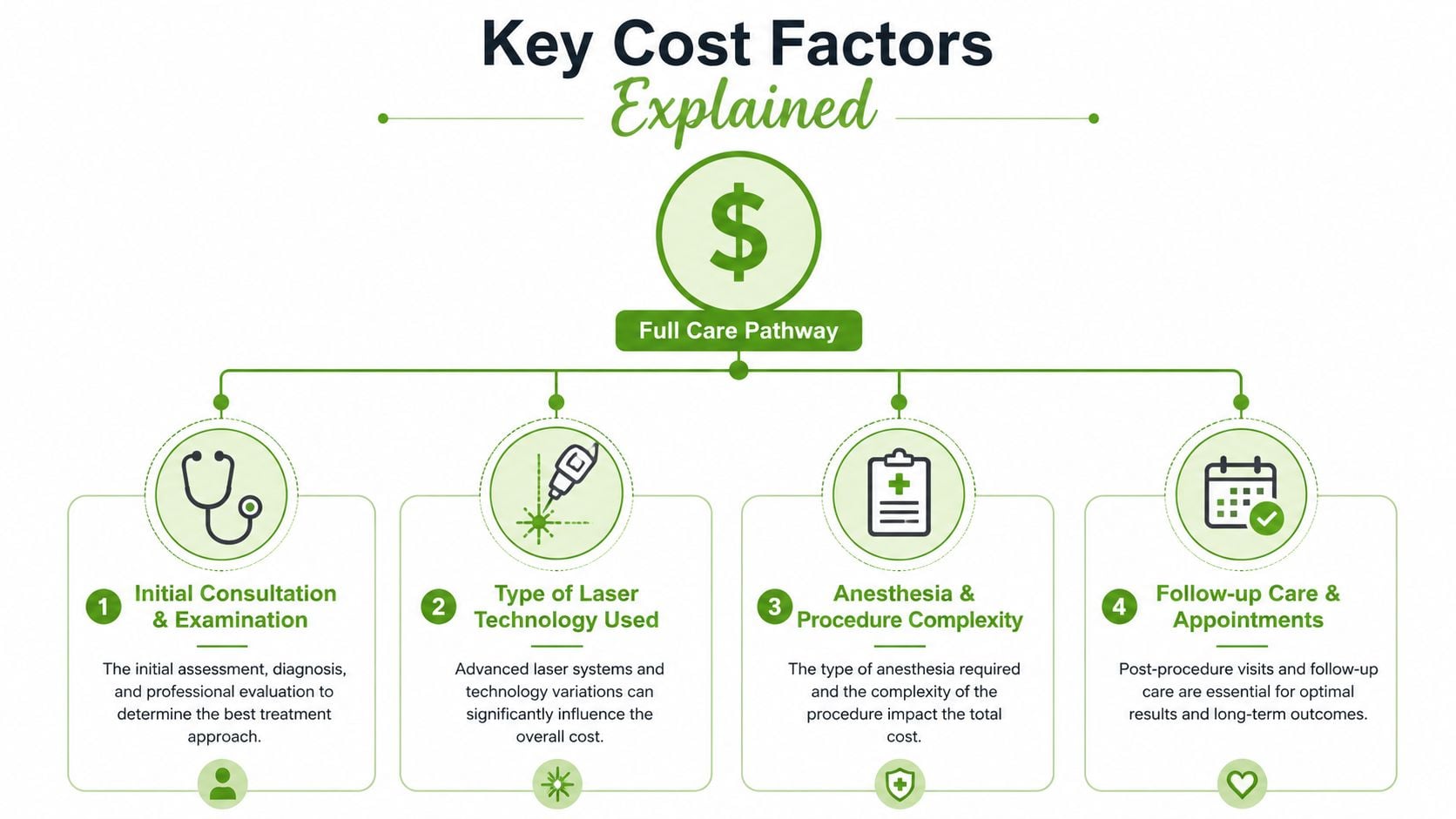
A laser release is never priced in isolation. The final bill reflects the path a patient takes, from consultation to recovery, and that pathway can be short or fairly involved depending on the case. Families often focus on the procedure itself, but the consultation and follow-up are part of the treatment, not extras to ignore.
Consultation, anatomy, and case complexity
The first cost layer is the evaluation. A clinician has to decide whether the frenum is limiting function, whether one site or more than one site needs treatment, and whether the anatomy is straightforward. A simple infant tongue-tie visit is not priced the same way as a complex adult case involving oral tension, periodontal concerns, or multiple restricted tissues.
The other major variable is how much technical judgment the operator has to use during the procedure. A peer-reviewed review of laser labial frenectomy identifies higher cost and the need for operator skill as key limitations of the laser approach, and that helps explain why laser pricing often sits above conventional techniques (peer-reviewed review). In plain terms, you're paying for more than a device. You're paying for the clinician's ability to use that device safely and effectively.
Follow-up care and adjunctive therapy
Post-op care matters because the release is only one part of the result. Some offices include stretching instructions, short-interval follow-up, and guidance for feeding or oral function. Others separate those services, which can make the initial quote look smaller than the actual total.
Good estimate, better questions: ask whether the price includes the consultation, the procedure, post-op checks, and any function-focused therapy recommended after release.
That last piece matters for families working through infant feeding concerns. If you want to see how cost questions come up in that broader context, the article on understanding tongue tie lactation costs is a helpful companion piece because it highlights the support services that can sit alongside the release itself.
Laser vs Traditional Frenectomy Cost and Value

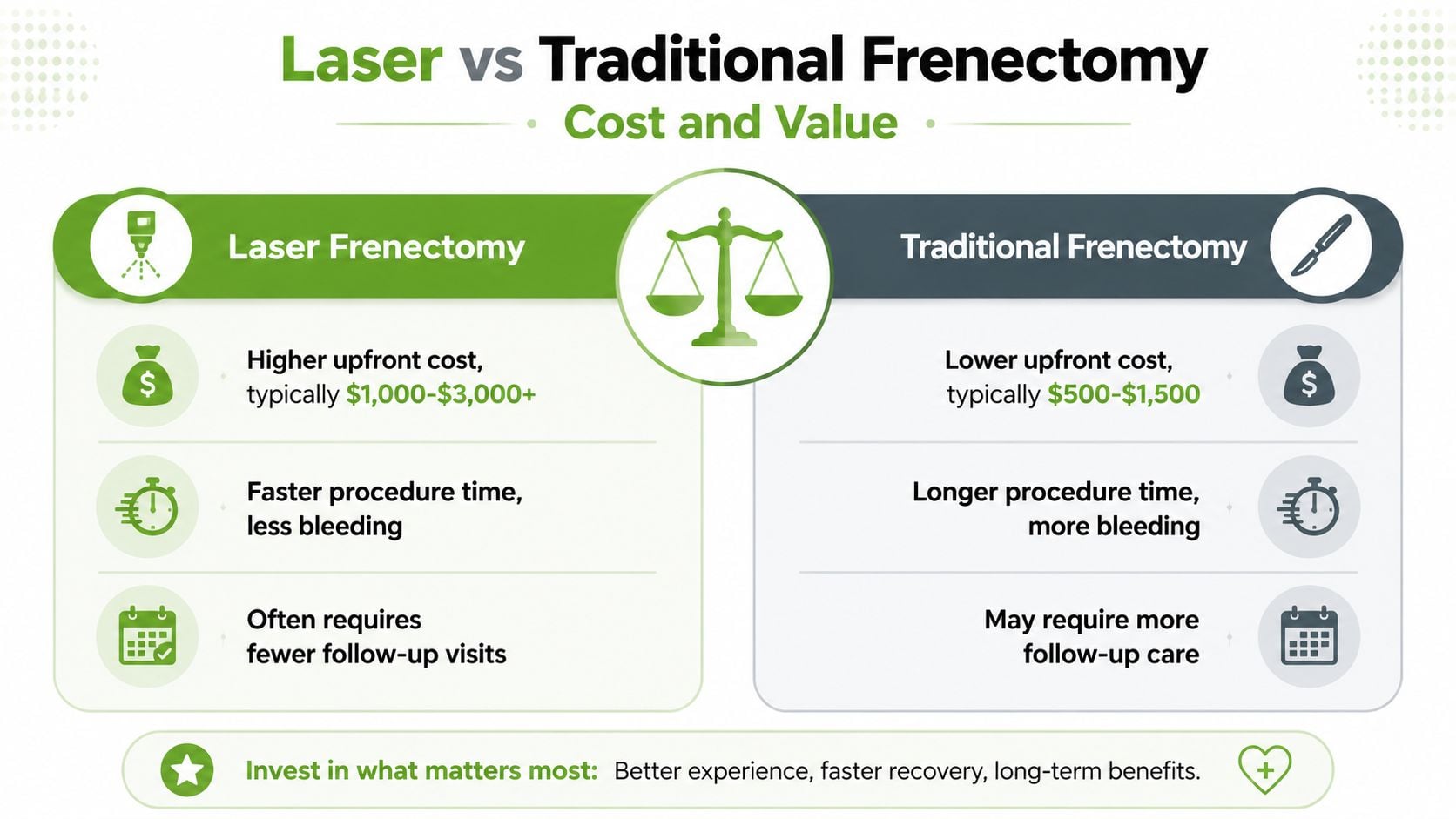
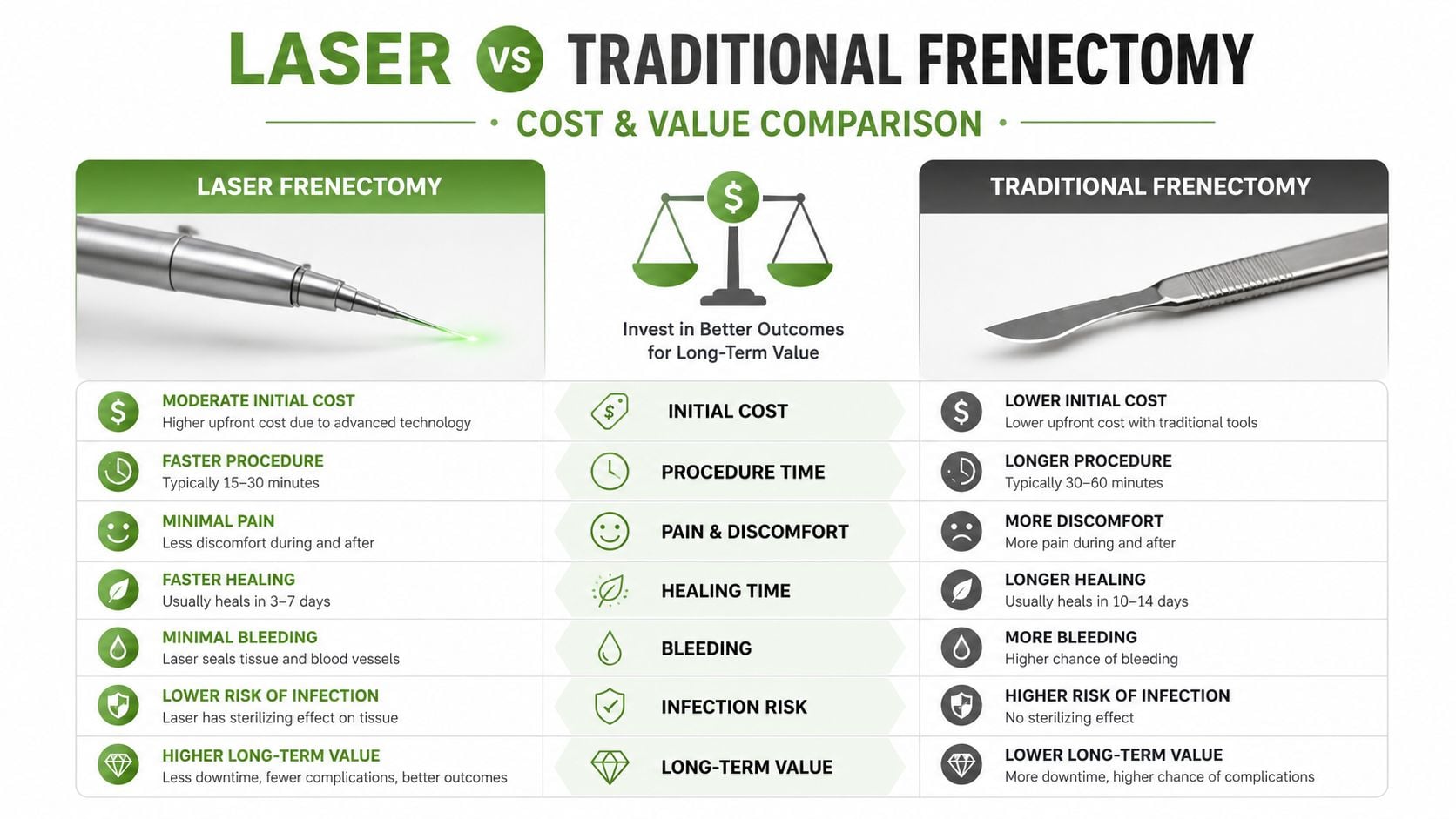
A fair comparison looks at total cost of care, not just the fee for the release itself. The question is whether the higher price for laser treatment buys something meaningful for the person in front of me, including the visit before treatment, the procedure, and the follow-up that may be needed afterward.
What the laser fee is actually buying
Laser treatment is often selected because it can improve bleeding control and make the procedure easier to tolerate. A peer-reviewed review also describes diode lasers as a potentially cost-effective option, while still stopping short of calling them the right choice for every patient (review of clinical studies). That distinction matters in real practice. Better comfort and cleaner soft-tissue control can justify a higher fee, but only if those benefits fit the case.
Traditional surgical release usually has a lower upfront price. In private practice, laser frenectomy is commonly quoted around $400 to $800, while traditional approaches often fall lower in the outpatient range. The difference is real, and so is the trade-off, because laser treatment may offer less bleeding and easier hemostasis, while conventional release may cost less at the start (peer-reviewed review).
When laser tends to make more sense
Laser tends to make more sense when comfort, precision, and efficient treatment matter most. That often comes up with infants, anxious patients, or cases where soft-tissue control is especially important. It can also fit better when the release is one part of a broader airway, feeding, or oral function plan.
For a clinic-level explanation of the procedure itself, the laser frenectomy procedure explains how the release is approached in practical terms. The same point applies here. A lower fee is not always the better value if it leaves out comfort, efficiency, post-op care, or the support needed after the procedure.
A useful billing resource for providers, and for patients trying to understand why claims get messy, is this discussion of effective RCM strategies for providers. It helps explain why documentation and claim structure matter so much in real-world reimbursement.
Navigating Insurance and Payment Options
Insurance for frenectomy care can be confusing because the same treatment may be billed under different benefit structures. In some cases, a claim may go through dental benefits. In others, a medical claim may be more appropriate, especially when the chart includes feeding, speech, or functional concerns. That difference can change the out-of-pocket total significantly.
Questions that prevent surprise bills
Before the procedure, ask the billing coordinator whether the office files as medical, dental, or both. Ask whether the estimate includes consultation, procedure, post-op visits, and any prescription or follow-up support. Also ask what happens if the insurance company denies part of the claim, because a clean estimate and a clean reimbursement are not the same thing.
A useful billing resource for providers, and for patients trying to understand why claims get messy, is this discussion of effective RCM strategies for providers. It helps explain why documentation and claim structure matter so much in real-world reimbursement.
Payment plans and practical planning
Some offices offer financing or staged payment options, which can help families move forward without waiting for a perfect insurance outcome. If a practice provides that option, read the terms carefully and confirm whether the total fee changes when financing is used. Ask whether there's a separate charge for splitting payment across visits.
For a quick look at how an office may structure those options, see the clinic's payment plans page. The smartest move is simple, get the estimate in writing, then compare that estimate to your insurance benefits before the day of treatment.
Getting a Clear Estimate at Pain and Sleep Therapy Center
Pain and Sleep Therapy Center approaches frenectomy planning as part of a broader functional assessment, not as a one-line procedure quote. That matters because patients usually need to know what the consultation covers, how the release is planned, and what the billing picture looks like before they commit.
The team typically starts with an evaluation, then maps out the likely treatment plan and the expected charges tied to that plan. If a frenectomy is recommended, the estimate should reflect the procedure itself, the site or sites treated, and the follow-up care discussed at the visit.
One practical advantage of this approach is clarity. A patient can see what is included up front instead of piecing together a bill after the fact. For families and adults already juggling symptoms, that kind of transparency makes a real difference.
Frequently Asked Questions About Frenectomy Costs
Is it cheaper to treat a lip tie and tongue tie in the same visit?
Sometimes the total is more efficient when both are addressed together, but the final price depends on how the office structures billing and how complex the anatomy is. A combined case can still cost more than a single-site release because it requires more time, more planning, and sometimes more follow-up.
Are adjunct services like oral function therapy included?
Not always. If a clinic recommends myofunctional or feeding-related support, ask whether that service is built into the quote or billed separately. The safest assumption is that anything outside the actual release may be an extra charge unless the office says otherwise.
Can financing change the overall cost?
It can change the payment schedule, but it shouldn't be a substitute for understanding the full fee. Always ask whether financing adds administrative charges or changes the final amount due. A workable monthly plan is helpful only if you know the true total upfront.
If you want a clear estimate that reflects the full treatment pathway, not just a single procedure line, visit Pain and Sleep Therapy Center to review options with a team that explains the financial side before treatment begins. The goal is to help you understand what's included, what may be separate, and how to move forward with confidence.