
You swallow your vitamins every morning. You keep the bottle by the coffee maker, or next to your toothbrush, because you're trying to be consistent. Yet you still feel wrung out by afternoon. Your jaw stays tight. Your muscles ache. Sleep doesn't feel restorative, even when you spend enough hours in bed.
That disconnect frustrates a lot of people. They're doing the “right” thing, but their body doesn't seem to be getting the message.
The missing piece is often absorption of vitamins. Taking a nutrient and using a nutrient aren't the same event. Your digestive system has to unpack it, transport it, and deliver it to the tissues that need it. If any part of that delivery chain breaks down, the label on the bottle matters less than you'd think.
For people dealing with persistent fatigue, symptom tracking often starts in the wrong place. This guide on natural remedies for chronic fatigue can help broaden that conversation, especially when rest alone hasn't fixed the problem.
Why Taking Vitamins Is Not Enough
A patient story I hear in many forms goes like this: “I've tried magnesium, vitamin D, a multivitamin, and B vitamins. I'm still tired, I'm still sore, and I'm still waking up at night.”
That experience is real. It doesn't mean the supplements were pointless, and it doesn't mean the symptoms are “just stress.” It often means the body's nutrient delivery system isn't working smoothly enough.
Think of a vitamin like a package you mail across town. Buying the package is only step one. It still has to be addressed correctly, sorted at the right facility, carried by the right truck, and delivered to the right house. If the road is blocked or the package needs special handling, it may never arrive where it's supposed to go.
That's what bioavailability means in practical terms. It's the gap between what you swallow and what your body can use.
Poor results from a supplement don't always mean you chose the wrong nutrient. Sometimes the body couldn't unpack or deliver it.
This matters even more when symptoms are vague but persistent. Fatigue, body pain, headaches, jaw tension, poor sleep, brain fog, and muscle tightness can all push people toward supplements. But if digestion is impaired, if bile flow is poor, if the small intestine is inflamed, or if transport systems are saturated, the body may still come up short.
Some consumer-facing sources estimate that only about 20% to 50% of orally taken “regular vitamins” are absorbed, which highlights how much formulation, meals, and gut health can affect real-world uptake, according to this review on vitamin bioavailability in the NIH's PubMed Central archive.
The Two Main Pathways for Vitamin Absorption
Most vitamin absorption happens in the small intestine, but vitamins don't all travel the same road. Their chemistry decides how they move.
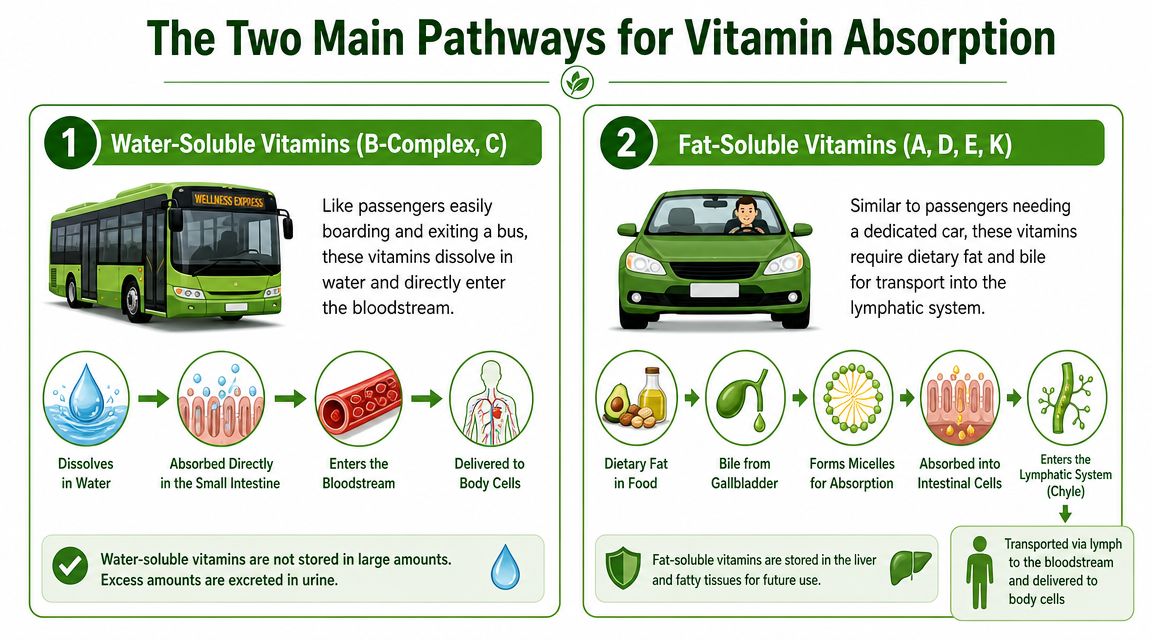
Water-soluble vitamins move like local mail
Vitamin C and the B-complex vitamins dissolve in water. Once digestion breaks them down and the intestinal lining takes them in, they move more directly into the bloodstream.
A simple analogy helps. Water-soluble vitamins are like letters that fit the regular mail system. They don't need a special vehicle. They can move through the standard route more easily.
That sounds simple, but it's not a free-for-all. Many water-soluble vitamins rely on specific transport systems in the intestine rather than just drifting through by bulk diffusion.
Fat-soluble vitamins need a ride
Vitamins A, D, E, and K are different. They don't dissolve well in water, so they need dietary fat and bile acids to help package them for absorption.
These vitamins are more like furniture deliveries. You can't toss a couch into a mailbox and hope for the best. It needs wrapping, loading, and the right vehicle. In your body, that vehicle is the fat-absorption pathway.
The distinction matters because a very low-fat meal can reduce uptake of fat-soluble vitamins. The review cited earlier notes that water-soluble vitamins generally depend less on dietary fat, while fat-soluble vitamins do require it for efficient absorption.
Why the small intestine matters so much
The small intestine is the main sorting hub. For fat-soluble vitamins, the body uses the same lipid-uptake machinery it uses for dietary fats. Medical physiology teaching materials from Colorado State University explain that these vitamins are incorporated into mixed micelles with bile acids in the intestinal lumen and then enter intestinal cells largely by diffusion through that lipid pathway, as described in this overview of vitamin absorption in the small intestine.
That's why the phrase “take it with food” is only partly helpful. The better question is, what kind of vitamin is it, and what does it need to get through the intestinal checkpoint?
Practical rule: Match the supplement to the pathway. Water-soluble vitamins usually need a functioning transport system. Fat-soluble vitamins need fat handling, bile support, and a healthy small intestine.
Common Factors That Impair Vitamin Uptake
Sometimes the supplement isn't the weak link. The environment it enters is.

If the digestive tract is irritated, inflamed, poorly coordinated, or missing key secretions, absorption of vitamins can drop long before symptoms show up on a lab report. That's why someone can eat well, take supplements faithfully, and still struggle with deficiency-related symptoms.
Problems with fat digestion block fat-soluble vitamins
Fat-soluble vitamins depend on bile delivery, lipid digestion, and micelle formation. If any of those fail, vitamins A, D, E, and K may not get absorbed efficiently.
An extensive review for patients and clinicians notes that small-intestinal disease, inflammatory bowel disease, celiac-like mucosal injury, pancreatic disease, and liver disease can all reduce the absorption efficiency of fat-soluble vitamins by interfering with bile delivery, fat digestion, or micelle formation, as outlined in this guide to vitamin malabsorption from A to K.
That's a major clue for people with digestive symptoms such as bloating, greasy stools, chronic abdominal discomfort, unexplained weight changes, or long-standing food intolerances.
Water-soluble vitamins can still hit a bottleneck
A lot of people assume water-soluble means easy absorption. It often isn't that simple.
Research on intestinal vitamin transport shows that vitamins such as folate, riboflavin, thiamin, biotin, niacin, pantothenic acid, pyridoxine, and ascorbate use specific carrier-mediated processes. Riboflavin is especially interesting because intestinal uptake adjusts to the body's status. Deficiency can increase uptake, while oversupply can decrease it. That means more isn't always better. You can review that mechanism in this article on intestinal transport of water-soluble vitamins.
Daily realities that can interfere
The biology above shows up in ordinary clinical life through patterns like these:
- Gut inflammation or injury: The intestinal surface has to be intact enough to absorb nutrients.
- Liver or pancreatic problems: These can reduce bile or digestive secretions that fat-soluble vitamins need.
- Medication effects: Some medicines alter stomach acid, gut motility, gut bacteria, or digestion.
- Antibiotic-related disruption: Changes in the gut environment can affect how nutrients are processed.
- Chronic digestive symptoms: Ongoing diarrhea, bloating, or stool changes can be signs that nutrients aren't being handled well.
For readers trying to support the digestive side of the equation, these tips for better gut health offer useful lifestyle starting points.
A visual walkthrough can also help make the process easier to understand:
Why “take it with food” can miss the real issue
For vitamin D specifically, Harvard's educational discussion cited in the malabsorption review notes that stomach juices, pancreatic secretions, bile, and intestinal integrity all influence absorption, and liver disease can reduce both absorption and metabolism.
So if someone says, “I always take it with dinner,” that's helpful information, but it doesn't answer the deeper question. Can their body process and transport that nutrient once it arrives?
The Hidden Link Between Malabsorption Pain and Sleep
You go to bed exhausted, but your body does not act tired. Your jaw stays tight. Your legs feel restless. You wake up with a headache or sore shoulders and wonder whether the problem is stress, your mattress, or getting older. Sometimes the missing piece is simpler and easier to overlook. The body may be struggling to absorb and deliver the nutrients that help muscles relax, nerves stay calm, and tissues recover overnight.

Pain, sleep, and nutrition are part of the same delivery system. If vitamins and minerals do not get from the digestive tract into the bloodstream, and then into the cells that need them, the effects can show up far away from the gut. A person may never say, “I think I have a nutrient absorption issue.” They are more likely to say, “My body never fully settles down.”
Why symptoms can show up as pain
Muscles, nerves, and connective tissue need a reliable supply of raw materials. Magnesium helps with muscle relaxation and nerve signaling. B vitamins support nerve function and energy production. Vitamin D, calcium, and other nutrients help maintain bone and muscle health. When absorption is impaired, the body can become more reactive. Muscles may stay guarded. Nerves may feel more irritable. Recovery after daily strain can take longer.
A postal service comparison helps here. Swallowing a supplement is like dropping a package at the post office. Absorption is the sorting and shipping process. Cellular use is the final delivery. If the package never leaves the warehouse, the destination still goes without what it needs.
That does not mean every headache, TMJ flare, neck spasm, or widespread ache comes from malabsorption. It means poor nutrient delivery deserves attention when pain is ongoing, hard to explain, or only partly improved by physical treatment.
The body cannot repair, relax, and regulate well if the raw materials do not reach the cells that need them.
Why symptoms can show up at night
Nighttime is when many people notice the gap between being tired and being able to rest. The nervous system is supposed to shift into a quieter mode. Muscles should loosen. Tissue repair should become easier. If nutrient status is poor because intake and absorption are not matching the body's needs, that overnight reset can feel incomplete.
The result may look like restlessness, nighttime muscle tightness, leg discomfort, frequent waking, light sleep, or sleep that never feels refreshing. Pain and poor sleep can then feed each other. Less restorative sleep lowers pain tolerance the next day. More pain makes it harder to settle the next night.
People dealing with long-term fatigue often live in this overlap. For a closer look at one pattern that can complicate sleep and daytime energy, see this overview of chronic fatigue and sleep apnea.
Why this matters in real life
Many adults take supplements and still do not feel better. That does not automatically mean the supplement is useless. It may mean the body is not processing, absorbing, transporting, or retaining that nutrient well enough to change symptoms.
This is one reason “I already take vitamins” is not the end of the conversation. A better clinical question is, “Are those nutrients getting delivered where they need to go?” That question matters for people with chronic pain, poor sleep, slow recovery, and fatigue that feels out of proportion to daily life.
A clinically useful way to think about it
When pain and sleep problems cluster together, these questions can help organize the problem:
| Question | Why it matters |
|---|---|
| Am I taking nutrients in forms my body can absorb well? | The form of a nutrient can affect how well it gets into circulation. |
| Could poor absorption be limiting overnight repair and muscle relaxation? | Low effective nutrient delivery can show up as tension, restlessness, and non-restorative sleep. |
| Do my symptoms suggest I need testing instead of more trial and error? | Persistent pain, fatigue, and broken sleep often deserve a closer medical look. |
Recognizing the Signs of Vitamin Malabsorption
Vitamin malabsorption often hides behind ordinary complaints. A person may say they're tired, foggy, moody, crampy, or slow to recover. Those symptoms are common, but common doesn't mean trivial.
The body usually gives clues. They're just easy to dismiss.
Signs people often overlook
Watch for patterns rather than isolated bad days. These are the kinds of things worth noticing and discussing with a clinician:
- Persistent fatigue: Not just sleepiness, but a feeling that your energy never refills.
- Muscle cramps or tension: Especially when hydration alone doesn't seem to help.
- Mouth changes: Recurrent mouth ulcers, tongue soreness, or cracks at the corners of the mouth.
- Skin, hair, and nails: Brittle nails, dry skin, or hair that seems weaker than usual.
- Easy bruising or slow recovery: The body may be signaling a nutrient delivery problem.
- Mood and concentration shifts: Irritability, low mood, or brain fog can have many causes, including poor nutrient status.
- Digestive symptoms: Bloating, stool changes, abdominal discomfort, or food intolerance patterns can add context.
Why high doses don't guarantee better results
Many people respond to symptoms by increasing the dose. That can make sense in some situations, but it can also miss the mechanism.
As noted in the earlier transport research, many water-soluble vitamins use carrier-mediated transport systems that can become saturated or down-regulated. In plain language, the gut can hit a limit. Taking more doesn't always create proportionally more absorption.
If you keep increasing the dose but your symptoms stay the same, think beyond quantity. Ask about digestion, transport, and whether testing is needed.
What a clinician may look at
Diagnosis isn't based on guesswork alone. A healthcare professional may combine your symptom history with medication review, digestive history, diet, and targeted lab work.
That evaluation may include blood testing for nutrient status and related markers, then a broader look at whether the issue seems dietary, digestive, inflammatory, medication-related, or linked to another medical condition. The point isn't to collect endless supplements. It's to understand why the body isn't using what it receives.
Practical Strategies to Maximize Vitamin Absorption
Improving absorption of vitamins usually starts with simple changes, not an overloaded supplement drawer. The goal is to make the body's delivery system easier to use.
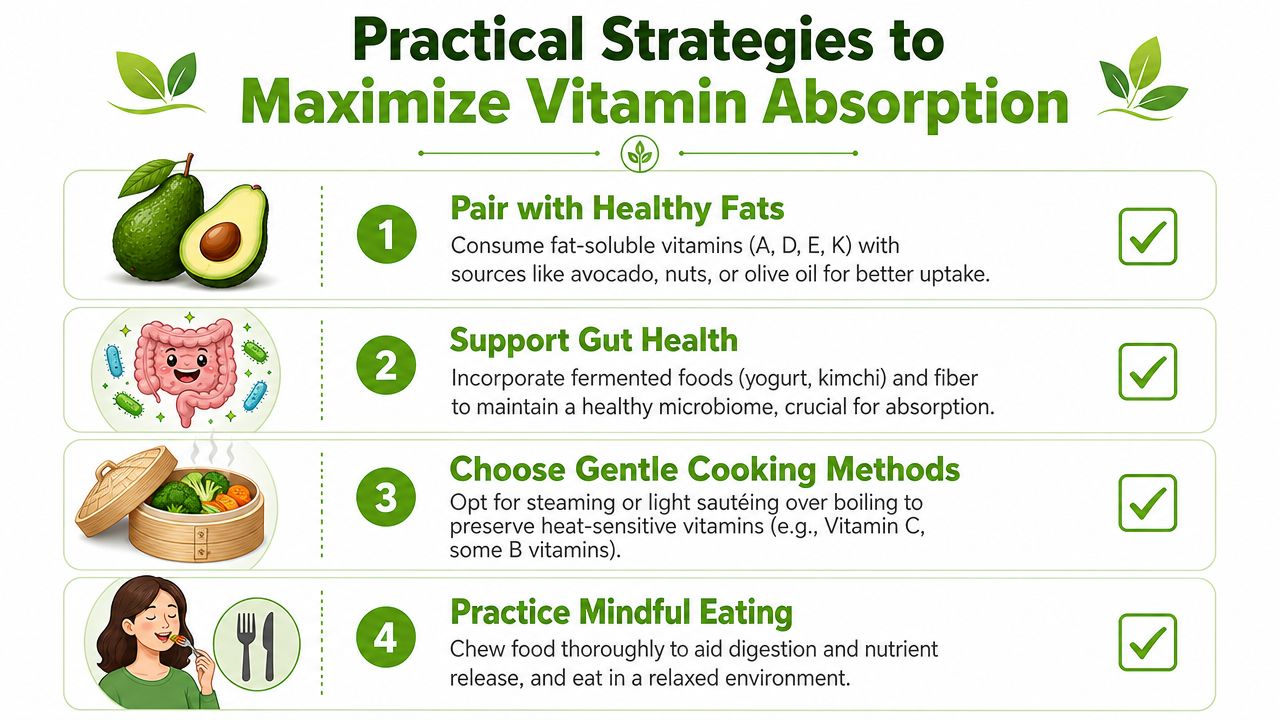
Pair the vitamin with the right meal
Fat-soluble vitamins need fat. If you take vitamins A, D, E, or K with a completely fat-free meal, absorption may be less efficient.
Good pairings can be simple:
- Add avocado: A practical option with breakfast or lunch.
- Use olive oil: A salad or cooked vegetables can work well.
- Include nuts or nut butter: Helpful when a supplement is taken with a snack.
- Choose a meal, not just coffee: Swallowing supplements with caffeine alone may not give the digestive system much to work with.
Water-soluble vitamins don't depend on fat in the same way, but they still benefit from a digestive system that's functioning calmly and consistently.
Help your gut do its job
Absorption starts before the capsule reaches the small intestine. Eating in a rush, chewing poorly, and living in a constant stress response can all work against digestion.
Try these habits:
- Chew thoroughly. Mechanical breakdown matters more than people think.
- Eat in a settled state. A calmer nervous system supports digestion better than eating while driving or working.
- Respect recurring digestive symptoms. Daily bloating, pain, or stool changes aren't background noise.
- Build meals from actual food. Whole foods bring nutrients in a matrix the body often handles well.
If you want a broader patient-friendly overview, this roadmap to better nutrient absorption offers additional practical ideas.
Think about timing and combinations
Not every supplement belongs in the same handful of pills. Different nutrients can compete, and some people tolerate certain supplements better at different times of day.
A useful approach is to keep a short written log for a couple of weeks. Note what you took, when you took it, what meal you paired it with, and how you felt afterward. Patterns become easier to spot when they're not trapped in memory.
Some of the best absorption changes are boring. Better meal pairing, slower eating, fewer random supplement combinations, and more consistency.
Consider formulation when the basics aren't enough
If someone has known digestive difficulty, a clinician may suggest trying a different dosage form or delivery method. That doesn't mean every new format is better. It means the right form depends on the person and the problem.
A few examples clinicians may think about include:
| Situation | Possible adjustment |
|---|---|
| Trouble swallowing large pills | Liquid or smaller capsule forms |
| Digestive sensitivity | Gentler formulations taken with food |
| Known malabsorption concerns | More individualized planning with a clinician |
| Complex symptom picture | Testing before adding more supplements |
Keep the goal in view
The goal isn't perfect optimization. It's clinical usefulness. Better absorption can support steadier energy, fewer deficiency-related symptoms, more comfortable muscles, and better odds that your supplement plan is doing something meaningful.
That's especially important when symptoms affect daily function, pain levels, or sleep quality.
When to Partner With a Healthcare Provider
A supplement plan can look correct on paper and still fail in the body. The problem is often not the vitamin itself. The problem is the delivery system.
If symptoms keep circling back, a clinician can help trace where the breakdown is happening. Vitamins have to be released from food or pills, moved through the gut lining, processed by the liver, carried in the blood, and delivered into tissues that can use them. That process works like a postal system. If the package is never mailed, sorting is delayed, the address is wrong, or the road is blocked, the nutrient does not reach the place that needs it.
That kind of troubleshooting matters when you have ongoing digestive symptoms, repeated low nutrient levels, fatigue, chronic pain, or poor sleep. People with gut inflammation, pancreatic or liver problems, medication interference, or sleep-disordered breathing often need more than better supplement timing. They may need testing, a different form of supplementation, treatment for the underlying condition, or a plan that connects nutrition with pain and sleep care.
Crowded routines are another signal to ask for help. As noted earlier, national CDC survey data show that many adults use multiple supplements, including a smaller group taking four or more, yet more pills do not guarantee better absorption or better results. If your routine keeps growing while your symptoms stay the same, that is a clue to reassess the system rather than add another bottle.
This matters even more when pain and sleep are part of the picture.
Low magnesium, low B vitamins, iron problems, and poor overall nutrient uptake can overlap with muscle tension, restless sleep, headaches, nerve irritability, and slower recovery. At the same time, poor sleep can worsen pain sensitivity, change appetite, increase inflammation, and make it harder to follow consistent meals or supplement habits. A good clinician helps sort out which problem is driving which symptom, because treating only one part often leaves people stuck.
If you're sorting through gut support questions, this overview of what works in probiotics may help you ask better questions, but it should not replace individualized care. If your symptoms center on snoring, airway problems, nonrestorative sleep, or fatigue that does not improve, seeing a sleep disorder specialist near you can help identify a barrier that is affecting both sleep quality and nutrient recovery.
If jaw pain, facial tension, headaches, chronic fatigue, or poor sleep still have not improved, Pain and Sleep Therapy Center can help you look deeper. Their team focuses on root causes, including sleep-related breathing problems and pain patterns that often overlap with broader whole-body health issues.