
Jaw pain can insidiously take over a day. You wake up with pressure near your temples, your jaw clicks when you brush your teeth, lunch turns into careful chewing, and by evening your face feels tired from doing something that should be effortless. Many people with TMJ and orofacial pain know this pattern well. They've tried pain relievers, a generic night guard, softer foods, stretching videos, and still the pain keeps coming back.
That cycle is exhausting because it makes the problem feel permanent. It often isn't. In the right patient, orthobiologic therapy offers a different path. Instead of only dampening symptoms, it aims to support healing in the irritated joint, ligaments, tendons, and surrounding tissues that drive chronic jaw pain.
For TMJ disorders, that distinction matters. The jaw is a small joint that works constantly. If the tissues around it are strained, unstable, or stuck in a low-grade inflammatory state, short-term relief usually doesn't last. A root-cause approach looks at why the tissue isn't recovering, then helps the body restart a healing response.
Healing Jaw Pain Without Surgery
A lot of TMJ patients arrive at the same point emotionally. They're tired of being told to “just manage it.” They may have been given a mouthguard without a deeper workup, or prescribed medication that dulls pain for a few hours but doesn't change what's happening inside the joint and surrounding muscles.
When temporary fixes stop being enough
Chronic jaw pain rarely stays limited to the jaw. It can show up as:
- Morning tightness: your jaw feels stiff when you first try to speak or yawn
- Clicking or popping: movement feels noisy, uneven, or unstable
- Pain with chewing: foods you used to eat casually now require planning
- Headaches and facial pressure: discomfort spreads into the temples, cheeks, or ears
- Guarding and tension: the muscles overwork because the joint doesn't feel supported
These problems can become a loop. Pain changes how you move. Altered movement strains nearby tissue. Strained tissue creates more pain.
That's why treatment has to do more than cover the alarm.
A different goal from pain masking
Orthobiologic therapy is part of regenerative medicine. The basic idea is simple. Your body already has repair signals. In some chronic conditions, those signals need help getting organized and delivered where they're needed.
For jaw disorders, that can be meaningful when the issue involves irritated joint tissues, strained attachment points, ligament laxity, or chronic inflammation that hasn't resolved. The goal isn't to force the jaw through pain. The goal is to create better conditions for healing.
Practical rule: If a treatment helps only while you're actively using it, but symptoms return as soon as you stop, it may be controlling pain without changing tissue health.
For some patients, this becomes an important alternative to more invasive procedures. If you're exploring jaw surgery alternatives, regenerative options are worth discussing before assuming surgery is the next step.
Why this matters for TMJ
The TMJ is small, but its workload is enormous. You use it when you talk, swallow, chew, yawn, and even when you hold your mouth at rest. A chronically irritated jaw joint doesn't get much downtime. That's one reason facial pain can linger far longer than people expect.
Orthobiologic therapy won't be right for everyone. But when the pain source is tissue-based and the joint still has healing potential, it can offer something many patients have been missing: a non-surgical plan that tries to repair, not just suppress.
Understanding How Orthobiologic Therapy Works
Orthobiologic therapy aims to change the healing environment inside a painful joint or support structure. In TMJ and orofacial pain care, that matters because the problem is often not just pain sensitivity. It may involve an irritated joint lining, a strained ligament, a tendon attachment under chronic load, or tissue that never fully recovered after months or years of overuse.
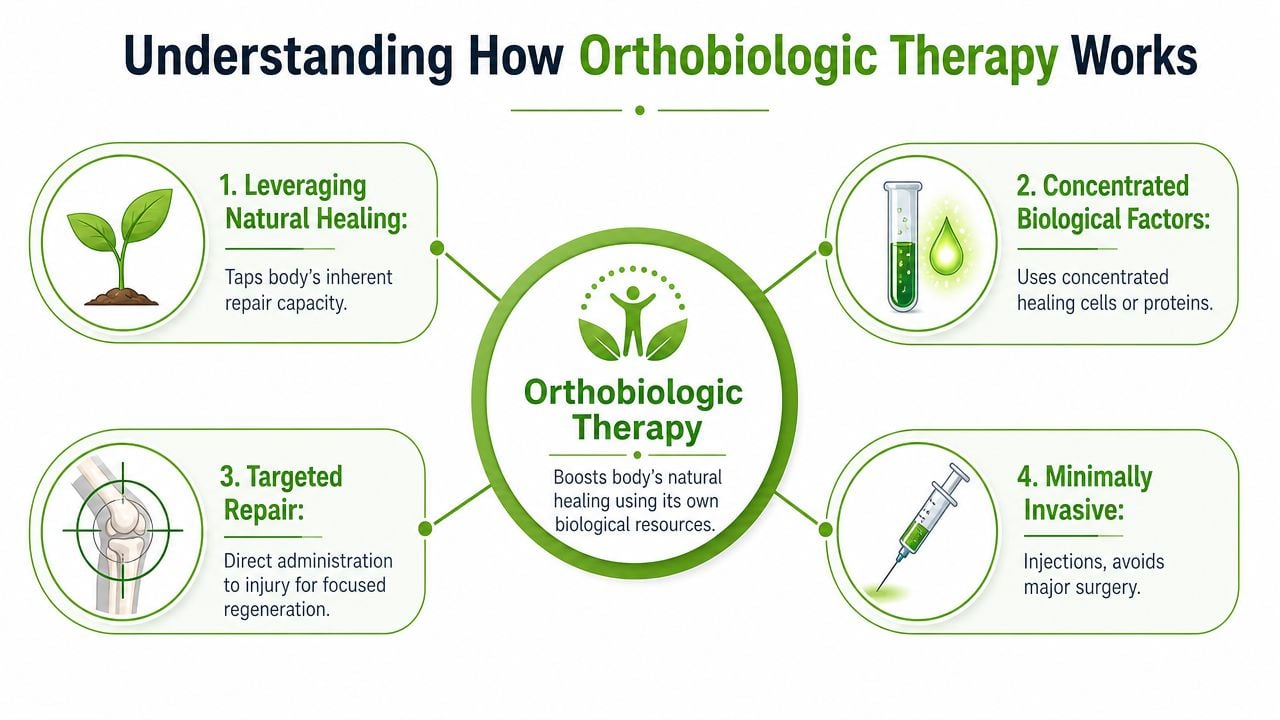
Here is the practical model I use with patients. The painful area is the treatment target. The biologic material comes from your own body. My job is to identify which structure is driving the pain and place treatment where it has a reasonable chance to help repair that tissue response.
What the mechanism looks like in practice
One of the best-known orthobiologic options is Platelet-Rich Plasma, or PRP. PRP contains platelets and signaling proteins that can support collagen activity, influence inflammation, and encourage a more organized healing response in injured tissue. That mechanism has been studied most heavily in orthopedic conditions such as tendon problems and early joint degeneration.
TMJ pain is different from knee pain, and I do not assume results in one body part automatically apply to the jaw. The principle still matters. If the jaw joint or its supporting tissues are stuck in an irritated, poorly repaired state, changing that local environment may help the tissue move toward recovery instead of staying in a cycle of flare, rest, and flare again.
Chronic jaw pain can persist even when tissue still has healing potential.
Why placement matters so much in facial pain
Orthobiologic treatment is only as good as the diagnosis behind it. A sore jaw can come from the joint, the capsule, the ligaments, tendon attachments, the chewing muscles, or a combination of those problems. If treatment is placed in the wrong structure, patients often conclude that regenerative medicine "didn't work," when the bigger issue was target selection.
This is one reason TMJ care deserves its own discussion instead of being folded into general orthopedic advice. The area is small. The anatomy is crowded. A few millimeters can matter. Good planning depends on the exam, the pain pattern, imaging when needed, and a clear sense of whether the problem is inflammatory, unstable, overloaded, or degenerative. Patients comparing TMJ treatment options for chronic jaw pain often find that this step changes the whole conversation.
What this treatment is trying to accomplish
Pain medicine can reduce symptoms. A nightguard can protect against grinding in the right case. Physical therapy can improve motion and muscle coordination. I use those tools when they fit.
Orthobiologic therapy serves a different purpose. It is meant to support tissue recovery at the source of the problem, not to quiet symptoms for a few hours or a few weeks. For patients with TMJ and orofacial pain, that root-cause approach is often the main reason to consider it before more invasive procedures.
That does not mean every case should be treated with injections. Some patients need load management, bite-related treatment, muscle care, or a broader rehabilitation plan first. In certain pain practices, this may also be combined thoughtfully with other non-surgical tools, including effective shockwave therapy treatments, depending on the tissue involved and the treatment goals.
A realistic expectation
This process is usually gradual. Orthobiologics do not "switch off" pain on the day of treatment the way a numbing injection might. The goal is steadier improvement in tissue tolerance, jaw function, and flare frequency over time. For the right TMJ patient, that trade-off is often worthwhile because the plan is aimed at repair, not temporary suppression.
Our Regenerative Treatments for Facial Pain
Not all regenerative treatments do the same job. In TMJ and orofacial pain care, the best choice depends on what's injured. A painful jaw joint needs a different strategy than a lax ligament, irritated tendon attachment, or chronically overloaded facial support structure.
PRF and Prolotherapy are not interchangeable
Two common options in facial pain treatment are Platelet-Rich Fibrin (PRF) and Prolotherapy. Both aim to help tissue recover, but they work in different ways.
| Therapy | What It Is | Best For | Healing Mechanism |
|---|---|---|---|
| PRF | A blood-derived concentrate prepared from the patient's own blood | Tissue that may benefit from a fibrin scaffold and biologic signaling support | Delivers healing components within a fibrin matrix that can support repair |
| Prolotherapy | An injection-based treatment designed to stimulate a controlled healing response | Ligament laxity, tendon strain, and areas where support tissue may need to tighten and strengthen | Triggers a mild local inflammatory response that can restart repair |
How PRF helps jaw tissues
PRF is often easiest to understand as a healing scaffold. After a blood draw, the sample is processed so that useful biologic components can be concentrated in a fibrin-rich matrix. That matrix can act like temporary scaffolding at the treatment site, helping organize the local healing response.
For TMJ patients, PRF may be considered when tissue quality and repair support are the central issue. It's especially appealing to patients who want a treatment built from their own biologic material rather than a synthetic filler or long-term medication strategy.
How Prolotherapy helps stability
Prolotherapy works from a different angle. Instead of mainly delivering concentrated biologic material, it creates a controlled irritation in tissue that has become chronically weak, stretched, or under-responsive. That sounds counterintuitive at first, but it can be useful when the body needs a clear signal to restart repair.
In jaw pain care, this can matter when ligaments and attachment points aren't supporting the joint well. A joint that lacks support often develops clicking, guarding, and muscle overcompensation.
The treatment choice should match the pain generator. If the main problem is instability, a treatment designed for support tissue often makes more sense than one aimed only at surface inflammation.
Matching the formulation to the problem
This principle isn't unique to TMJ. It shows up across orthobiologic medicine. A 2025 report found that leukocyte-poor PRP is used by 76.1% of clinicians for osteoarthritis, representing 71.6% of leukocyte-poor PRP use, while leukocyte-rich PRP is preferred for muscle, ligament, and tendon injuries. That pattern highlights an important clinical point: formulation should match the condition, not marketing language (2025 orthobiologics utilization report).
That same logic applies to facial pain. A worn joint, a strained tendon, and a lax ligament aren't the same problem. They shouldn't get the same treatment by default.
For some patients, regenerative injections are also paired with rehabilitation strategies that improve how force moves through the jaw, neck, and face. In broader musculoskeletal care, some clinicians also use adjunctive options such as effective shockwave therapy treatments to stimulate tissue response in selected pain conditions. The exact combination depends on diagnosis, not trend.
If you've been comparing TMJ treatment options, that's the key question to keep asking: what tissue is driving the pain, and what treatment is designed for that tissue?
Your Orthobiologic Treatment Journey Step by Step
The unknown is often what makes patients most anxious. Once people understand the process, the treatment usually feels much more manageable.
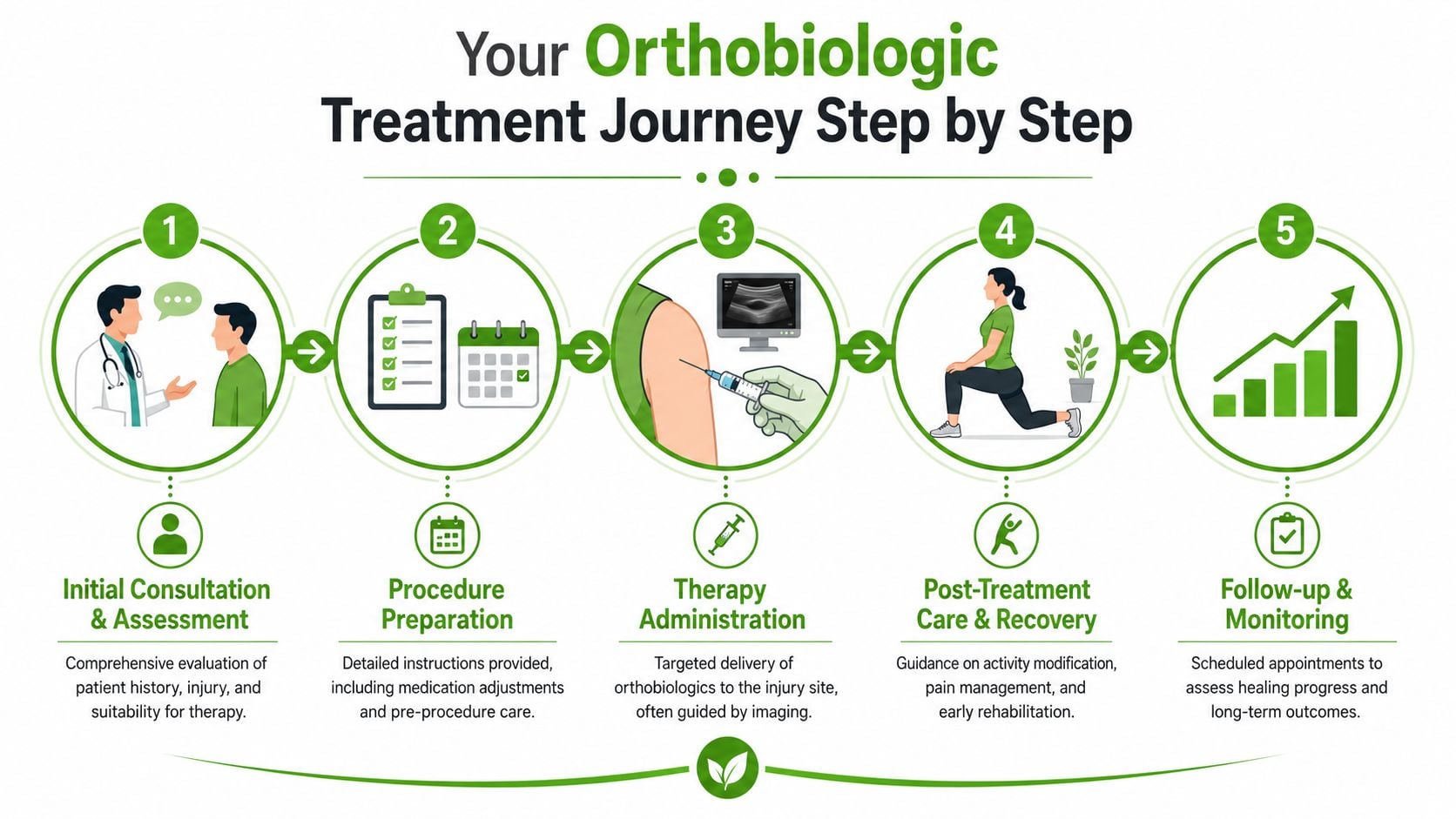
A typical journey has a clear sequence. Evaluation comes first. Treatment comes second. Recovery is guided, not left to guesswork.
The first visit and planning
The visit starts with a detailed history and examination. The clinician wants to know when the pain began, what makes it worse, whether there's clicking or locking, how chewing feels, whether headaches are part of the picture, and what treatments have already failed.
This is also where the real decision-making happens. Not every sore jaw needs an injection. Some patients need bite stabilization, airway evaluation, muscle retraining, or imaging before regenerative care makes sense.
To make the process easier to visualize, here's the overall sequence:
What treatment day is usually like
If PRF is part of the plan, treatment day often begins with a simple blood draw. The sample is prepared so the biologic material can be placed where it's needed. If Prolotherapy is chosen, the focus is on the targeted injection itself and the tissue response it's meant to create.
Most patients do best when they know the day isn't chaotic. It's usually a focused office procedure. The target area is identified carefully, the injection is delivered, and aftercare instructions are reviewed before you leave.
Some people like to watch a physician explain regenerative concepts before their appointment. This overview can help set expectations:
What it feels like after the procedure
You should expect the area to feel different for a short time. Mild soreness, pressure, or fullness can happen after treatment because the tissue has been intentionally stimulated. That isn't the same thing as something going wrong.
Common early experiences include:
- Day-one tenderness: the site may feel bruised or achy
- Temporary tightness: jaw movement can feel guarded for a short period
- Gradual settling: discomfort usually shifts as tissue calms down
- Slow improvement: changes often build over time rather than appearing overnight
Recovery and follow-up
Post-treatment care usually includes simple activity guidance, jaw-friendly food choices for a period, and instructions about what to avoid while the tissue response begins. In the right setting, rehab may also include exercises, posture work, airway-focused strategies, or muscle coordination training.
A good orthobiologic plan always includes follow-up. The question isn't only “Did the injection happen?” It's “Is jaw function improving, is pain changing, and do we need to adjust the broader treatment plan?”
If cost is part of your planning, it helps to review regenerative therapy cost before your consultation so you can ask informed questions about the full process.
Could You Be a Candidate for This Therapy?
Some patients are excellent candidates for orthobiologic therapy. Others need a different first step. The best way to think about candidacy is simple: this approach works best when there's a clear tissue problem with healing potential, and when the patient is ready to support recovery after the procedure.

You may be a good candidate if
- Your jaw clicks, pops, or feels unstable: this can point to support tissue issues rather than simple muscle fatigue
- Chewing causes pain or early fatigue: the joint and surrounding attachments may be overloaded
- You get headaches that seem tied to jaw tension: many patients notice temple or facial pain that tracks with jaw use
- You've tried conservative care without lasting relief: short-term help from medication or generic appliances doesn't always mean the problem has been solved
- You want a non-surgical approach: many adults prefer to explore regenerative options before considering invasive procedures
- Your evaluation suggests a tissue-based source of pain: this is one of the strongest signs that orthobiologic therapy may be useful
Situations that call for caution
This treatment isn't automatically appropriate for every person with facial pain. A careful clinician will pause or redirect treatment when there's an active infection, when the diagnosis is still unclear, or when a medical condition makes injection-based regenerative care a poor fit.
Some patients also need a different priority first. If the jaw pain is being driven mainly by severe clenching, airway issues, major bite instability, or a more advanced structural problem, regenerative therapy may be only one part of care, or it may need to wait.
A good candidate isn't just someone in pain. It's someone whose pain pattern matches the tissue target and whose treatment plan is based on diagnosis, not desperation.
The self-check that matters most
Ask yourself three questions:
- Does my pain keep coming back despite symptom-based treatment?
- Has anyone clearly explained what tissue is likely causing the problem?
- Am I looking for repair, not just temporary relief?
If the answer is yes, an evaluation for orthobiologic therapy may be worth pursuing.
Benefits and Realistic Outcomes for TMJ Patients
A patient with chronic TMJ pain usually wants the same simple things back. Comfortable chewing, easier talking, less guarding, and the ability to get through the day without planning around the jaw. Orthobiologic therapy can help move in that direction when the pain is coming from injured or worn joint and support tissues.
For the right TMJ patient, the benefit is not just a quieter joint for a few days. The goal is to improve how the tissue functions so the jaw is more stable, less irritated, and better able to handle normal use. In practice, that may look like less pain with meals, better opening, fewer pain spikes after long conversations, and less reliance on repeated short-term measures.
What improvement often looks like
Patients often notice progress in daily tasks before they think in medical terms.
Potential benefits may include:
- Reduced pain during function: less discomfort with chewing, yawning, speaking, or morning jaw use
- Better jaw mechanics: smoother opening and closing, less protective muscle tightening, and improved tolerance for normal movement
- A non-surgical option: treatment is performed without the disruption and recovery of jaw surgery
- Less dependence on temporary symptom control: some patients need fewer repeated interventions aimed only at calming pain
That said, improvement is rarely identical from one person to the next.
Realistic expectations
TMJ and orofacial pain are more complex than a sore knee or elbow because the jaw never fully rests. You use it to eat, speak, swallow, and sometimes clench through the night without realizing it. That constant load affects outcomes.
As noted earlier, regenerative medicine studies in other joints suggest a pattern that is useful here. Softer tissue problems may respond more directly once healing is restarted. Arthritic or degenerative joint problems can still improve, but they may need follow-up care over time rather than one permanent fix.
That distinction matters in the TMJ. A patient with an irritated ligament, tendon attachment, or capsule may improve differently than a patient with long-standing joint wear, disc dysfunction, heavy clenching, and surrounding muscle overuse. Both can benefit, but the timeline, ceiling of improvement, and need for maintenance are not the same.
What helps results last
Precise diagnosis matters. Image-guided placement matters. The plan after the procedure matters just as much.
I tell patients that orthobiologic therapy works like scaffolding for healing. It supports repair, but it cannot protect the jaw from the same forces that caused the tissue to struggle in the first place. If nighttime bracing, airway strain, bite instability, or poor muscle coordination keeps overloading the joint, those issues usually need attention too.
That is why the best outcomes come from treating the root cause of facial pain, not just injecting a painful spot. For many TMJ patients, this becomes part of a broader non-surgical strategy to calm inflammation, improve function, and help the joint hold its gains.
Frequently Asked Questions About Orthobiologics
How many treatments will I need
It depends on the tissue being treated, how chronic the problem is, and how your jaw responds after the first session. Some patients need only a limited series, while others benefit from staged treatment and follow-up assessment. The exact number should come from your exam, not from a preset package.
Is the procedure painful
Most patients tolerate it well. The area is prepared carefully, and local comfort measures may be used. You may feel pressure, brief stinging, or soreness afterward, but the experience is usually more manageable than people expect.
How soon will I notice results
Orthobiologic therapy works through healing, so results are usually gradual. Some people notice early changes in pain or movement, while others improve more slowly as tissue recovery unfolds over weeks and months.
Does insurance cover orthobiologic therapy
Coverage varies. Many regenerative treatments are considered elective or are only partially covered, so it's smart to ask about financial details before treatment begins. Clear planning reduces stress and helps you focus on recovery.
Is this better than a mouthguard or physical therapy
Not necessarily better in every case. It's different. Mouthguards, myofunctional care, breathing work, rehab, and bite-specific treatment each solve different problems. Orthobiologic therapy is most useful when tissue healing and joint support are central parts of the diagnosis.
Can it replace surgery
Sometimes it can help a patient avoid or delay surgery. Sometimes it can't. If the tissue still has healing potential and the diagnosis fits, regenerative care may be an excellent non-surgical option. If the damage is too advanced, surgery may still need to be part of the conversation.
If you're living with chronic TMJ pain, jaw clicking, headaches, or facial tension and you want a root-cause, non-surgical approach, Pain and Sleep Therapy Center offers specialized evaluation and regenerative treatment options designed for the unique demands of the jaw and face. A thoughtful consultation can help you find out whether orthobiologic therapy fits your diagnosis and what a realistic path toward relief looks like.