You hear it at dinner first. Your child opens wide for a bite of pasta and there's a small click near the ear. Maybe they say their jaw feels “weird.” Maybe they stop chewing bagels, chew on one side, or complain about headaches that don't quite sound like a dental problem.
Most parents don't think “TMJ” right away. They think ear issue, stress, braces, growth spurt, or a harmless habit. Sometimes it is mild and temporary. Sometimes it isn't.
The good news is that TMJ problems in kids can be evaluated in a calm, structured way. The better news is that treatment often starts conservatively. In many cases, the right path is not surgery, not a rushed orthodontic fix, and not only waiting for a child to outgrow it. It's a careful look at joint function, muscle patterns, breathing, oral habits, and the bigger picture of development.
That Click Is Not Just a Quirk
A jaw click is easy to dismiss when a child seems otherwise fine. Parents often tell me they noticed it for weeks or months before pain showed up, or before they realized their child had started avoiding crunchy foods.
The temporomandibular joint, or TMJ, works like a highly active hinge and gliding joint combined. It helps your child talk, chew, yawn, swallow, and coordinate the lower jaw with muscles of the face, head, and neck. When the system is moving well, it feels effortless. When it isn't, the first clue may be a pop, click, or shift in movement rather than severe pain.
A click by itself doesn't automatically mean damage. But it does mean the joint deserves attention, especially if it keeps happening or comes with other symptoms. Parents who want a deeper explanation of what jaw noises can mean may find this guide on why the jaw clicks helpful.
Why this matters in children
TMJ disorders are not just adult problems. A major systematic review and meta-analysis reported that TMD prevalence in children and adolescents varies from 20% to 60%, and in the pooled dataset 736 of 1,914 patients, or 38.4%, had TMD. The same review found 44.7% prevalence in females versus 30% in males, with females showing a relative risk of 2.10. It also noted 17% self-reported TMJ sounds in young patients, which supports what many parents notice first at home: noise before a child can clearly describe dysfunction. Those findings are detailed in the 2023 review in the Journal of Oral Rehabilitation.
Practical rule: If a click is occasional, painless, and not changing function, it may be watched. If it's persistent, worsening, or paired with pain, chewing changes, locking, or headaches, it deserves an evaluation.
What parents should take from that
Concern is appropriate. Panic isn't.
Most children with TMJ symptoms do not need aggressive treatment on day one. They do need someone to sort out whether the problem is mostly muscular, primarily inside the joint, related to growth and habits, or connected to a broader issue like airway or oral function.
Decoding the Signs of Pediatric TMJ Disorder
Children rarely give textbook descriptions. They don't always say, “My jaw joint hurts.” More often they say their ear feels funny, their face gets tired, they don't want chewy foods, or their head hurts after school.
That's why it helps to think in categories.
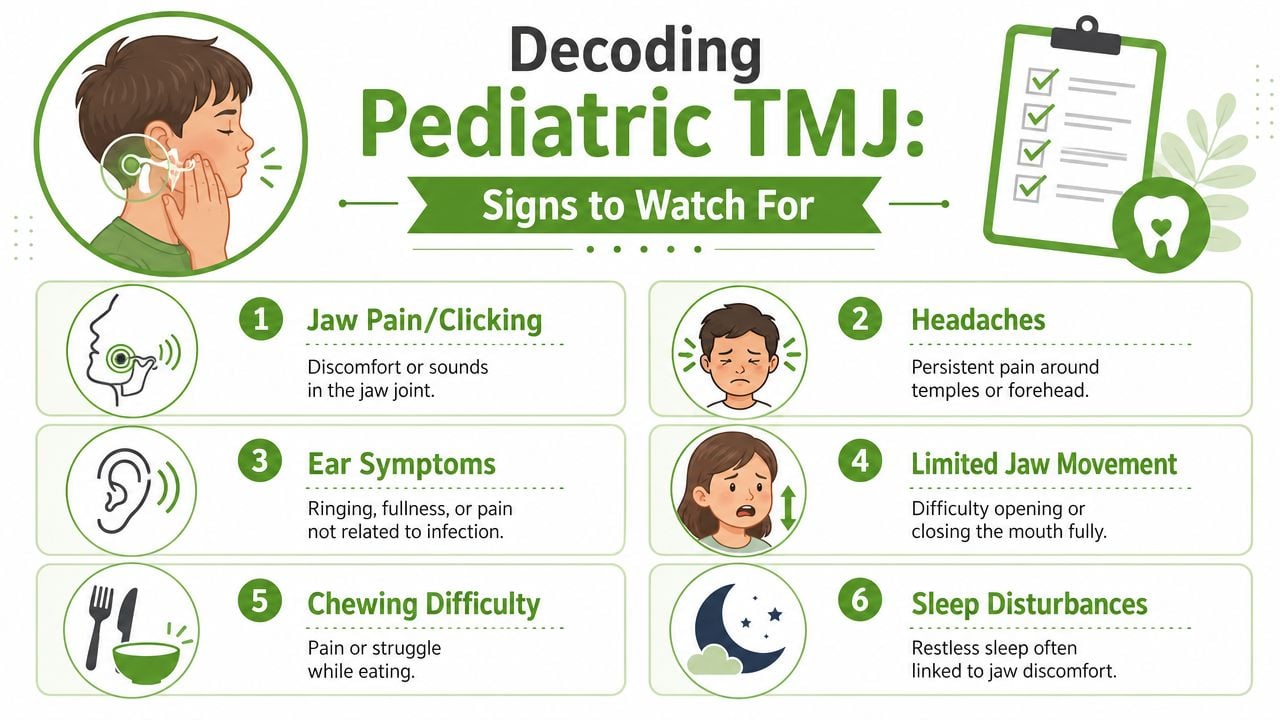
Audible signs
These are the sounds parents often notice before a child complains.
- Clicking: A distinct pop when opening or closing.
- Popping: Similar to clicking, sometimes louder and less consistent.
- Grinding or grating: A rougher sound that can suggest a different kind of joint involvement.
- Silence after previous clicking: If a child used to click and suddenly can't open normally, that change matters.
A large systematic review of 17,051 children and adolescents found that clinical signs of intra-articular TMJ disorder were present in 16%, summarized by the authors as “one in 6” young patients. In that study, TMJ sounds occurred in 14%, clicking in 10.0%, and jaw locking in 2.3%. You can review those findings in the PubMed summary of the meta-analysis.
Physical signs
These symptoms may look unrelated to the jaw at first.
- Jaw pain or tenderness: Especially near the joint, cheeks, or temples.
- Headaches: Often around the temples or forehead.
- Ear discomfort: Fullness, ringing, or pain without a clear infection.
- Facial fatigue: A child says chewing makes the face tired.
- Neck tension: Tightness in the neck or shoulders can travel with jaw dysfunction.
Jaw disorders in kids often hide behind other complaints. Ear pain without infection, temple headaches, and facial fatigue are common examples.
Functional signs
Function matters as much as pain, sometimes more.
- Limited opening: Your child doesn't open as wide as expected.
- Pain with chewing: Tough foods become a problem.
- Jaw deviation: The jaw shifts to one side when opening.
- Locking episodes: The mouth gets stuck open or closed, even briefly.
- Changed eating behavior: Smaller bites, slower chewing, one-sided chewing, avoiding certain foods.
- Sleep disruption: Restless sleep, clenching, morning soreness, or waking with a tense jaw.
What to watch at home
A simple parent log helps. Note when the sound happens, whether it's painful, what foods are harder, and whether symptoms are worse in the morning or after long school days. Patterns often reveal whether the issue is load-related, habit-related, sleep-related, or progressive.
Uncovering the Root Causes Beyond Braces and Grinding
A lot of parents are told some version of this: your child grinds, their bite is off, or they may need orthodontics. Those factors can matter. They just don't explain every case of TMJ in children.
That matters because treatment gets narrow when the explanation gets narrow. If everyone focuses only on teeth, they may miss how the jaw is being loaded all day and all night by breathing patterns, tongue posture, swallowing mechanics, and muscle compensation.
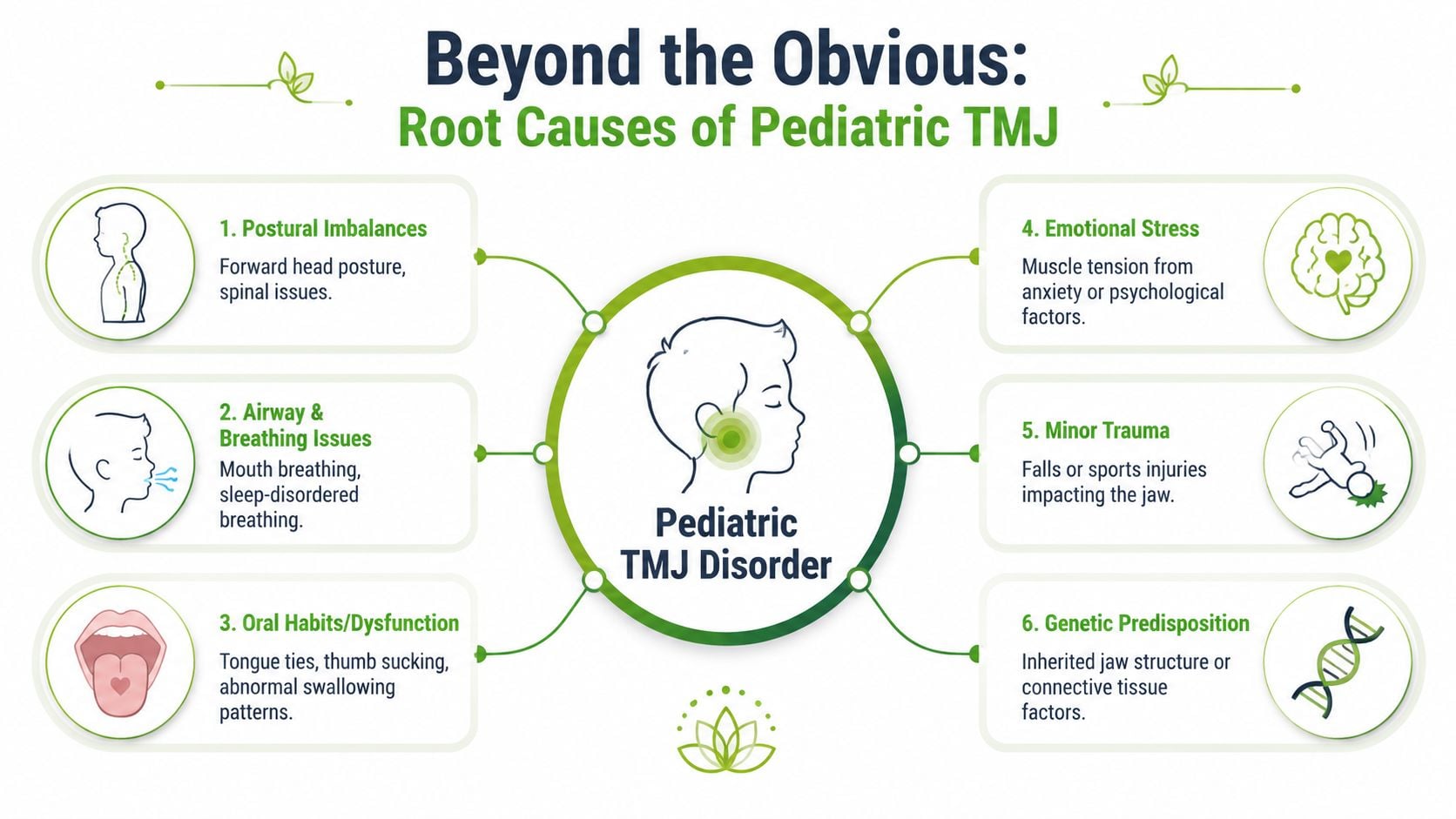
When bite problems are only part of the picture
The literature is more mixed than many parents realize. Bite relationships may be associated with symptoms in some children, but they don't account for all pediatric TMJ cases. A review discussing pediatric TMD notes that prevalence rises with age, many children with symptoms don't have a clear dental or occlusal cause, and oral-facial habits and airway function may play important roles. It also supports a risk-based approach rather than assuming every child needs immediate bite correction. That discussion appears in Frontiers in Public Health.
Root-cause patterns I look for clinically
Some of the most important drivers are functional.
- Airway and breathing strain: Chronic mouth breathing changes tongue posture, lip posture, and how the lower jaw sits at rest.
- Tongue-tie or restricted oral tissues: If the tongue can't move well, the child may compensate when swallowing, speaking, and resting.
- Poor oral-facial habits: Low tongue posture, lip incompetence, thrusting swallow patterns, and muscle overuse can keep stress on the jaw.
- Clenching from stress: Emotional tension often shows up in the jaw muscles.
- Postural compensation: Forward head posture can increase strain through the jaw and neck.
- Minor trauma: A fall, sports contact, or impact to the chin can start symptoms that don't fully settle.
Why this changes treatment
If chronic mouth breathing or dysfunctional swallowing is the primary cause, a simple night guard may help protect teeth but won't fully solve the problem. If the tongue is restricted, exercises alone may not restore normal movement. If muscle overactivity is secondary to poor sleep or airway resistance, the jaw keeps getting overloaded until that broader issue is addressed.
The jaw doesn't work in isolation. Children chew, swallow, breathe, sleep, and hold posture as one system.
That's why good care for TMJ in children often involves more than one discipline. Pediatric dentistry, airway evaluation, myofunctional therapy, ENT input, and sometimes orthodontic coordination all have a place when the findings support them.
The Path to Clarity How Specialists Diagnose TMJ in Children
A true TMJ evaluation is different from a quick dental exam. The goal isn't just to confirm that the jaw clicks. The goal is to find out why it clicks, what structures are involved, and whether the problem is mild, active, compensating, or progressing.

What a comprehensive exam usually includes
The American Academy of Pediatric Dentistry recommends a structured exam for suspected pediatric TMD. That includes palpation of the masticatory and TMJ structures, documentation of joint sounds, occlusal analysis, and measurement of active and passive mandibular opening. The guideline also recommends considering imaging when pain appears to come from the joint itself or when crepitation is present, because those findings raise suspicion for internal joint pathology. Parents can learn more about the role of an orofacial pain specialist when symptoms go beyond a routine dental concern.
A good pediatric TMJ workup often includes:
- History: When symptoms started, whether there was injury, morning soreness, chewing fatigue, headaches, sleep disturbance, or stress.
- Joint assessment: The clinician listens for clicks, pops, or crepitation and checks whether sounds happen early or late in opening.
- Muscle exam: Tenderness in jaw, temple, cheek, and neck muscles helps separate muscle pain from joint pain.
- Range of motion testing: Active opening, assisted opening, and side-to-side movement show how the joint and muscles are functioning.
- Bite and oral habit review: Not to blame everything on occlusion, but to see how the teeth, tongue, lips, and swallowing pattern interact.
When imaging becomes important
Not every child needs imaging. That's a key point.
If the exam suggests mostly muscular pain, imaging may not change first-line care. If pain appears centered in the joint, if there's crepitation, asymmetry, trauma history, persistent limitation, or concern about structural change, imaging can answer questions that hands and ears cannot.
Here's a short visual explanation of how TMJ problems are evaluated and managed.
Why precision matters
A child with muscle guarding needs a different plan than a child with internal derangement, inflammatory joint involvement, or restriction tied to tongue posture and airway dysfunction. Accurate diagnosis protects children from two common mistakes: undertreating a meaningful problem, or overtreating a mild one.
Clinical insight: The most useful exam doesn't rush to a label. It identifies what hurts, what moves poorly, and what keeps irritating the system.
A Gentle Start with Conservative and Myofunctional Therapies
Most children do best when care starts gently and specifically. That means reducing joint strain, calming irritated muscles, and correcting the patterns that keep feeding the problem.
The first phase is often simple. Softer foods for a period of time, smaller bites, less gum chewing, less wide yawning, heat when muscles are sore, and better awareness of clenching can make a real difference. But supportive home care works best when it's attached to a clear diagnosis rather than used as a vague “see if it goes away” strategy.
What myofunctional therapy actually does
When TMJ symptoms connect to mouth breathing, low tongue posture, lip incompetence, or an inefficient swallow, orofacial myofunctional therapy can be one of the most valuable tools in the plan.

This is not random exercise. It's targeted rehabilitation for the tongue, lips, cheeks, and jaw patterning. The work may include rest posture training, nasal breathing support, swallow retraining, and coordination exercises that reduce unnecessary strain on the TMJ. Parents who suspect airway-driven symptoms can learn more about myofunctional therapy for mouth breathing.
What tends to help and what usually doesn't
A practical way to think about early treatment:
| Approach | When it helps | Where it falls short |
|---|---|---|
| Soft diet and habit reduction | Acute flare-ups, chewing pain, muscle tenderness | Doesn't fix dysfunctional breathing or swallowing |
| Jaw awareness and home care | Mild overuse patterns | Hard to sustain without identifying the driver |
| Myofunctional therapy | Low tongue posture, mouth breathing, swallow compensation, poor lip seal | Works best when the anatomy allows proper function |
| Stress reduction support | Clenching, tension patterns, sleep-related strain | Doesn't address structural restriction alone |
The mental health piece matters too
Kids carry stress in their bodies, and the jaw is a common place for that stress to land. When anxiety, perfectionism, school pressure, or sleep disruption is part of the pattern, emotional regulation support can lower muscle guarding and clenching. Families looking for broader options may find this overview of non-pharmacological mental health treatment useful as part of a more complete plan.
The key is not to oversimplify. A child with TMJ pain may need behavior support, breathing retraining, muscle rehab, and dental guidance at the same time. Conservative care works best when it's coordinated.
Advanced Non-Surgical and Regenerative Options
Some children improve with home care and myofunctional therapy alone. Others need a more targeted next step because the joint remains irritated, the muscles keep overworking, or structural restriction keeps reloading the system.
Custom appliances and targeted unloading
A custom oral appliance is not just a generic night guard. In the right case, it can reduce joint loading, calm protective muscle activity, and create a more stable environment while irritated tissues settle. The exact design matters, especially in a growing child. An appliance should fit the diagnosis, not solely the symptom of grinding.
This is also where coordinated specialty care can help. One option is Pain and Sleep Therapy Center, which evaluates TMJ, oral function, and sleep-related breathing together when those issues overlap.
Regenerative and low-force therapies
When a child has persistent joint irritation and the clinical picture supports it, some specialists use regenerative or biostimulatory approaches to support healing rather than jumping to invasive procedures.
Examples include:
- Cold laser therapy: Often used to calm irritated tissues and support local healing.
- Platelet-Rich Fibrin, or PRF: Uses the body's own blood-derived healing components in a concentrated form.
- Prolotherapy: Used in selected cases to support tissue healing and joint stability.
These tools are not first-line for every child. They are more useful when conservative therapy has been appropriate but incomplete, and when the diagnosis suggests a local tissue problem that needs additional support.
When tongue-tie treatment enters the picture
If a restricted lingual frenulum is contributing to low tongue posture, dysfunctional swallowing, speech strain, or compensatory jaw movement, a laser frenectomy may be part of the solution. But it should rarely be viewed as a stand-alone fix.
A release works best when paired with proper preparation and follow-through. Without functional retraining, children often return to the same compensations that created stress in the first place. The anatomy can change in one visit. The movement pattern usually takes longer.
Advanced care should still be conservative in spirit. The question isn't “What can we do?” It's “What does this child's diagnosis justify?”
Your Questions About Pediatric TMJ Answered
Is a painless jaw click serious?
Sometimes no. Sometimes yes. A painless click can stay stable, but it can also be the first sign of altered joint mechanics. If it happens often, increases, or starts affecting chewing, it's worth evaluating.
Can my child just grow out of it?
Some mild, short-lived symptoms do settle with simple care. But persistent dysfunction shouldn't be brushed off. In children with juvenile idiopathic arthritis, research found that a smaller mandibular opening even without pain predicted future TMJ deformity, showing that functional limitation can matter even when pain is absent. That finding is described in this study on TMJ pain, dysfunction, and deformity in children with JIA.
When should I see a specialist instead of a general dentist?
Consider a specialist if your child has locking, limited opening, repeated headaches, ear symptoms without infection, chewing difficulty, facial asymmetry, history of trauma, or symptoms tied to sleep and mouth breathing. A general dentist may identify the issue first, but persistent or complex cases often need a more focused exam.
Should I give pain medicine and wait?
Short-term pain relief can be reasonable when symptoms are mild and clearly temporary. If you're considering over-the-counter medication, use pediatric dosing carefully. Parents who need a medication reference may want to review the correct Junior Advil chewable dose before giving anything at home. Medication can ease discomfort, but it won't diagnose the cause.
What's the biggest mistake parents make?
Waiting too long when function is changing. Pain matters, but so do clicking that worsens, reduced opening, one-sided chewing, and chronic mouth breathing.
If your child has jaw clicking, pain, chewing changes, headaches, or sleep-related signs that seem connected, a thorough evaluation can bring a lot of relief and clarity. Pain and Sleep Therapy Center provides pediatric TMJ, oral function, and airway-focused assessment with non-surgical treatment options when they're appropriate.