
Ever heard of physical therapy for your face, mouth, and throat? That’s the simplest way to think about orofacial myofunctional therapy (OMT). It’s a personalized exercise program designed to correct poor muscle habits and retrain the complex system that controls how you breathe, swallow, and speak.
A Deeper Look at Orofacial Myofunctional Therapy
Think of your tongue, jaw, and facial muscles as a highly skilled team. When they work together in sync, everything runs smoothly. But if one key player—often the tongue—develops a bad habit, it can throw the entire system out of whack. This kind of imbalance is known as an orofacial myofunctional disorder (OMD).

OMT acts as the coach for this muscular team. It uses a series of gentle, targeted exercises to retrain these muscles, guiding them back to proper and efficient function. This isn't about building bulk; it's about restoring coordination and balance.
The Foundation of Proper Function
At its heart, OMT focuses on three critical functions that have a ripple effect on everything from your dental health to your sleep quality:
- Correct Tongue Posture: Teaching the tongue to rest naturally against the roof of the mouth. This simple change supports proper jaw development and helps keep the airway open.
- Nasal Breathing: Encouraging breathing through the nose instead of the mouth. This is a big one. Nasal breathing filters and humidifies the air you breathe while improving oxygen levels.
- Proper Swallowing Pattern: Retraining the swallowing motion to be more efficient, which stops the tongue from pushing against the teeth (a common issue called tongue thrust).
Using exercises to fix these problems isn't a new idea. Orofacial myofunctional therapy actually has roots going back over a century. Early orthodontists were among the first to see just how much muscle function mattered. Back in 1918, Dr. Alfred Rogers published an influential paper arguing that proper muscle function alone could correct certain dental misalignments—a groundbreaking concept for its time. You can learn more about the early days of this therapy and how it evolved.
More Than Just Exercises
Orofacial myofunctional therapy is a proactive approach that gets to the root cause of many stubborn health issues. By correcting these foundational muscle patterns, it can lead to dramatic improvements in conditions that might seem completely unrelated at first glance.
By addressing dysfunctional muscle patterns, OMT can contribute to overall well-being, boosting confidence and improving quality of life by tackling issues at their source.
This therapy helps restore harmony to the intricate muscular system of your face and mouth, paving the way for better health. To give you a clearer picture, this table breaks down the core concepts.
Orofacial Myofunctional Therapy at a Glance
This quick summary highlights the key principles of OMT, what it treats, and its primary goals.
| Core Concept | What It Is | Primary Goal |
|---|---|---|
| Neuromuscular Re-education | A personalized exercise regimen for the face, mouth, and throat muscles. | To correct improper muscle habits and restore proper function. |
| Airway Optimization | Techniques to promote consistent nasal breathing and proper tongue posture. | To improve sleep quality, reduce snoring, and support overall health. |
| Functional Correction | A focus on retraining activities like swallowing and chewing. | To prevent dental issues and reduce strain on the jaw joints (TMJ). |
Ultimately, OMT is about retraining the body to perform these essential functions the way it was designed to—naturally and effectively.
Who Can Myofunctional Therapy Help?
Orofacial myofunctional therapy offers powerful solutions for a surprisingly wide range of people. It’s not just for one age group or a single condition. Instead, it gets to the root of muscular imbalances that cause problems from infancy all the way through adulthood.
The benefits are often most life-changing for two main groups: adults struggling with chronic pain and sleep issues, and children facing developmental hurdles.

This therapy works by retraining the muscles of your face, mouth, and throat to function correctly. By correcting these foundational patterns, it provides lasting relief and supports overall health, no matter how old you are.
Let's dig into who stands to gain the most.
Adults Looking for Relief from Chronic Issues
For many adults, orofacial myofunctional therapy is the missing piece of the puzzle. It helps resolve stubborn health complaints that other treatments just haven't been able to fix, often because they stem from lifelong dysfunctional muscle patterns that went unnoticed.
A classic example is an adult who has dealt with morning headaches for years. They might blame stress or their pillow, never realizing the real cause is their tongue's incorrect resting posture during the night. A low tongue posture can narrow the airway, leading to clenching or grinding, which then causes facial tension and headaches.
OMT is especially effective for adults experiencing:
- Chronic Jaw Pain (TMJ/TMD): By correcting tongue posture and retraining chewing and swallowing muscles, OMT reduces strain on the jaw joint, helping to relieve clicking, popping, and pain.
- Facial Tension and Headaches: The therapy helps release chronic tension in the facial and neck muscles that often contributes to tension headaches and even migraines.
- Sleep-Disordered Breathing: This is a major area where OMT shines. Strengthening the muscles of the upper airway can significantly reduce or even eliminate snoring.
Studies have shown that orofacial myofunctional exercises can reduce the severity of sleep apnea by approximately 50% in adults. This makes it a powerful, non-invasive alternative or partner to traditional treatments like CPAP machines.
By addressing the root muscular causes, OMT provides a path to real, sustainable relief. To learn more about its specific application, you can check out our detailed guide on myofunctional therapy for sleep apnea.
Children and the Power of Early Intervention
For kids, myofunctional therapy is less about fixing long-term problems and more about guiding proper growth and development from the start. Early intervention can prevent a whole host of issues from ever taking hold, setting a child up for a lifetime of better health.
Think about a child who is a chronic mouth breather. This seemingly harmless habit can have major consequences down the road. It can lead to improper facial development, a narrowed palate, and crowded teeth, often resulting in the need for extensive orthodontic work later on.
OMT helps children by correcting these foundational habits early. It’s a vital tool for those with:
- Tongue-Tie (Ankyloglossia): After a tongue-tie release (frenectomy), OMT is crucial. It trains the tongue to move correctly and prevents the tissue from reattaching, which is essential for proper feeding, speech, and swallowing.
- Harmful Oral Habits: The therapy provides effective, positive strategies to eliminate habits like thumb-sucking, nail-biting, or prolonged pacifier use that can negatively impact dental alignment.
- Feeding and Swallowing Difficulties: For picky eaters or kids who struggle with certain food textures, OMT can retrain the muscles involved in chewing and swallowing, making mealtimes much less stressful.
- Improper Breathing Patterns: By promoting nasal breathing, OMT ensures a child’s airway develops properly. This supports better sleep, concentration, and even facial structure.
By addressing these issues in childhood, parents can help their children avoid more complex problems in the future. OMT provides the tools to build a strong foundation for healthy orofacial function, making sure the muscles of the face and mouth support, rather than hinder, their development.
Common Signs You May Need Myofunctional Therapy
How do you know if the muscles in your face and mouth are behind a nagging health issue you just can't seem to shake? It’s a fair question. The signs of an orofacial myofunctional disorder (OMD) are often subtle and easy to dismiss as “just the way I am.” You might assume your loud snoring is genetic or that your jaw pain is simply from stress.
But these symptoms are frequently your body’s way of signaling a deeper muscular imbalance. Recognizing them is the first step toward finding a real, lasting solution.
Think of it like a car with misaligned wheels. The car still drives, but the constant, subtle strain causes uneven wear and tear over time, eventually leading to bigger problems down the road. These issues are almost never isolated; they're interconnected signs that the complex system of your facial, oral, and throat muscles isn't working together in harmony.
Jaw and Facial Discomfort
One of the most common red flags is persistent pain or discomfort in your jaw and face. This is a classic sign that your muscles are overworked or functioning improperly, putting a huge amount of strain on the temporomandibular joint (TMJ).
Consider these common signs:
- Jaw Clicking or Popping: Those audible sounds when you open or close your mouth often point to joint instability, which can be driven by muscle imbalances.
- Teeth Grinding or Clenching (Bruxism): Many people grind their teeth at night because of an unstable bite or an underlying airway issue. This leads to worn-down teeth and a perpetually sore jaw.
- Facial Fatigue or Pain: Do your facial muscles just feel tired or achy after talking or eating a meal? This suggests they're working much, much harder than they should be.
- Chronic Headaches or Neck Pain: It's all connected. Tension from dysfunctional jaw muscles often radiates outward, causing stubborn headaches (especially in the temples) and stiffness in the neck and shoulders.
These symptoms aren't just minor annoyances. They point to a system under constant stress. Myofunctional therapy helps by retraining these muscles to function efficiently, taking the pressure off your jaw joint for good.
Breathing and Sleep Problems
The way you breathe, especially at night, is a powerful window into your orofacial health. Your tongue has a proper "home"—resting gently against the roof of your mouth. This posture is critical for keeping your airway open while you sleep. When the tongue rests low in the mouth, it can easily fall back and obstruct airflow.
A low-resting tongue fails to support the palate, which can cause the airway to narrow. This anatomical change is a primary contributor to both snoring and more serious conditions like obstructive sleep apnea.
Pay close attention to these breathing-related signs:
- Chronic Mouth Breathing: If you find yourself breathing through your mouth during the day or at night, that's a major sign of dysfunction. Your nose is designed for breathing; your mouth is just the backup plan.
- Loud, Persistent Snoring: Snoring is the sound of tissues vibrating as air struggles to get through a narrowed airway. It's a clear signal of obstruction.
- Waking Up Exhausted: Feeling tired even after a full night's sleep? That can be a sign of sleep-disordered breathing, where your body isn't getting the restorative oxygen it needs to truly recover.
Many people with tongue restrictions also struggle with these issues. If you're curious, you can explore our guide on how to check for tongue-tie for more information.
Oral Function and Speech Challenges
Even everyday actions like eating and speaking can reveal underlying myofunctional problems. When the tongue, lips, and jaw aren't properly coordinated, these simple tasks become inefficient, messy, or even difficult.
Here are a few more things to watch for:
- Messy or Noisy Eating: Difficulty managing food in your mouth can be a tell-tale sign of poor muscle control.
- Trouble Swallowing Pills: This often points directly to a weak or uncoordinated swallowing pattern.
- A Noticeable Lisp or Speech Difficulties: Some speech impediments are directly tied to improper tongue placement when making certain sounds.
- Tongue Thrust: This is when the tongue pushes forward against or between the teeth during a swallow. Over time, that constant pressure can cause an open bite or other major orthodontic problems.
The good news is that exercises to correct these patterns have a long history of incredible success. Modern data shows orofacial myofunctional therapy can resolve 70-95% of tongue thrust cases in children. Better yet, some clinics in the U.S. report an 85% reduction in sleep apnea symptoms when combining OMT with specific breathing techniques.
Symptom Checker: Is Myofunctional Therapy Right for You?
Still not sure if your symptoms point to an OMD? This table connects some common, everyday complaints to the underlying issue and explains how myofunctional therapy can get to the root of the problem.
| Symptom Category | Common Signs You May Notice | How OMT Addresses the Root Cause |
|---|---|---|
| Jaw & Face | Clicking/popping jaw, headaches, neck pain, teeth grinding (bruxism) | Retrains jaw muscles to reduce strain on the TMJ, promoting stable and pain-free movement. |
| Breathing & Sleep | Chronic mouth breathing, loud snoring, waking up tired, diagnosed sleep apnea | Strengthens the tongue and throat muscles to keep the airway open, encouraging nasal breathing. |
| Oral Function | Messy eating, trouble swallowing pills, tongue pushing against teeth (tongue thrust) | Corrects improper swallowing patterns and improves muscle coordination for eating and drinking. |
| Speech | Lisp or difficulty with "S," "T," "D," and "L" sounds | Teaches correct tongue placement for clear speech production, addressing the physical cause of the impediment. |
If you found yourself nodding along to several items in this table, it's a strong indicator that an orofacial myofunctional disorder could be impacting your quality of life. The next step is a proper evaluation to confirm the diagnosis and build a plan for relief.
Your Myofunctional Therapy Journey Explained
Stepping into a new kind of therapy can feel a bit uncertain. But the path through orofacial myofunctional therapy is a clear, structured partnership between you and your therapist. It’s an empowering journey designed to retrain your muscles and restore proper function, literally from the ground up.
Think of it as creating a new, healthier blueprint for your body’s automatic habits. The whole process is built on a logical progression—starting with a deep dive into your unique challenges and moving toward building new, healthy muscle memory. It’s a proactive path toward lasting relief, not just a quick fix.
The Comprehensive Evaluation
Your journey starts with a thorough assessment. This first appointment is much more than a simple chat; it's a detailed investigation into how your facial and mouth muscles currently work. Your therapist acts like a detective, looking for clues in your everyday habits.
They’ll carefully observe and measure key functions, including:
- Breathing Patterns: Are you primarily breathing through your nose or your mouth? Your therapist will assess your breathing both at rest and during activity.
- Tongue Posture: Where does your tongue sit inside your mouth when you’re not talking or eating? This reveals crucial information about airway support and jaw stability.
- Swallowing Mechanics: The therapist will watch how you swallow liquids and solids to spot dysfunctional patterns like a tongue thrust, where the tongue pushes against the teeth instead of up against the palate.
This detailed evaluation gives us the roadmap we need to create a treatment plan that addresses the root cause of your symptoms, not just the surface-level issues.
Designing Your Personalized Treatment Plan
After the evaluation, your therapist develops a personalized treatment plan. There's no one-size-fits-all approach here. Your plan is built specifically around your diagnosis, your goals, and your lifestyle.
This plan becomes your roadmap to success, outlining a specific sequence of exercises designed to progressively retrain your muscles. It's a structured approach that ensures you build a strong foundation before moving on to more complex movements, much like a personal trainer starts you with basic exercises before advancing to heavier weights. You can see examples of these routines in our guide to orofacial myofunctional therapy exercises.
The infographic below shows some of the key areas we look at during an evaluation.
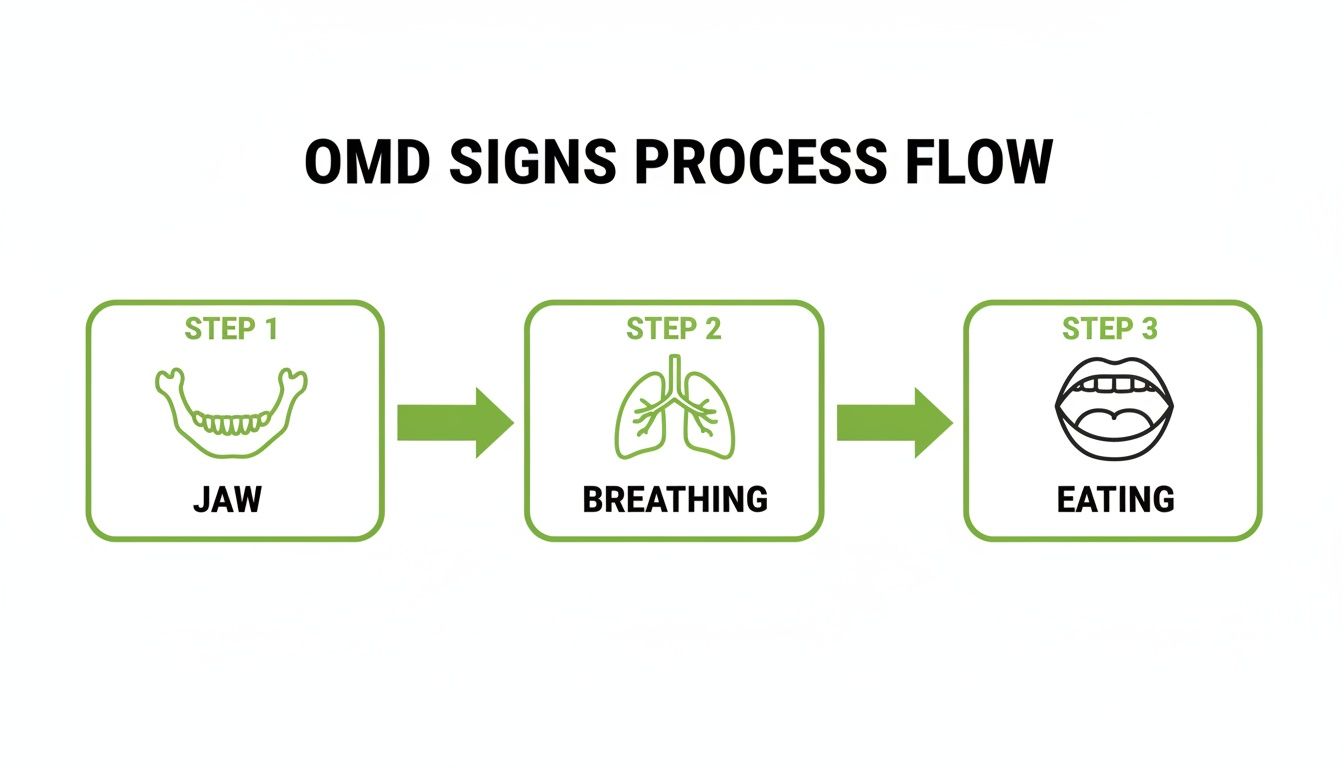
It highlights how dysfunction in the jaw, breathing, and eating are all interconnected signs of an underlying orofacial myofunctional disorder.
The Active Therapy Phase
This is where the real work of creating new habits begins. This phase involves regular sessions with your therapist—often weekly or bi-weekly—and, most importantly, consistent daily practice at home. The exercises themselves are gentle and targeted, focusing on building coordination and awareness.
The goal is not to exhaust your muscles but to re-educate them. Through repetition, these conscious exercises eventually become unconscious, automatic habits.
Consistency is everything. Performing your exercises for just a few minutes each day is far more effective than one long session a week. This steady practice is what actually forges and solidifies new neuromuscular pathways.
Importance of Interdisciplinary Collaboration
Finally, a crucial part of the journey is teamwork. OMT specialists rarely work in a silo. True, lasting success often requires an interdisciplinary approach, where your therapist collaborates with other healthcare providers.
This professional field has a long history of these kinds of partnerships. The formal recognition of orofacial myofunctional therapy grew significantly in the 1970s, with the founding of key professional organizations. The very first meeting of what would become the International Association of Oral Myology (IAOM) in 1972 brought together just 10 or 11 dentists, speech therapists, and orthodontists who understood the power of working together.
This team may include your dentist, orthodontist, an Ear, Nose, and Throat (ENT) doctor, or a sleep medicine physician. This ensures that every aspect of your health is aligned, leading to more comprehensive and lasting results.
Expected Results And Treatment Timelines
When you start orofacial myofunctional therapy, you’re making an investment in your long-term health. It’s completely natural to wonder what changes you can expect and how long it’ll take to see them. The results can be profound, but understanding the timeline is key to setting realistic expectations and staying committed.

Think of this therapy less as a quick fix and more like permanently rewiring your body's old habits. It’s a lot like learning to play a musical instrument—it takes consistent practice to build new muscle memory until the right movements become second nature.
Early Changes And Long-Term Goals
While true, lasting change takes time, many of our patients feel some encouraging improvements pretty quickly. Some of the first benefits people often notice include:
- Easier Nasal Breathing: Many clients report a real difference in their ability to breathe through their nose within the first few weeks, simply by becoming more aware of their habits.
- Reduced Facial Tension: The initial exercises start to release chronic muscle tightness around the jaw and face, which can bring some early relief from discomfort.
- Improved Sleep Awareness: Patients often become more tuned in to their sleep quality, noticing they wake up less or feel a bit more refreshed in the morning.
These early wins are fantastic motivation, but they're just the beginning. The real goal of orofacial myofunctional therapy is to make these new, healthy patterns your body's automatic setting.
The most significant, evidence-based outcomes come from consistent effort over time. We’re aiming for unconscious competence—where proper breathing, swallowing, and tongue posture just happen naturally, without you having to think about it.
This process is all about strengthening specific muscles and forging new pathways between your brain and those muscles. It’s this deep re-education that leads to truly transformative, long-term health gains.
Typical Timelines For Lasting Results
So, how long does this rewiring actually take? Everyone’s journey is a little different, but a typical course of orofacial myofunctional therapy lasts anywhere from several months to a year. The exact duration depends on a few things, like how complex the issue is, how consistent you are with the exercises, and how we collaborate with your other healthcare providers.
A general timeline often breaks down like this:
- Phase 1: Intensive Training (First 2-3 Months): This is where we lay the groundwork. Appointments are usually weekly or bi-weekly, focusing on learning the core exercises and building a solid daily practice at home.
- Phase 2: Habit Formation (Months 3-8): As the exercises become more familiar, appointments might spread out. This phase is all about reinforcing the new muscle patterns until they start to feel automatic.
- Phase 3: Stabilization (Months 8-12+): In the final stage, we shift focus to making sure the new habits are fully locked in for the long haul. Appointments might become monthly or quarterly check-ins to track progress and make any final tweaks.
Patience and persistence are your best friends here. Committing to the full timeline is what allows our patients to achieve life-changing results, like a major reduction in TMJ pain, lower AHI scores for sleep apnea, an end to snoring, and more stable orthodontic outcomes. This investment of time helps many avoid more invasive options like surgery or a lifelong reliance on a CPAP machine.
Ready to Take the Next Step?
Understanding what orofacial myofunctional therapy is can be a real "aha!" moment. But the real change happens when you decide to do something about it. This isn't just another temporary fix; it's a powerful, non-surgical way to get to the root cause of stubborn issues with your jaw, breathing, and sleep. By retraining the muscles that have been working against you, we can help you find lasting relief and truly improve your quality of life.
If you’ve been reading this guide and nodding along, recognizing your own struggles, please know you’re not alone. More importantly, know that there are real solutions out there. The key is to stop just managing symptoms and start correcting the faulty muscle patterns that are holding you back.
Where Do You Go from Here?
It can feel like a lot to take in, so let's break down what your next step might look like based on what you're dealing with.
-
If you’re living with jaw pain, clicking, or constant headaches, an orofacial myofunctional evaluation is the perfect starting point. We can pinpoint the specific muscle imbalances contributing to your TMJ dysfunction. Simply correcting your tongue posture and swallow can take a surprising amount of strain off your jaw joints.
-
For parents worried about a child’s thumb-sucking, mouth breathing, or feeding difficulties, acting early makes all the difference. A consultation can give you a clear roadmap to encourage healthy growth and potentially sidestep the need for complex orthodontic work down the road.
-
If snoring or sleep apnea is robbing you of rest, OMT offers a proven way to strengthen and tone the muscles around your airway. These exercises are a fantastic standalone therapy, but they also work incredibly well alongside treatments recommended by your sleep doctor.
The real goal here is to restore function and build new, healthy habits until they become second nature. Think of it as a direct investment in your long-term wellness.
You Don't Have to Figure This Out Alone
Choosing to start this journey means finding a team that truly gets the intricate connections between your muscles, your breathing, and your overall well-being. Here at the Pain and Sleep Therapy Center, our specialists are committed to providing expert, compassionate care that gets to the heart of the problem. We build personalized programs designed to help you reclaim comfort, restore proper function, and get your life back.
Are you ready to leave pain and restless nights in the past? Don't wait for your symptoms to get worse. Scheduling a consultation is the most direct way to understand exactly what’s going on and discover a treatment plan designed just for you.
Contact us today to take that first, crucial step.
Common Questions About Orofacial Myofunctional Therapy
It's completely normal to have questions as you start exploring orofacial myofunctional therapy. Getting a clear picture of what to expect helps you feel confident and ready for the journey ahead. Here are some straightforward answers to the questions we hear most often.
Is Orofacial Myofunctional Therapy Painful?
One of the first things people worry about is pain, but you can put that concern aside. The answer is simple: no, OMT is not painful. The exercises are gentle and designed to improve muscle coordination, awareness, and strength—not cause strain.
Think of it as personal training for the small, intricate muscles in your face, mouth, and throat. It’s about re-educating them, not pushing them to their limit. You might feel a gentle stretch or become aware of muscles you haven’t used correctly, but you should never feel pain.
Does Insurance Cover Myofunctional Therapy?
This is a very practical and important question. Insurance coverage for orofacial myofunctional therapy can be a mixed bag, varying widely depending on your specific plan and provider. While some plans are starting to recognize its benefits, others may not cover it yet.
The best first step is always to call your insurance company directly to ask about your benefits. We suggest asking specifically about coverage for "myofunctional therapy" or any related codes. Our clinic also offers flexible payment options to make sure care is accessible and fits your budget.
How Is OMT Different From Speech Therapy?
It’s easy to see why people mix these two up, since both involve the mouth. And while there’s some overlap, their primary goals are very different. Speech therapy is all about communication—helping with how sounds are made (articulation), understanding and using words, and fluency.
OMT, on the other hand, zeroes in on how the muscles function for basic life actions.
- Orofacial Myofunctional Therapy (OMT): Focuses on the muscle patterns for proper breathing, chewing, swallowing, and oral rest posture. The goal is to correct dysfunctional habits that affect sleep, jaw health, and even facial development.
- Speech Therapy: Focuses on producing sounds, processing language, and vocal quality. The goal is to make communication clearer and more effective.
At the end of the day, a speech therapist helps you speak correctly, while a myofunctional therapist helps your mouth and face function correctly.
Will I Have to Do the Exercises Forever?
This is a fantastic question because it gets right to the heart of why OMT works so well. The goal isn’t to give you a lifelong list of chores; it’s to build new, automatic muscle memory that sticks.
The whole point of OMT is to retrain your muscles until proper function—like nasal breathing and correct swallowing—becomes your new default, something you do without even thinking about it.
In the beginning, you’ll need to do the exercises daily to build these new pathways. But once those correct patterns are locked in and become second nature, the need for daily practice fades away. Your therapist might recommend an occasional check-in or a quick refresher, but the ultimate goal is for these changes to become permanent and self-sustaining.
At the Pain and Sleep Therapy Center, we believe in giving our patients the knowledge and personalized care they need to heal. If you have more questions or you’re ready to see if OMT is the right path for you, we invite you to take the next step. Learn how our expert team can help you find lasting relief by visiting us at https://pscharlotte.com.