If you're reading this with a sore jaw, a tight temple, a clicking joint, or a neck that never quite relaxes, you're not alone. Many people reach cold laser therapy after they've already tried the usual path: mouthguards, anti-inflammatories, softer foods, stretching, maybe even physical therapy, yet the pain keeps cycling back.
That frustration gets worse when the pain sits in a complicated area like the TMJ, face, or upper neck. These regions are small, crowded, and sensitive. A treatment that works well for a knee or shoulder doesn't automatically translate to the jaw joint or the muscles around the mouth, cheek, and temple.
A cold laser therapy machine can be a useful tool here, but only when the clinician understands dosing, tissue depth, beam placement, and safety around the eyes and facial structures. That's where many generic articles fall short. They explain the basics, but they don't answer the practical questions patients and referring providers ask.
Freedom from Chronic Pain Starts Here
Chronic facial pain has a way of shrinking daily life. You start avoiding chewy foods. You stop yawning fully. You notice yourself clenching during work, while driving, even while trying to sleep. Some patients tell me the worst part isn't the pain itself. It's the sense that nothing has addressed the underlying cause.
Cold laser therapy, also called photobiomodulation or low-level laser therapy, offers a different approach. It is non-invasive, drug-free, and designed to support healing rather than dull symptoms. In a careful treatment plan, it can become part of root-cause care for inflamed joints, irritated muscles, and overworked tissues in the jaw and face.
Why patients ask about it now
People usually arrive at this option for one of three reasons:
- Pain keeps returning: The relief from medication or self-care doesn't last.
- The area is sensitive: They want something gentle for the jaw, face, or neck.
- They want function back: They want to chew, talk, yawn, and sleep without bracing for pain.
For patients comparing conservative options, this overview of TMJ treatment options gives helpful context on where laser therapy may fit alongside other non-surgical strategies.
Clinical reality: A cold laser therapy machine isn't a magic wand. It works best when the diagnosis is clear and the treatment is matched to the tissue involved.
There is also a practical side that referring offices and practice administrators think about. If your team is evaluating how therapies like this fit into documentation and reimbursement workflows, this playbook for pain clinic billing managers is a useful operational resource.
The key question isn't whether laser sounds modern. The key question is whether the machine, settings, and treatment plan match your condition. For TMJ and facial pain, that matters more than is often recognized.
How Cold Laser Therapy Promotes Healing
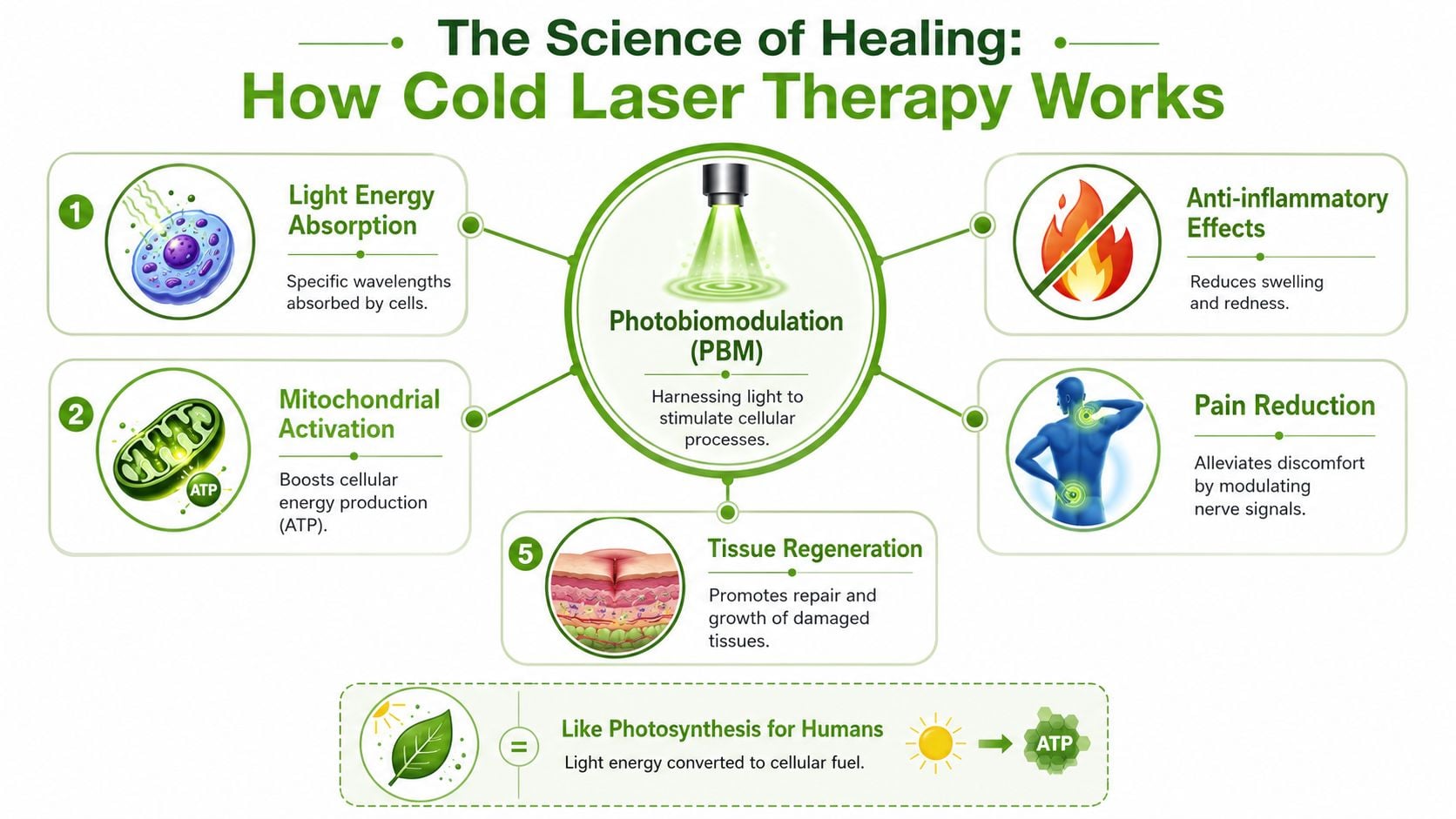
Cold laser therapy works by delivering light to tissue at settings intended to stimulate a biological response without generating the heat associated with surgical lasers. Clinical literature commonly places these devices in the 600 to 1000 nm wavelength range, with 5 to 500 mW often cited for low-level laser therapy devices, according to this technical review of low-level laser therapy parameters.
That sounds technical, but the basic idea is simple. Think of it as photosynthesis for human cells. Plants use light to support energy production. Human tissue doesn't photosynthesize, of course, but certain cells can respond to light in ways that support repair and recovery.
What the light is doing
When the right wavelength reaches the target tissue, clinicians aim to influence cellular activity, especially in tissue that is inflamed, strained, or healing poorly.
In practice, the intended effects usually center on:
- Cellular energy support: Better cellular energy availability can help damaged tissue repair more efficiently.
- Inflammation control: Many treatment plans use PBM to calm an irritated pain cycle rather than just covering it up.
- Pain modulation: Light-based therapy may help reduce the sensitivity of painful tissues and irritated nerves.
- Recovery support: It is often used where clinicians want to encourage tissue repair after overuse, injury, or procedures.
Why it doesn't feel like a surgical laser
Patients often hear the word "laser" and assume heat, burning, or cutting. That's not what this therapy is designed to do.
A surgical laser destroys or removes tissue. A cold laser therapy machine is chosen specifically to deliver low-intensity light so the tissue can be treated without the heat and tissue damage associated with surgical lasers. That distinction matters, especially in the jaw and face, where comfort and precision are essential.
The goal is stimulation, not destruction.
Why depth matters
Not all painful structures sit at the same depth. Skin, superficial muscle, trigger points, joint capsule tissue, and deeper muscles don't all respond to the same setup. That's why wavelength selection, beam area, and treatment time matter so much.
Another point that often gets missed is that light doesn't deliver its full energy straight to deep tissue. Some of that energy is absorbed before it reaches the target. That is one reason experienced clinicians think in terms of dose at the tissue, not just the number printed on the machine.
A good laser treatment isn't defined by hype. It's defined by whether the clinician can answer a practical question: what tissue are we targeting, how deep is it, and how much energy needs to arrive there?
Clinical Uses and Proven Benefits
Cold laser therapy has moved well beyond novelty. The global cold laser therapy market was valued at USD 420.28 million in 2024 and is projected to reach USD 709.26 million by 2032, reflecting a 6.76% CAGR over the forecast period, according to Data Bridge Market Research's cold laser therapy market analysis. That growth doesn't prove that every machine or every protocol is effective, but it does show steady adoption of this modality as a mainstream non-invasive tool.
For clinicians, the more useful question is where it fits in actual care.
Where it tends to help most
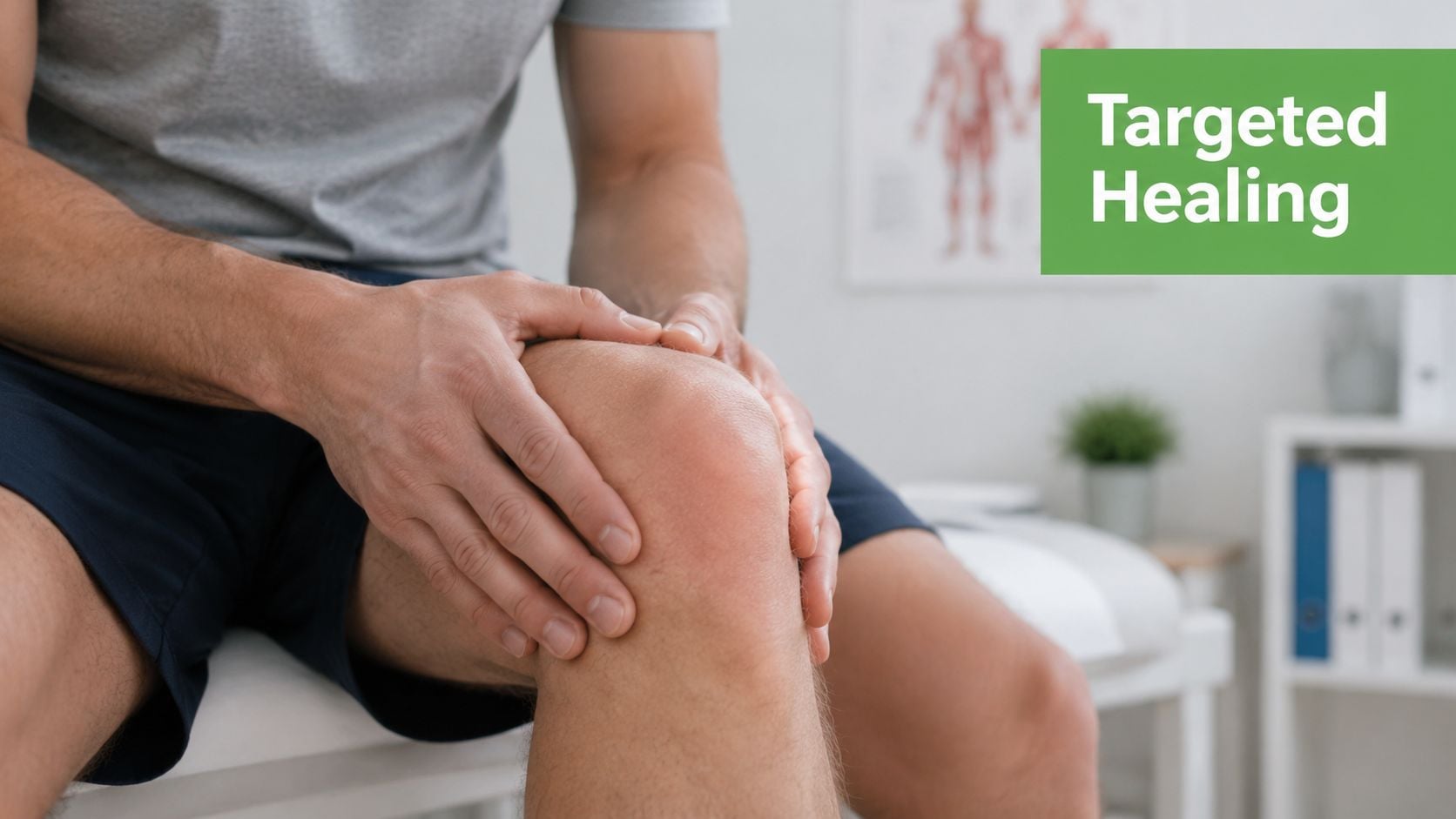
A cold laser therapy machine can be used across a wide range of musculoskeletal and rehabilitation settings. In facial pain and TMJ-focused practice, the most practical applications include:
- TMJ disorders: For joint irritation, painful opening, tenderness over the jaw joint, and muscle guarding around the cheeks and temples.
- Orofacial pain: Useful when pain involves the muscles of chewing, facial trigger points, or tissue irritation around the jaw and mouth.
- Tension-related head and neck symptoms: Often considered when jaw dysfunction and upper cervical muscle tension feed into each other.
- Recovery after procedures: Clinicians may use it to support tissue healing after dental or oral procedures when the goal is a gentler recovery.
- Regenerative care support: It can be paired with broader treatment plans that focus on tissue healing rather than symptom suppression alone.
For readers who want a condition-specific overview, this page on cold laser therapy for pain relief shows how one TMJ-focused clinic describes its use in care.
What patients usually care about
Patients rarely ask about wavelength first. They ask whether they can eat without pain, turn their head more easily, or stop waking up with jaw tension.
The benefits they usually notice fall into a few practical buckets:
| Concern | What cold laser therapy may support |
|---|---|
| Jaw pain | A calmer pain response in irritated soft tissue and joint structures |
| Tight muscles | Reduced guarding in overworked facial and neck muscles |
| Limited function | Easier opening, chewing, and speaking when inflammation settles |
| Procedure recovery | Support for tissue repair in a non-invasive format |
What works best: Laser therapy tends to perform better as part of a targeted plan than as a stand-alone add-on with no clear diagnosis.
Where clinicians make mistakes
The biggest mistake is using it too generally. A provider treats "the jaw area" without deciding whether the actual target is the joint capsule, masseter, temporalis, pterygoid region, cervical muscles, or post-procedural tissue.
The second mistake is assuming all pain responds the same way. Acute irritation, chronic overload, and tissue that has been dysfunctional for a long time may each need a different approach. That is why the machine matters, but the clinical reasoning matters even more.
Used well, laser therapy becomes one tool in a broader strategy to reduce inflammation, improve function, and support tissue healing without pushing the patient toward surgery or long-term medication.
Why the Right Machine Matters for Your Condition
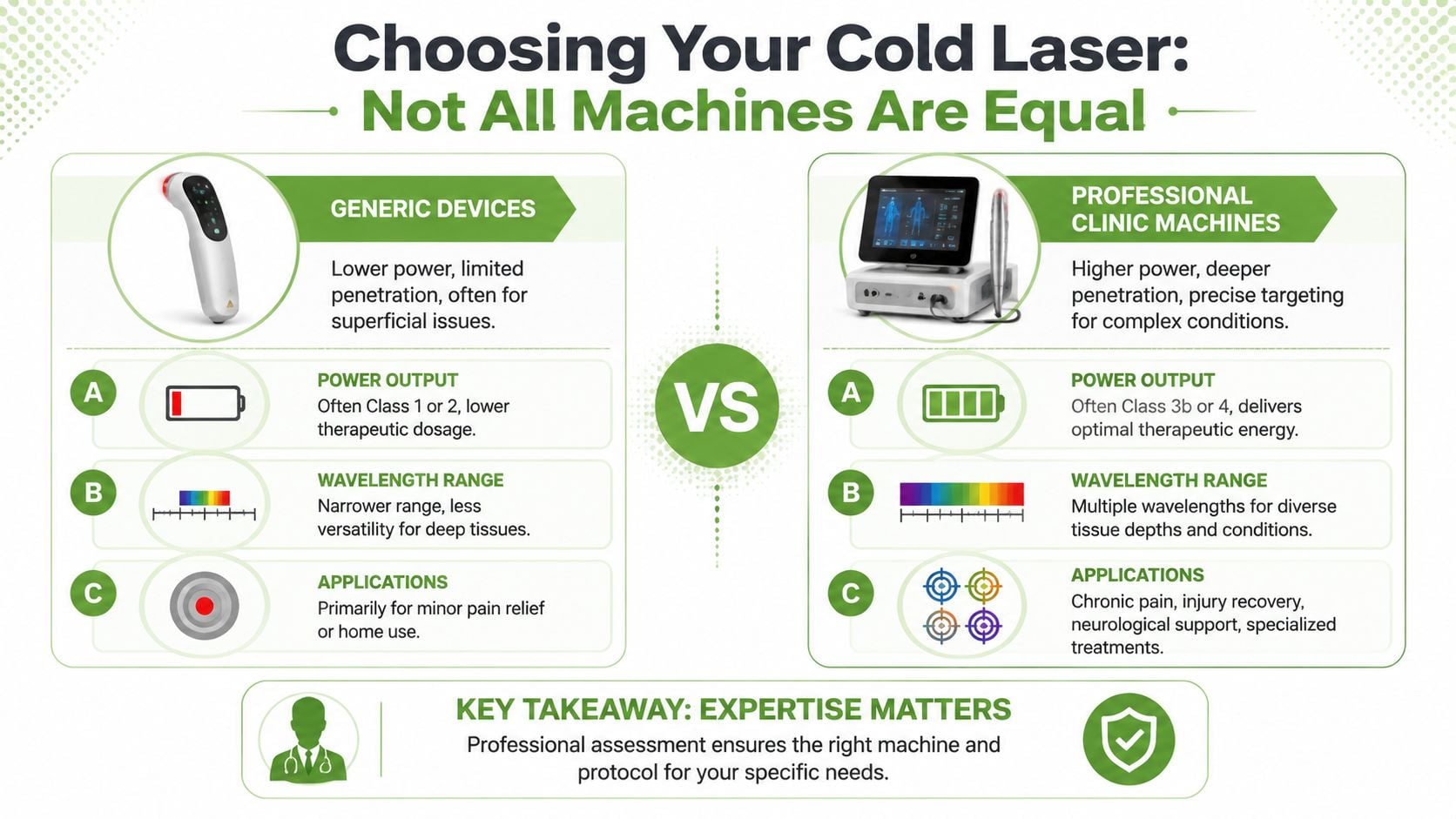
Many people assume a cold laser therapy machine is basically interchangeable. It isn't. Two devices can both be called lasers and still behave very differently in actual treatment.
That becomes especially important in the TMJ and face, where the treatment zone is small and the anatomy is crowded. A machine that works acceptably for a broad hamstring or knee region may be awkward, imprecise, or poorly matched for the jaw joint.
TMJ is not a large-joint problem
A 2024 review in the Journal of Clinical Dentistry noted that 80% of LLLT studies address large joints, while less than 12% focus on craniofacial applications. That gap helps explain why so many clinicians are left without standardized equipment guidance for the jaw and facial region.
The variables that change treatment quality
When I evaluate whether a machine is suitable for TMJ or facial pain work, these are the issues that matter most:
- Wavelength: Different wavelengths are used for different depths. Some are better suited to more superficial tissue, while others are chosen when the target sits deeper.
- Power output: Power affects how quickly energy can be delivered, but more power alone doesn't guarantee a better treatment.
- Beam area and spot size: Small structures need controlled coverage. If the beam is too broad, precision drops.
- Applicator design: The shape and usability of the handpiece matter when working near the jawline, cheek, ear, and eye region.
- Collimation and targeting: A clean, controlled beam helps the clinician treat the intended structure rather than "washing" a general area.
Power is not the same as dose
Often, purchasing choices are misjudged. Clinicians and patients often compare machines by watts alone, but treatment effect depends on the actual dose delivered.
A practical way to think about it is this:
| Machine feature | Why it matters |
|---|---|
| Watts | Influences how quickly the device can deliver energy |
| Time | Determines how long the tissue is exposed |
| Beam area | Affects how concentrated or spread out the energy is |
| Joules and J/cm² | Reflect the actual therapeutic dose delivered |
The dosing relationship is straightforward: Joules = Watts × seconds, and energy density = (power × time) ÷ beam area, as outlined in this clinical buying guide for cold laser therapy devices.
Practical rule: The right machine for TMJ is the one that lets the clinician deliver a precise dose to a small target safely and repeatably. It isn't automatically the strongest machine in the room.
For deeper targets, this gets even more important. WALT-aligned dosing is commonly expressed as 4 to 12 J/cm² at the target tissue, not at the skin surface, and because 70 to 90% of energy is absorbed before reaching depth, clinicians may need roughly 5 to 10 times higher surface energy to treat deeper tissue effectively. Some systems therefore operate up to 50 W to reduce treatment time while reaching deeper structures, as discussed in these power level requirements for therapeutic laser dosing.
That doesn't mean every TMJ patient needs a high-output system. It means the provider must understand the trade-off between depth, time, comfort, and control.
What to Expect During Your Treatment
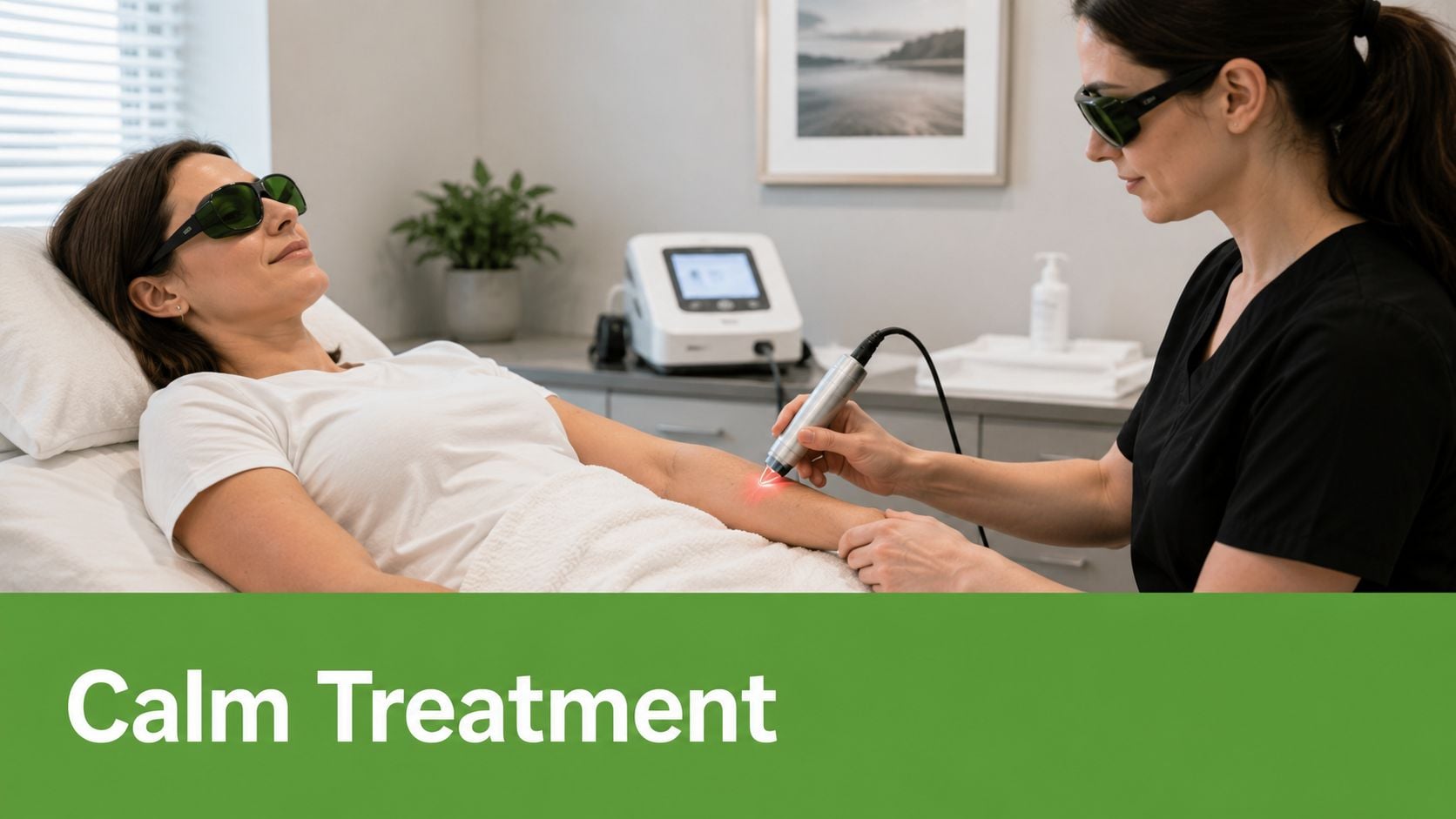
The treatment experience is usually much simpler than patients expect. You don't need sedation. There isn't a recovery room. In most cases, you sit or recline comfortably while the clinician positions the applicator over the target area.
What happens first
The visit starts with a focused exam. For TMJ and facial pain, that often means identifying whether the main source appears to be joint irritation, muscular overload, postural strain, trigger points, or a mixed pattern.
Then the actual treatment setup is straightforward:
- Protective eyewear goes on. This is a standard safety step for both patient and clinician.
- The target area is positioned. The jaw joint, cheek muscles, temple, or upper neck may be treated depending on the plan.
- The applicator is placed carefully. In some cases it rests directly on the skin. In others, it is positioned very close to the treatment site.
- Energy is delivered for a brief interval. The clinician adjusts time and placement based on the tissue being treated.
What it feels like
Most patients are surprised by what they don't feel.
There is usually no cutting, no vibration, and no sharp sensation. Some people feel nothing at all. Others notice a mild awareness at the treatment site. For facial areas, comfort matters, so a good operator pays close attention to positioning and pacing.
If a patient is anxious about laser, I usually tell them the session feels far less dramatic than the word "laser" suggests.
How it fits into a real care plan
Laser therapy often works best when it supports other parts of treatment rather than trying to carry the whole case by itself. A patient with TMJ pain may also need bite-related evaluation, muscle retraining, breathing work, or guided exercises for the neck and jaw.
That is especially true when pain has become chronic. At that stage, the goal isn't just to calm one tender point. It's to reduce the drivers that keep re-irritating the area.
Sessions are typically brief, with patients able to return to normal daily activities right away. The more important question isn't whether the session is easy. It usually is. The important question is whether the treatment is being repeated in a way that matches the biology of healing.
Safety Limitations and Contraindications
Cold laser therapy has a strong appeal because it is non-invasive, comfortable, and generally easy to tolerate. Those are real advantages. They should not be confused with "works for everything" or "requires no caution."
A careful clinic treats laser as a medical tool, not a spa gadget. That means screening the patient, defining the target tissue, using protective eyewear, and avoiding areas where treatment is not appropriate.
Safety first, especially near the face
The most consistent safety rule is simple: protect the eyes. That matters in every treatment, but it matters even more in TMJ and facial work because the target is physically close to the orbit.
Clinicians also use judgment about where not to apply treatment. In routine practice, that usually means avoiding direct treatment over:
- The eyes
- The thyroid region
- Known or suspected cancerous tissue
- Pregnancy-related treatment zones when caution is indicated
Limitations patients should know upfront
Patients usually appreciate honesty here. Laser therapy is a healing modality, not an instant reset button.
A few practical limits are worth stating clearly:
- Results are often cumulative: Some people notice change quickly, but many improve over a series of visits.
- Diagnosis still matters: If the pain source is misunderstood, even a good machine may be used poorly.
- Mechanics matter too: If clenching, airway issues, posture, or muscle patterning keep reloading the area, symptom relief may fade unless those drivers are addressed.
For patients who want an even gentler non-pharmacologic option in the same general treatment conversation, acupuncture without needles is another modality some clinics use for pain modulation without traditional needle insertion.
Good safety protocols don't make a treatment sound weaker. They show that the clinician respects the anatomy and the biology.
Frequently Asked Questions About Cold Laser Therapy
Does the treatment hurt
Usually, no. Most patients feel very little during treatment. For facial and TMJ cases, the session should feel calm and controlled, not aggressive.
How many sessions will I need
That depends on the diagnosis, the tissue involved, and whether the problem is recent or longstanding. Acute irritation may respond faster than chronic pain with muscle guarding and joint overload. In practice, treatment is usually planned as a series rather than a one-time event.
Is a stronger machine always better
No. This is one of the most common misunderstandings.
For deep TMJ tissue, a dose of 10 to 15 J/cm² is often needed to trigger a therapeutic response. But that doesn't mean a higher-watt machine is automatically better. If the clinician doesn't use enough treatment time, even a higher-power device may fail to deliver the needed total energy in joules for effective healing.
How is the correct dose determined
The clinician has to think about four things together:
- Target depth: Superficial tissue and deeper joint structures don't need the same approach.
- Machine output: Power affects delivery speed, not just treatment strength.
- Treatment time: Time determines how much total energy reaches the tissue.
- Contact area: Dose must be matched to the size of the area being treated.
That is why dose calculation is more important than marketing language. A machine's watt rating tells you something, but not enough by itself.
Is this covered by insurance
Coverage varies by plan and by clinic. Patients should ask the treating office and their insurer how a specific service is handled. Referring clinicians should also be aware that coverage policies often lag behind clinical adoption.
Can it be combined with other treatments
Yes. In many practices, laser therapy is one part of a broader plan. It may be paired with exercise-based care, occlusal management, breathing and myofunctional work, or regenerative approaches depending on the diagnosis.
What should I ask before starting
Ask practical questions:
- What tissue are you targeting
- Why is this machine appropriate for my condition
- How do you determine dose
- How will you measure progress if my pain is in the TMJ or face
Those questions tend to separate thoughtful care from generic add-on treatment.
If you're dealing with jaw pain, facial tension, headaches, or sleep-related issues that may be tied to TMJ dysfunction, Pain and Sleep Therapy Center offers evaluation and non-surgical care that may include cold laser therapy when it fits the diagnosis. The clinic focuses on TMJ disorders, facial pain, and airway-related problems, with treatment plans built around the underlying cause rather than short-term symptom masking.