
The pediatric dental formula is 2.1.0.2 per quadrant, and that gives a child 20 primary teeth in total. That's the key difference from the 32-tooth adult set, and it's why a child's mouth needs its own roadmap, not just a smaller version of adult care.
A parent usually notices this difference at a very ordinary moment, after the first tiny tooth appears, or before a first dental visit when someone asks how many teeth should be there. A clinician sees the same question in a different form, a chart, a sleepy toddler, and a mouth that is changing fast.
What the Pediatric Dental Formula Means
A child's mouth can feel mysterious right up until the first tooth breaks through. One day you are wiping gums after feedings, and the next day you are looking at a small white edge and wondering what comes next.
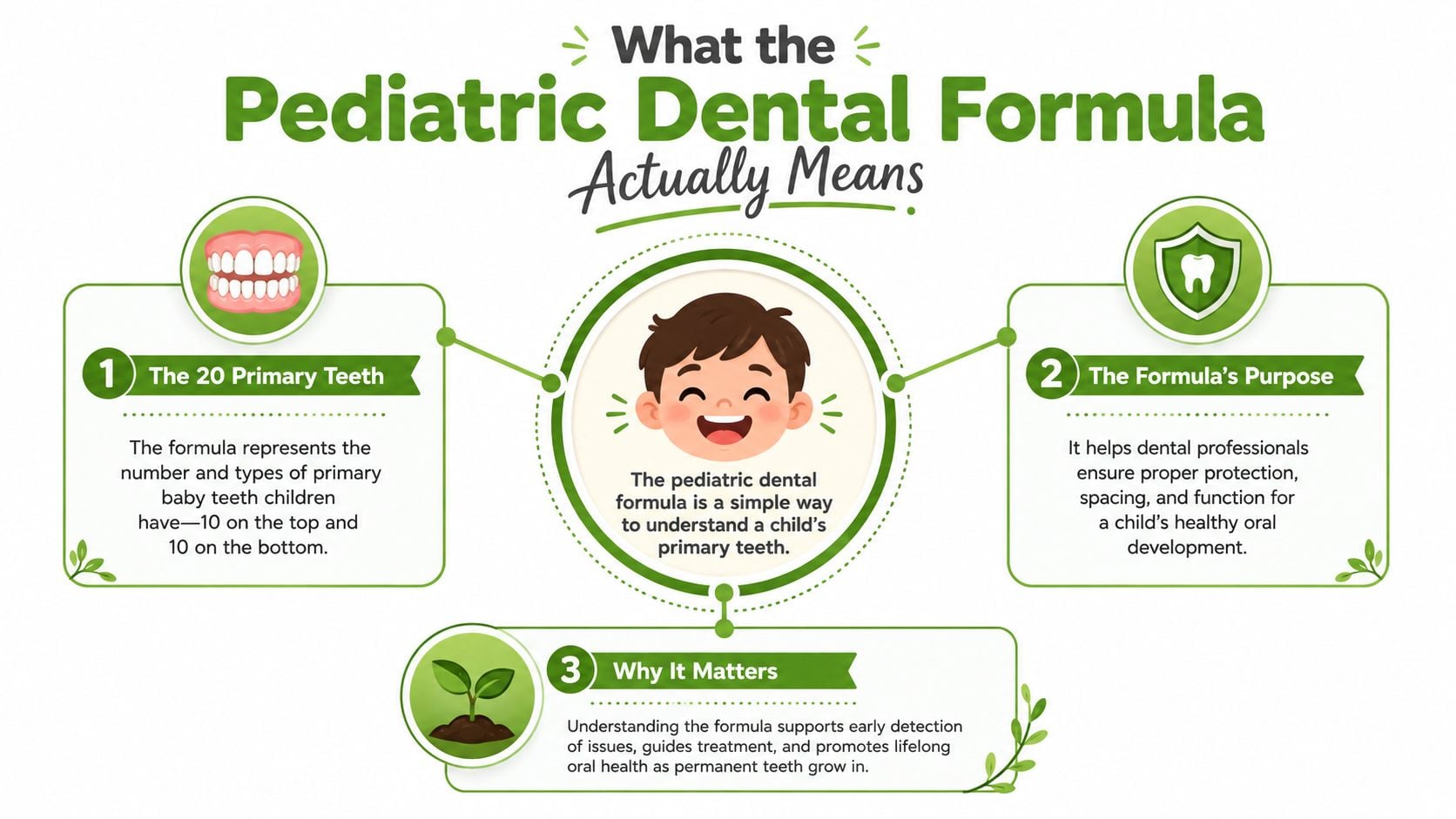
The pediatric dental formula gives that pattern a clear shorthand. 2.1.0.2 / 2.1.0.2 means that in one half of the upper jaw and one half of the lower jaw there are 2 incisors, 1 canine, 0 premolars, and 2 molars. Read across both sides of both jaws, and the full pattern adds up to 20 primary teeth. That notation is the same kind of dental shorthand used in basic biology references and child dentistry explanations (Vedantu, Affiliated Dentists).
Why dentists use this shorthand
Dentists, biologists, and people who estimate age in forensic or anthropological settings all use the same general idea, a tooth formula gives a quick snapshot of dental development. For parents, the value is more practical. It shows that a child's mouth is built around a smaller, temporary set of teeth before the permanent set arrives (Vedantu).
That matters because the formula is not just a label. It helps explain what to expect at each stage, which teeth should be present, and why a baby tooth that looks small still has a job to do. Chewing, speech development, and spacing for later growth all depend on that first set of teeth.
Practical rule: if you know the formula, you know the basic structure of a child's mouth, and that makes the rest of dental care easier to follow.
How to Read the Formula Step by Step
A parent can read 2.1.0.2 the same way a clinician reads a simple map. Each quadrant follows one pattern, and that pattern tells you what belongs in a child's mouth at each stage of early development.
Reading each number in plain language
- 2 incisors means the two front teeth used for biting food.
- 1 canine means the pointed tooth beside the incisors.
- 0 premolars means baby teeth do not include premolars.
- 2 molars means the back teeth that grind food during chewing.
The slash in 2.1.0.2 / 2.1.0.2 divides the upper and lower jaws. The first half refers to the upper right and upper left sides, and the second half follows the same pattern for the lower jaw. Read together, the formula shows the full primary dentition and totals 20 primary teeth.
A quick comparison with adult teeth
Adult teeth follow a different pattern because the mouth is built for a later stage of growth. The adult formula is 2.1.2.3, while the pediatric formula is 2.1.0.2. That difference is easiest to see in the back of the mouth, where premolars appear only after the primary teeth are replaced.
| Tooth Type | Pediatric per quadrant | Permanent per quadrant |
|---|---|---|
| Incisors | 2 | 2 |
| Canine | 1 | 1 |
| Premolars | 0 | 2 |
| Molars | 2 | 3 |
The table shows the pattern clearly. The pediatric formula reflects a different stage of development rather than a gap in the tooth count.
Why Baby Teeth Have No Premolars
A parent may notice that a child's mouth seems to skip a step. The space is there, the front teeth are there, and the back teeth are there, yet premolars never appear in the baby set. That is normal.
A mouth designed for growth
Primary teeth fit a growing jaw. They give a child enough help for biting, chewing, and speech while the jawbones keep expanding and the permanent teeth develop underneath and behind them. The smaller primary set supports staged jaw growth rather than requiring all permanent teeth at once.
That is why the pediatric formula ends with 2 molars in each quadrant and leaves out premolars entirely. Premolars belong to the permanent dentition, where they fill the middle space between the canines and molars and help build the adult chewing pattern.
What that means for families
A child who has no premolars is not missing teeth that should already be there. You are usually looking at the normal first set of teeth, arranged for an earlier stage of development.
That difference changes what parents and clinicians watch for at each stage. In the baby years, the goal is spacing, comfort, chewing, speech, and keeping the teeth healthy until they are ready to fall out. Later, when the first permanent back teeth and the 2-year molars begin to come in, two-year molars symptoms become part of the conversation because those teeth can bring pressure, sore gums, and sleep disruption.
A useful way to read the mouth is this. The primary dentition is a separate developmental system, built for a shorter job before the permanent teeth take over.
Typical Eruption Order by Age
A parent's first real question usually isn't about formulas. It is, “Which tooth should come next?” The mouth usually follows a familiar order, even though healthy children can still vary by months in either direction.
The usual sequence in early childhood
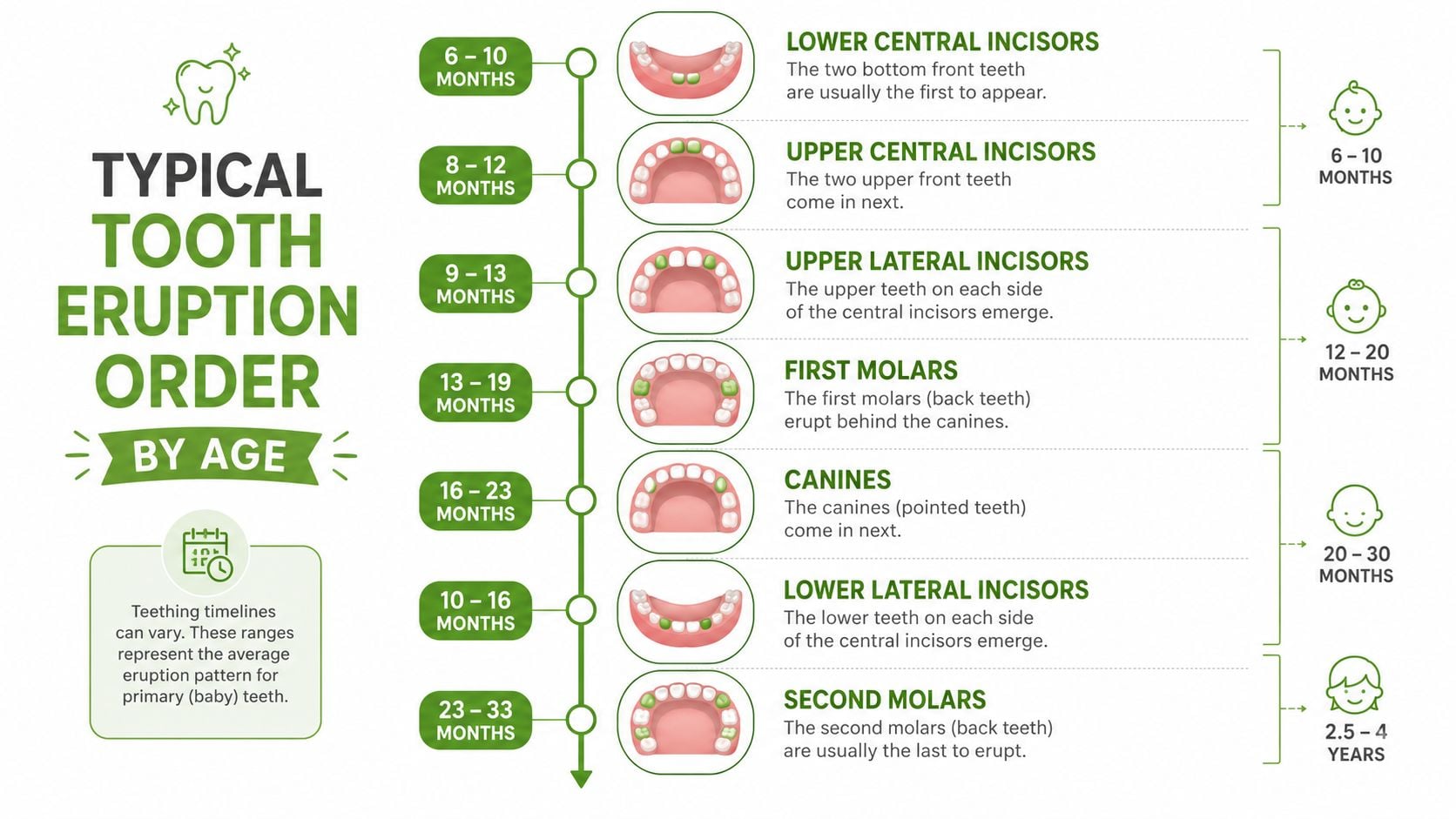
The first teeth to show are often the lower central incisors, usually around 6 to 10 months. After that, the upper central incisors and upper lateral incisors come into the front of the smile, then the lower lateral incisors and the first molars, followed by the canines, and finally the second molars. By about 2.5 to 4 years, the full primary set is typically in place. Around age six, the mouth begins the mixed-dentition phase, as baby teeth start to exfoliate and permanent teeth come in. The usual eruption pattern can be tracked in a detailed primary tooth eruption timeline, which helps parents see the order at a glance.
Parents often think of teething as one event. It is really a long sequence, and that is why a child can seem to be “getting teeth forever.”
When variation is still normal
Some children erupt early, some late, and many fall somewhere in between. What matters most is the overall pattern, symmetry over time, and whether a child is eating, growing, and comfortable enough to keep progressing.
A few teething episodes are easy to separate from a larger concern, but the back molars can make the picture feel muddy. Those teeth often bring chewing changes, fussiness, and sleep disruption, so parents who are sorting out ordinary teething from a more difficult stretch may find this guide to 2-year molar symptoms helpful.
When brushing gets harder as back teeth come in, families may also need a tool that reaches the narrow spaces more easily. A practical place to start is how to choose a kids water flosser, especially when a child is old enough to cooperate but still needs help cleaning the back of the mouth.
Turning the Formula Into a Prevention Plan
The formula matters most when it turns into a habit. Parents do not need a dental textbook, they need a clear plan for what to do as each tooth stage arrives.
Infant care
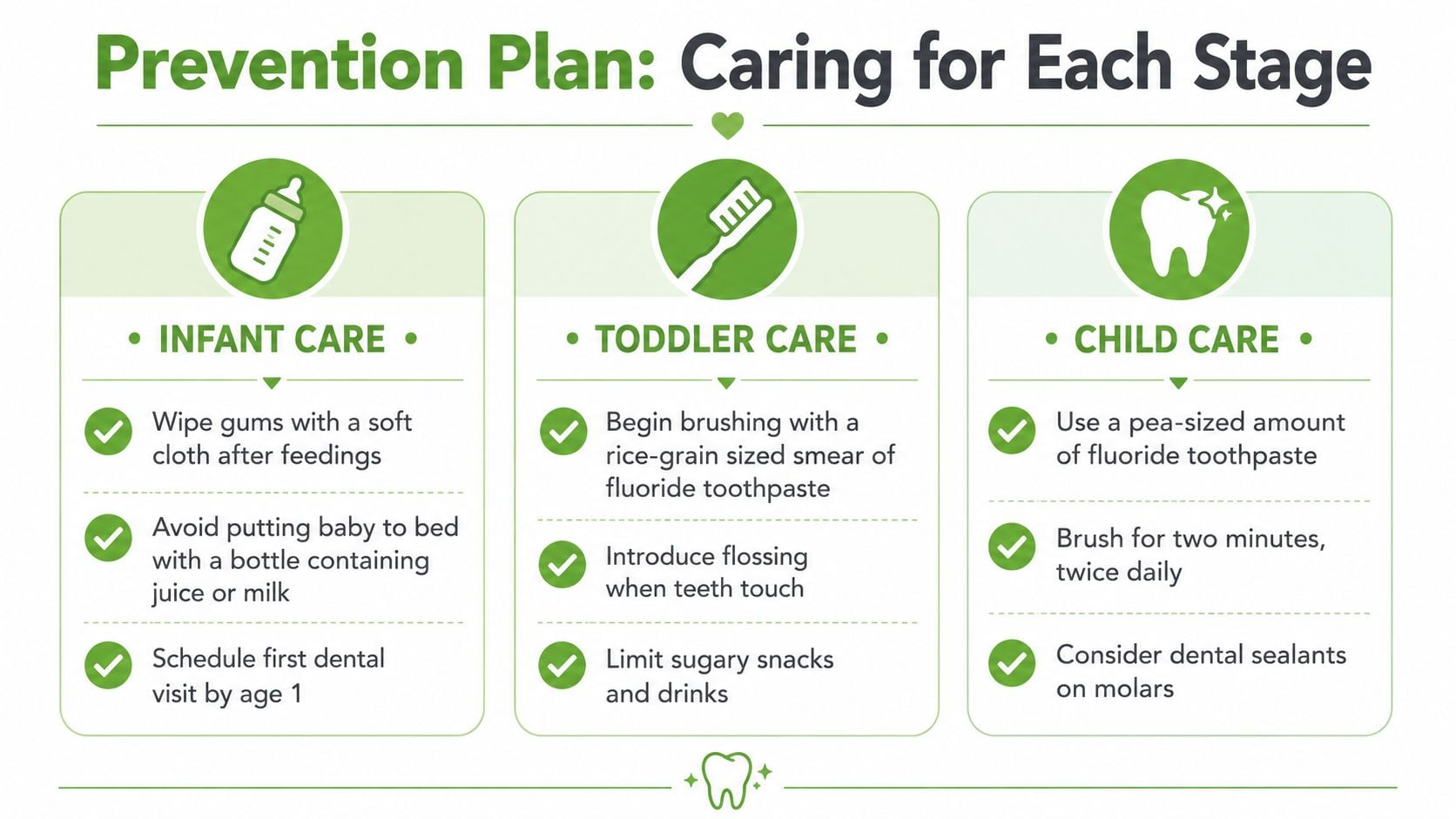
The early months are about protection before the mouth feels “toothy.” During infancy, the focus is on reducing sugar exposure, cleaning gently, and getting parents used to the idea that the mouth needs care long before every tooth is in place. A recent narrative review links infancy and early childhood caries risk with feeding patterns such as bottle exposure to sugary drinks, and it emphasizes parental education, early checkups, and fluoride toothpaste in a rice-grain-sized amount for children under 3 years (PMC narrative review).
A simple routine helps a lot. Wipe gums early with a soft cloth after feedings, avoid bedtime bottles with juice or milk because prolonged contact raises risk, and plan the first dental visit early so you can get guidance before problems start. If feeding habits are already a concern, this guide to infant feeding problems can help parents think about how mouth care and feeding choices affect the same small space.
Toddler care
Once teeth are visible, brushing becomes a daily job for adults, not a skill children can do well on their own. At this stage, the mouth is crowded enough that plaque can settle along the gumline and between teeth, so the routine has to become more deliberate. The same review supports fluoride toothpaste for young children, and that advice fits with routine pediatric oral health guidance.
Brushing is only part of the picture. If flossing feels awkward in a busy house, some families do better with a water flosser once teeth are touching, because it can reach the narrow spaces where a brush misses. A practical overview of how to choose a kids water flosser can help parents decide whether that tool fits their child's routine.
Simple habit stack: brush twice daily, supervise every brush, and keep sugary drinks from turning into a constant background exposure.
Mixed dentition and beyond
As baby teeth loosen and permanent teeth appear, the focus shifts to protecting both sets at once. This is the point where a child's mouth can feel like a worksite, with one tooth falling out, another erupting, and chewing surfaces changing shape at the same time. Sealants, ongoing fluoride use, and orthodontic screening become more relevant, especially as spacing changes and molars settle into place.
Why Those 20 Teeth Are Worth Fighting For
A child's primary dentition is small, but it does a lot of work. Those teeth help with chewing, speech, and keeping the jaws and arches ready for the permanent teeth that will follow, so problems in this short-lived set can create long-lasting effects.
The risk is not theoretical. In the United States, the NIDCR reports that 23% of children ages 2 to 5 had dental caries in their primary teeth during 2011 to 2016, and 10% already had untreated decay in that age group. By ages 6 to 8, the prevalence rises to 52%, which shows how quickly disease can build across the primary set before and during the mixed-dentition years (NIDCR).
The CDC's 2024 Oral Health Surveillance Report adds that more than 1 in 10 children ages 2 to 5 had at least one untreated cavity, and by ages 6 to 8 it was nearly 1 in 5. For parents, that means decay in baby teeth is common enough that routine prevention has to start early, before a small spot becomes a broken tooth or a painful infection (CDC 2024 Oral Health Surveillance Report).
A few feeding patterns can raise that risk even before a child is old enough for a full brushing routine. Parents who are trying to sort out infant feeding problems that increase cavity risk often need to look at bottles, nighttime comfort habits, and how often the mouth is exposed to sugar, because those details affect the same small tooth surfaces that are just starting to erupt.
Why decay in baby teeth still changes the future
Early loss of a baby tooth can affect chewing, speech, arch integrity, and the space available for the permanent tooth that follows. Families often think of a decayed baby tooth as temporary, but the effect on function can last long after the tooth is gone.
The point is not to frighten parents. It is to make the 20-tooth set feel like what it is, a limited resource that needs protection during the exact years when families are most tempted to relax about it.
Practical rule: treat a primary tooth that hurts, darkens, or breaks down as a real dental problem, not a tooth that can simply be waited out.
Access, Equity, and When to Refer
A pediatric dental formula can tell a parent what teeth should be present, but it cannot guarantee that care is easy to reach. A child may need help long before a family can find a dentist who accepts their insurance, treats children, and has room on the schedule.
That gap matters most for families who already face extra barriers. Work on equitable oral health access shows that structural limits shape who gets preventive care, especially for children with public insurance and for children with special health care needs. In that study, unmet preventive and specialized dental needs were reported more often in some regions, and the pattern points to a system problem, not a family failing (JHA study).
What referral should look like in real practice
For clinicians, the formula is the starting line, not the finish line. A child with persistent mouth breathing, tongue-tie concerns, sleep-disordered breathing, or early malocclusion needs a closer look because those findings can affect how the mouth works day to day, from eating to sleeping to growth.
Parents can use the same rule at home. If something feels off, ask for a referral early instead of waiting for the next routine visit, because delay often means the problem has more time to shape function. Care models also point toward telehealth and broader access strategies for rural pediatric oral health, since reaching the right clinician is often the hardest part.
This pediatric frenectomy resource can help parents and clinicians decide whether tongue-tie or oral function may be part of the concern.
Practical Takeaways and Common Questions
The pediatric dental formula is a map, not a memorization test. Use it to match age, tooth type, and action.
- Infants: wipe gums, avoid sugary bedtime bottles, and arrange early dental guidance.
- Toddlers: supervise brushing, use the right fluoride toothpaste amount, and keep an eye on eruption order.
- Mixed dentition: watch spacing, protect molars, and ask early about orthodontic or airway concerns.
Can the formula change as children grow? Yes, the primary formula gives way to the permanent one as baby teeth exfoliate and adult teeth erupt.
When should delayed eruption worry me? If the pattern is far outside the usual sequence or a tooth seems stuck for months, ask a dentist to check the eruption path.
What if a baby tooth is knocked out or badly decayed? Call a dental professional promptly. Primary teeth still matter for space, comfort, and function.
When is specialized care worth considering? If tongue-tie, mouth breathing, or sleep concerns keep showing up, an airway-focused or pediatric oral evaluation can help clarify the cause.
The pediatric dental formula is most useful when it helps you act early, not when it stays on the page.
Pain and Sleep Therapy Center helps families and clinicians look beyond isolated tooth concerns and connect oral function with breathing, growth, and comfort. If your child needs a thoughtful evaluation for tongue-tie, airway concerns, or related oral health issues, visit Pain and Sleep Therapy Center to learn how their team approaches root-cause care.