You can be halfway through brushing your teeth, taking a sip of cold water, or stepping into a windy parking lot when it happens. A sudden jolt cuts across one side of the face, sharp enough that you stop moving and start wondering if the problem is a tooth, a sinus, the jaw joint, or something deeper. That kind of face pain is frightening because it feels ordinary at first, then it behaves in a way ordinary pain usually doesn't.
Trigeminal nerve pain is a broad way to talk about pain driven by the trigeminal nerve, the main sensory nerve of the face. In classic trigeminal neuralgia, the pain is often brief, severe, and shock-like, but not every facial pain pattern means the same thing. Some problems start in the teeth, some in the jaw joint, and some in the nerve itself, which is why sorting the pattern matters so much.
What Trigeminal Nerve Pain Actually Feels Like
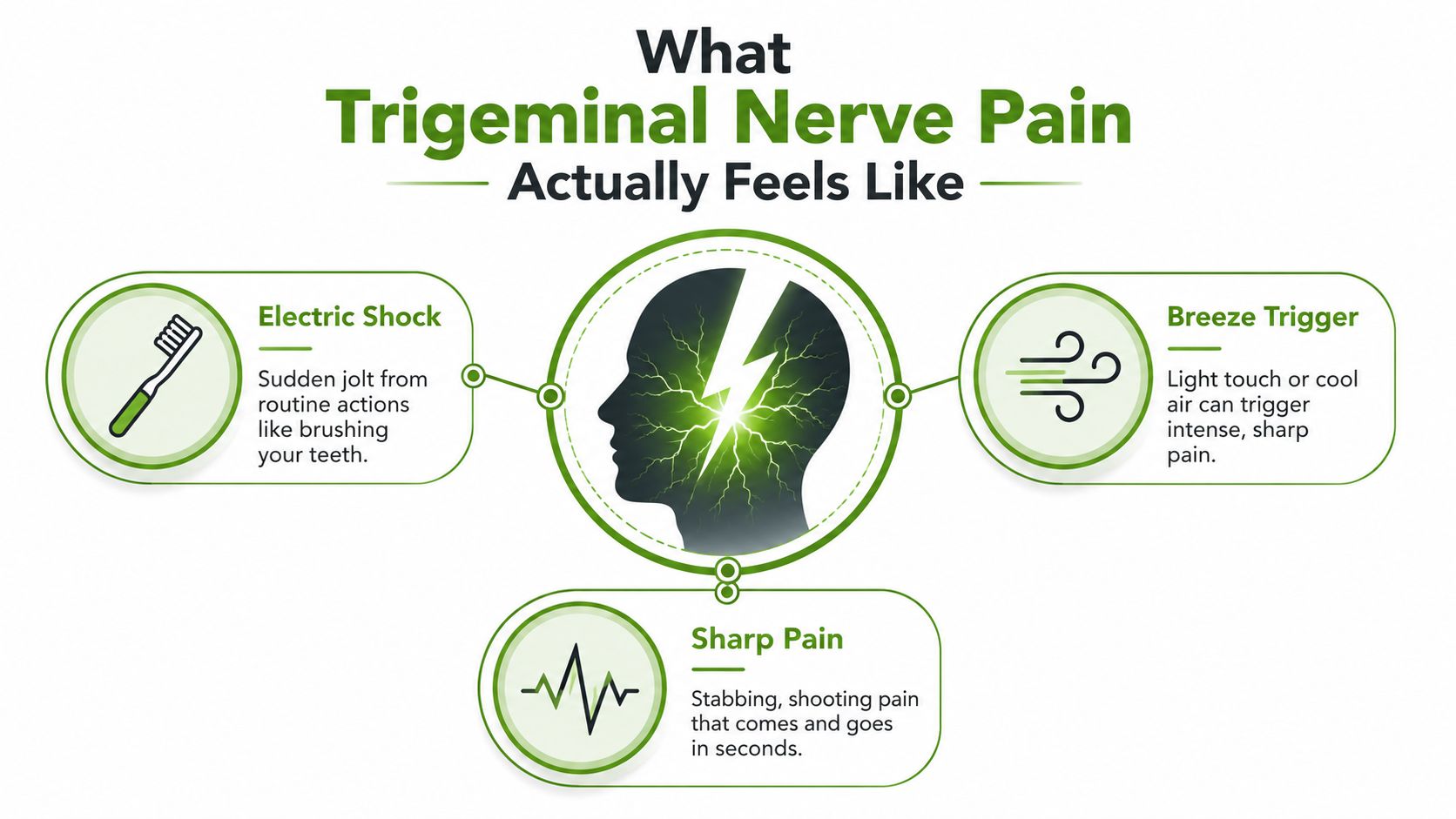
A person with trigeminal nerve pain often describes a pain that doesn't build slowly, it arrives all at once. It may feel like an electric shock, a stab, or a sudden burst of sharp pain on one side of the face, and routine actions like brushing teeth, chewing, talking, or a light breeze can set it off. That pattern is one reason this condition gets confused with dental pain, because the mouth and jaw are common trigger zones.
The practical clue is not just that the pain is severe. It's that it is brief, abrupt, and trigger-sensitive, which makes it different from the more steady, aching discomfort people usually associate with a toothache, sinus pressure, or a sore jaw joint. In classic trigeminal neuralgia, attacks are often unilateral and can be hard to predict, which is why people start guarding their face, eating differently, and avoiding cold air.
Practical rule: if a harmless stimulus causes a lightning-quick facial pain attack, think about the nerve first, not just the tooth.
The trigeminal nerve itself helps explain the experience. It functions as a three-lane sensory highway running across the face. Each lane serves a different zone, so pain can appear in the forehead, cheek, upper jaw, lower jaw, or around the eye depending on which branch is irritated.
The nerve doesn't just carry sensation. It also helps power the chewing muscles, so face pain and jaw dysfunction can overlap in the same person. That overlap is exactly why a patient can feel sure the problem is “a tooth” while the source is higher up in the nerve pathway.
Anatomy of the Trigeminal Nerve Made Simple
A patient may point to the cheek and swear the problem is “the tooth,” while the source sits farther back in the nerve pathway. That confusion makes more sense once the trigeminal nerve is broken down into its three main divisions, because each one serves a different facial neighborhood.
The first branch, V1, the ophthalmic division, covers the forehead, upper eyelid, and eye region. The second, V2, the maxillary division, carries sensation from the cheek, upper lip, upper teeth, and upper gum. The third, V3, the mandibular division, reaches the lower jaw, lower lip, lower gum, and also helps with chewing muscles.
A clearer mental model is a street map with three neighborhoods on it. If irritation occurs along one route, the pain is felt in that route's territory, even when the problem is farther up near the nerve root. That is why V2 pain can resemble a sinus complaint or upper tooth pain, while V3 pain can look like lower dental pain or a jaw joint problem.
The brain does not tag the source for you. It receives the distress signal from the branch that is irritated and localizes the pain to the mapped facial area. That is one reason facial pain can be so misleading, especially when the pain seems local and the trigger appears to come from chewing or even light touch on the face.
The map still has to be interpreted in context. Clinicians ask where the pain begins, where it spreads, and whether it stays on one side, because those details help separate a nerve pattern from a localized dental or jaw problem. A process closer to the nerve root can produce symptoms that do not point neatly to one tooth, while a more localized dental source usually stays tied to one area.
Trigeminal Neuralgia Versus Other Causes
A person may sit in a dental chair, worry about a cracked tooth, and still be dealing with trigeminal nerve pain. That confusion is common because facial pain often lands in the wrong lane at first. True trigeminal neuralgia is uncommon in the general population, but it matters because the burden is real. A recent global meta-analysis found a pooled incidence of 25.33 cases per 100,000 person-years, a pooled annual prevalence of 45.38 per 100,000 inhabitants, and a pooled lifetime prevalence of 108.43 per 100,000 inhabitants, with data spanning 1945 to 2024 and wide confidence intervals that point to real regional variation (global meta-analysis of trigeminal neuralgia burden). Authoritative reviews also describe a strong age and sex pattern, with diagnosis most often after age 50 and a higher prevalence in women than men (StatPearls trigeminal neuralgia review).
What classic trigeminal neuralgia usually looks like
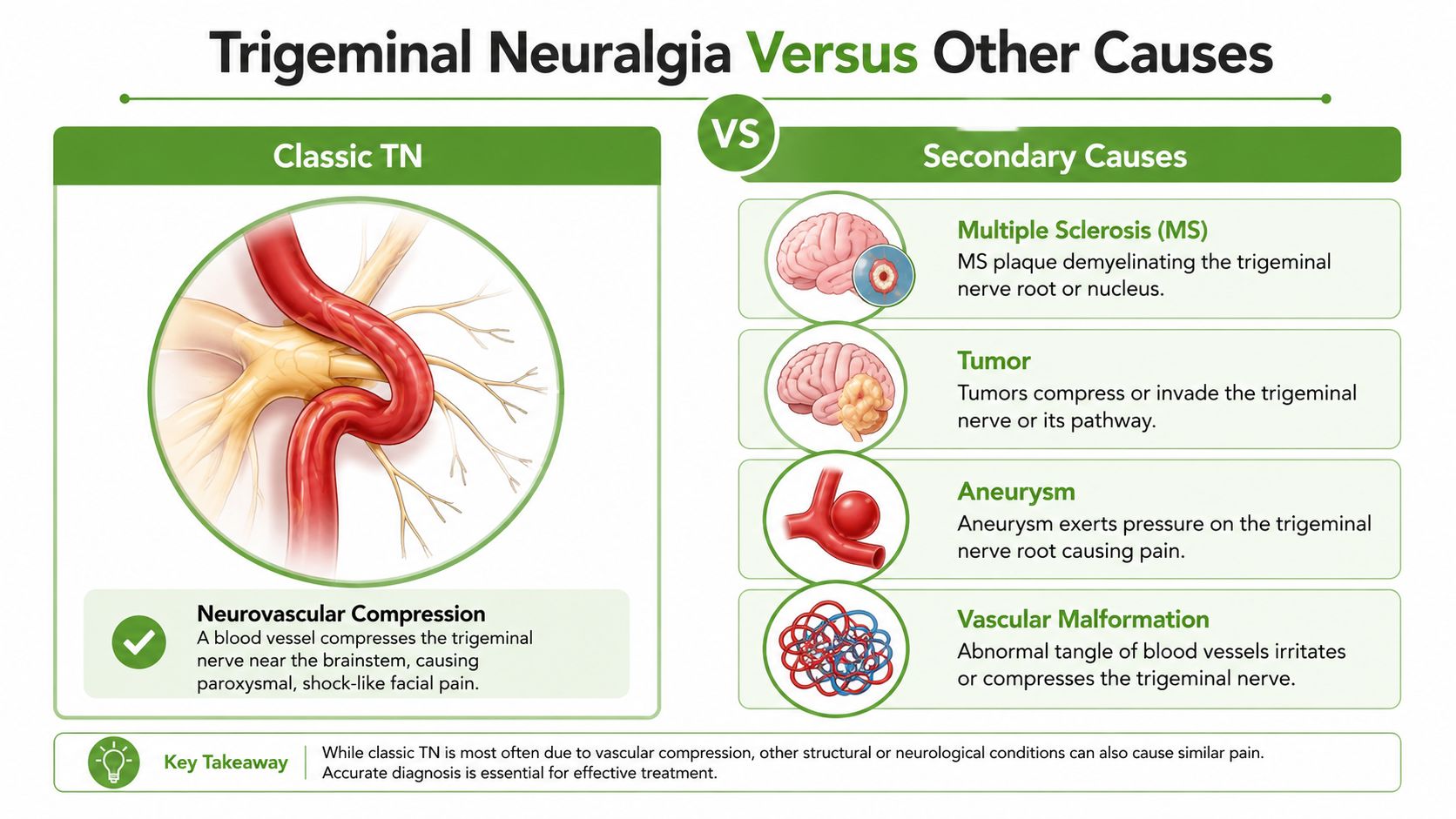
Classic TN attacks are usually sudden, unilateral, and brief, often lasting less than a second to a couple of minutes, and they're commonly set off by light touch, chewing, or talking (Practical Neurology review). That combination matters more than the word “sharp” alone. Many facial pain conditions can feel sharp, but they do not behave like TN. In practice, the pattern is what separates a nerve discharge from a sore tooth, a strained jaw, or a muscle problem.
A helpful way to sort it is to listen for the rhythm of the pain. TN behaves like a switch being flipped on and off, while many other causes stay simmering in the background.
What points toward a secondary cause
Secondary causes can create a TN-like pattern, but they often add extra clues. Multiple sclerosis, tumors, aneurysms, and vascular malformations are among the structural causes clinicians think about, especially when there's numbness, persistent aching, or a less typical pattern (Practical Neurology review). Diagnostic guidance also notes that pain inside the mouth, autonomic symptoms, or pain that is not clearly unilateral can point away from classic TN and toward another diagnosis that needs careful sorting (review on facial pain screening and diagnostic gaps).
That is why the history matters so much. A pain story that starts after dental work may fit a different path, including post-procedure nerve irritation, such as the patterns discussed in facial pain after dental work. A jaw that aches more in the morning points readers toward muscle clenching or grinding, which is why why your jaw hurts in the morning can look very different from classic TN.
How to Tell TN Apart From TMJ and Dental Pain
People get stuck here, because jaw pain, tooth pain, and trigeminal nerve pain can overlap. A lot of front-line articles stop at “electric shock-like pain,” but real life is messier. A recent review found there are few validated screening tools for trigeminal neuralgia, and none are currently suitable for primary care use, which helps explain why sorting facial pain early is so hard (facial pain diagnostic gap review).
A practical sorting framework
Start with four questions. How long does the pain last, what triggers it, where exactly is it, and does it come with numbness or other symptoms? That simple checklist often separates a nerve pattern from a joint pattern or a tooth pattern.
| Feature | Trigeminal Neuralgia | TMJ Pain | Dental Pain |
|---|---|---|---|
| Pain quality | Sudden, shock-like, stabbing | Dull ache, soreness, pressure | Localized ache, throbbing, sensitivity |
| Duration | Seconds to minutes | Often longer, more persistent | Often constant or lingering |
| Trigger | Light touch, chewing, talking, breeze | Clenching, chewing, jaw use, morning grinding | Hot, cold, biting, percussion |
| Location | One side, in trigeminal territory | Around the jaw joint, temples, face | One tooth or a specific dental area |
TMJ pain usually sits closer to the joint, often near the ear or the jaw hinge, and it tends to worsen with clenching, chewing, or waking up with a sore jaw. If morning jaw soreness is the main complaint, a useful related resource is why your jaw hurts in the morning, because sleep-related grinding or clenching can change the whole picture. Dental pain, by contrast, usually feels more localized and is often tied to hot, cold, or biting.
Rule of thumb: brief electric pain leans nerve, persistent bite-sensitive pain leans tooth, and joint-centered soreness leans TMJ.
For people who've had dental work and still have facial pain, the pattern can stay confusing, which is why a focused facial pain evaluation matters. If that's your situation, this overview of trigeminal nerve pain after dental work may help you think through next steps without assuming every pain signal is a cavity.
How Doctors Diagnose Trigeminal Nerve Pain
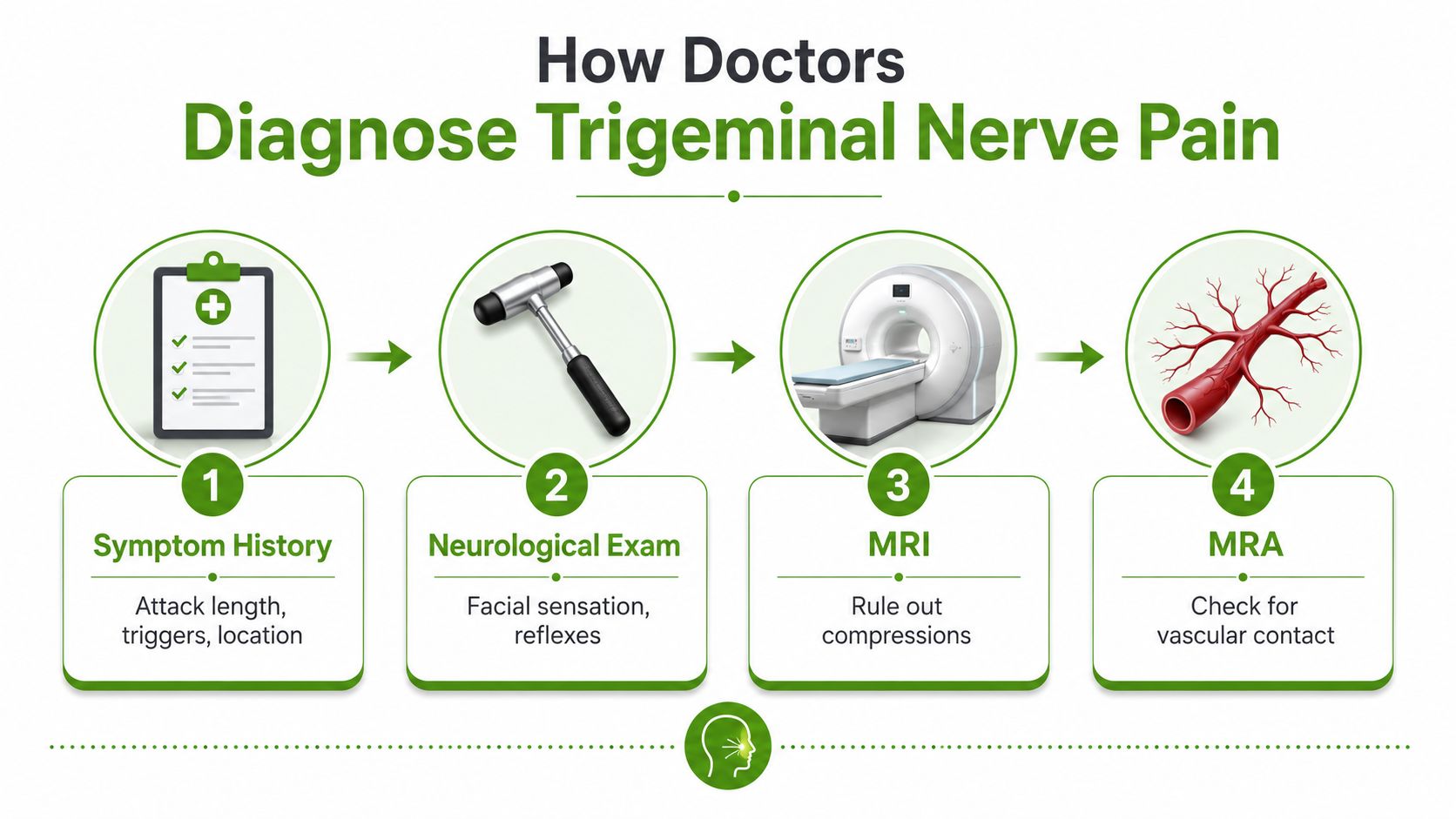
Diagnosis starts with the story, not the scan. A clinician wants the exact location, attack length, trigger, and pattern over time, because the difference between a nerve attack, a jaw problem, and a dental source often shows up in the history first. Then comes the neurological exam, which checks facial sensation, chewing muscle function, and other cranial nerve findings that can hint at a secondary problem.
What the exam is trying to rule out
A bedside exam is looking for clues that the pain is not classic TN. Facial numbness, abnormal reflexes, or weakness in the chewing muscles push the clinician toward more than just symptom control. That's why the exam matters even when the patient already feels sure of the diagnosis.
Imaging is the next key step. High-resolution MRI with contrast is used to look for a compressing vessel, demyelination, or a mass, and MRA can help assess vascular contact in some cases. If the symptoms are atypical, if there's numbness, or if TN begins before age 40, imaging becomes especially important because structural causes need to be ruled out (Practical Neurology review; StatPearls trigeminal neuralgia review).
Why referral can matter early
Some people need neurology, some need neurosurgery, and some need a facial pain specialist who can compare the nerve story with the dental and TMJ story in the same visit. That kind of triage is useful because the test that feels urgent to a patient isn't always the test that answers the question.
If the clinical picture points toward bone or jaw involvement rather than a pure nerve disorder, targeted imaging can still be part of the workup, including options such as the 3-phase bone scan when a different source of pain is being considered. The point isn't to order more tests for their own sake. It's to match the test to the likely pain generator.
Treatment Options From Conservative to Regenerative
Treatment should follow the problem, not the fear level. For confirmed trigeminal neuralgia, medication is often the first backbone of care, and anticonvulsants such as carbamazepine, oxcarbazepine, and sometimes gabapentin are commonly used to calm abnormal nerve firing (StatPearls trigeminal neuralgia review). If medications help but don't fully control symptoms, clinicians may discuss procedural options.
Where procedures fit
For people who don't respond well to medication, or who can't tolerate the side effects, the standard procedural conversation may include microvascular decompression, Gamma Knife radiosurgery, or rhizotomy-type procedures. These are generally considered when there's a strong reason to move beyond medicine, such as persistent disability or a structural cause on imaging. The logic is simple, if the nerve is being compressed or misfiring in a way medication can't adequately control, a procedure may be the more direct fix.
Where conservative and regenerative care can fit
Not every facial pain case needs a surgical mindset, especially when the pain overlaps with TMJ dysfunction, oral posture issues, or jaw overload. Custom oral appliances can reduce joint strain, cold laser therapy may be used as a noninvasive pain-care tool, and regenerative therapies such as Prolotherapy and Platelet-Rich Fibrin (PRF) are used in some clinics to support tissue healing rather than rely only on long-term medication. Pain and Sleep Therapy Center also uses this root-cause style of care in facial pain and TMJ cases, alongside interdisciplinary evaluation.
The main point is not that one lane is always better than another. It's that the right plan depends on whether the pain is being driven by nerve compression, jaw mechanics, dental pathology, or a combination of problems.
A good plan should answer one question first. What is the pain generator, and what do we need to do about it without guessing?
For readers comparing approaches, the clinic's orthobiologic therapy information can be useful if you're trying to understand how regenerative care is used in a broader facial pain strategy.
Red Flags, Self-Care Limits, and When to Seek Help
Some facial pain can be watched for a short time, but some signs need prompt evaluation. New facial numbness, double vision, hearing changes, pain that becomes constant aching rather than brief shocks, onset under age 40, or facial pain with fever or weight loss all deserve a same-week medical review. Those clues can point away from classic TN and toward something that needs a broader workup.
Self-care has a role, but it has limits. Heat packs may ease muscle guarding, posture changes may help a clenching pattern, and over-the-counter pain medicine can blunt discomfort, but none of those steps reverse a compressed nerve root or solve active TMJ degeneration. If the pain generator is mechanical or structural, symptom relief alone can leave the problem untouched.
The safest approach is to treat self-care as support, not proof that the condition is harmless. If the pain is brief, one-sided, and clearly trigger-linked, a targeted facial pain evaluation is reasonable. If the pattern is changing, spreading, or bringing new neurological symptoms with it, it's time to escalate.
If you're unsure which specialist to call first, start with a clinician who regularly evaluates TMJ, dental, and facial pain overlap. That kind of triage can save time and reduce the chance of being shuffled from one office to another without a clear answer.
Choosing the Right Care Pathway and Next Steps
The most useful path starts with sorting the pain correctly, then choosing the least invasive treatment that still matches the cause. For some people, that means neurology and imaging. For others, it means jaw-focused care, oral appliance therapy, breathing and oral posture work, or regenerative support for irritated tissues. In a root-cause clinic model like Pain and Sleep Therapy Center, those pieces can be reviewed together instead of one at a time.
That matters for adults with TMJ plus headache overlap, people with chronic facial pain, parents navigating oral development concerns in children, and providers looking for coordinated referral support. It also helps when the symptom pattern doesn't fit neatly into one specialty, because trigeminal pain often sits at the intersection of dental, muscular, airway, and nerve issues.
If you're dealing with facial pain that keeps getting labeled differently, a focused evaluation can help separate trigeminal neuralgia from TMJ or dental causes and show you what's worth treating first. Visit Pain and Sleep Therapy Center to explore a root-cause approach to facial pain, TMJ, and sleep-related issues, and use the clinic's triage resources to decide whether your next step should be a sleep check, a referral review, or a facial pain consultation.