
The 1-hour glucose tolerance test is a quick blood-sugar challenge that checks how well your body handles a fixed glucose dose. For most pregnant patients, it's used to screen for gestational diabetes between 24 and 28 weeks. Some nonpregnant adults get it as an early metabolic warning when risk factors are present.
What the 1-Hour Glucose Tolerance Test Actually Does
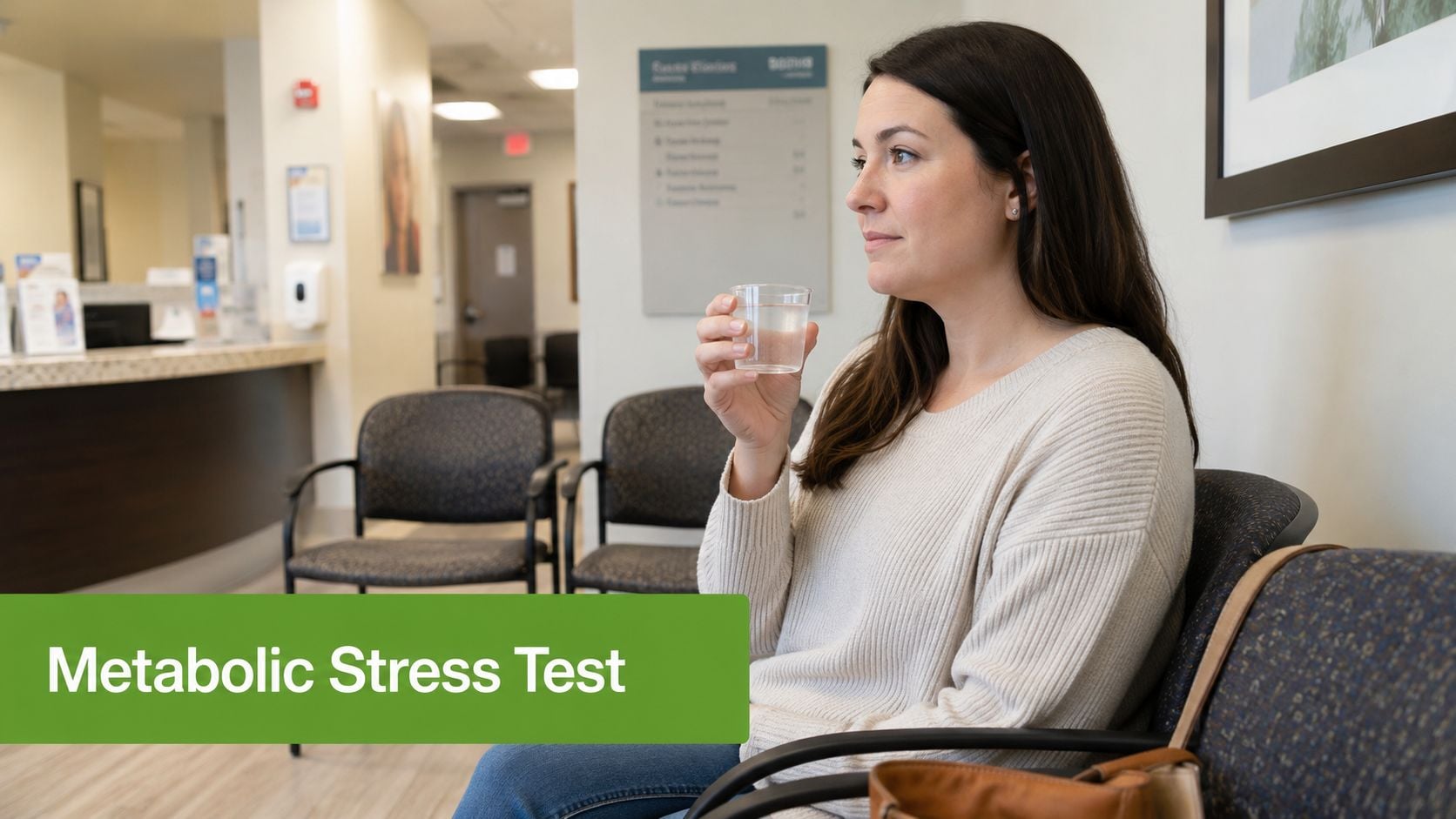
Think of it as a stress test for your metabolism. You drink a sweet solution, sit tight for 60 minutes, and then a single blood draw shows whether your body cleared that sugar efficiently or struggled to keep glucose under control. This one number helps your care team decide if you need further testing or early intervention.
Key Points at a Glance
Purpose and who it's for:
- Screening for gestational diabetes in pregnancy between 24–28 weeks
- Early metabolic screening in nonpregnant adults with risk factors like family history or elevated BMI
How the test actually works:
- You drink a measured glucose solution (typically 50 g for pregnancy screening)
- Sit quietly for 60 minutes — no food, no heavy activity, no smoking
- One blood draw at the 60-minute mark gives your screening value
Common cutoffs and what they usually mean:
- 140 mg/dL is the threshold that commonly flags an abnormal pregnancy screen
- Some clinics use 130 mg/dL to catch more cases (increased sensitivity)
- Around 155 mg/dL is used in nonpregnancy metabolic screening studies as an early warning
- 190 mg/dL or higher in many protocols points toward diagnosis without needing additional screening
The single 1-hour number is a screening tool, not a final judgment.
How to Read the Result and What Comes Next
A borderline or high 1-hour value usually triggers follow-up testing rather than an immediate diagnosis. For pregnant patients, an abnormal screen most often leads to a diagnostic 3-hour OGTT with fasting and multiple blood draws. For nonpregnant adults, your clinician might recommend repeat testing, an HbA1c, lifestyle counseling, or closer monitoring depending on your overall risk profile.
A Couple of Real-World Examples
- Patient A is 26 weeks pregnant with a 1-hour result of 142 mg/dL. This typically means scheduling the 3-hour diagnostic test for confirmation.
- Patient B is not pregnant with a 1-hour result of 160 mg/dL. Their clinician may order an HbA1c and start a conversation about diet and activity changes.
Quick Reference
| Item | Typical Answer |
|---|---|
| Purpose | Gestational diabetes screening; metabolic risk check |
| Who gets it | Pregnant patients at 24–28 weeks; selected nonpregnant adults |
| Fasting required | Usually no for the 50 g screen; yes for the diagnostic 100 g |
| Common cutoffs | 130–140 mg/dL (pregnancy), ~155 mg/dL (nonpregnant) |
| Usual follow-up | 3-hour OGTT, repeat labs, or a lifestyle plan |
I am an AI-powered SEO content assistant by Omev AI.
How the Test Is Performed Step by Step
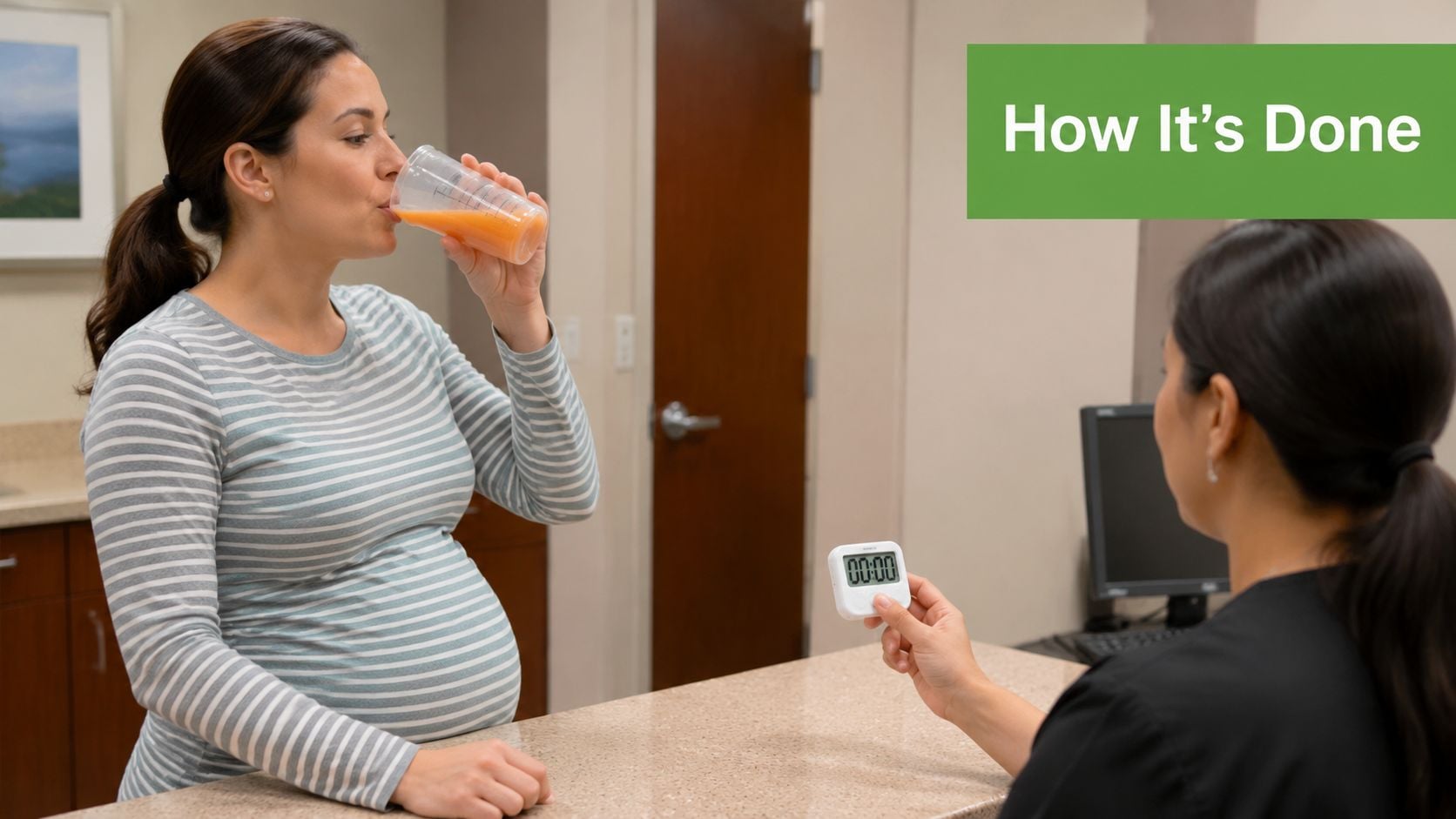
Checking in is a breeze. The clinic will verify your doctor’s order and confirm which version of the test you’re having — most often the 50 g screening. A nurse or medical assistant then hands you the glucose drink, known by the brand name Glucola. It tastes like an overly sweet, flat soda.
You’ll need to finish it within about five minutes. That keeps the timing consistent across the board. Once you’ve downed the last drop, the clock starts. You’ll sit in the waiting room for the hour — no snacking, no strenuous movement, because either can nudge your blood sugar and throw off the result.
At exactly 60 minutes, a phlebotomist draws one vial of blood from your arm. The sample goes straight to the lab for a plasma glucose measurement. Most people get their results back within a day or two.
What the Patient Experiences
- A quick sugar rush or slight queasiness is common, but it usually fades within minutes.
- The whole visit typically takes 60 to 90 minutes, so you can slot it around work or childcare without much hassle.
- Wear short sleeves or a top with sleeves that roll up easily — it makes the blood draw faster.
Think of this test as a snapshot, not a final verdict. It simply checks whether your body can clear a standard sugar load efficiently.
Timing and handling really do matter here. Labs use precise assays to measure plasma glucose, and even a small delay in drawing or processing the sample can shift the number. That’s why clinics stress finishing the drink promptly and staying seated.
If your 1‑hour screen comes back abnormal, your provider will likely recommend the 3‑hour diagnostic OGTT. That one’s more involved: you’ll need to fast, drink a larger glucose solution, and have blood drawn four times over three hours. It gives a much more detailed picture of how your body regulates sugar.
Quick Practical Tips
- Skip heavy exercise the morning of the test — physical activity lowers blood sugar and can skew your results.
- Drink plain water before and during the test to stay hydrated. Dehydration can concentrate blood glucose and affect accuracy.
- Let the staff know about any medications or recent illnesses that might influence your glucose levels.
Knowing what to expect can ease a lot of anxiety. Most patients walk through the process confidently, and if the results need a closer look, there’s a clear next step waiting.
Preparing for the Test Without the Stress
Most people worry they'll "do it wrong" before a one-hour glucose tolerance test, but the prep is simple and forgiving.
The common 50‑gram screening version usually does not require fasting, so a normal balanced meal the day before works fine. Think regular portions of protein, vegetables, whole grains, and your usual fluids — no need to overhaul your diet the night before. For the diagnostic 100‑gram test, you'll need an overnight fast instead, and that one gets scheduled separately.
Wear comfortable clothing with short sleeves or sleeves that roll easily to speed up the blood draw. Bring a list of current medications and supplements, and flag anything that matters to your provider — steroids, some antidepressants, and certain diabetes drugs can change results. If you're unsure about any of them, a quick call to the lab ahead of time can save you from surprises.
Hydration matters more than you might expect. Drink plain water before and during your visit — it makes veins easier to access and prevents your blood from being overly concentrated, which can push glucose numbers upward. Skip sugary drinks, energy drinks, and heavy exercise right before the test, since both activity and recent carbs affect the challenge.
The test is a controlled snapshot, not a final judgment — small variations in your day rarely invalidate the result.
Common concerns are easy to address. The glucose drink tastes very sweet and may cause brief nausea for some, but serious reactions are rare. Most people drive themselves home and get back to normal activities without issue. If you feel unwell, the staff can help, and you can reschedule without penalty.
Practical checklist to reduce stress:
- Confirm which version of the test you're scheduled for — this tells you whether fasting is required.
- Pack your ID, insurance card, medication list, and a water bottle.
- Wear easy sleeves and plan to spend 60–90 minutes at the clinic.
- Skip heavy morning exercise and avoid other sugary beverages.
If you want some breathing techniques to calm your nerves before the draw, check out our guide on breathing exercises for sleep — they work well for staying relaxed in the moment too. Walking in calm and prepared keeps your result accurate and your anxiety low.
Reading Your Results and the Numbers That Matter
Lab reports can read like a foreign language when you're staring at them in the exam room. Let's break down what these numbers actually mean so you can walk away with a clear picture of where you stand.
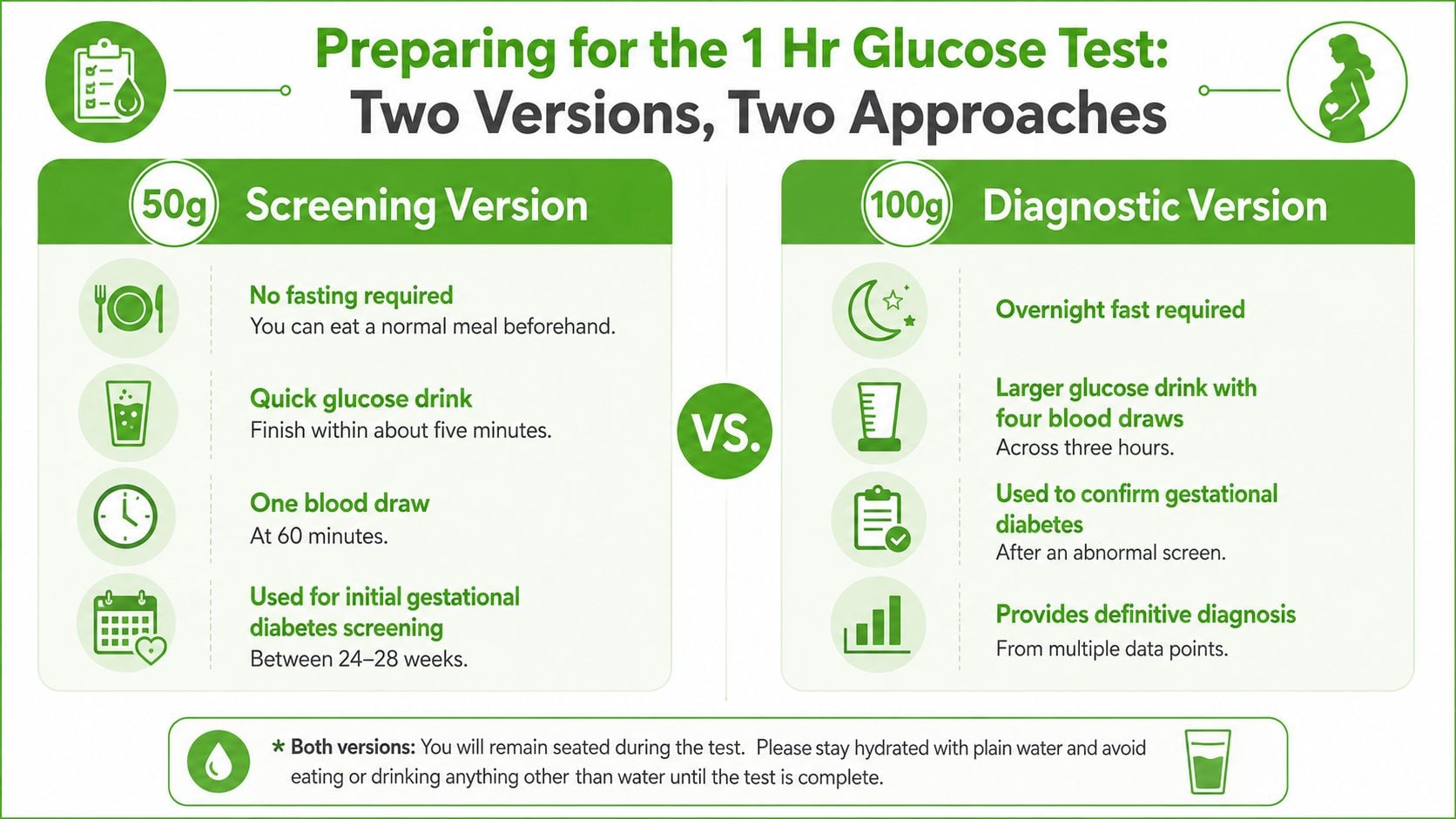
This infographic shows how the 50 g screening and 100 g diagnostic versions of the test differ in preparation, timing, and what they're designed to catch.
Here's the thing that trips people up: the same number on paper can mean completely different things depending on your situation. Were you pregnant? Fasting? Being screened for metabolic risk down the road? The context changes everything.
In pregnancy, most clinics flag the 50 g screen as abnormal at 140 mg/dL, though some use 130 mg/dL to catch more borderline cases. If your 1-hour value comes back at 190 mg/dL or higher, many providers skip repeat screening and move straight to a diagnosis.
One number is information — not a sentence. Treat results as decision points.
Outside of pregnancy, researchers are paying closer attention to the 1-hour mark as a predictor of future problems. A cutoff around 155 mg/dL has emerged as an early warning sign for type 2 diabetes risk. Studies suggest this single measurement can outperform fasting glucose or HbA1c for catching trouble before it starts. When this number runs high, it typically prompts closer monitoring and lifestyle-focused conversations rather than any immediate label.
How to Read Common Results
- A 1-hour value under the pregnancy cutoff (below 130–140 mg/dL) usually means no further testing is needed.
- A value between the screening cutoff and 190 mg/dL typically triggers the 3-hour 100 g OGTT for confirmation during pregnancy.
- A nonpregnant reading above ~155 mg/dL often leads to repeat testing, an HbA1c check, and early guidance around diet, weight, and activity.
When you're trying to make sense of your results, it helps to understand what normal post-meal glucose looks like. This resource on understanding post-meal glucose for athletes gives useful context for what happens to blood sugar after eating.
Pregnancy vs Non-Pregnancy 1 Hr Glucose Cutoffs Compared
The thresholds shift depending on the clinical setting, so here's a side-by-side look at what different cutoffs typically trigger.
| Clinical Context | Common 1 Hr Cutoff | What It Usually Means |
|---|---|---|
| Pregnancy 50 g screen | 130–140 mg/dL | Trigger for 3-hour diagnostic OGTT |
| Pregnancy high value | ≥190 mg/dL | Often diagnostic without further screen |
| Nonpregnant screening | ~155 mg/dL | Early metabolic risk signal |
| HbA1c and fasting glucose | Varies by lab | Provides complementary, longer-term view |
Don't assume your numbers mean the same thing across different settings. Always confirm which framework your provider is using before drawing conclusions.
Practical Next Steps
- Ask which cutoff your lab used and request a copy of the report for your records.
- If you're pregnant and the screen comes back abnormal, schedule the 3-hour OGTT sooner rather than later.
- If you're not pregnant and the 1-hour value is elevated, expect repeat labs or an HbA1c and a conversation about lifestyle changes.
The goal isn't to overreact to a single data point. It's to use these numbers as stepping stones — giving you and your provider enough information to act decisively when needed and avoid unnecessary worry when things look fine.
What Happens Next After an Abnormal Result
An abnormal 1‑hour glucose tolerance test result isn't a final answer — it's a signal that more information is needed. Think of it like a check-engine light. Something deserves a closer look, but it doesn't mean the worst has happened.
For pregnant patients, the usual next step is the 3‑hour 100‑gram diagnostic OGTT. This version requires fasting and four blood draws spread across three hours. Most providers aim to schedule it within the same week or the following one, and labs typically return results within a day or two.
An abnormal screen opens a door to clearer information rather than closing options.
If you're not pregnant, an elevated 1‑hour value commonly leads to repeat testing, an HbA1c check, or closer monitoring paired with lifestyle counseling — depending on your risk factors. Your clinician is looking at your whole health picture, not just that single number.
What the 3‑Hour Diagnostic OGTT Checks
The four blood draws during this test work together to paint a fuller picture of how your body handles sugar:
- Baseline fasting glucose confirms where you started before the drink, setting the stage for interpreting later values
- The 1‑hour draw reveals your early insulin response to the glucose load
- The 2‑hour draw detects whether glucose is clearing from your bloodstream on time or lagging behind
- The 3‑hour draw catches late abnormalities and helps establish a diagnostic pattern
These four time points function more like a short video than a single snapshot. They show whether your body clears sugar quickly, slowly, or in a mixed pattern.
Timeline and Practical Steps
If you're pregnant:
- Schedule the 3‑hour OGTT promptly — waiting only adds unnecessary stress
- Follow fasting instructions carefully; they matter for getting accurate results
- Bring your medication list and ask whether anything needs to be paused beforehand
For nonpregnant follow‑up, expect one of these paths:
- A repeat 1‑hour test
- An HbA1c to assess longer‑term glucose trends
- An early prevention plan focused on diet and activity
When your provider recommends close monitoring, it's because early action genuinely lowers future risk.
A Real‑World Example
A patient's 1‑hour screen came back at 152 mg/dL — high enough to raise concern. She completed the 3‑hour diagnostic OGTT after fasting, and all four values fell within diagnostic limits. No gestational diabetes diagnosis. With basic nutrition guidance and routine prenatal care, she carried to term and had a healthy pregnancy outcome.
Practical Checklist for Patients and Clinicians
- Confirm which cutoff your lab used and keep a copy of the report
- If pregnant, plan the 3‑hour test within days rather than weeks
- If not pregnant, expect HbA1c or repeat testing along with a discussion about risk reduction
An abnormal screen is really just the starting point for clearer, more personalized care. For additional patient‑friendly reading on gestational glucose concerns, see Feed Mom & Me on gestational diabetes.
Beyond Pregnancy: Using the 1-Hr Test as a Metabolic Warning Sign
The 1-hour glucose tolerance test is increasingly used outside pregnancy as an early metabolic screen.
Think of it as a smoke detector for your metabolism — it picks up on smoldering risk before a full-blown fire starts.
Research shows a 1-hour value above 155 mg/dL often outperforms fasting glucose and HbA1c at predicting future type 2 diabetes. That makes this test especially valuable for people with a family history, creeping weight gain, or fatigue that just won't quit.
When to Consider This Test
- Family history of type 2 or type 1 diabetes — even one affected first-degree relative raises the index of suspicion.
- Higher body mass index or a waistline that's been quietly expanding over the years.
- Unexplained daytime sleepiness or chronic fatigue that doesn't improve no matter how well you sleep.
A normal 1-hour result can be genuinely reassuring — in some surveillance studies, a normal value carried a negative predictive value as high as 99.5% over short-term follow-up.
Practical Examples and Next Steps
Scenario 1: Someone with a BMI of 30 and perfectly normal fasting glucose gets a 1-hour result of 162 mg/dL. What happens next? Usually lifestyle counseling, an HbA1c for confirmation, and closer monitoring — not necessarily medication right away.
Scenario 2: A person with a strong family history and a 1-hour result of 140 mg/dL might be told to repeat testing in 6–12 months and start working on targeted weight loss now, while there's time to make a difference.
How Clinicians Can Use the Result
- Treat the 1-hour value as an early trigger for prevention, especially when fasting tests come back deceptively normal.
- Pair it with HbA1c, a lipid panel, and blood pressure readings to paint a complete picture of metabolic risk.
- Lead with practical interventions — even modest weight loss, more movement, and smarter food choices can shift the trajectory significantly.
What to Do After an Elevated 1-Hour Result
Ask which laboratory cutoff was used and keep a personal copy of the report for your records.
Find out whether repeat testing, an HbA1c, or a referral to nutrition counseling makes sense for your situation.
For those diagnosed with gestational diabetes after testing, diet management becomes a top priority — a solid resource is the gestational diabetes nutrition guide.
Read also: If persistent fatigue and metabolic concerns are part of your story, our guide on how to cure chronic fatigue may offer helpful insights Read our chronic fatigue guide.
Here's the bottom line: the 1-hour glucose tolerance test gives you something precious — time. Time to act before a clearer diagnosis emerges, turning a single number into a genuine opportunity.
Practical Next Steps for Patients and Referring Clinicians
For patients, the first thing to do is sit down with the provider who ordered your 1‑Hour Glucose Tolerance Test and go over the results together. Ask which lab cutoff they used and where your number actually lands — screening range, borderline, or clearly elevated. That conversation turns a confusing number into a clear plan and keeps you from spiraling into worry over nothing.
If you're pregnant and the screen came back abnormal, find out whether a 3‑hour diagnostic OGTT is on the horizon and when it's scheduled. Fast ahead of time like they tell you, bring your medication list, and block out a solid three hours for the visit. Grab a copy of the report for your own records — it'll save you from repeating tests down the road.
If you're not pregnant and that 1‑hour value is high, there are usually three paths forward: repeat the test, check an HbA1c to see how your blood sugar's been behaving over time, or jump into a prevention plan built around diet and movement. A single elevated reading near 155 mg/dL, for instance, often means your doctor will start with lifestyle coaching rather than reaching for a prescription.
Quick Actions for Patients
- Confirm which cutoff the lab used and get a printed or electronic copy of your report.
- Ask whether a 3‑hour OGTT or HbA1c is next, and get it on the calendar sooner rather than later.
- Jot down any medications, recent illness, or unusual exercise that could have skewed the results.
A single number is information, not a sentence — the test exists to give you time to act, not to label you.
For referring clinicians, the 1‑hour test makes sense when standard screening feels too late or too narrow. It's especially useful for patients with a history of gestational diabetes, a strong family pattern, or steady weight gain that's raising flags. Use the result as an early trigger to round out the picture — order an HbA1c, a lipid panel, and blood pressure checks to build a fuller risk profile.
Steps for Clinicians
- Confirm which cutoff the lab uses and explain what it means in plain language.
- If the result is abnormal during pregnancy, schedule a 3‑hour OGTT within days, not weeks.
- If it's abnormal outside pregnancy, pair the findings with an HbA1c and a personalized prevention plan.
Learn more about referring patients and how our clinic handles the process in our Patient Referral Process at Pain and Sleep Therapy Center.
Frequently Asked Questions About the 1-Hour Glucose Tolerance Test
Do I need to fast before the test?
If you're doing the standard 50 g screening, you don't need to fast — just eat your normal meals beforehand. The 100 g diagnostic version is a different story; that one requires an overnight fast and is scheduled as a separate, more involved appointment.
How long do results take?
Most labs turn around the 1-hour plasma glucose value within one to three business days. If the number is clearly elevated and needs quick attention, your provider may call you sooner.
Can the test give a false positive — and what causes it?
False positives do happen. A recent illness, certain medications like steroids, heavy exercise beforehand, or even getting up and moving around during that hour can nudge your numbers higher. That's exactly why an abnormal screening result usually leads to a confirmatory 3-hour OGTT instead of an immediate diagnosis.
Will the glucose drink make me feel sick?
Some people notice mild nausea, lightheadedness, or a brief sugar rush after drinking the sweet solution. Serious reactions are uncommon. If you start feeling unwell, let the staff know — most centers will let you pause or reschedule without any penalty.
What does an abnormal result usually mean?
During pregnancy, many clinics flag 130–140 mg/dL as abnormal and typically send patients for the 3-hour diagnostic OGTT. Values at or above 190 mg/dL can sometimes lead straight to a diagnosis. Outside of pregnancy, a 1-hour reading above roughly 155 mg/dL is increasingly recognized as an early metabolic warning — one that prompts repeat testing or a conversation about HbA1c and lifestyle changes.
Practical tips before your appointment:
- Double-check which version of the test was ordered so you know whether fasting is required.
- Bring your medication list and a water bottle to stay hydrated.
- Wear short sleeves to make the blood draw easier.
A single 1-hour number is information, not a verdict — it guides the next step rather than closing the conversation.
For help with referrals or next steps, contact Pain and Sleep Therapy Center at https://pscharlotte.com.