

Feeding your baby should not feel like a guessing game, yet many parents end up there fast. The latch hurts, feeds take forever, your baby slips off the breast or bottle, and every well-meaning person seems to offer a different explanation. By the time someone mentions tongue-tie, many families are already tired, worried, and wondering whether a procedure is the next step.
Sometimes it is. Often, it isn't.
Infant tongue tie release can be very helpful when a tight lingual frenulum is clearly limiting tongue function and feeding hasn't improved with good support. But the most important word in that sentence is function. A visible frenulum under the tongue is normal anatomy. What matters is whether that tissue is preventing efficient feeding, causing pain, or limiting tongue movement in a meaningful way.
Parents deserve a calmer, more careful approach than "I see a tie, so let's clip it." The right plan starts with a full feeding assessment, not fear.
A Parent's Guide to Understanding Infant Tongue-Tie
Tongue-tie, also called ankyloglossia, means the band of tissue under the tongue, the lingual frenulum, is tighter, shorter, or more restrictive than usual. That sounds straightforward, but in real life it's not a purely visual diagnosis. Two babies can have frenulums that look similar and function very differently.
One baby feeds well, gains weight, and causes no maternal pain. Another struggles to stay latched, transfers milk poorly, and leaves a parent dreading the next feeding. The anatomy may look similar. The outcome is not.
That distinction matters because tongue-tie is common, and diagnosis has risen sharply. A clinical review reported that infant tongue-tie affects about 4% to 11% of newborns, and that frenotomy rates have quadrupled in many high-income countries as diagnosis and intervention have increased over time (BJGP Open review). More families are hearing about tongue-tie now, which can make the issue feel urgent even when the picture is still incomplete.
What the frenulum does
The frenulum helps anchor the tongue. A problem arises when that tissue restricts the tongue enough to interfere with:
- Latch quality
- Milk transfer
- Tongue elevation and extension
- Maternal comfort during feeding
A tight frenulum is not automatically a problem. A restrictive frenulum with symptoms is a different conversation.
Practical rule: Treat the baby, the feeding pattern, and the parent's symptoms. Don't treat the appearance alone.
Why parents often feel confused
Many families are told opposite things in the same week. One clinician says the tie is obvious. Another says it doesn't matter. The reason for that gap is simple. Some evaluations focus on how the mouth looks. Better evaluations focus on how feeding works.
That shift toward function over appearance changes everything. It lowers the chance of unnecessary procedures and helps identify babies who really do benefit from release.
Signs Your Baby Might Have a Functional Tongue-Tie
A functional tongue-tie usually shows up during feeding, not just during a quick glance under the tongue. The clues often involve both the baby and the parent. Looking at both sides of the feeding relationship gives a much clearer picture.
What parents often notice first
Many babies with feeding dysfunction don't look dramatic during an exam. The problem appears in the pattern of feeds.
Common signs include:
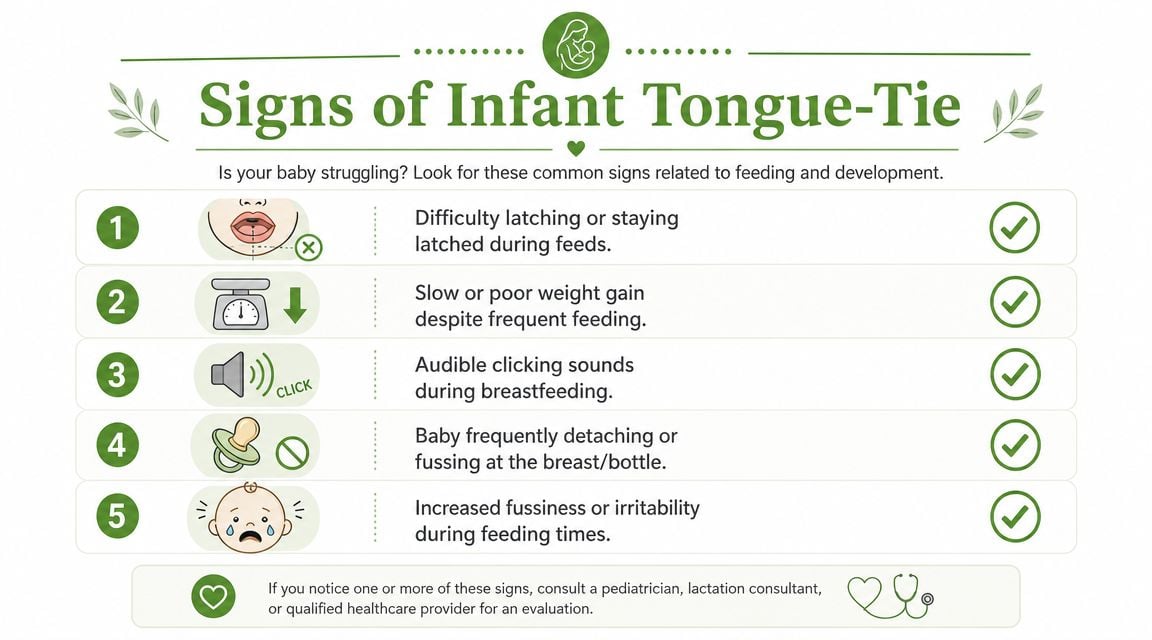
- Latch problems that keep happening. Your baby may struggle to get on, slip off repeatedly, or seem to latch shallowly.
- Clicking sounds during feeds. This can suggest poor seal and inefficient milk transfer.
- Fussiness at the breast or bottle. Some babies pull away, cry, or feed in a stop-and-start way.
- Long, tiring feeds that don't seem satisfying.
- Poor weight gain or concern that your baby feeds often but doesn't transfer milk well.
A baby can also seem unusually sleepy during feeds, gassy from swallowing air, or unsettled soon after feeding. Those signs aren't specific to tongue-tie, but they help complete the picture.
What the breastfeeding parent may feel
Tongue-tie assessment should include maternal symptoms, because pain matters. A provider should consider evaluation when an infant cannot protrude the tongue to cover the lower gum or lift the tongue tip at least 1 cm, and that is paired with persistent maternal nipple pain or poor weight gain after lactation support has already been tried (South Australia tongue-tie fact sheet).
You might notice:
- Nipple pain that doesn't improve with basic latch correction
- Nipple damage such as cracking or compression
- Misshapen nipples after feeding
- A feeling that feeds are unusually hard work
- Ongoing concern that your baby isn't emptying the breast well
If you're trying to sort out whether what you're seeing fits this pattern, this guide on how to tell if baby has tongue tie can help you frame the right questions before an evaluation.
Pain during feeding is common in the early days. Pain that persists despite skilled help deserves a closer look.
Signs that should prompt a full feeding assessment
A full assessment makes sense when several symptoms cluster together, especially if basic positioning help hasn't solved the problem. I tell parents to pay attention to the whole feeding story, not just one sign in isolation.
| What you notice | Why it matters |
|---|---|
| Baby can't stay latched | May reflect limited tongue mobility or poor feeding mechanics |
| Clicking during feeds | Often points to loss of seal |
| Ongoing nipple pain | Suggests the latch may be shallow or compensatory |
| Poor weight gain | Means function matters more than anatomy labels |
| Fussing or frequent detaching | Can reflect inefficient milk transfer or fatigue |
Why a Team-Based Assessment Is Crucial
At 2 a.m., a painful feed can make any answer that sounds quick feel appealing. But tongue-tie decisions are rarely best made from a brief look under the tongue alone. Feeding depends on anatomy, yes, but also on coordination, milk transfer, body tension, airway comfort, positioning, and how baby and parent are working together in real time.
That is why a team evaluation matters.
A Harvard Medical School report on multidisciplinary feeding assessment found that 62.6% of referred newborns did not undergo surgery after detailed evaluation and were able to breastfeed successfully without it (Harvard Medical School report). In practice, that fits what many clinicians see. Some babies do benefit from release. Others improve when the actual problem is identified first and treated directly.

What each clinician contributes
The best evaluations are collaborative. Not every family needs every specialist, but each role answers a different question:
- Pediatrician checks growth, hydration, medical history, and whether another health issue could be affecting feeding.
- Lactation consultant watches a real feed and assesses latch, milk transfer, positioning, maternal comfort, and whether changes help in the moment.
- Pediatric dentist or ENT examines oral anatomy and decides whether the frenulum is restricting movement in a meaningful way.
- Speech-language pathologist or feeding therapist looks at oral motor patterns, coordination, and sucking function.
- Occupational therapist or body-based therapist may identify asymmetry, tension, or regulation issues that interfere with feeding.
This approach often saves families time, frustration, and procedures that may not solve the full problem.
Problems that can mimic tongue-tie
A restrictive frenulum is sometimes only one piece of the picture. I often tell parents to ask a simple question: does the anatomy match the feeding problem we are seeing?
Other causes of feeding difficulty can include:
- Positioning and latch mechanics
- Low or disorganized oral tone
- Neck or jaw tension
- Airway or nasal obstruction
- Reflux-related feeding stress
- Fast or slow milk flow issues
If those factors are present, release may still be considered, but it should be part of a broader plan. Otherwise, the tissue changes and the feeding struggle stays.
A frenulum can contribute to feeding problems without explaining all of them.
What a good assessment should include
A useful visit involves more than a mouth exam. The provider should take a feeding history, watch your baby feed if possible, assess tongue motion and oral function, review what support you have already tried, and explain clearly whether the restriction they see is likely driving the symptoms.
Parents should also hear the trade-offs. A release may help when restriction and dysfunction clearly line up. If the picture is mixed, therapy, latch work, bodywork, or follow-up observation may be the better first step.
At clinics that use a functional model, including Pain and Sleep Therapy Center, infant evaluations are built around feeding function, history, and follow-up care rather than a procedure-first mindset. That is the standard worth looking for anywhere.
Understanding Infant Tongue-Tie Release Procedures
Once a baby clearly has a restrictive frenulum and persistent feeding dysfunction, release becomes a reasonable option. Parents usually want to know the same things right away. What happens, how long it takes, how uncomfortable it is, and whether timing matters.
The timing does matter. For a symptomatic infant, early frenotomy is often preferred because it can usually be done in-office with minimal anesthesia. Delaying beyond roughly 4 months may mean a more complex procedure under general anesthesia in an older child (evidence-based timing review).

Scissors and laser
The two approaches parents hear about most are scissor frenotomy and laser release. Both aim to free restrictive tissue. The main differences are in technique, precision, and the provider's workflow.
A simple comparison helps:
| Approach | What it involves | Parent considerations |
|---|---|---|
| Scissor frenotomy | Restrictive tissue is divided manually | Straightforward and commonly used |
| Laser release | Restrictive tissue is released with a dental laser | Allows controlled tissue release and is often chosen in dental settings |
The best method is the one performed well by a qualified provider who has made the correct diagnosis and has a clear aftercare plan. Technique matters, but selection matters more.
What the appointment usually feels like
For most young infants, the appointment is brief. The baby is swaddled or gently positioned, the mouth is supported, and the release is performed carefully. Providers may use topical anesthetic or minimal anesthesia depending on age, anatomy, and office protocol.
Parents often expect the procedure itself to be the hardest part. In reality, the bigger challenge is often what comes after. The tongue has to learn a new range of motion, and feeding may improve quickly or more gradually depending on the baby.
A short video can make the process feel less abstract:
What release can and can't do
A good infant tongue tie release can improve tongue mobility. That may reduce maternal pain, improve latch, and help milk transfer. But it does not automatically fix every feeding issue on its own.
Babies still need practice. Parents still need support. If muscle tension, poor coordination, or feeding aversion are also in play, those pieces need treatment too.
Post-Procedure Care and Essential Exercises
The procedure is the beginning, not the finish line. Parents are often relieved once the release is done, then surprised to learn that aftercare plays a major role in the final result.
Healing tissue naturally wants to come back together. The goal of aftercare is to support open healing, preserve mobility, and help your baby use that new tongue motion during feeding.
What normal healing looks like
Many parents are alarmed when they first look under the tongue after a release. The wound often appears as a pale or white healing area. That appearance is usually part of normal healing, not a sign of infection.
You may also hear providers describe a diamond-shaped wound under the tongue after release. That description helps parents know what they're seeing and why wound care matters.
What matters most after release: protect healing, keep the wound from closing back down too quickly, and support better feeding function right away.
The parts of aftercare that families should expect
Aftercare plans vary by provider, but they usually include several pieces working together:
- Comfort measures such as soothing, feeding, skin-to-skin contact, and any clinician-approved pain guidance
- Wound stretches or lifting exercises to reduce the risk of reattachment
- Feeding support so the baby can relearn latch and tongue use
- Follow-up visits to check healing and function
- Oral motor or myofunctional guidance when needed
If you'd like a more detailed overview of healing expectations, this page on tongue-tie surgery recovery is a useful companion to your provider's instructions.
Exercises are about function, not just the wound
Parents sometimes think stretches are the whole job. They aren't. The wound needs care, but the baby also needs help learning how to move differently.
That may include:
- Gentle tongue-lifting support as taught by your provider.
- Feeding right after the procedure when recommended, so the baby starts using the tongue in a functional pattern.
- Guided oral exercises if your care team identifies persistent weakness, poor coordination, or compensatory habits.
Some babies improve almost immediately. Others need days or weeks of guided support. That variation is normal.
What doesn't work well
The biggest mistake after infant tongue tie release is assuming the procedure alone will carry the full result. Problems are more likely when families receive little instruction, skip follow-up, or don't get feeding help after the release.
A second common problem is over-focusing on the wound while under-focusing on feeding. The tongue can be physically freer but still function poorly if no one addresses latch mechanics, body tension, or oral patterning.
How to Choose a Qualified Tongue-Tie Provider
Choosing a provider shouldn't come down to who can perform a release soonest. It should come down to who can tell you, with confidence and clarity, whether your baby needs one at all.
That changes the questions parents should ask.
What to look for first
Start with clinical habits, not marketing language. A strong provider should evaluate feeding function, not just point to a frenulum and name it.
Look for these features:
- Infant-specific experience with newborn and early infancy feeding problems
- Collaboration with lactation and feeding professionals
- Functional assessment before treatment
- Clear explanation of why release is or isn't recommended
- Structured aftercare and follow-up
If a provider doesn't watch a feed, doesn't ask about pain and weight gain, or treats appearance as enough, that's a reason to pause.
Questions worth asking at the consultation
Bring direct questions. Good providers usually welcome them.
- How do you decide whether a baby needs release?
- Do you work with lactation consultants or feeding therapists?
- What does your aftercare plan include?
- What should we expect if feeding doesn't improve immediately?
- When would you recommend against a procedure?
A provider who gives thoughtful, balanced answers is usually safer than one who promises a quick fix.
One practical way to vet options
Parents often search broadly and get overwhelmed by mixed credentials and mixed philosophies. If you're comparing local options, a page like this guide to finding a pediatric tongue-tie specialist near me can help you organize your search around evaluation quality, infant experience, and post-release support.
If a clinician only talks about what they cut, ask more questions about how they diagnose, support feeding, and follow healing.
Frequently Asked Questions About Tongue-Tie
Will tongue-tie affect my child's speech later?
This is one of the most common worries, and parents often hear stronger claims than the evidence supports. Tongue-tie release may improve tongue mobility for breastfeeding, but speech effects remain debated, and speech delay is not a proven risk according to Brown University Health's summary of the evidence (Brown University Health review).
That doesn't mean speech can never be part of the conversation. It means speech alone should not be assumed, predicted, or used to pressure families into treatment during infancy.
Does release improve sleep, airway growth, or long-term development?
These claims are common online, but the evidence is much less settled than many parents are led to believe. The strongest support for infant tongue tie release is around breastfeeding function and tongue mobility in appropriately selected babies. Long-term claims about sleep, facial growth, palate development, and airway outcomes are still being studied.
When families are told a release will prevent many future problems, I recommend slowing down and asking exactly what evidence is being used.
What about chiropractic, craniosacral therapy, or bodywork?
Some babies clearly have body tension, asymmetry, or regulation issues that affect feeding. Body-based care may be part of a broader plan for those infants. But it should be used thoughtfully, alongside pediatric, feeding, and oral evaluation, not as a substitute for a proper diagnosis.
The key question is always the same. Does this intervention improve feeding function in this specific baby?
Can breastfeeding improve without surgery?
Yes, sometimes it can. A careful feeding plan, lactation support, latch adjustments, and time can make a real difference in selected cases. That is one reason a thorough evaluation matters so much. It helps families avoid treating every feeding struggle as a surgical problem.
How quickly should parents decide?
Don't panic, but don't drift either. If your baby has significant feeding dysfunction, poor transfer, persistent pain, or weight concerns, seek assessment promptly. Timely evaluation gives you more options and a better chance of matching the right treatment to the underlying problem.
If you're trying to sort out whether your baby needs a full feeding evaluation or an infant tongue tie release, Pain and Sleep Therapy Center offers collaborative pediatric assessment that looks at tongue function, feeding mechanics, and post-procedure support as part of one care pathway.