Breakfast gets awkward first. You try to take a normal bite and realize your mouth won't open the way it used to. Then brushing your teeth feels cramped. Yawning pulls instead of relieving tension. Talking for a long stretch can leave your jaw tired, tight, or sore.
That pattern is common with trismus, which means your jaw opening has become restricted. Sometimes it shows up after dental work, facial pain, TMJ irritation, surgery, or prolonged muscle guarding. Whatever started it, the day-to-day experience is the same. Your jaw feels stuck, stiff, or resistant, and normal tasks suddenly require planning.
The good news is that home exercise can help. The better news is that the right home program doesn't rely on force. It relies on repetition, gentle progression, and knowing when to bring in professional support.
Reclaiming Your Jaw's Freedom from Trismus
Trismus can make people feel like their jaw has betrayed them. A movement that used to happen automatically now feels limited, protective, and sometimes painful. What's needed isn't a lecture on anatomy at that point. They need a clear way to start moving again without making things worse.
In practical terms, jaw exercises for trismus are meant to restore motion gradually. They help quiet overactive muscle guarding, improve the jaw's ability to open and move side to side, and make daily function easier again. That means eating with less hesitation, speaking more comfortably, and getting through oral care without bracing first.
There's real reason to stay hopeful. A major study on exercise therapy for trismus reported an 87% patient recovery rate at 3 years after a structured program, showing that consistent, non-invasive exercise can lead to durable improvement in jaw mobility (study on long-term trismus exercise outcomes).
Clinical reality: The exercises that work best usually aren't dramatic. They're repeatable, controlled, and done often enough for the tissues to adapt.
That matters because many people try one of two unhelpful extremes. They either avoid moving the jaw because it feels tight, or they force it aggressively and flare things up. Neither approach builds trust between the joint, muscles, and nervous system. A better plan uses steady, tolerable stretching and reassessment over time.
If your symptoms overlap with clicking, clenching, or broader jaw dysfunction, Peak Therapy's guide to TMJ gives helpful context on how muscle tension and joint mechanics often interact. Trismus and TMJ problems aren't always identical, but they often travel together.
Goals and Safety First Your Guide to Pain-Free Stretching
Before you start any exercise, get the target right. The purpose is not to pry the jaw open. The purpose is to encourage a guarded jaw to move more freely, a little at a time.
That distinction changes everything. When people rush, clench through stretches, or chase a bigger opening in one session, they often irritate the exact tissues they're trying to calm.

What a good stretch feels like
A useful stretch usually feels like:
- Gentle pulling: You notice resistance, but you can still breathe normally and keep your face relaxed.
- Mild fatigue: The jaw muscles may feel worked, especially if they've been underused.
- Release afterward: The jaw often feels looser, warmer, or easier to move once you stop.
A harmful stretch feels different:
- Sharp pain: Stop right away if the sensation is stabbing, pinching, or electric.
- Protective wincing: If your shoulders rise, your eyes squint, or your neck starts helping, you've gone too far.
- Lingering aggravation: If your jaw feels more irritable well after the session, the intensity was too high.
If it feels like a stretch, continue gently. If it feels like pain, back off.
Non-negotiable safety rules
Keep these rules in place every time:
- Start warm: Use a warm shower, a warm compress, or a few easy jaw movements before stretching so the tissues aren't being asked to lengthen cold.
- Keep the tongue and shoulders quiet: Tension spreads fast. If your neck tightens or your tongue presses hard into the roof of your mouth, pause and reset.
- Stay in a pain-free range: Stretching should invite motion, not demand it.
- Favor consistency over intensity: Repeating a modest program daily beats one aggressive session followed by two days of soreness.
- Watch for compensation: Keep your head upright and avoid jutting the chin forward to fake a wider opening.
- Stop if locking worsens: A jaw that starts catching more, deviating more, or feeling unstable needs closer evaluation.
The mindset that gets results
People often assume more pressure equals more progress. It doesn't. Tight jaw muscles usually respond better to calm repetition than force.
This is also where professional coaching matters. A trained clinician can tell whether your restriction is mostly muscular, joint-related, habit-driven, or tied to oral posture and breathing patterns. That changes the exercise prescription. The safest home program is one that fits the reason your jaw is restricted in the first place.
Phase 1 Foundational Jaw Stretches for Initial Relief
The first phase is for the jaw that feels guarded, stiff, and easily irritated. You're not trying to build strength yet. You're restoring motion the jaw can tolerate.

Start with active opening
Sit upright in front of a mirror. Relax your shoulders and let your teeth separate slightly. Open your mouth slowly until you feel a mild stretch, then stop before pain starts. Hold briefly, then close slowly.
Use the mirror to make sure you're opening straight rather than twisting or pushing the head forward. If the jaw tracks unevenly, reduce the range and make the motion smaller and cleaner.
Try this sequence:
- Open gently to the first point of stretch.
- Hold there.
- Close with control.
- Repeat the same quality of motion for several rounds.
A simple active opening drill works well before passive stretching because it tells you what the jaw can do on its own that day.
Add side-to-side motion
Lateral motion matters because trismus rarely affects only one direction. Move the lower jaw gently to the left, return to center, then to the right. Keep the motion small at first.
Hold each side briefly. The point is not to reach a dramatic end range. The point is to reduce stiffness and let the jaw relearn movement in more than one plane.
For readers who also feel dense muscle tightness through the cheeks and temples, this guide on how to loosen tight jaw muscles pairs well with early mobility work.
Use passive finger-assisted stretching carefully
This is one of the most useful early drills when done correctly. Clinical protocols advise starting passive stretches with 5 to 10 second holds, then progressing toward 30 seconds as tolerated. The stretch is typically repeated 5 times per session, 5 to 10 times per day for best results (St George's jaw exercise protocol).
Here's the setup:
- Place your thumb on the upper teeth.
- Place your index finger on the lower teeth.
- Apply gentle downward pressure to create a stretch.
- Do not bounce.
- Do not push into pain.
- Repeat for 5 repetitions.
Start at the shorter hold if your jaw is reactive. Build duration only when the stretch feels manageable and your recovery between sessions is smooth.
Practical cue: Your face should stay soft during the stretch. If your forehead wrinkles or your neck joins in, reduce the pressure.
A visual demonstration can help if you learn best by watching movement rather than reading it.
What usually does not work in phase 1
Some habits slow people down:
- Forcing a wide yawn on purpose
- Chewing gum to “work it out”
- Testing the jaw all day
- Holding stretches so hard that the jaw feels inflamed afterward
Early relief comes from controlled repetition, not repeated provocation.
Phase 2 A Progressive Program for Building Mobility
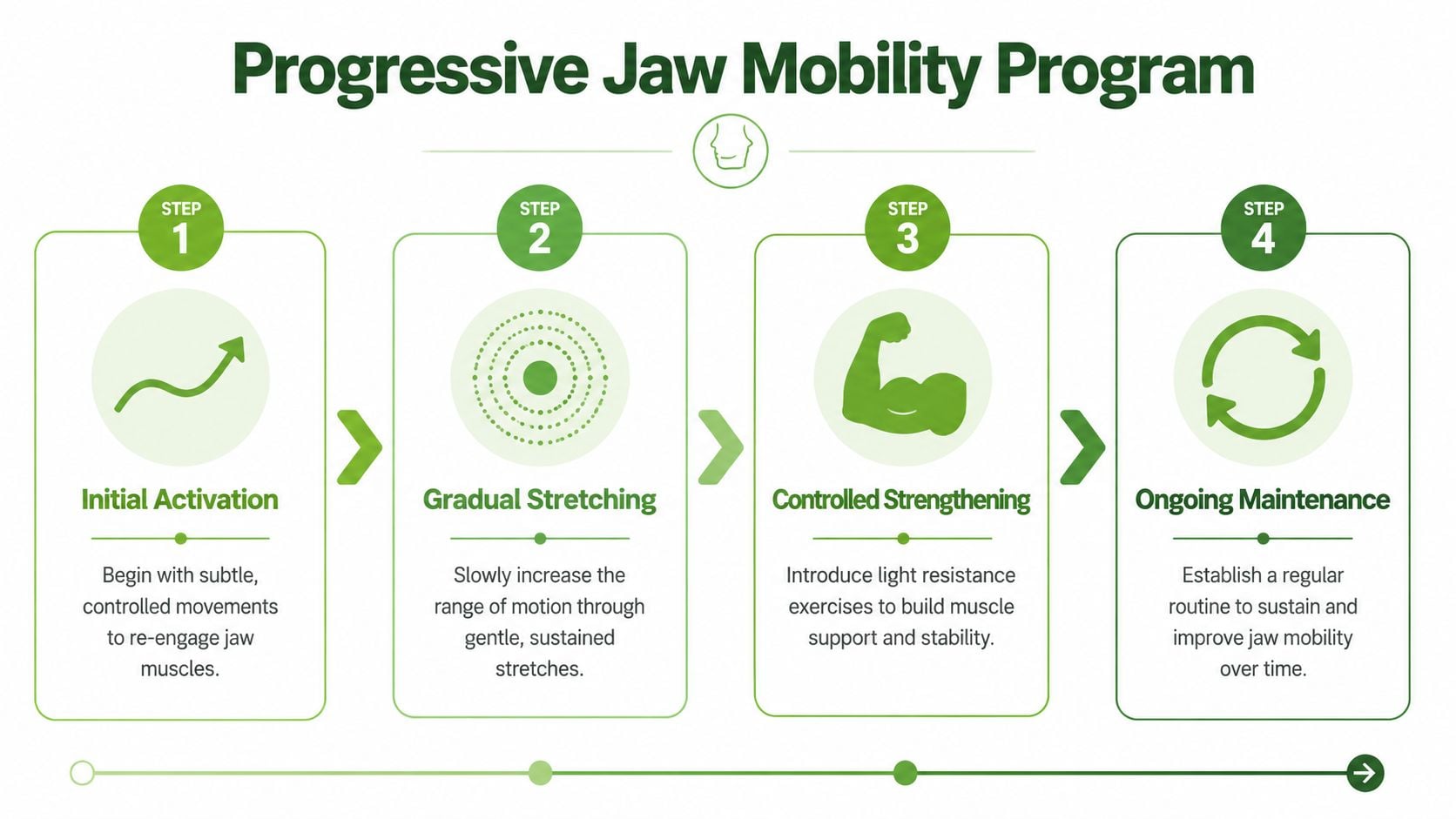
Once the jaw tolerates basic opening and side-to-side work, build a routine that prepares tissue, moves through range, and finishes with functional motion. At this stage, many people stop improvising and start improving.
The three-part sequence
A complete routine includes a structured sequence:
- Massage the masseter muscle in circular motions for 30 seconds.
- Perform active stretches, including opening and side-to-side movements, holding each for 10 seconds.
- Finish with 5 to 10 circular jaw motions in each direction.
This sequence should be performed 2 to 3 times daily according to the cited guidance (WebMD trismus exercise overview).
That order matters. Massage reduces guarding. Active motion uses the available range. Circular movement helps the jaw function more naturally instead of only opening and closing in a stiff line.
How to perform the sequence well
Masseter massage
Place your fingers over the thick chewing muscle on the side of your jaw. Use small circular motions. You're not digging for a trigger point. You're warming the tissue and reducing its resting tension.
If one side feels denser or more tender, spend extra attention there without becoming aggressive. Better input often beats stronger input.
Active holds
After massage, repeat your opening and side-glide drills. Hold each position for the recommended count, then return to neutral slowly. A mirror helps keep the motion honest.
Circular jaw motions
Finish with slow circles as if exaggerating a gentle chewing pattern. Move in both directions. Keep the circles smooth rather than large.
When to add a simple home tool
If finger-assisted stretching has become easier and your clinician approves, a stack of tongue depressors can provide a gentle passive stretch. The basic idea is simple. You place a comfortable number between the teeth, hold a tolerable stretch, and progress gradually over time.
The trap is trying to “win” the exercise by adding too many at once. Don't. Passive tools should create a controlled stretch, not a fight.
For people who are later in recovery and want to understand the difference between mobility work and resistance work, these jaw strengthening exercises can be useful once basic range is more stable.
Progressive Trismus Exercise Plan
| Phase | Exercise Type | Hold Duration / Reps | Frequency | Goal |
|---|---|---|---|---|
| Early relief | Active opening | Gentle repeated openings | Daily, based on tolerance | Restore safe motion |
| Early relief | Passive finger stretch | 5 reps, building from short holds toward longer holds | Regular daily practice | Improve jaw opening |
| Mobility building | Masseter massage | 30 seconds | 2-3 times daily | Reduce guarding |
| Mobility building | Active side-to-side and opening holds | 10-second holds | 2-3 times daily | Expand controlled range |
| Functional integration | Circular jaw motions | 5-10 each direction | 2-3 times daily | Improve coordinated jaw movement |
| Maintenance | Combined routine | Individualized | Ongoing | Keep gains and reduce relapse |
Where orofacial myofunctional therapy fits
Home stretching works best when it's part of a bigger recovery plan. Orofacial myofunctional therapy helps address the habits and movement patterns that can keep a jaw irritated, including tongue posture, lip seal, swallowing mechanics, and facial muscle overuse.
That matters because some jaws don't stay tight only because the muscles are short. They stay tight because the whole system keeps recruiting in the wrong pattern. A person who clenches, mouth breathes, thrusts the tongue, or overloads one side while chewing may improve with stretching, then stall unless those patterns change too.
Better mobility without better function often leads to temporary progress. Better mobility plus better muscle habits is where lasting change usually happens.
When to Complement Exercises with Professional Care
A home program is a strong first step. It isn't the right final step for every case.
If your jaw is improving, great. Keep going. If it's not, don't assume you only need to push harder. That's where a lot of preventable setbacks happen.

Signs you need more than home care
Look for these patterns:
- Pain is escalating: Stretching should feel manageable. If each session leaves the jaw angrier, the plan needs adjustment.
- The jaw locks or catches more often: Mechanical symptoms can point to a joint issue, not just muscle restriction.
- You're not making meaningful progress: A flat response suggests the driver may be more complex than simple tightness.
- Clicking or popping comes with loss of motion: Noisy joints aren't always dangerous, but paired with restriction they deserve assessment.
- Daily function is still limited: If eating, speaking, or oral care remain difficult, the exercise plan may be incomplete.
What professional care can add
A skilled clinician can sort out whether the restriction is being driven by joint mechanics, protective muscle guarding, oral habit patterns, postural issues, or airway-related compensation. That evaluation changes treatment.
Orofacial myofunctional therapy can help retrain tongue posture, swallowing, breathing patterns, and facial muscle coordination. In some cases, clinicians may also use supportive therapies such as manual treatment or cold laser therapy to calm irritated tissue and make exercise more productive.
If you do self-massage at home, a practical overview of RMT care for trigger points at home may help you understand the difference between gentle release and overworking sore muscle.
For patients dealing with jaw pain, facial tension, or recurring restriction, seeing an orofacial pain specialist can clarify what's keeping the jaw from fully recovering.
Home exercises are excellent for restoring movement. Professional care matters when the reason for restriction is still active.
Your Path to Lasting Jaw Comfort and Function
Individuals recover jaw motion the same way they rebuild any guarded movement. They start smaller than they want to. They repeat the right motions more often than they think they need to. They stay patient long enough for the tissues and nervous system to trust the movement again.
That's the value of jaw exercises for trismus. They give you something practical to do today, not someday. A few minutes of calm, well-executed work can begin shifting a jaw that has felt stubborn and unreliable.
Keep the sequence simple. Warm up. Stretch without forcing. Progress gradually. Pay attention to the quality of the movement, not just how wide the mouth opens. If your jaw responds well, stay consistent. If it doesn't, get help before frustration turns into overdoing it.
Recovery usually isn't a straight line. Some days the jaw feels looser. Some days it feels guarded again. That doesn't mean the process isn't working. It means the jaw is adapting, and adaptation takes repetition.
The best long-term outcomes usually come from combining home care with expert guidance when needed. That's especially true when trismus overlaps with TMJ strain, clenching, oral posture issues, or breathing and swallowing dysfunction. You don't have to guess your way through all of that alone.
If your jaw feels tight, painful, or limited and you want a plan that goes beyond generic stretches, Pain and Sleep Therapy Center offers evaluation and treatment for TMJ disorders, facial pain, airway-related dysfunction, and orofacial muscle problems. Their team can help you understand what's driving your restriction and build a recovery plan that supports comfortable movement, better oral function, and lasting relief.