
Jaw pain rarely arrives at a convenient time. It shows up when you're chewing dinner, trying to sleep, or sitting in a dentist's chair hearing the words, “You should see an oral surgeon.” For many people in Mooresville, that referral brings a mix of relief and uncertainty. You know something needs attention, but you may not know what an oral surgeon does, whether surgery is the only answer, or how to choose the right next step.
That uncertainty is normal. Some problems need surgical skill right away. Others, especially TMJ pain, facial tension, and certain bite-related symptoms, may respond better when you start with a careful diagnosis and consider non-surgical options first.
Your Guide to Finding the Right Care in Mooresville
If you're looking for an oral surgeon in Mooresville, NC, start with the problem you're trying to solve, not the procedure name. A missing tooth, impacted wisdom teeth, jaw locking, facial pain, or a past injury can all lead to the same referral, but they don't all call for the same treatment path.
A smart first step is to gather your dental records, any recent imaging, your medication list, and a simple symptom timeline. Write down when the problem started, what makes it worse, and whether it affects eating, speaking, sleeping, or opening your mouth fully. That gives any specialist a better picture than “my jaw hurts sometimes.”
Local patients also benefit from understanding how practices communicate online, because a polished website doesn't always tell you how clearly a provider explains options. If you want a useful outside perspective on how healthcare practices present themselves digitally, Leaping Lemur marketing insights can help you think more critically about what you're seeing.
Practical rule: The best consultation is the one where you leave understanding your diagnosis, your options, and why one path makes more sense than another.
What Is an Oral Surgeon and What Do They Do
An oral and maxillofacial surgeon is the specialist your dentist calls when a problem goes beyond routine dental care. These surgeons work at the intersection of dentistry, surgery, and anesthesia. Their field focuses on conditions involving the mouth, jaws, facial bones, and surrounding structures.
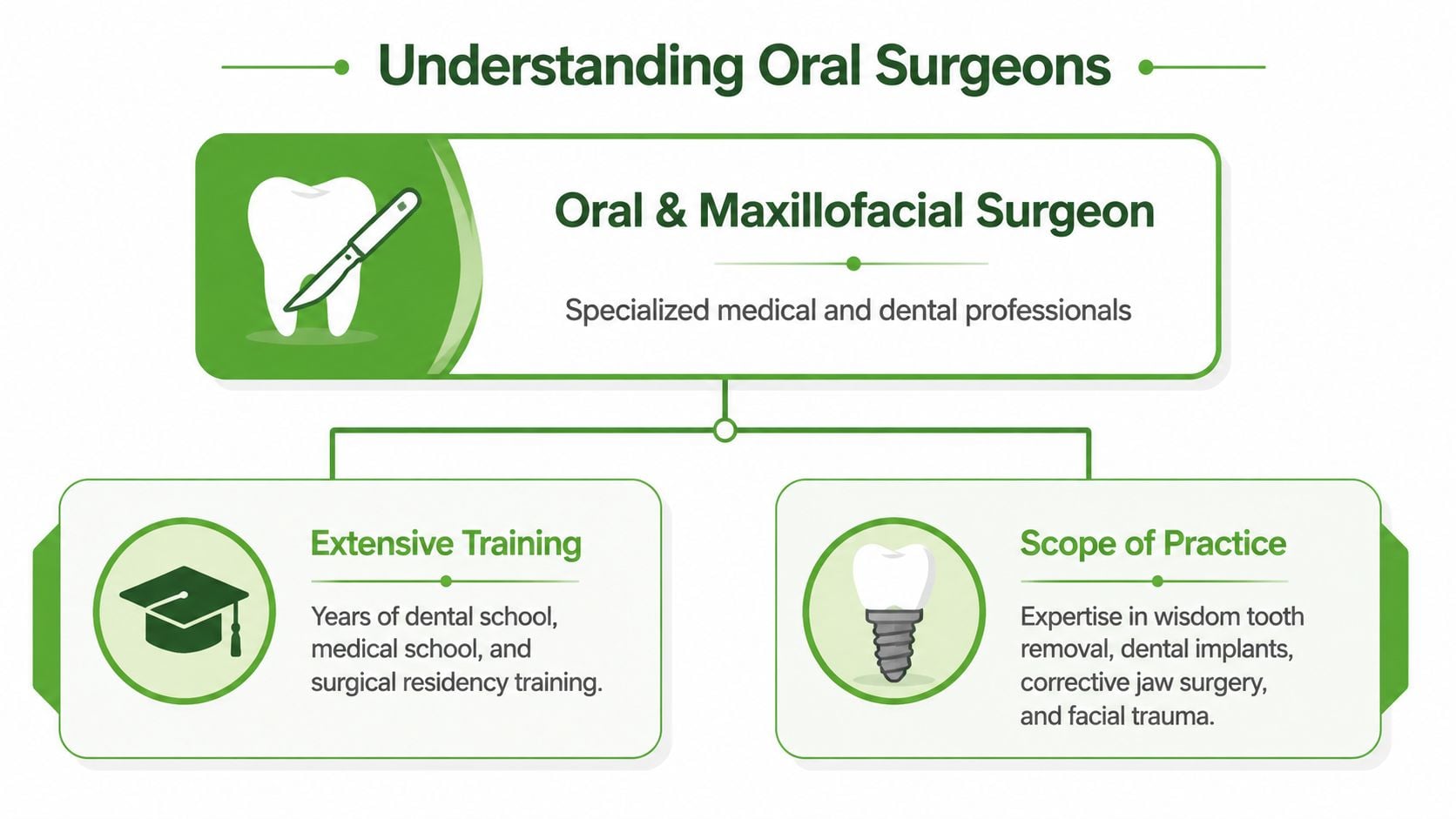
You can think of them as the specialists who handle the structural side of oral health. A general dentist manages preventive care, fillings, crowns, and many routine problems. An oral surgeon steps in when anatomy, surgical access, sedation, or complexity make the case more demanding.
According to the Mooresville oral and maxillofacial surgery overview on Healthgrades, oral and maxillofacial surgeons integrate expertise from dentistry, surgery, and anesthesia to treat diseases affecting the oral cavity, jaws, and facial structures. That scope includes dental implant placement, wisdom tooth removal, and bone grafting.
Problems that fit their scope
A surgeon may be the right specialist when you have:
- Impacted teeth that don't have a clear path to erupt
- Severe tooth damage where extraction is more complex
- Missing teeth and not enough bone for straightforward implant placement
- Jaw position issues that affect bite function
- Facial trauma involving the jaws or surrounding structures
- Pathology concerns such as unusual lesions that need surgical evaluation
Why dentists refer out
The referral usually isn't a sign that your case is alarming. More often, it means the treatment needs a different toolbox. Oral surgeons use surgical planning, imaging, and anesthesia options that general practices may not provide in-house.
That matters because success in oral surgery often depends on planning as much as technique. Bone shape, nerve location, sinus position, bite forces, and medical history all affect what should happen first and what should wait.
The right referral should make the problem clearer, not more confusing. If the explanation feels rushed, ask for it again in simpler language.
Common Reasons You Might Need an Oral Surgeon
Most patients don't search for an oral surgeon because they're curious about the specialty. They search because something hurts, something broke, or something isn't working the way it should.

Impacted wisdom teeth
Wisdom teeth often become a surgical issue when they're trapped under the gums, pushing against neighboring teeth, or causing repeated irritation. Some patients feel pressure or swelling. Others only learn about the problem on imaging.
Surgical judgment is paramount. Removing an impacted tooth isn't the same as taking out a fully erupted tooth with clear access. The surgeon has to consider position, depth, nearby structures, and the safest way to remove it while limiting unnecessary trauma.
Missing teeth and implant planning
Dental implants are one of the most common reasons patients seek an oral surgeon in Mooresville, NC. Implant treatment sounds simple from the outside. Replace the root, add the crown, move on. In reality, the foundation determines the outcome.
When performed by experienced oral surgeons, dental implant success rates can exceed 95% according to the Center for Oral and Maxillofacial Surgery implant overview. That same source notes that 3D CT scanning helps surgeons assess bone density and plan placement more precisely.
Here's why that matters in plain language:
- Bone quality matters: If the site lacks support, the implant may not integrate as intended.
- Position matters: Small planning errors can affect bite forces, comfort, and restoration design.
- Timing matters: Some patients need grafting or healing time before placement.
A short explainer can make the difference between “I guess I need an implant” and understanding what the process involves.
Jaw alignment and structural problems
Some people are referred because their bite doesn't fit together well, their jaw shifts, or they've lived with functional problems for years. In more advanced cases, corrective jaw surgery may be part of treatment. These cases usually involve coordination between surgery, dental planning, and sometimes orthodontic care.
Facial injuries and pathology concerns
A fall, sports injury, or accident can damage teeth, bone, or surrounding tissues. Oral surgeons also evaluate certain abnormal growths or suspicious areas in the mouth when a surgical diagnosis is needed.
TMJ symptoms and facial pain
Understanding the nuances of oral surgery referrals is often paramount for patients. Jaw clicking, headaches, clenching, facial tension, ear-area pain, and limited opening can lead to an oral surgery referral, but that doesn't automatically mean surgery is the best first move. Some TMJ problems are structural. Others are driven more by muscle overload, airway issues, bite strain, or parafunctional habits such as clenching.
Your First Consultation What to Expect
The first consultation usually feels easier once you know its rhythm. You schedule the appointment, complete health forms, list your medications, and describe what's been happening. The most helpful patients don't try to sound technical. They describe function. “It hurts when I chew on the left.” “My jaw locks in the morning.” “I can't open wide without pain.”
The surgeon or team will review your history, examine the area, and decide whether more imaging is needed. Some visits are straightforward. Others need a closer look at bone, roots, joints, or airway-related factors before any treatment recommendation makes sense.
What to bring and what to ask
Bring prior X-rays if you have them, your referral note, a list of medical conditions, and any questions you don't want to forget. Ask direct questions such as:
- What exactly is the diagnosis
- What are the treatment options
- What happens if I wait
- Is this a surgical problem, a pain problem, or a combined problem
- What kind of anesthesia or sedation is typically used
- What will recovery limit in daily life
If you're concerned about sedation, it helps to understand the basics of oral surgery anesthesia options. Patients are often less anxious once they know how comfort and safety are managed during more involved procedures.
What a useful treatment plan looks like
A good treatment plan doesn't just name the procedure. It explains sequence. For example, you may need infection control before extraction, grafting before implant placement, or a non-surgical evaluation before anyone decides that TMJ surgery belongs in the conversation.
Bring a written question list. People often remember the diagnosis and forget the details that matter later, especially when they're in pain.
You should leave with clarity on the next step, expected healing, and whether the recommendation is urgent, elective, or conditional on other findings.
Finding the Right Provider in Mooresville NC
Mooresville has access to multiple board-certified oral surgeons. Verified local listings identify Dr. Tony Johnson, Dr. Travis Nesbitt, and Dr. Michelle Zoccolillo among the surgeons serving the area, which reflects a competitive local market with strong demand for oral and facial surgery care in the Lake Norman region, as shown in this Mooresville oral surgeon directory on Yelp.
That's good news for patients. You have options. But more options also mean you need a way to compare providers beyond star ratings and polished service pages.
What to compare locally
Some factors matter more than others:
- Scope of care: Does the practice routinely handle the kind of problem you have
- Diagnostic process: Do they explain how they reached the diagnosis
- Technology and planning: Are they using appropriate imaging and careful case planning
- Communication style: Do they discuss alternatives, or only the procedure they perform
- Coordination: Will they work with your dentist, orthodontist, physician, or pain specialist if needed
Patients often underestimate the value of clear communication. A technically skilled provider who can't explain trade-offs leaves people confused. A strong consultation makes it obvious why a procedure is recommended, what the realistic alternatives are, and where uncertainty still exists.
When surgery may not be the first answer
This matters most in TMJ disorders and facial pain. A local oral surgeon may absolutely be the right person to rule out structural disease, joint damage, or pathology. But if the primary driver is muscle tension, clenching, airway dysfunction, or oral posture, cutting into the problem too early may not address the root cause.
If you're comparing local options and trying to judge how practices present themselves online, how to dominate local search for doctors offers a helpful look at what medical websites emphasize and why that doesn't always equal clinical fit.
Patients exploring broader care pathways sometimes also review resources on oral surgeons in Charlotte that accept Medicaid when insurance access shapes where they can realistically be seen.
When to Consider Non-Surgical Alternatives for Pain
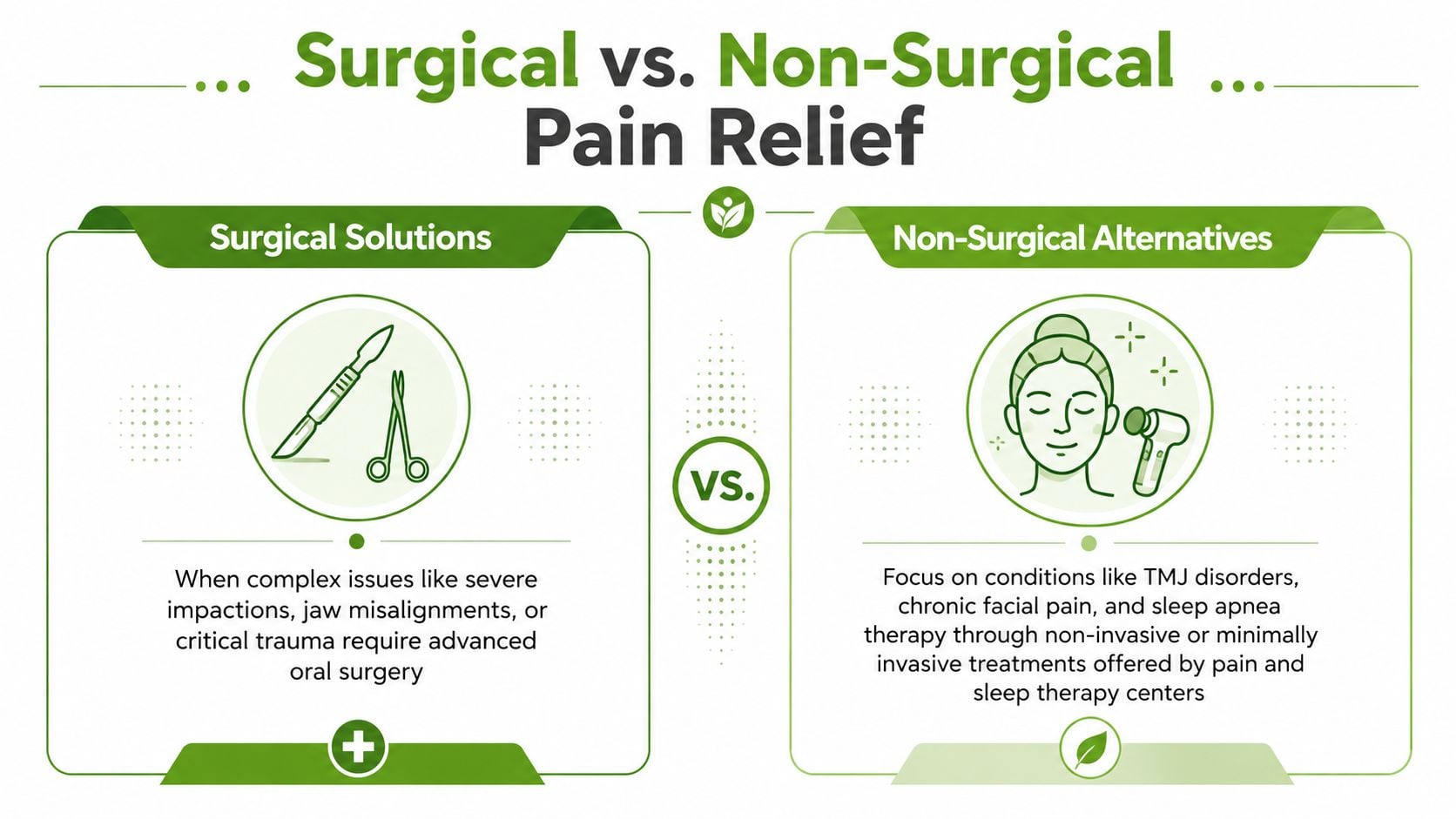
If your main complaint is jaw pain, facial pain, headache pressure, clenching, joint tenderness, or limited opening, surgery shouldn't be treated as the automatic first step. It may be necessary in selected cases. But many patients do better when the diagnostic question changes from “What procedure fixes this?” to “What is overloading this system?”
TMJ pain is often more than a joint problem
People use “TMJ” to describe almost any jaw symptom, but the joint is only one part of the picture. Muscles, posture, breathing pattern, tongue position, sleep quality, bite habits, and stress-related clenching can all contribute. That's why some patients have severe pain with little visible joint damage, while others have joint noise without major disability.
When the pain is driven by function rather than a clear surgical defect, non-surgical care can make more sense as the first line. The point isn't to avoid surgery at all costs. The point is to avoid the wrong surgery for the wrong problem.
Non-surgical approaches worth discussing
Depending on the diagnosis, clinicians may recommend tools that support healing, reduce load on the joint, or improve how the mouth and airway function. These can include:
- Custom oral appliances: These may help reduce strain from clenching, improve jaw position during sleep, or create a more stable resting relationship for overloaded muscles.
- Cold laser therapy: This is often used as a conservative option to calm irritated tissues and support comfort without invasive treatment.
- Regenerative PRF injections: In some cases, minimally invasive regenerative therapies are considered when the goal is to support tissue healing rather than remove or reconstruct anatomy.
- Breathing and myofunctional work: If a patient mouth-breathes, postures the tongue poorly, or overloads the jaw during sleep, retraining function can matter as much as pain control.
- Targeted exercises and habit change: Daytime clenching, gum chewing, forward head posture, and sleep disruption can keep symptoms active even after temporary relief.
What works and what usually doesn't
What works is a diagnosis that separates joint pathology from muscle-driven pain, sleep-related overload, or dysfunctional oral habits. What doesn't work is treating all jaw pain as if it were a purely structural problem.
Some treatments fail because they're bad. Others fail because they're mismatched. A patient with airway-related clenching may not improve much from a plan that only focuses on the bite. A patient with severe structural degeneration may not get enough relief from exercises alone.
Start with the least invasive option that actually matches the diagnosis.
That's also why many patients look into jaw surgery alternatives before committing to an irreversible procedure. Non-surgical care isn't a consolation prize. In the right case, it's the more logical first move.
Key Credentials and Questions to Ask Any Specialist
Choosing between specialists gets easier when you stop asking, “Who seems nicest online?” and start asking, “Who can explain my case clearly and justify the plan?”

Credentials that matter
Look for a provider whose training matches your problem. For surgical cases, that may mean board certification, regular experience with the procedure, and access to appropriate anesthesia support. For facial pain or TMJ care, it may mean focused expertise in diagnosis, conservative treatment, and function-based rehabilitation.
Questions that reveal a lot
Ask a few questions that can't be answered with a rehearsed sales line:
- How often do you treat this specific condition
- What findings support your diagnosis
- What non-surgical options should be considered first
- What are the trade-offs of treating now versus monitoring
- How do you decide when imaging changes the plan
- If your treatment doesn't solve the problem, what would be the next step
A strong specialist won't get defensive when you ask these. They'll welcome the conversation.
“Help me understand why this is the right first treatment for my case” is one of the best questions a patient can ask.
Frequently Asked Questions
Will insurance cover oral surgery or TMJ care
Coverage depends on the diagnosis, the procedure, and whether the service falls under dental or medical benefits. Extractions, implants, anesthesia, TMJ evaluation, and appliance therapy are often handled differently. Ask the office to explain what they can estimate, what requires predetermination, and what costs may remain your responsibility.
How long does recovery take after wisdom tooth removal
Recovery varies with the position of the teeth, the difficulty of the surgery, your health history, and how closely you follow post-op instructions. Some people bounce back quickly. Others need a more gradual return to normal chewing and activity. Your surgeon should give you a realistic range based on your case, not a one-size-fits-all answer.
How can I tell if jaw pain is TMJ or something else
You usually can't tell on symptoms alone. Jaw pain can come from joints, muscles, tooth problems, nerve irritation, sinus pressure, bite overload, or sleep-related clenching. If the pain includes locking, limited opening, headaches, ear-area pressure, or facial tightness, it's worth getting a focused evaluation rather than assuming it's “just stress.”
What kinds of procedures do oral surgeons in Mooresville handle
A full-scope oral surgery practice can manage dental implants, wisdom teeth, corrective jaw surgery, TMJ surgery, oral pathology, and facial trauma care. For example, Dr. Michelle Zoccolillo's Mooresville practice profile lists full-scope services and notes support from an in-house anesthesia team for complex cases.
Does every TMJ problem need surgery
No. Some patients need surgical evaluation, especially when there's a clear structural issue. Many others benefit from non-surgical care first, particularly when pain appears linked to muscle tension, clenching, breathing, sleep, or functional habits.
If you're dealing with jaw pain, facial tension, headaches, or sleep-related symptoms and want a careful look at non-surgical options before considering invasive treatment, Pain and Sleep Therapy Center offers root-cause evaluation for TMJ disorders, facial pain, and airway-related problems. It's a practical next step for patients who want a diagnosis that explains not just where the pain is, but why it keeps happening.