You're exhausted. The lights are off, your body is heavy, and tomorrow is already too close. But the moment your head hits the pillow, your brain starts sorting emails, replaying awkward conversations, and inventing new problems. A lot of people know this feeling well. You're tired, but you're not settled.
That mismatch matters. Sleep doesn't begin just because you want it to. Your body has to shift into a quieter physiologic state first. When it doesn't, the harder you try to force sleep, the more awake you feel.
That's where breathing exercises for sleep can help. Not as a magic trick. Not as a replacement for medical care when something deeper is going on. But as a simple, physical way to tell your system that the emergency is over.
Why You Can't Switch Off Your Brain at Night
For many adults, bedtime is the first quiet moment of the day. That silence can feel like relief at first. Then the mental noise gets louder. Work stress, family worries, pain, hormones, jaw tension, or a sense that you have to fall asleep right now can all keep the brain alert when the body needs to downshift.
This is why “just relax” rarely works. An overactive mind at night usually isn't a character flaw. It's often a nervous system problem. Your body is still acting like it needs to stay on guard.
Some people notice this pattern around life transitions. Hormonal changes can make sleep feel less predictable, and resources on managing perimenopause sleep issues can help connect those dots if that sounds familiar. Others deal with stress-related arousal, pain, or shallow breathing patterns that keep the body from settling.
You can't think your way into sleep when your physiology is still braced for action.
Controlled breathing gives you something practical to do with that state. Instead of wrestling with thoughts, you work through the body first. The breath is unusual because it happens automatically, but you can also influence it on purpose. That makes it a useful entry point when sleep feels out of reach.
A good bedtime breathing practice doesn't need to be complicated. It needs to be gentle, repeatable, and calm enough that your body starts to trust it. If you're also trying to improve your overall habits, this guide on how to improve sleep quality naturally can support the bigger picture.
What breathing can and can't do
Breathing exercises for sleep can help when the main problem is activation. Racing thoughts. Muscle tension. A fast heart rate. That feeling of being mentally “on.”
They're less helpful when the true problem is mechanical. If you snore heavily, wake with a dry mouth, clench your jaw, or feel tired no matter how long you sleep, relaxation alone may not be enough. That distinction is important, and it's where many people lose time trying the wrong solution for the wrong problem.
How Controlled Breathing Calms Your Nervous System
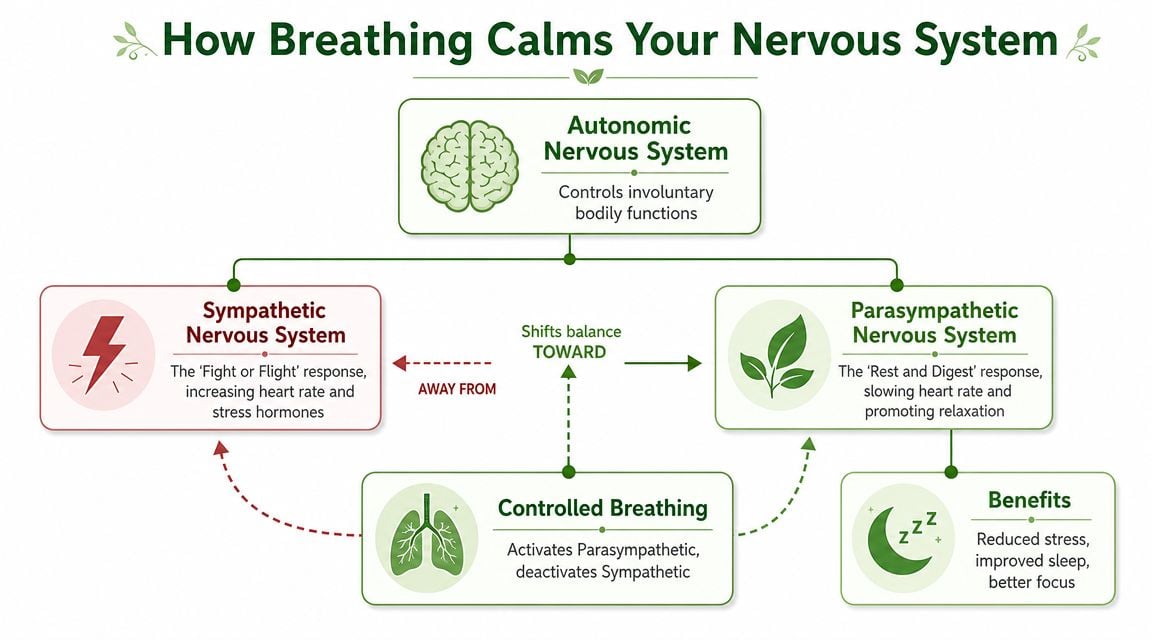
Your nervous system has different settings. One is built for action and vigilance. Another supports recovery, digestion, and sleep. At night, you need the second one to take over.
Controlled breathing helps shift that balance. A 2025 systematic review in PMC found that consistent breathing-exercise programs lasting a month or longer were associated with improved sleep quality in adults, and the review explains that controlled breathing can activate the parasympathetic nervous system and lower heart rate, blood pressure, and cortisol, which are physiologic changes that support sleep (PMC review on breathing exercises and sleep).
Think of it like a dimmer switch
Falling asleep often involves trying to mentally shut off thoughts. That's difficult when the body still feels revved up. Breathing works better as a first step because it turns down the volume physically.
A slower, quieter breathing pattern tells your system that you are safe enough to let go of vigilance. That doesn't mean every breath has to be dramatic. In fact, the calmer pattern is usually subtle.
What to notice while you breathe
A useful bedtime breath tends to have a few features:
- Nasal airflow: Breathing through the nose is usually more settling than open-mouth breathing.
- Low effort: Your chest and shoulders shouldn't be straining.
- A softer exhale: A slightly longer exhale often helps the body release tension.
- Steady rhythm: Smooth is more important than deep.
If you want a structured way to practice pacing, this article on mastering 6 breaths per minute offers one rhythm many people find calming.
Clinical perspective: The best sleep breathing pattern is usually the one that feels quiet, light, and sustainable. If it feels like work, it's often too much.
Why this matters before bed
When people say a breathing exercise “works,” what they often mean is not that it knocks them out instantly. It helps them stop escalating. Their thoughts may still be present, but the body is no longer feeding the spiral with a pounding heart, tight chest, or restless tension.
That's the value. Breathing exercises for sleep create conditions that make sleep more likely. They don't force sleep, and they don't fix every sleep disorder. But they can make the transition into sleep much smoother when stress physiology is the main obstacle.
Three Proven Breathing Techniques for Better Sleep
Not every exercise fits every person. Some people need a very simple pattern because counting wakes them up. Others do better with structure because it gives the mind a job. Start with one method and stay with it for several nights before deciding it doesn't suit you.
The 4-7-8 method for a racing mind
This is the clearest stepwise protocol for many beginners. A widely cited version of the 4-7-8 method is to start with a full exhale, inhale through the nose for 4 counts, hold for 7, exhale for 8, and repeat for about 4 cycles. Cleveland Clinic notes that experts recommend beginning with the exhale and avoiding strain during the hold (Cleveland Clinic on 4-7-8 breathing).
Try it this way:
- Exhale fully first. Let the breath out without pushing hard.
- Inhale through your nose for 4 counts.
- Hold for 7 counts. Keep it gentle. If the hold feels stressful, shorten it.
- Exhale for 8 counts. Slow and unforced.
- Repeat for about 4 cycles.
Who it's best for:
- People with looping thoughts
- Those who like a clear rhythm
- Anyone who benefits from a longer exhale
Trade-off: if breath holds make you tense, this may not be your best bedtime method right away.
Diaphragmatic breathing for body-based relaxation
This is the foundational skill I return to most often. It teaches the body to breathe with less effort and less upper-chest tension.
Sleep-focused guidance describes diaphragmatic breathing as being done seated or lying down with one hand on the chest and one on the belly, then taking 20 slow nose-breaths while keeping the chest relatively still and letting the belly rise and fall. The same guidance warns that overbreathing or forcing deep breaths can backfire, and emphasizes light, nasal, quiet breathing before bed (Sleep Foundation on breathing exercises for sleep).
Use it like this:
- Set up your posture. Lie on your back or sit supported.
- Place one hand high on the chest and one on the abdomen.
- Breathe in through your nose. Let the belly move more than the chest.
- Breathe out softly through your nose.
- Complete 20 slow breaths.
This is especially helpful for:
- Beginners
- People with jaw, shoulder, or chest tension
- Anyone who tends to breathe fast and shallow when stressed
If you suspect nasal breathing is a weak point, this guide on how to breathe through your nose can help you build that skill.
If your breathing gets louder as you “relax,” scale back. Quiet breathing usually settles the body better than big breaths.
Box breathing for rhythm and focus
Box breathing is often easier for people who want symmetry and a mental anchor. It's a structured pattern, usually with equal counts on the inhale, hold, exhale, and pause. It can be useful when your attention keeps drifting back to worry.
A good explanation of box breathing for instant calm can be helpful if you like guided pacing and want a simple rhythm to follow.
A practical version at bedtime looks like this:
- Inhale gently through the nose for a comfortable count.
- Pause briefly without straining.
- Exhale for the same count.
- Pause again.
- Continue for several rounds, keeping the breath smooth.
Best for:
- People who feel mentally scattered
- Those who relax with repetition
- Anyone who dislikes longer exhale patterns
Trade-off: if pauses make you anxious, diaphragmatic breathing is usually a better first choice.
Breathing Exercise Quick Reference
| Technique | Primary Benefit | Best For |
|---|---|---|
| 4-7-8 | Helps interrupt anxious momentum | Racing thoughts at bedtime |
| Diaphragmatic breathing | Reduces upper-body tension and encourages quieter breathing | Beginners and people with shallow breathing |
| Box breathing | Builds rhythm and focus | Restless minds that need structure |
How to choose tonight's technique
Pick based on your actual problem, not what sounds impressive.
- Mind won't stop: Start with 4-7-8.
- Body feels tight or breath feels high in the chest: Use diaphragmatic breathing.
- You want a repetitive pattern to focus on: Try box breathing.
You don't need all three in one night. It's generally better to choose one and keep it simple.
Creating a Sustainable Bedtime Breathing Routine
The biggest mistake people make with breathing exercises for sleep is treating them like a rescue tool only. They use them once on a miserable night, feel uncertain, and give up. That misses how these practices usually help.
A 2021 clinical study of insomnia patients found that 1 week of mindful breathing plus a sleep-inducing exercise did not significantly change PSQI, GAD-7, or ISI scores, but compared with controls, the intervention group showed significant improvements in sleep quality, daytime functioning, negative emotions, sleep latency, sleep duration, sleep efficiency, anxiety, and insomnia severity at 1 and 3 months after treatment. The same paper also describes a University of Arizona inspiratory muscle training protocol of 30 breaths a day, 5 days per week, for 24 weeks, and notes earlier work showing 5 minutes a day of resistance breathing can improve sleep quality and lower blood pressure. Taken together, the message is clear. Breathing practices work best when you do them consistently over weeks to months, not as a one-night fix (clinical study on breathing practice and sleep outcomes).
Make it part of something you already do
The easiest routine is the one that doesn't depend on motivation. Attach your breathing practice to a habit that already happens every night.
Good anchors include:
- After brushing your teeth
- Once you turn off the bedroom light
- After setting your phone down
- When you first get into bed
This is also where broader sleep habits matter. If you want a complementary read on creating a wind-down process, this guide to deeper, restorative sleep fits well alongside a bedtime breathing routine.
A simple first-week routine
Keep the bar low enough that you'll do it.
- Night 1 and 2: Practice diaphragmatic breathing for a brief, easy session.
- Night 3 and 4: Try 4-7-8 for a few rounds if you like more structure.
- Night 5: Repeat the method that felt most calming.
- Night 6 and 7: Use the same method at the same point in your bedtime routine.
What matters most is regularity. Not perfect counts. Not dramatic sensations. Not falling asleep during the exercise itself.
For people who prefer guided pacing, a short visual cue can help you stay consistent without overthinking it.
What to aim for: A breathing routine should feel familiar by the end of the week. Familiarity is calming in its own right.
What progress usually looks like
Individuals don't notice a sudden transformation. They notice less struggle. Bedtime feels less combative. It takes less effort to settle. If that's happening, the routine is doing its job.
Important Safety Notes and Common Mistakes to Avoid
Breathing exercises for sleep should feel calming, not effortful. When people say a technique “didn't work,” the problem is often how they did it, not the fact that they tried breathing at all.
A common pitfall is overbreathing. Sleep-focused guidance warns that forcing deep breaths can increase arousal instead of relaxation. The safer approach is to start with an exhale, keep any hold gentle, and focus on light, nasal, quiet breathing before bed.
What to watch for
- Dizziness or lightheadedness: You're probably breathing too much or too hard. Return to normal breathing and try a softer pattern later.
- Chest and shoulder effort: Shift attention lower. Your abdomen should move more than your upper chest.
- Stress during the hold: Shorten the hold or skip techniques that include one.
- Frustration when your mind wanders: That's normal. Return attention to the breath without trying to “win.”
A few practical corrections
If the exercise feels stimulating, reduce the intensity. Smaller breaths are often better at bedtime than bigger breaths.
If you can't breathe comfortably through your nose because of congestion or blockage, don't force it. Address the obstruction first, or choose a very gentle pattern rather than trying to push air through resistance.
Stop if the practice makes you feel more activated. A sleep exercise should lower effort, not increase it.
If you have a significant respiratory condition and you're unsure whether a technique is appropriate, check with your clinician before starting a new breath practice. That's especially sensible if breath holding or resistance breathing has been uncomfortable for you in the past.
When Breathing Exercises Are Not Enough to Fix Your Sleep
You get into bed, do the breathing exercise correctly, and still wake up tired, foggy, or startled awake. In clinic, that pattern usually means the problem is larger than bedtime arousal alone.
Breathing exercises help many people fall asleep because they reduce stress physiology. They do not correct every cause of broken sleep. If the problem is airway collapse, chronic nasal obstruction, bruxism, pain, or another sleep disorder, a calm nervous system may still not be enough to keep sleep stable through the night.
That distinction matters. People often assume they failed at relaxation when the body is working too hard to breathe during sleep. As noted earlier in the Healthline overview on breathing exercises and sleep limitations, breathwork can support relaxation, but it does not treat obstructive sleep apnea or other structural breathing problems.
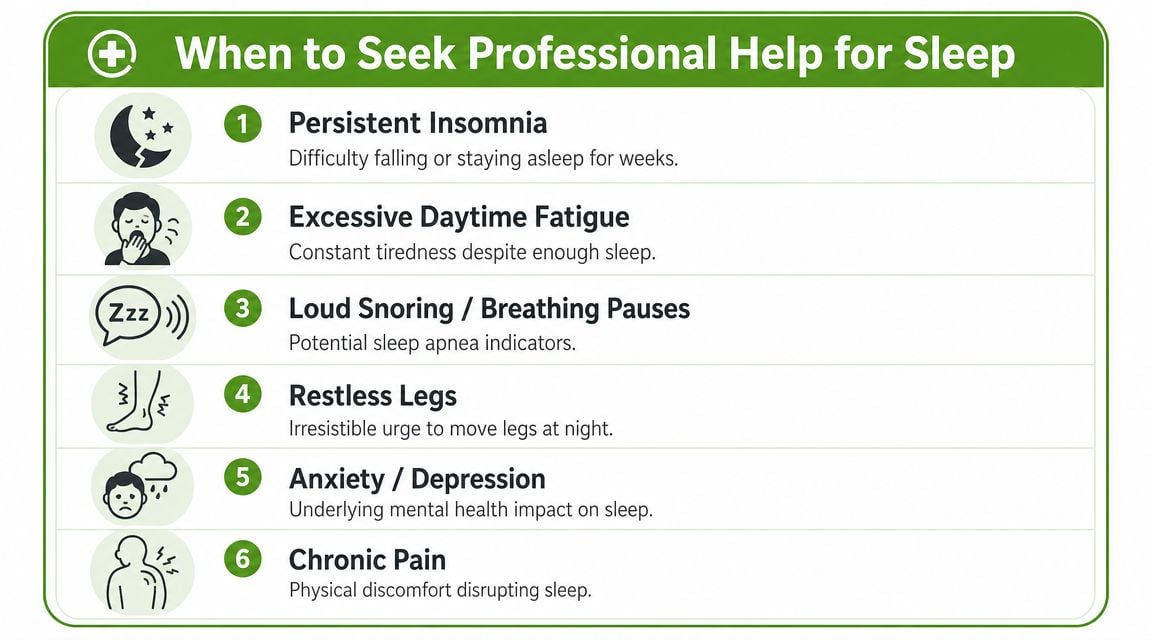
Signs you may need more than a relaxation routine
A formal sleep or airway assessment is worth considering if any of these keep showing up:
- Habitual snoring: especially loud snoring, snoring that breaks through closed doors, or snoring paired with dry mouth
- Pauses in breathing, choking, or gasping: these raise concern for sleep-disordered breathing
- Daytime sleepiness despite enough time in bed: quantity and quality are not the same
- Morning headaches, jaw pain, or tooth wear: these can go with clenching, strained breathing, or both
- Nighttime mouth breathing: often a clue that nasal breathing is not working well enough during sleep
- Fragmented sleep with no clear stress trigger: repeated awakenings can reflect breathing instability, pain, reflux, limb movements, or other conditions
What the next step may look like
The right next step depends on the pattern.
Some people need a sleep study. Others need an airway and oral function assessment that looks at nasal resistance, tongue posture, jaw position, oral habits, and how breathing is happening during the day and at night. In selected cases, orofacial myofunctional therapy or Buteyko-based retraining can help improve breathing mechanics and oral posture. Those approaches are not quick bedtime tricks. They are targeted treatment strategies, and they work best when matched to the actual problem.
Pain and Sleep Therapy Center evaluates sleep-related breathing concerns along with jaw tension, facial pain, and airway function.
If your body feels relaxed but your sleep remains effortful, unrefreshing, or repeatedly interrupted, stop assuming stress is the whole story.
Breathing exercises are still a good first step. They are low-risk, practical, and often useful for people whose main problem is hyperarousal. But when symptoms point to airflow limitation, airway collapse, pain, or dysfunctional breathing patterns, the better answer is assessment, not more repetition of the same bedtime routine.