You wake up with a tight jaw. Breakfast feels like work. By late afternoon, your temples ache, your teeth feel tired, and you catch yourself shifting food to one side because chewing evenly is uncomfortable. If that sounds familiar, the problem often isn’t just the joint. It’s the whole system around it.
The jaw depends on coordinated muscle function, steady joint tracking, healthy oral posture, and a nervous system that isn’t stuck in protection mode. Jaw strengthening exercises can help, but only when they’re done with good form, at the right intensity, and as part of a bigger plan. Random squeezing, aggressive stretching, or chewing on resistance gadgets usually creates more irritation than progress.
Why Jaw Strength Is Crucial for Pain-Free Function
Jaw pain often gets framed as a joint problem alone. In practice, that’s incomplete. The temporomandibular joint works with the masseter, temporalis, pterygoids, tongue, neck muscles, and upper airway mechanics. If those pieces are weak, overworked, poorly coordinated, or compensating for each other, the jaw starts to click, deviate, fatigue, or lock.

Weakness doesn’t always feel like weakness
Most patients don’t describe the issue as “my jaw is weak.” They say their jaw gets tired, their face feels tense, chewing steak is harder than it used to be, or they get headaches after talking for long periods. That pattern matters. A muscle system that can’t stabilize well often responds by clenching harder, not by relaxing.
That’s one reason strengthening matters. Done correctly, it improves the jaw’s ability to handle normal daily load without relying on guarding and overuse.
A 2021 meta-analysis in the Journal of Dental Research found that oral exercise programs significantly improved mean bite force. The research also showed that chewing and clenching exercises were most effective, with greater gains associated with higher intensity and frequency. That supports what many clinicians see: structure matters more than random effort.
Stability changes symptoms
When the muscles that guide opening, closing, and chewing work in sync, the joint tracks more smoothly. That can reduce the strain that drives clicking, soreness, and post-meal fatigue. Stronger doesn’t mean bulky. It means the jaw can do ordinary jobs without flaring up.
This also connects to orofacial myofunctional therapy. If the tongue posture is low, lips are apart, breathing is mouth-based, or swallowing mechanics are off, the jaw often carries extra load it shouldn’t have to manage alone. Patients who want to understand that larger pattern can learn more about orofacial myology and how oral muscles affect function.
Clinical reality: A painful jaw is often both irritated and underperforming. Calming symptoms helps, but rebuilding control is what makes progress last.
Strength is part of root-cause care
Jaw strengthening exercises aren’t a trick for masking pain. They’re a way to restore capacity. That’s different from merely avoiding hard foods forever or relying on passive treatments alone.
A useful way to think about it is this:
| Problem pattern | What often happens | What strengthening can help restore |
|---|---|---|
| Chewing fatigue | Muscles tire quickly and compensate | Better endurance and bite control |
| Jaw deviation | One side dominates during opening | Improved symmetry and tracking |
| Tension headaches | Temporalis overworks to stabilize | More balanced load sharing |
| Clenching habits | Protective gripping replaces control | Better function with less guarding |
What works and what doesn’t
Some people improve because they start with small, repeatable movements and build gradually. Others stall because they jump straight to forceful opening, overdo resisted biting, or treat every click like something to “push through.”
What works is consistency, precision, and progression. What doesn’t work is aggression.
That’s why a good home program focuses on controlled resistance, alignment, and symptom response, not on making the jaw “work hard” for the sake of it.
Four Foundational Jaw Strengthening Exercises
A home program should feel controlled, not dramatic. If an exercise leaves the joint angry for the rest of the day, it was too much, too soon. The right starting point is usually low-load movement with good tracking.

Studies summarized in a 2022 article on jaw-opening exercise approaches show that jaw exercises improve TMJ function in 70-85% of cases. Specific studies on jaw-opening exercises reported a 20-40% increase in maximum mouth opening and a 30-50% reduction in pain after four weeks of daily practice. The key phrase is daily practice. Occasional effort doesn’t build reliable control.
Resisted mouth opening
This exercise helps the muscles that open and stabilize the jaw work against gentle resistance.
- Sit upright with your head stacked over your shoulders.
- Place your palm or a couple of fingers under your chin.
- Start with your teeth slightly apart and lips relaxed.
- Open your mouth slowly while your hand gives light resistance upward.
- Move only through a pain-free or mildly effortful range.
- Hold briefly, then close slowly.
What you should feel: mild work under the jaw and around the sides of the face, without sharp joint pain.
Form cue: Keep your neck neutral. If your chin lifts toward the ceiling, your neck is doing the work instead of your jaw.
Common mistake: pushing hard with the hand and forcing the jaw through a crooked path.
Resisted mouth closing
This movement trains controlled closing and helps reduce the sloppy “drop and snap shut” pattern many people develop.
- Set your position: Open slightly, keeping the jaw centered.
- Place resistance: Put two fingers on the front of the chin.
- Close with control: Gently close while your fingers provide light downward resistance.
- Finish softly: Let the teeth approach each other without clenching.
This should feel steady, not compressed. If your molars crash together or your temples grip hard, reduce resistance.
Gentle lateral jaw movements
Lateral work matters because chewing isn’t purely open and close. The jaw shifts side to side constantly. If one side is weak or restricted, the other side often overcompensates.
Try it this way:
- Open your mouth a small amount.
- Move your lower jaw to the left.
- Pause briefly.
- Return to center.
- Move to the right.
- Return to center.
Keep the range small at first. Smooth movement matters more than distance. If your jaw swings forward or twists, shorten the range and slow down.
For a broader collection of jaw and neck movements that pair well with this work, review these guided exercises for jaw and neck tension.
Chin tucks for jaw support
This isn’t a jaw exercise in the narrow sense, but it belongs in almost every TMJ routine. Forward head posture changes how the jaw sits and how the muscles recruit. If the head is drifting forward all day, the jaw rarely gets a fair mechanical setup.
- Sit tall or stand against a wall.
- Keep your eyes level.
- Draw your head straight back, as if making a small double chin.
- Hold briefly, then relax.
- Breathe normally and keep your shoulders quiet.
This should feel subtle. Don’t jam the chin down toward the chest.
A quick demonstration can help before you practice:
How to know an exercise is helping
People often ask whether they should feel soreness. A little muscular effort is fine. A rising ache in the joint, sharp pain in front of the ear, or more catching afterward usually means the dosage or mechanics need adjusting.
Here’s a simple check:
| During exercise | Usually acceptable | Usually a warning sign |
|---|---|---|
| Muscle effort | Mild fatigue | Cramping or shaking |
| Joint sensation | Light awareness | Sharp, pinching, or stuck feeling |
| Motion quality | Smooth and centered | Deviation, popping with pain |
| After effect | Settles quickly | Irritation that lingers |
Don’t chase range. Chase clean movement.
A practical sequence
If you want a basic starting routine, use this order:
- Chin tucks to set posture
- Resisted mouth opening for controlled activation
- Resisted mouth closing for stability
- Gentle lateral movements for chewing mechanics
That order works well because posture usually improves the quality of everything that follows.
Building Your Personal Jaw Strengthening Program
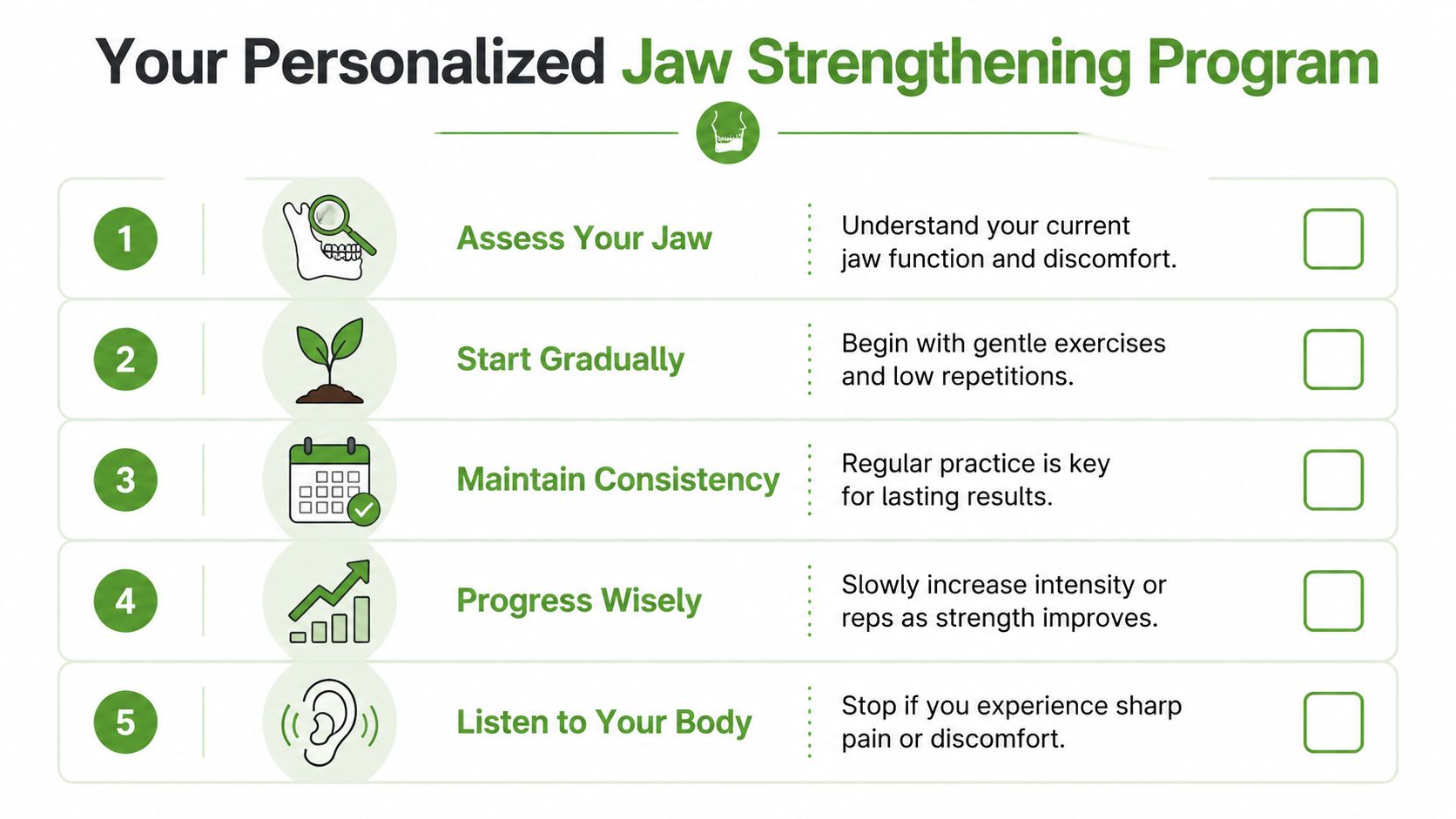
Failure with jaw strengthening exercises often occurs for one reason. The common mistake is treating them like isolated tricks instead of a training plan. The jaw responds better when capacity is built in the same manner as shoulder or hip strength. Start below your limit, repeat consistently, and progress only when control is solid.
A clinical protocol described in Dr. Ho’s jaw exercise handout from OrthoVirginia recommends 3 sets of 5 repetitions per exercise, performed up to 3 times a day. That same source notes that this type of regimen can improve pain relief and increase maximal jaw opening by 4-7 mm in 70-85% of TMJ patients within 4-6 weeks.
The first phase
The beginner phase is about coordination, not force. You’re teaching the jaw to move evenly again.
Use a simple schedule:
- Morning session: one round of your selected exercises
- Midday session: repeat if symptoms are calm
- Evening session: short, gentle, and controlled
Start with fewer reps if you’re sensitive. It’s better to finish wanting a little more than to provoke a flare.
When to progress
Progress only if these are true for several days in a row:
- Your movement stays centered
- Symptoms during exercise are mild and manageable
- You don’t feel worse later the same day
- Chewing and speaking feel a little easier
If those boxes are checked, you can increase one variable at a time. Add a brief hold. Add a little more resistance. Add a set. Don’t increase all three at once.
Progression rule: Change one variable, then watch the response for a few days before changing anything else.
A sample progression mindset
General strength training follows the same principle. The logic behind Strive Workout Log's training program is useful here because it emphasizes gradual overload instead of dramatic jumps. The jaw is a smaller system, but the principle still applies. Consistent, measured progression tends to outperform sporadic hard effort.
A practical weekly framework
Instead of obsessing over the “perfect” plan, use this structure:
| Phase | Focus | What you’re watching |
|---|---|---|
| Early phase | Symmetry and tolerance | Less deviation, less post-exercise irritation |
| Build phase | Light resistance and repetition | Better endurance for chewing and talking |
| Refinement phase | Precision under slightly higher load | More stable opening and closing |
Some people need to stay in the early phase longer. That isn’t failure. It usually means the joint is irritable, the neck is contributing, or clenching habits are still active.
What a sustainable program feels like
A good program doesn’t dominate your day. It fits into it. Most patients do best when they attach exercises to things they already do, such as after brushing their teeth, during a mid-day work break, and before bed.
Keep notes on three things:
- Morning stiffness
- Pain with chewing
- Ease of opening
Those markers usually tell you more than a single “pain score.”
Signs your plan is too aggressive
If your jaw strengthening exercises are set up well, you should feel more control over time. If not, step back.
Watch for these patterns:
- More clicking with pain
- Feeling the need to force through a stuck point
- Temple soreness that lasts
- Joint tenderness in front of the ear after every session
In that case, reduce either resistance or range. Many people need less than they think.
Common Mistakes and How to Avoid Injury
The biggest myth in rehab is that more effort always means more progress. With the jaw, that belief causes setbacks fast. The joint is small, heavily used, and closely linked to the neck, tongue, breathing pattern, and stress response. A sloppy program can turn a manageable problem into a daily flare.

Pushing through sharp pain
Muscle effort is acceptable. Sharp joint pain is not. If the pain feels pinching, stabbing, or like the jaw is catching on something, stop that movement.
Instead, try this: shorten the range, reduce resistance, and reset your posture before repeating. If the same motion stays sharp, remove it from your home routine until you’ve been evaluated.
Sharp pain is feedback, not a challenge.
Letting the jaw deviate
A lot of people open in a curved path without realizing it. Then they add resistance on top of that faulty path and reinforce the asymmetry.
Instead, try this: practice in front of a mirror. Watch whether the chin tracks straight. If it veers to one side, use a smaller opening range and slower tempo until the path improves.
Using the neck to fake jaw strength
This is extremely common. The chin lifts, the shoulders tense, and the front of the neck starts doing work that should come from better jaw control.
Instead, try this: sit with your upper back supported, keep your eyes level, and lightly tuck the chin before each rep. If your throat feels strained, reset.
Clenching instead of strengthening
People with TMJ pain often live in a cycle of over-gripping. So when they hear “strengthening,” they typically bite harder. That usually overloads the masseters and temporalis.
Instead, try this: think “steady and controlled,” not “hard.” The jaw should work without crushing. Resistance should feel light enough that you can keep the movement smooth.
Choosing gimmicks over therapy
Commercial jaw exerciser devices appeal to people because they promise a stronger jaw quickly. The problem is that they often deliver force without precision. That’s risky for an irritated joint.
Instead, try this: use hand resistance, controlled opening, lateral work, and postural support. Those let you manage direction, load, and symptom response.
Ignoring daily aggravators
Even a good exercise program can fail if the rest of the day keeps feeding the problem.
Look for these contributors:
- Chewing gum for long periods
- Resting your chin in your hand
- Mouth breathing and open-mouth posture
- Teeth clenching during concentration
- Sleeping face-down with the jaw compressed
Changing those habits often lowers the background irritation enough for strengthening to work.
When not to do home exercises
There are times when self-directed jaw strengthening exercises should wait.
Avoid starting or intensifying a program if you have:
- Recent dental surgery
- Acute trauma to the jaw
- A jaw that is severely locked
- Sudden major changes in your bite
- Pain that escalates rapidly with basic movement
If any of those are present, get professional guidance first. The right treatment may still include exercises, but the sequence matters.
When to Combine Exercises with Professional Treatment
Home exercises are powerful, but they’re not complete care for every case. Some jaws need more than movement drills. If the disc isn’t tracking well, the muscles are in protective spasm, the tongue posture is poor, or airway strain is driving clenching at night, exercises alone may only solve part of the problem.
That’s where professional treatment changes the picture. A proper evaluation looks at jaw motion, muscle tenderness, oral posture, breathing pattern, sleep symptoms, neck involvement, and how the bite behaves under function. Those details determine whether your home program should focus on stability, mobility, myofunctional retraining, or tissue healing.
When a basic program isn’t enough
You should consider professional help if:
- Pain keeps returning despite careful exercise
- Your opening stays limited
- The jaw locks or catches repeatedly
- You have frequent headaches, ear pressure, or facial pain
- Snoring, poor sleep, or mouth breathing are part of the picture
Those signs often point to a layered problem rather than simple deconditioning.
How exercise fits into advanced care
At-home strengthening usually works best when it supports a larger treatment plan. In clinical practice, that may include manual therapy, habit retraining, airway-focused care, or orofacial myofunctional therapy. It may also include regenerative approaches when the joint or supporting tissues need help healing.
A useful overview of non-surgical options is available in this guide to best TMJ treatments and how they’re selected.
Regenerative medicine and strengthening
This is one of the most important distinctions missing from generic online advice. If irritated tissues are healing after treatment, they still need better function afterward. Otherwise, the jaw returns to the same weak, compensatory pattern that helped create the problem in the first place.
A future-dated report referenced by TMJ Plus on short-term TMJ relief strategies describes emerging 2026 research suggesting 65% faster muscle recovery when jaw exercises follow Platelet-Rich Fibrin (PRF) injections compared with exercises alone. The same source also notes a 75% improvement in swallow function in pediatric patients when targeted strengthening is combined with laser frenectomy. Those findings are promising because they support a practical truth: tissue treatment and muscle retraining often work better together than either one alone.
Orofacial function matters too
Jaw strengthening can’t be separated from tongue function, lip seal, nasal breathing, and swallow pattern. If a patient keeps resting with the mouth open, thrusting the tongue, or breathing through the mouth at night, the jaw often loses the stable environment it needs to calm down.
That’s why some patients improve only after treatment addresses both mechanics and behavior. Exercises build capacity. Myofunctional work helps the system use that capacity correctly.
Home exercises help the jaw perform. Professional care helps determine what the jaw is compensating for.
A root-cause mindset
The most effective treatment plans don’t ask whether you need exercises or advanced care. They ask how the pieces fit together. A patient with joint irritation may need regenerative support plus a carefully progressed strengthening routine. A patient with snoring, clenching, and facial pain may need airway-focused treatment plus retraining of oral posture. A child after frenectomy may need guided strengthening so new mobility turns into useful function.
That’s the ultimate goal. Less pain, yes. But also a jaw that opens evenly, chews comfortably, supports better breathing, and doesn’t require constant guarding to get through the day.
Frequently Asked Questions About Jaw Exercises
Will jaw strengthening exercises make my face look wider or more masculine
Therapeutic jaw exercises are not designed for cosmetic hypertrophy. They’re designed to improve control, endurance, and stability. When done properly, they’re usually low-load and precise. The goal is better function, not building oversized chewing muscles.
Are commercial jaw exerciser devices safe
They’re often too blunt for a painful or unstable jaw. A device can add resistance, but it can’t tell whether your jaw is deviating, whether your neck is compensating, or whether the joint is being compressed in a bad path. Therapeutic exercises let you control the line of movement and back off quickly if symptoms rise. For most TMJ patients, that’s the safer starting point.
Should I change my diet while doing these exercises
Usually, yes. If your jaw is flared, very tough, crunchy, or chewy foods can keep provoking the tissues you’re trying to calm down. A temporary shift toward easier-to-chew foods often helps. That doesn’t mean avoiding chewing forever. It means matching food load to your current tolerance while your mechanics improve.
How long should I keep doing jaw strengthening exercises
Continuing some version of the routine often yields the best results even after symptoms improve. Early on, the exercises act like rehab. Later, they act like maintenance. The exact long-term plan depends on whether your underlying drivers are stress clenching, posture, airway issues, tongue posture, joint instability, or recovery after treatment.
What if my jaw clicks but doesn’t hurt
A painless click isn’t always an emergency, but it’s still worth paying attention to if it’s new, getting louder, or paired with deviation, fatigue, or reduced opening. Clicking tells you something about tracking. Exercises may help, but the right program depends on why the click is happening.
If jaw pain, facial tension, headaches, snoring, or mouth breathing are affecting your daily life, Pain and Sleep Therapy Center can help you look beyond the symptom and identify the root cause. Our team evaluates TMJ function, oral posture, airway factors, and sleep-related breathing issues so treatment can be personalized. Whether you need a guided exercise plan, myofunctional therapy, regenerative support, or a more complete root-cause workup, we’re here to help you move toward comfortable function and better sleep.