

A baby cries at the breast, a parent wonders whether every feeding is supposed to hurt, and an adult notices that a tight tongue seems to travel with jaw tension, poor sleep, or difficulty finding a comfortable oral posture. Searching for tongue tie release often begins with a visible band beneath the tongue, but the primary concern is usually functional: Is this restriction causing the problem, and would releasing it help?
That question deserves more care than a quick look or a promise that one procedure will fix feeding, speech, breathing, or jaw symptoms. Tongue-tie release can be useful for selected patients, especially when tongue restriction is clearly linked to breastfeeding difficulty. It can also be the wrong first step when the main driver is an inefficient latch, nasal obstruction, oral muscle weakness, mouth breathing, or another condition.
This guide follows that distinction from anatomy through evaluation, procedure, recovery, and next steps. If you're building a broader health or family education resource, a journal for business owners can also help you think about how to evaluate health information carefully, rather than relying on isolated claims. Adults seeking a focused overview can review adult tongue-tie evaluation and treatment as part of that process.
Introduction to Tongue Tie Release and Who It Helps
Why families and adults start searching
A parent may report painful nursing, clicking sounds, an unsettled infant, or concern that the baby isn't transferring milk effectively. Another family may be investigating unclear speech, fatigue during meals, or persistent open-mouth posture in an older child. Adults often arrive with a different cluster, such as restricted tongue movement, jaw fatigue, facial tension, snoring, or a history of orthodontic relapse.
Those symptoms can overlap with many causes. A tongue that can't lift comfortably may affect how an infant creates suction, but feeding mechanics also depend on positioning, breast or bottle flow, coordination, and the infant's overall strength. In an adult, a restricted tongue may influence oral posture, yet nasal congestion, sleep-disordered breathing, stress-related clenching, or muscle coordination may contribute just as much.
Release is a decision point, not an automatic fix
The lingual frenulum is the tissue beneath the tongue. When it restricts elevation or forward movement, clinicians may call the condition ankyloglossia, commonly known as tongue-tie. The appearance of that tissue matters, but appearance alone doesn't establish that treatment is needed.
A useful clinical question is:
Does the restriction explain a specific functional problem, and has appropriate support been tried or considered?
For an infant, that may mean observing a complete feed with a lactation professional. For an older child or adult, it may involve examining tongue mobility, swallowing, nasal breathing, oral posture, speech, sleep, and jaw function. Some people need a release. Others improve with feeding support, orofacial myofunctional therapy, breathing retraining, or treatment for an unrelated condition.
The strongest current evidence concerns short-term breastfeeding outcomes in selected mother-infant pairs, not a universal cure for every symptom associated with a tight frenulum. A careful plan should therefore match the intervention to the patient's actual difficulty, set realistic goals, and include follow-up.
Understanding What Tongue Tie Really Is
Think of the tongue as a flexible sail and the lingual frenulum as an anchor line beneath it. A normal anchor line allows the sail to move through its useful range. A short, thick, or strategically attached frenulum may hold the tongue down, making it harder to lift the tongue tip, spread it from side to side, or create a coordinated wave during swallowing.
That movement matters because the tongue does more than shape speech sounds. During feeding, it helps seal, compress, and move milk. During swallowing, it participates in a coordinated sequence that moves food and liquid backward. At rest, the tongue may influence oral posture and the way the lips, jaw, and palate work together.
Restriction is not the same as dysfunction
A visible frenulum is common, but not every visible frenulum limits useful movement. Some people compensate easily and have no meaningful symptoms. Others may have a less dramatic-looking attachment that still interferes with elevation or functional coordination.
Prevalence estimates illustrate why diagnosis can be confusing. A 2022 meta-analysis of 71 studies estimated overall ankyloglossia prevalence at 5%, with a 95% confidence interval of 4% to 5%. The estimate varied from 2% with a nonspecific diagnostic tool to 20% with the Coryllos classification, showing how strongly the method can influence the reported rate. The same review estimated prevalence at 7% in infants and found a higher diagnosis rate in boys, with a prevalence ratio of 1.34, although the certainty of that evidence was very low. The 2022 meta-analysis explains those differences.
A separate 2020 systematic review and meta-analysis of 24,536 children under age 1 estimated prevalence at 8%, with a 95% confidence interval of 6% to 10%. Standardized assessment identified 10%, compared with 7% through visual examination alone. The review reported prevalence of 7% in males and 4% in females. The pediatric prevalence review demonstrates why a label shouldn't replace a functional assessment.
For families exploring an infant tongue-tie release assessment, the practical takeaway is simple: function outranks appearance. Clinicians should ask what the tongue can do, what the infant or adult is struggling to do, and whether the restriction is the most plausible explanation.
How Clinicians Decide If a Release Is Indicated
A release decision should emerge from several observations, not from a severity score in isolation. The clinician first identifies the complaint, then tests whether tongue restriction is consistent with the observed pattern.
The functional questions
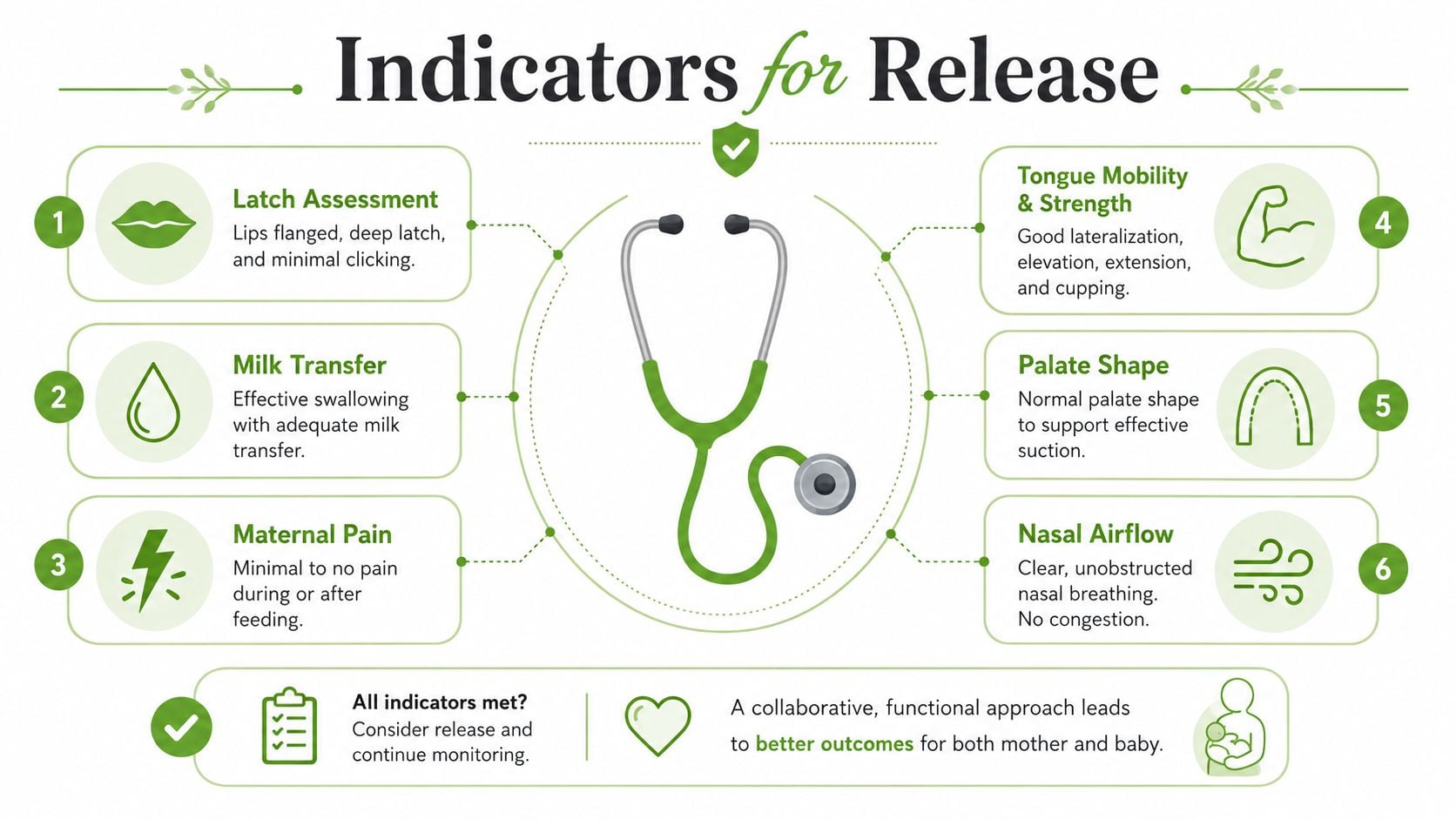
For an infant, assessment may include:
- Latch quality: Does the infant maintain a deep, comfortable latch, or repeatedly lose suction?
- Milk transfer: Is feeding efficient enough for the infant's needs, with appropriate clinical monitoring?
- Maternal pain: Does pain persist despite skilled positioning and latch support?
- Tongue movement: Can the tongue lift, extend, cup, and move laterally?
- Palate and oral coordination: Does the mouth shape or muscle pattern make compensation difficult?
- Nasal airflow: Can the infant breathe comfortably through the nose while feeding?
For an older child or adult, the evaluation may add speech articulation, chewing, swallowing, resting tongue position, nasal breathing, sleep quality, snoring, jaw tension, and signs of compensatory muscle use. A restricted tongue can be one part of a larger oral and airway pattern, rather than the single cause.
Assessment tools can organize an examination, but they can't reliably answer the most important question, which is who will benefit from division. A systematic review of tongue-tie assessment tools found substantial heterogeneity and no statistical correlation between severity scores and identifying patients likely to benefit from division. The 2025 review of ankyloglossia evidence also described a rapid rise in publications without a matching improvement in answers about causation, patient selection, and outcome measurement. The 2025 evidence review outlines these unresolved issues.
When support may come first
If the infant has a shallow latch caused mainly by positioning, or if an adult has significant nasal obstruction and mouth breathing, immediate release may not address the central problem. Feeding therapy, lactation support, evaluation for nasal or sleep conditions, and myofunctional care may be appropriate before or alongside a procedure.
Pain and Sleep Therapy Center describes a collaborative model involving dental sleep care, pediatric partners, orofacial myofunctional therapy, and Buteyko breathing instruction. That type of coordination can help distinguish a tethered tongue from a broader breathing, swallowing, or muscle pattern.
Watch the procedure overview here for a visual explanation of the clinical sequence:
Prompt evaluation is appropriate when an infant can't feed effectively, shows signs of inadequate intake, or continues to cause significant maternal pain despite skilled feeding help. For adults and children, persistent functional limitations, troublesome sleep symptoms, or worsening jaw discomfort also deserve assessment, but they don't prove that a frenulum release is the answer.
What Happens During a Tongue Tie Release Procedure
The experience differs by age, anatomy, technique, and the patient's ability to cooperate. The clinical team should explain the planned method, pain-control approach, protective measures, and follow-up before treatment begins.
Infants
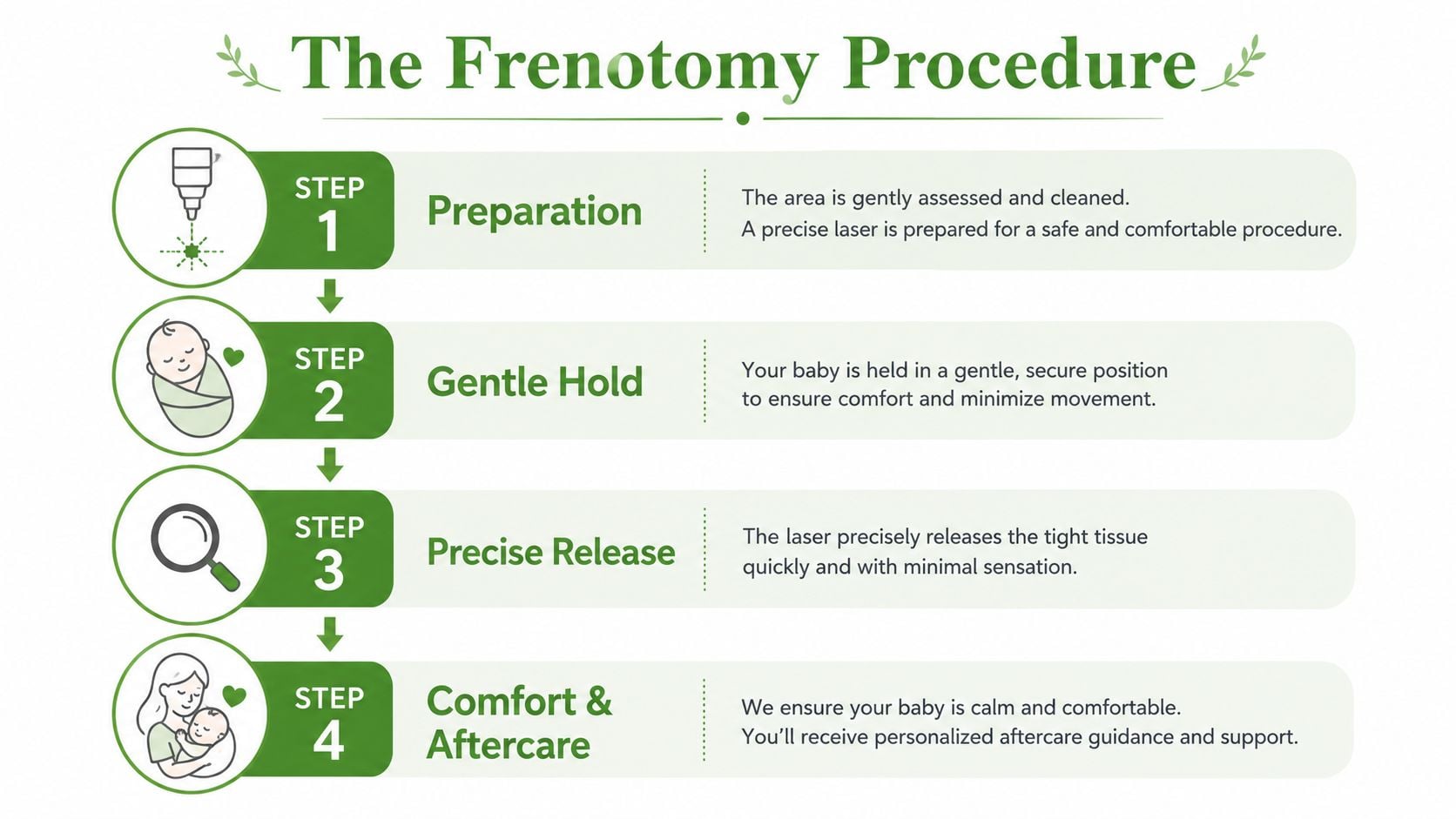
An infant frenotomy is often performed in an office setting. The clinician positions and stabilizes the baby, examines the tissue, and releases the restrictive attachment using the selected instrument. Some practices use a soft-tissue laser, while others use scissors or another method. The exact approach depends on the provider's training, the infant's anatomy, and the clinical plan.
Afterward, many infants can return to feeding quickly, which allows the team to observe whether the new mobility changes latch or comfort. A release can free the anchor line immediately, but it doesn't instantly teach the tongue a new movement pattern. The infant may still need help coordinating suction, tongue elevation, and swallowing.
Older children and adults
An older patient generally receives a more extensive consultation before the procedure. The provider may discuss local anesthesia, laser or non-laser technique, positioning, tissue control, and how the patient will manage the procedure while awake. The treatment area is kept visible and protected, and the clinician works to control bleeding and preserve nearby structures.
The sensation may include pressure, vibration, warmth, or temporary soreness, depending on the method and the patient's sensitivity. A calm explanation matters because fear can increase jaw and facial muscle tension, especially in patients already dealing with TMJ symptoms.
Families and practices also benefit from clear documentation, consent processes, and follow-up workflows. A compliance platform for dental practices can support administrative organization, but it doesn't replace the clinician's examination or shared decision-making. For more detail on the procedure itself, review laser frenectomy treatment.
The important distinction is between immediate tissue mobility and lasting functional change. The first may occur during treatment. The second depends on healing, practice, feeding or speech support, and the patient's ability to use the new range of motion.
Benefits Risks Contraindications and Alternatives to Consider
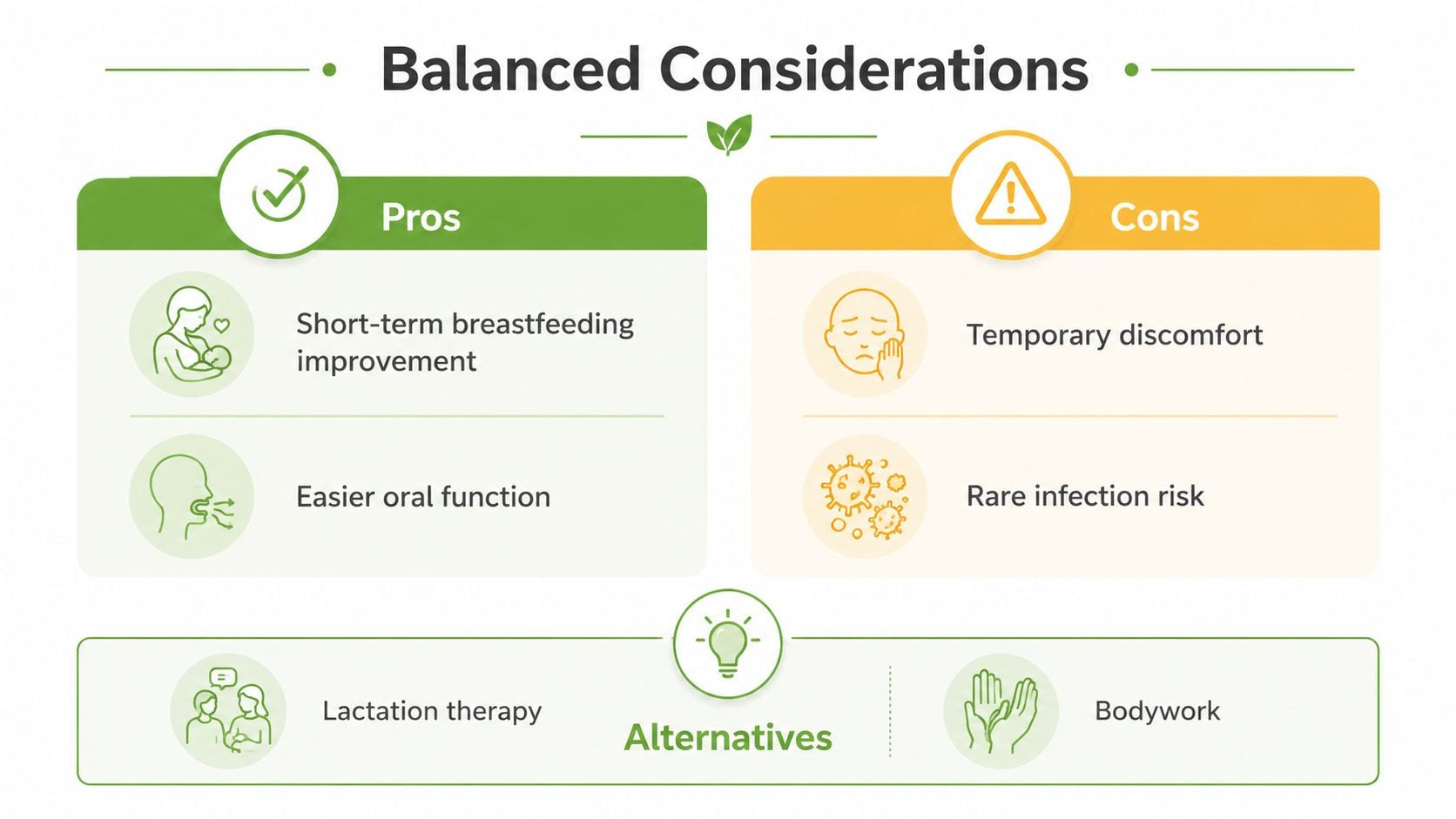
The evidence supports a selective approach. For symptomatic infants with breastfeeding difficulty related to ankyloglossia, frenotomy has the clearest support for short-term improvement. A 2024 systematic review and meta-analysis found significant improvements in breastfeeding self-efficacy, maternal pain, infant latch, and infant gastroesophageal reflux. It reported a standardized mean difference of 1.28 for latch at five to seven days and 0.91 for self-efficacy at one month, and recommended offering frenotomy to mother-infant pairs whose breastfeeding difficulty is related to ankyloglossia. The 2024 review provides the detailed findings.
That evidence doesn't mean every breastfeeding problem comes from a tongue-tie or that every infant needs a procedure. It means release may be reasonable when assessment connects restriction with the feeding problem and conservative support hasn't solved it.
What the evidence supports less clearly
Speech claims need more restraint. An earlier review of 20 studies involving 1,012 participants reported breastfeeding improvement but no significant gains in speech function. A later review of speech outcomes associated frenectomy with improved articulation in selected children, including 10 studies with an average age of 4.1 years and a mean articulation improvement of 0.78, with a 95% confidence interval of 0.64 to 0.87. The speech outcome review suggests possible benefit in carefully selected cases, not a universal speech indication.
Evidence for long-term airway, orthodontic, digestive, or jaw outcomes remains less settled. Those concerns may justify a broader evaluation, but they shouldn't be presented as proof that release will prevent or cure a particular condition.
Risks and alternatives
Independent reviews and reports document complications that can include bleeding, oral aversion, readherence, repeat procedures, salivary duct injury, airway obstruction, weight loss, and delayed diagnosis of another condition. Severe complications are difficult to quantify, but they have been reported, and the 2025 Washington State evidence review emphasizes that indication, technique, and aftercare aren't uniformly settled. The evidence review on benefits and harms supports a balanced consent discussion.
Treatment may be deferred when the patient has an untreated medical issue, the symptoms don't match the restriction, feeding support hasn't been attempted where appropriate, or the family can't yet manage follow-up care. Alternatives can include lactation consultation, feeding therapy, speech-language support, orofacial myofunctional therapy, nasal breathing retraining, and sleep or airway evaluation. These options may stand alone or complement a release.
Recovery Aftercare and Myofunctional Support
Healing isn't only about the wound. It also involves teaching the tongue, jaw, lips, and swallowing muscles to use the available movement. Without a functional plan, a patient may continue the same compensations that existed before treatment, even if the tissue looks more open.
Early recovery
For an infant, the first priority is comfortable feeding and adequate intake. Parents may receive instructions for soothing, positioning, feeding observation, and gentle mobility work. The wound can appear different from normal mouth tissue during healing, so families should follow the treating clinician's specific instructions rather than comparing photographs online.
Older children and adults may experience soreness, altered awareness beneath the tongue, or temporary difficulty with certain foods and speech movements. Hydration, soft foods when recommended, prescribed pain control, and careful oral hygiene can make the early period easier. The provider should explain which exercises are appropriate, how often to perform them, and what to do if the patient can't tolerate them.
Practical rule: Aftercare should be individualized. Don't copy an exercise schedule from another family, because the extent of release, age, healing response, and functional goals may differ.
Retraining matters
A myofunctional therapist may work on tongue elevation, resting posture, nasal breathing, swallowing, lip seal, and jaw stability. An infant may need playful oral-motor activities and feeding adjustments. An adult may need structured exercises that connect tongue mobility with speech, chewing, swallowing, and relaxed nasal breathing.
Follow-up helps the clinician assess healing, mobility, symptoms, and technique. Contact the provider promptly for persistent or heavy bleeding, fever, worsening swelling, breathing difficulty, poor feeding, poor weight gain, escalating pain, or signs of dehydration. Readherence and the need for repeat treatment are documented concerns, so follow-up isn't merely administrative.
Sleep also deserves attention during recovery. A consistent sleep routine, comfortable nasal breathing, and reduced jaw clenching can support practice, but persistent snoring, witnessed breathing pauses, or marked daytime fatigue require a separate sleep evaluation rather than an assumption that the release has solved the problem.
Finding the Right Care and Next Steps in Charlotte
The right starting point is a symptom record, not a procedure request. For an infant, note feeding duration, latch changes, maternal pain, clicking, fatigue, and concerns about intake. For an older child or adult, record speech difficulties, chewing or swallowing problems, mouth breathing, snoring, jaw tension, headaches, and situations that make symptoms worse.
A practical decision roadmap
- Describe the functional problem. Explain what the patient can't do comfortably or efficiently.
- Gather relevant observations. Bring feeding notes, videos when clinically appropriate, sleep observations, speech concerns, and prior evaluations.
- Request a whole-pattern assessment. Ask the clinician to examine tongue mobility alongside nasal airflow, oral posture, swallowing, jaw function, and sleep-related symptoms.
- Compare options. Discuss feeding support, therapy, breathing care, observation, and release rather than assuming one treatment fits every patient.
- Plan follow-up before treatment. Clarify aftercare, exercises, warning signs, and which professional will measure functional progress.
A pediatrician, dentist, lactation consultant, speech-language pathologist, orthodontist, or ENT may contribute useful information. Referral doesn't mean that every specialist will recommend release. It means each person can address a different part of the problem and help identify whether the tongue restriction is causal, contributory, or incidental.
Charlotte families may look for a clinic that can coordinate oral function, sleep, facial pain, and pediatric care. Pain and Sleep Therapy Center offers tongue-tie evaluation and laser frenectomy alongside orofacial myofunctional guidance and breathing-focused care, while referrals to dental, medical, or pediatric partners may be appropriate when another condition needs attention.
Not every restriction needs release. A personalized plan should prioritize comfortable function, nasal breathing, effective swallowing, feeding success, speech goals, and long-term jaw comfort, with the procedure used when its likely benefit outweighs its risks and alternatives.
If you're concerned about feeding, tongue mobility, mouth breathing, snoring, or jaw tension, Pain and Sleep Therapy Center can provide an individualized evaluation and coordinate tongue-tie, myofunctional, breathing, and sleep-related care. Visit Pain and Sleep Therapy Center to request the next step for your family or for yourself.