
You can spend weeks doing what people often try first, pain relievers, a night guard, a dental check, maybe even imaging, and still wake up with a tight jaw, sore temples, and that dull facial ache that never really leaves. When the pain keeps returning after chewing, talking, or sleeping, the problem is often not the tooth or the joint alone. It's usually myofascial pain dysfunction, a muscle-based pain pattern that lives in the jaw, face, and neck, and it's far more common than many patients realize, with reviews reporting 30% to 93% of musculoskeletal pain patients may have myofascial pain syndrome, and one expert review estimating about 9 million people in the United States are affected NCBI Bookshelf.
That matters because the condition is easy to miss when the focus stays on the symptom instead of the source. Trigger points, oral posture, sleep disruption, and breathing strain can all keep the muscles in a cycle of guarding and overload. The relief usually comes when someone looks at the whole picture, not just the jaw.
When Jaw and Facial Pain Will Not Go Away
A patient often tells the same story in different words. The jaw feels tight by breakfast, the temples start throbbing by afternoon, and by night the face feels bruised even though nothing looks wrong from the outside. They may have already tried anti-inflammatory medication, a custom splint, or a round of dental treatment, yet the soreness keeps coming back.
That pattern raises suspicion for myofascial pain dysfunction, a pain pattern driven by overworked skeletal muscles in the jaw, face, and neck. Trigger points keep firing and referring pain into other places, so the complaint can sound like a toothache, an earache, a headache, or pressure in the cheek. The overlap with other pain conditions is common in specialty care, which is why the right diagnosis often depends on a careful muscle exam, not a quick look at the teeth.
Why it's missed so often
The exam can look deceptively normal if nobody palpates the right muscles or asks the right questions. Patients may describe a toothache, an earache, a headache, or pressure in the cheek, while the source sits in the masseter, temporalis, or pterygoid muscles. That is why isolated treatment often disappoints.
Practical rule: if the pain changes with chewing, clenching, posture, sleep quality, or mouth breathing, muscle involvement deserves serious attention.
The rest of the picture matters too. In adults aged 30 to 60 years, a review reports mean prevalence of 37% in men and 65% in women, rising to as high as 85% in adults over 65 NCBI Bookshelf. For orofacial pain, pooled prevalence of myofascial orofacial pain was estimated at 20.60% across 3,395 observations, rounded to about 21% in a 2024 global review NCBI Bookshelf. Those numbers explain why this diagnosis keeps showing up in a facial pain clinic, even when patients have been told “everything looks fine.” Oral posture and sleep-related breathing strain can keep the jaw muscles guarding long after the day is over. When that pattern is present, a trigger point therapy approach can be one part of care, but lasting relief usually depends on addressing the airway, the bite forces, and the muscle load together.
How Trigger Points Drive Myofascial Pain Dysfunction
A trigger point is a hyperirritable spot within a taut band of skeletal muscle that can reproduce local pain and referred pain when pressed. In the jaw and face, that matters because the pain often shows up far from the muscle that is carrying the load. A patient may feel it in a molar, the temple, the ear, or along the side of the face, while the source sits in overworked chewing or neck muscles.
Where the pain actually starts
In the jaw system, the muscles that most often become involved are the masseter, temporalis, medial pterygoid, lateral pterygoid, and the supporting neck muscles. When those muscles stay shortened or overloaded, they lose mobility, become stiff, and begin sending pain signals into nearby or distant areas. That is why a trigger point in the masseter can feel like a toothache, and a temporalis trigger point can feel like a tension headache.
The most useful clue is reproducibility. Pressing one spot can bring back the exact pain a patient feels somewhere else, which is one reason the condition gets mislabeled as sinus pressure, dental pain, migraine, or a pure TMJ problem. The joint may be involved, but the trigger point often drives the pain pattern.
A careful clinical evaluation should follow the pain map, not just the site the patient points to first. In practice, that means checking for taut bands, tenderness, movement limits, and referred pain patterns, then using imaging only where it helps rule out other problems. A myofascial workup may also include trigger point therapy, because hands-on assessment often reveals what scans do not show.
The exam has to follow the pain trail, not just the place where the patient points first.
A Springer chapter describes the same basic mechanism from a broader pain-science perspective, and it fits what is seen in clinic. If the muscle keeps pulling, the pain keeps coming back. Relief usually depends on lowering the muscle load, calming the trigger point cycle, and addressing the airway, oral posture, and bite forces that keep the system under strain.
Common Causes and Risk Factors Behind the Pain
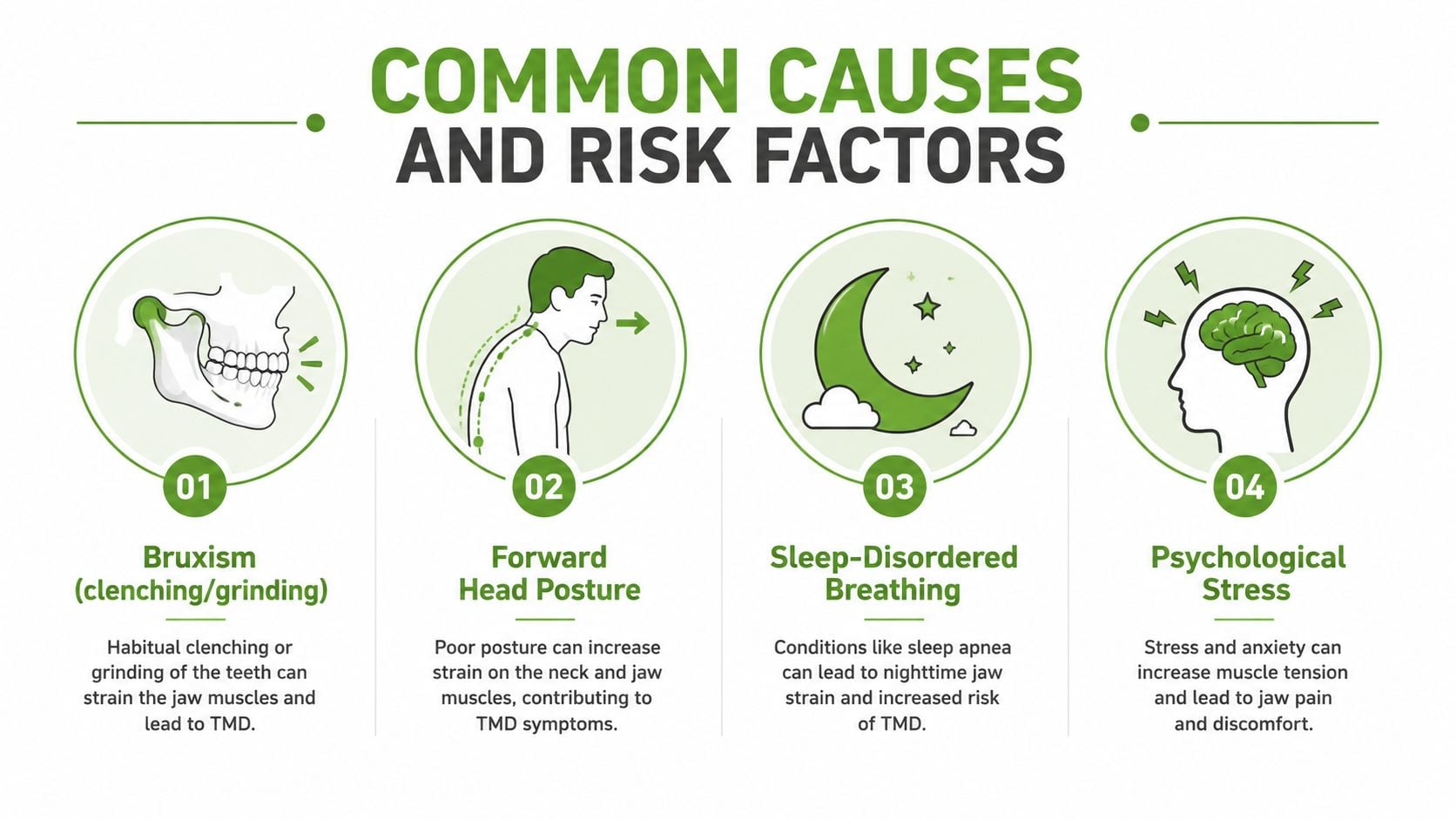
myofascial pain dysfunction usually builds from repeated load, not a single event. A jaw that clenches, a neck that stays braced, or a face that never fully relaxes can keep the muscle fibers irritated long after the original trigger has passed. Review articles describe the condition as multifactorial, with muscle overuse, postural imbalance, systemic influences, and psychological or behavioral factors all playing a role IASP paper.
The jaw, airway, and posture connection
Clenching and grinding are common contributors, but they rarely work alone. Forward head posture, prolonged desk work, and a resting mouth position that stays open change how the jaw and neck muscles share the work. Sleep-disordered breathing matters too, because a narrowed airway at night often leads to bracing, shallow recovery, and muscle guarding that carries into the next day.
Oral posture sits in the middle of that pattern. A low tongue rest, a weak lip seal, and chronic mouth breathing can all push the jaw muscles into compensation. That does not mean every patient with jaw pain has a sleep-breathing disorder, but it does mean airway habits deserve attention when the pain keeps returning after short periods of relief.
The clinical burden is broad, which is one reason the condition deserves a careful look rather than a quick label. Reviews of musculoskeletal pain repeatedly find a high overlap with myofascial pain, and expert summaries describe it as a frequent source of persistent discomfort in everyday practice. That pattern matters because patients often arrive after being treated for isolated teeth, joints, or headaches, while the muscle load that keeps reactivating the pain has not been addressed.
If the jaw hurts more after a poor night's sleep or a stressful day at the computer, the muscles are probably being asked to do too much.
Systemic strain and persistent stress also keep the cycle going. Poor recovery, heightened arousal, and ongoing guarding make it harder for the jaw muscles to settle, especially when the airway, oral posture, and bite forces continue to work against healing. Treating only the pain site rarely lasts if the underlying load stays in place.
Recognizing the Hallmark Symptoms
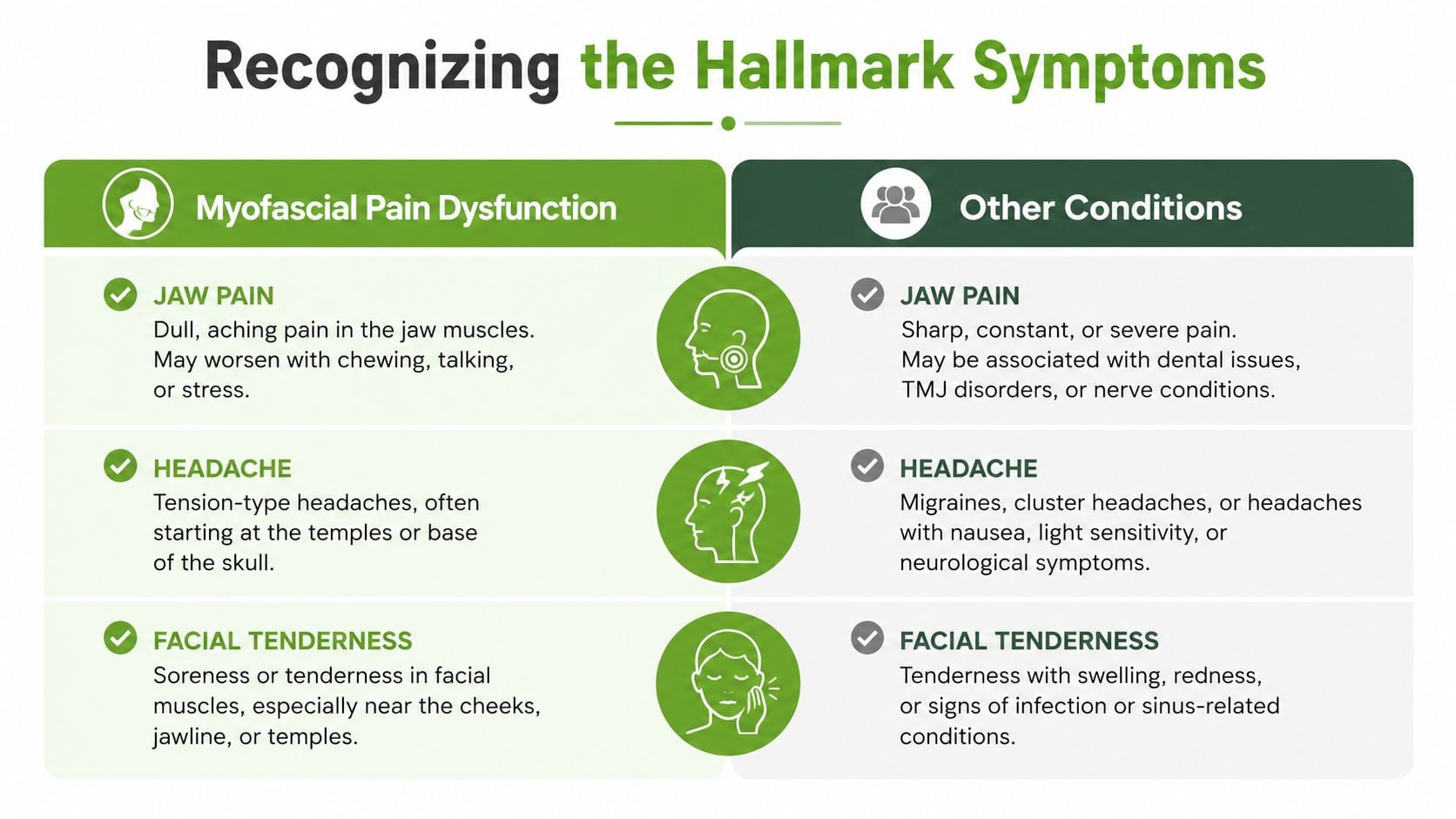
The complaints often begin as ordinary soreness, which is why they are so easy to miss. Jaw pain, facial aching, temple headaches, and a tight feeling when opening the mouth are all common clues. The pain is usually dull, aching, and persistent, and it tends to get worse when the muscles are working, especially with chewing, talking, yawning, or holding tension for long periods.
The daily rhythm gives it away
The pattern often tells the story. Some patients wake up sore after a night of clenching. Others notice the pain building as the day goes on, especially after hours of forward head posture, desk work, or strain through the neck and jaw. That rhythm points to muscle load rather than random nerve irritation, and it matters because airway problems can keep the load going through the night. Ear fullness without infection and temple pain that feels like a headache are also common in a jaw-centered trigger point pattern.
Oral posture can be part of the same picture. A low tongue rest, open-lip posture, and chronic mouth breathing can keep the jaw muscles on alert even when the face should be resting. Sleep-disordered breathing can add to that load, because a narrowed airway often leads to bracing, shallow recovery, and muscle guarding that shows up the next day as facial pain or morning stiffness.
Joint disorders usually behave differently. Clicking, locking, or a sense of mechanical catching points more toward the joint. Neuropathic pain more often feels burning, electric, or shock-like. Referred dental pain can mimic a tooth problem, but it does not usually follow the same reproducible trigger pattern from the muscles.
A pain specialist looks for that pattern instead of chasing a label first. If the jaw stiffens after tougher foods, if the temples flare after a long call, or if the face aches after sleep, the muscle story becomes stronger. That is especially important when dental work has not solved the problem. A focused diagnostic workup can also help clarify whether another source of pain is present, and in some cases a 3 phase bone scan is used to look for active bone or joint changes when the clinical picture calls for it.
Pain that repeats in the same places, but changes with muscle use, is rarely random.
Patients often ask whether it is “just TMJ.” The better question is whether the symptoms come from the joint, the muscles, or both. Those can overlap, but the treatment plan changes depending on what is driving the pain.
What a Thorough Diagnostic Workup Looks Like
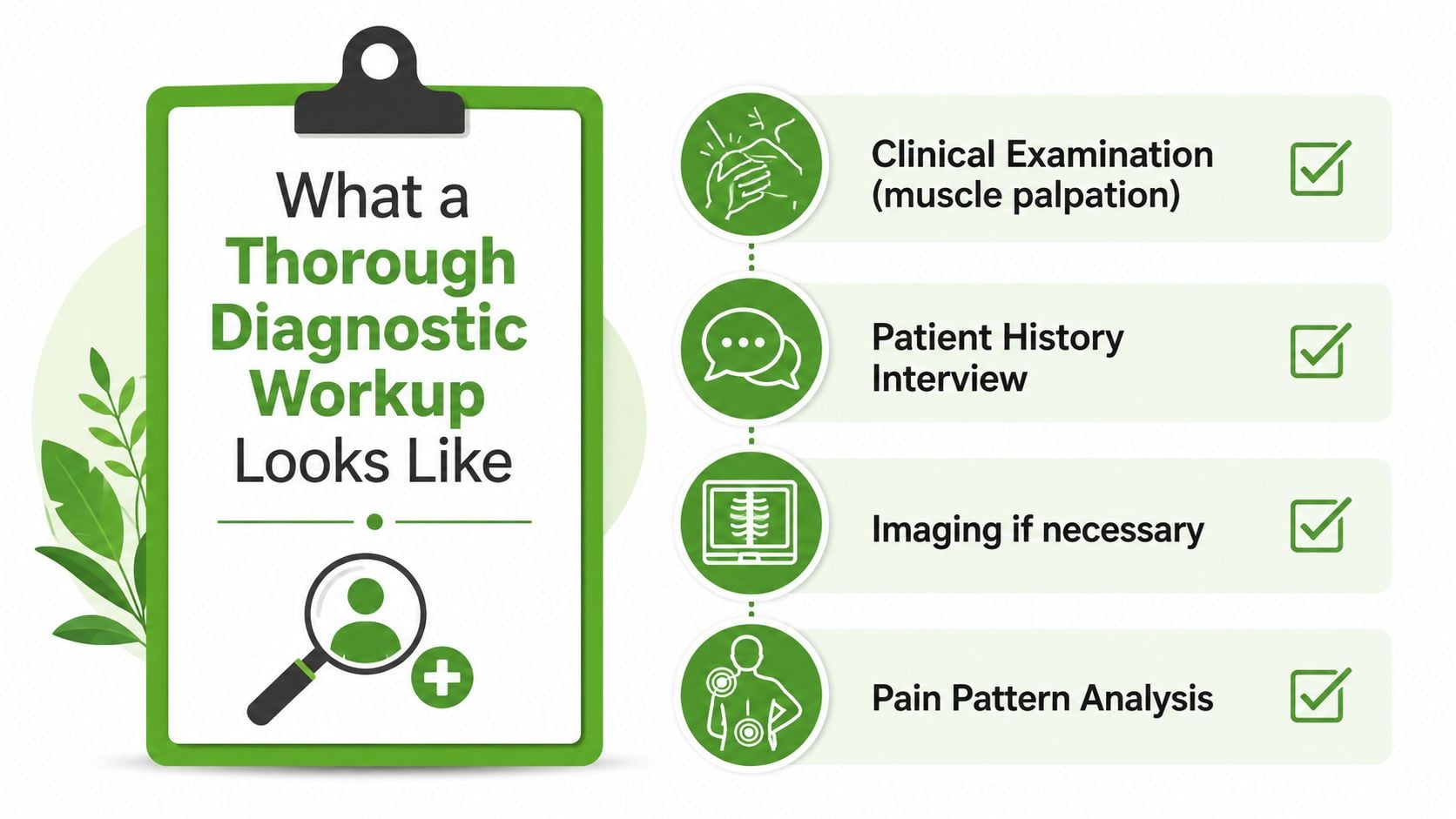
A careful exam starts with the muscles, not the x-ray. The clinician palpates the masseter, temporalis, pterygoids, and cervical muscles for taut bands and trigger points, then checks jaw opening, side-to-side movement, bite contacts, and whether pressing a spot recreates the familiar pain. That hands-on examination matters because trigger points are identified clinically, and imaging cannot replace it.
A good workup also looks beyond the jaw. Sleep quality, snoring, mouth breathing, and morning fatigue can all point to a nighttime airway load that keeps the jaw muscles braced after the patient falls asleep. If that pattern is present, screening for obstructive sleep apnea and checking nasal airflow can explain why the muscles never fully settle.
Orofacial myofunctional assessment belongs in the same visit. Tongue posture, swallow pattern, and lip seal affect where the jaw rests and how hard the muscles work during the day and at night. When those habits are off, the face can stay active even in supposed rest.
What belongs in the workup
The history should map the pain pattern, not just the location. A clinician asks when the pain starts, what brings it on, whether clenching or long conversations make it worse, how sleep has been going, and whether the symptoms change after waking. That is the context that separates a muscle-driven problem from joint disease, nerve pain, or referred dental pain.
The exam then fills in the mechanical details. Range of motion, bite contacts, muscle tenderness, and pain referral patterns are checked side by side. Imaging can still have a role, but it is used to rule out joint pathology or another structural source, not to prove trigger points.
- Clinical examination: muscle palpation, range of motion, and bite assessment.
- Patient history: pain timing, sleep quality, clenching habits, and daily triggers.
- Imaging when needed: panoramic x-rays, CBCT, or MRI to rule out joint pathology, not to diagnose trigger points.
- Pattern analysis: where the pain starts, where it refers, and what makes it worse.
If the picture is unclear, a 3-phase bone scan may be part of the rule-out process in select cases, especially when bone or joint activity needs a closer look. Even then, the muscle findings still carry the most weight when myofascial pain is present.
The diagnosis should never rest on a scan alone. The exam, the history, and the pain pattern have to agree. If they do not, the treatment plan usually misses the source. If dry needling is being considered, patients often ask about what is dry needling therapy, and that discussion belongs in the broader plan, not as a substitute for diagnosis.
Evidence-Based Treatment Options That Target the Root Cause
A jaw that keeps tightening through the day often has more than one driver. The strongest treatment plans address the muscles, the airway, and the habits that keep the system overloaded. That may mean calming trigger points, improving oral posture, and reducing nighttime strain from sleep-disordered breathing at the same time.
What tends to help most in practice
Manual therapy and myofascial release can ease guarding and improve motion, especially when the jaw and neck are both part of the problem. When the tongue rests low, the lips stay apart, or the jaw braces during sleep, the muscles never fully settle. That is why I often pair hands-on care with orofacial myofunctional therapy, which retrains tongue posture, swallow pattern, and lip seal. For patients whose pain is tied to airway resistance, oral appliance therapy can reduce the overnight load on the jaw and neck muscles. A more detailed overview of myofascial release techniques can help patients understand how that part of care fits into a broader plan.
Regenerative options are usually considered when tissue recovery needs support rather than simple symptom suppression. Prolotherapy and Platelet-Rich Fibrin (PRF) fit that model, and cold laser therapy is often used to calm pain without adding more mechanical irritation. The right choice depends on the exam findings, the patient's sleep pattern, and how much clenching or bracing is happening day and night.
For patients who want a clearer explanation of one adjunctive option, what is dry needling therapy is a useful primer. Dry needling can be a good fit when trigger points are especially reactive, but it works best as part of a broader plan. In practice, that usually means combining it with posture work, breathing correction, and muscle retraining so the pain source does not keep getting reactivated.
The mistake is treating the muscle as if it were only inflamed. Most of the time, it is being overloaded, under-recovered, or both.
A multidisciplinary approach usually performs better than a single intervention because it addresses the loop from more than one angle. One provider can treat the trigger points, but that same visit may not correct sleep, breathing, oral posture, and the daily habits that keep the jaw braced. In selected cases, I also consider the broader resources available through Pain and Sleep Therapy Center, which includes TMJ pain treatment, sleep-related breathing care, and regenerative therapies in one setting.
Self-Care Strategies and Home Exercises for Daily Relief
The best home care is gentle and consistent. Start with self-massage over the masseter and temporalis muscles, using slow pressure and short holds rather than aggressive digging. If a spot is tender but doesn't flare sharply, that's the kind of area that often responds to calm, repeated release rather than force.
Small daily habits matter more than intensity
A short jaw stretch after meals, a light cervical stretch during desk breaks, and a few minutes of relaxed nasal breathing can lower the muscle's resting tone. Heat often helps when the jaw feels stiff and guarded, while cold can be useful after a flare if the area feels irritated. Neither should be extreme, and neither should be used to push through pain.
Desk ergonomics matters more than people think. If the head drifts forward toward the screen, the neck and jaw muscles have to compensate, and that can keep trigger points active well into the evening. Sleep hygiene counts too, especially reducing late-night clenching triggers like heavy stress, poor wind-down routines, and sleeping in positions that strain the jaw.
- Massage gently: use fingertip pressure on the masseter and temporalis for short, repeatable releases.
- Breathe through the nose: nasal breathing can help reduce jaw bracing at rest.
- Rest the tongue high: let the tongue sit lightly on the palate, not pushed against the teeth.
- Move often: brief posture resets are better than one long stretch session.
For patients who want guided techniques, myofascial release techniques can be part of a structured home and in-office plan.
Improvement usually starts gradually. Some people notice less morning tightness first, then fewer daytime flare-ups as the routine becomes consistent. The key is repetition, not intensity, because irritated muscles don't like being bullied into calm.
When to Seek Specialist Care and What to Expect
If the jaw opening is getting smaller, the pain is waking you at night, or home care hasn't changed the pattern after several weeks, it's time for a specialist evaluation. Persistent facial pain can also overlap with sleep problems, mood strain, and chronic stress, so the workup should stay broad and practical. For support around the emotional toll that long-term pain can bring, Interactive Counselling depression support is one resource people sometimes use alongside medical care.
A multidisciplinary pain and sleep center usually brings together dental sleep medicine, orofacial myofunctional therapy, neurology, and regenerative care. That kind of team can sort out whether the main driver is clenching, airway strain, joint involvement, or a combination. Patients often want to know whether the condition is curable. A more honest answer is that it's usually manageable once the root causes are identified and treated directly.
Treatment time varies with how long the pattern has been present and how many drivers are involved. Insurance coverage depends on the service and plan, so patients should ask in advance which parts are billed medically, which are dental, and which are self-pay. A qualified provider should be able to explain the exam findings, the sleep and airway questions, and the logic behind each treatment step.
If your pain keeps returning, don't keep treating it as a mystery. The right diagnosis usually makes the next step much clearer.
Pain and Sleep Therapy Center evaluates jaw pain, facial muscle tension, sleep-disordered breathing, and the oral posture patterns that keep trigger points active. If you're dealing with recurring jaw soreness, headaches, or clenching that doesn't settle down, visit Pain and Sleep Therapy Center to explore a root-cause evaluation and a care plan built around how you breathe, sleep, and use your jaw every day.