
Your jaw clicks when you chew. Your temples ache by afternoon. The night guard didn't fix it, the ibuprofen barely touched it, and one clinician told you to “just manage stress.” That's exactly why people end up searching what specialist treats TMJ. They're tired of guesses, and they want the right door to knock on first.
The honest answer is blunt. There isn't one single TMJ doctor in most systems. TMJ and TMD care usually takes a multidisciplinary team, and the right starting point depends on whether your main issue is muscle pain, bite mechanics, headaches, ear symptoms, bruxism, or joint damage (generalmedicine.co, TMJ Association). If you start with the wrong specialist, you can waste months. If you start with the right one, the whole process gets simpler fast.
The Bumpy Road to a TMJ Diagnosis
Maya did what a lot of people do. She saw her general dentist first, got told her jaw pain was probably stress, and left with a night guard that helped her teeth but not her jaw. A few weeks later, an urgent care clinician suggested anti-inflammatory medication. Then an ENT looked inside her ears, found nothing alarming, and sent her back into the same loop.
That kind of zigzag is frustrating, but it's common. TMJ symptoms sit at the intersection of dentistry, muscle function, headache medicine, ear complaints, and sometimes joint degeneration, so a single label rarely solves the problem the first time around. The better question isn't “Who treats TMJ?” It's “Which clinician matches the symptom cluster I'm dealing with?”
Practical rule: start where your dominant symptom lives, not where the pain happens to radiate.
If the pain is mostly in the jaw muscles, you want a different clinician than someone with a locked joint or severe clicking. If the ear pain is the loudest symptom, the path looks different again. That's why the search for what specialist treats TMJ should work like triage, not like a generic directory.
Understanding the TMJ and Why One Specialist Is Not Enough
The temporomandibular joint is a hinge-and-slide joint. It opens like a hinge, then glides forward as the jaw moves, which is why chewing, yawning, and speaking can all expose a problem in the same small area. When that joint works smoothly, you barely notice it. When it doesn't, you feel it everywhere.
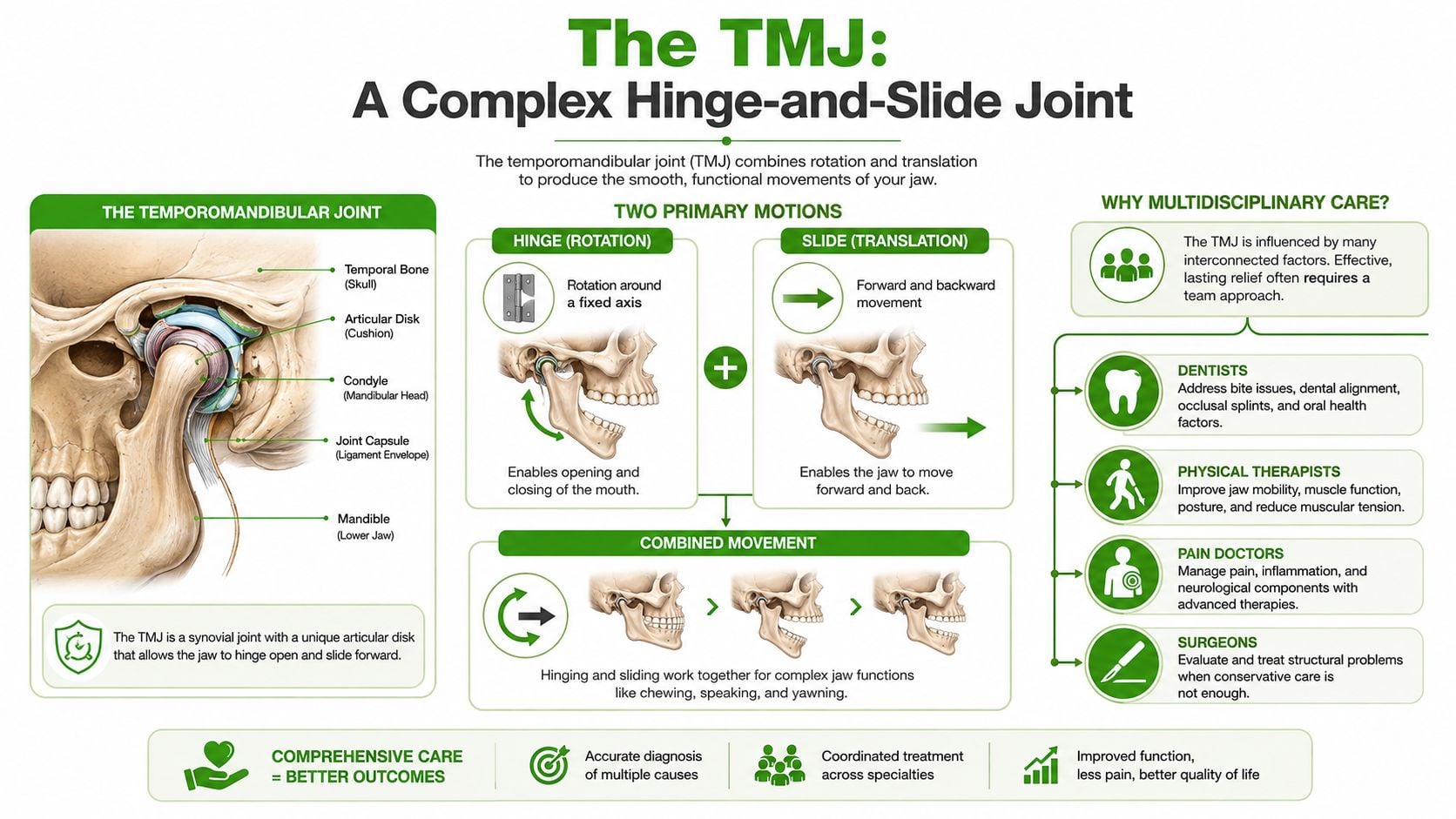
A simple hinge model is too small for the problem. Some patients are mainly dealing with muscle-driven pain, often tied to clenching, grinding, posture, or jaw overuse. Others have joint-internal problems, like disc displacement or degenerative change. A third group has pain that overlaps with headaches, neck tension, facial nerve irritation, or sleep-related bruxism, which means the jaw is part of a larger system rather than the only issue.
That's why one provider can't credibly “own” every TMJ case. Dentistry matters, but so do physical therapy, pain medicine, neurology, sleep medicine, and sometimes surgery. The TMJ Association's historical review makes the shift clear. TMJ care began as a mostly dental problem, but modern understanding recognizes involvement across multiple body systems, including the circulatory, digestive, endocrine, exocrine, immune, muscular, nervous, reproductive, respiratory, and skeletal systems (TMJ Association).
For a broader care model, see this multidisciplinary approach to pain management. That's the right mindset here. TMJ is usually not one diagnosis with one fix. It's a family of overlapping problems that need the right sequence of care.
The Multidisciplinary Team That Treats TMJ
The clearest answer to the question "What specialist treats TMJ?" is that the right starting point depends on your main symptom. If the pain is mostly muscle-driven, start with an orofacial pain specialist. If the jaw locks, clicks with structural change, or seems mechanically stuck, start with an oral and maxillofacial surgeon. If the pain tracks with headaches, neck tension, ear symptoms, or sleep problems, the best first step may be a different specialist who can sort out that overlap. TMJ Compass, scienceinsights.org
The most specialized dental starting point is often an orofacial pain specialist. That clinician focuses on jaw disorders, facial pain, clenching, grinding, and the kind of symptoms that look like TMJ but are being driven by muscles, the bite, or referred pain patterns. For a practical overview of that role, see what an orofacial pain specialist evaluates. The point is simple. If the pain pattern is unclear, this is usually the best first stop.
TMJ Specialists at a Glance
| Dominant Symptom | Best Starting Specialist | Typical Role |
|---|---|---|
| Jaw muscle pain, clenching, tooth wear | Orofacial pain specialist | Sorts out pain source, coordinates conservative care, evaluates bite-related and muscle-related contributors |
| Jaw locking, structural joint damage, nonreducing disc issues | Oral and maxillofacial surgeon | Handles advanced joint evaluation and surgery when needed |
| Neck tension, posture-related jaw pain | Physical therapist | Treats jaw, neck, and movement patterns that aggravate symptoms |
| Ear fullness, ear pain, sinus-like pressure | ENT | Rules out ear and throat causes, helps sort facial pain overlap |
| Headaches, facial pain, nerve-type symptoms | Neurologist | Evaluates headache disorders and neurologic overlap |
| Sleep grinding, snoring, suspected sleep apnea | Sleep medicine clinician | Connects jaw symptoms with sleep-disordered breathing or bruxism |
An oral and maxillofacial surgeon is the right escalation point when the exam or imaging shows structural TMJ disease, such as nonreducing disc displacement, degenerative change, or severe mechanical locking. These surgeons receive advanced surgical training after dental school and can determine whether TMJ surgery is appropriate, including arthrocentesis, arthroscopy, disc repositioning, and joint replacement (scienceinsights.org). When the joint is physically failing, this is the clinician who should be reading the scan and making the surgical call.
Orthodontists can matter when bite relationships are part of the picture, but they are not the first stop for most painful TMJ cases. Rheumatologists come in when inflammatory arthritis or another systemic joint disorder is suspected. Pain medicine physicians become useful when pain is widespread, persistent, or hard to control. A coordinated clinic such as Pain and Sleep Therapy Center can also help when jaw pain sits inside a larger sleep and facial pain pattern.
What a TMJ Evaluation Actually Looks Like
The first visit should feel thorough, not mysterious. A good clinician starts with your history, because the story matters as much as the jaw. They'll ask where the pain lives, when it started, whether you grind or clench, whether the jaw locks, whether headaches are part of the picture, and whether sleep, stress, or prior trauma seem to make things worse.
What the clinician checks in the room
The exam usually includes palpating the jaw muscles and the joint itself, measuring how wide you open, checking side-to-side motion, and listening for clicks, pops, or crepitus. That tells the clinician whether the problem looks more muscular, mechanical, inflammatory, or structural. If the jaw opens unevenly or gets stuck, that changes the next step quickly.
Advanced imaging enters the picture when the exam suggests more than simple muscle strain. MRI helps show the disc and soft tissues. Cone-beam CT helps show bony joint detail. If there's objective evidence of internal joint damage or if symptoms don't fit the basic pattern, imaging can keep you from being treated blindly.
Bring the records that matter. A list of symptoms, prior imaging, previous guards or splints, medications, and the names of past clinicians helps the specialist avoid duplicate work. That's not administrative fluff. It shortens the path to a real plan.
Non-Surgical and Regenerative Treatment Options Worth Knowing
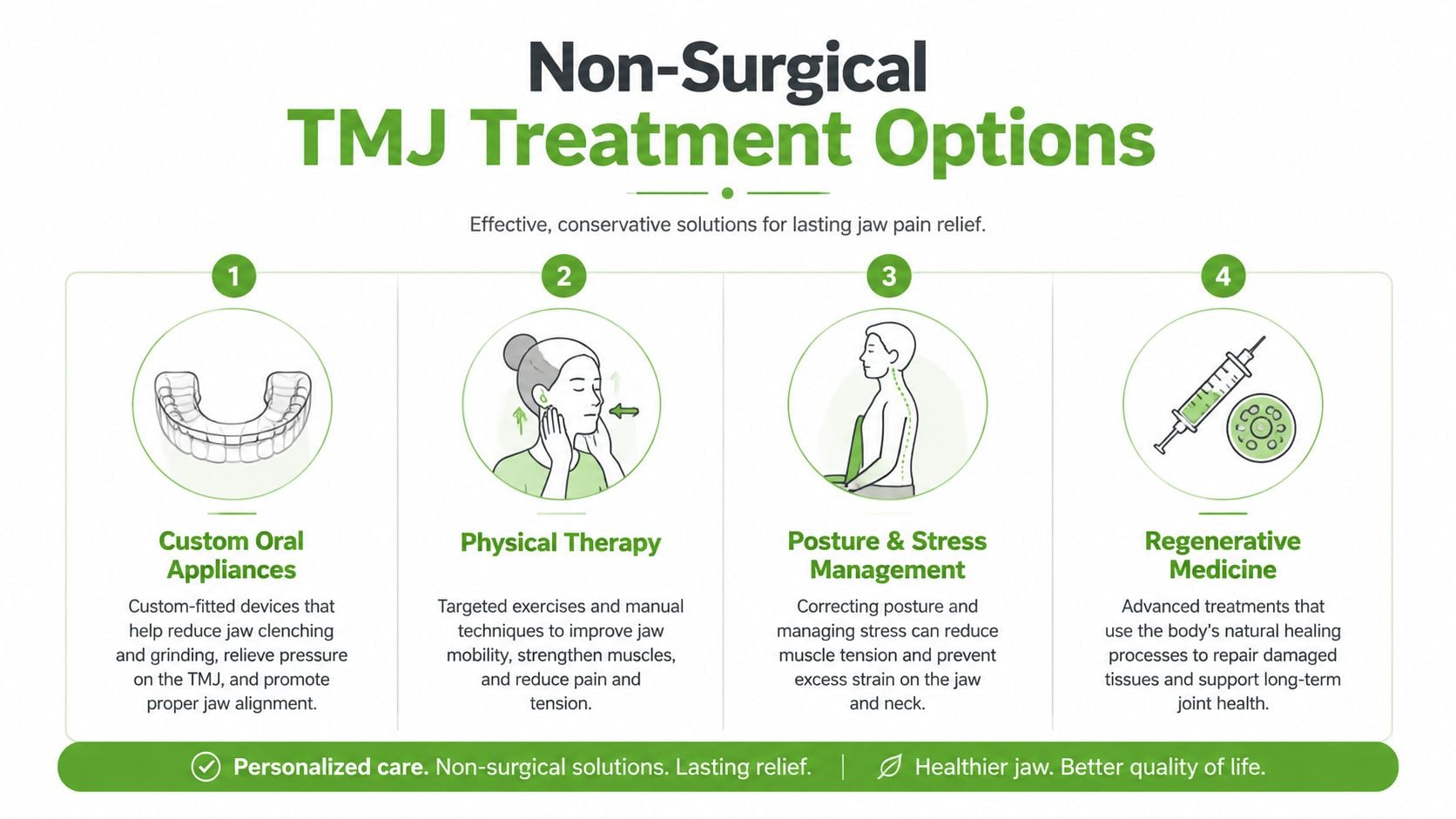
Most TMJ care should begin without surgery unless the joint is clearly damaged or locked. A custom oral appliance can help protect the teeth and reduce overload in patients whose main issue is clenching or grinding, especially when the bite and jaw muscles are part of the pattern. It's not a magic fix, but in the right case it's a solid stabilizer.
Physical therapy matters when the jaw, neck, and posture are all feeding the pain loop. Therapists who understand TMJ don't just stretch the jaw. They work on movement patterns, cervical tension, coordination, and the habits that keep the joint irritated.
When conservative care still has room to work
Posture and breathing retraining can be useful when the jaw is recruited as a stabilizer for an airway or neck problem. That's one reason TMJ clinics often think beyond the mouth. The jaw doesn't live in isolation, and the treatment plan shouldn't either.
Regenerative options are part of many modern TMJ toolkits. Prolotherapy, platelet-rich fibrin, and cold laser therapy are used by some clinicians to support tissue recovery and calm irritation when a case hasn't responded to basic care. These aren't first-line for every patient, but they belong on the table when the plan needs more than splint-only management.
For patients interested in biologic care, see orthobiologic therapy. The key is matching the tool to the problem. Conservative care isn't passive care. It's usually a layered plan.
Building a Coordinated Care Pathway That Actually Works
Good TMJ care doesn't bounce the patient around. It starts with one clinician who can sort the problem, then moves in a straight line toward the next best step. That may begin with an orofacial pain specialist or a dentist trained in TMJ evaluation, then shift to physical therapy, sleep medicine, ENT, neurology, or surgery depending on what the exam shows.
The older model treated TMJ like a dental nuisance. That's too small. The newer model treats it like an interdisciplinary condition and uses referral only when it improves the plan, not when the first clinician runs out of ideas. That historical shift, from the dental model that dominated since 1936 to a broader medical view across nearly 90 years, is one of the reasons patients get better answers today (TMJ Association).
Ask every clinician one question, “What is the main driver of my symptoms, and who handles that best?”
That question cuts through a lot of confusion. It also protects you from duplicate scans, scattered advice, and mismatched treatments. When records move cleanly between providers, the patient doesn't have to become the case manager. The team does the coordinating.
Red Flags That Mean You Should Be Seen Sooner
Some TMJ symptoms can wait for a routine appointment. Others can't.

Call for urgent evaluation if you suddenly can't open or close your mouth normally, if the jaw locks hard, if you have major facial swelling, or if you had trauma to the jaw. Facial numbness, slurred speech, or other neurological changes need immediate medical attention, not a routine TMJ visit. If symptoms point to inflammatory arthritis or another systemic joint disease, don't wait around hoping a guard will fix it.
If the jaw problem comes with severe, spreading pain or a clearly worsening mechanical block, contact the specialist the same day if you can. If you also have neurologic symptoms or significant swelling, go to urgent care or the ER.
Later in the day, if you're still unsure what to do, ask one direct question by phone. “Do these symptoms need urgent evaluation, or should I schedule a regular TMJ consult?” That's a much smarter move than guessing.
Your First Appointment and What Comes Next
Bring the shortest useful history you can. Note when symptoms started, what makes them worse, what helps, what your bite guard did or didn't change, and whether headaches, ear pain, sleep issues, or neck tension are part of the pattern. If you already had imaging or saw another clinician, bring those records so the new provider can build on them instead of repeating the same work.
If two providers seem possible, choose the one who matches the dominant symptom cluster. Jaw muscle pain points to orofacial pain or physical therapy first. Structural locking or suspected joint damage points toward oral and maxillofacial surgery. Sleep-related grinding or snoring points toward sleep-focused evaluation. That's the fastest route to clarity.
Most non-surgical plans take time and require coordination, not a single visit. That's normal. The right specialist should explain the plan clearly, tell you who else needs to be involved, and give you a next step you can follow.
If you're in Charlotte and want a focused evaluation for jaw pain, headaches, facial tension, or sleep-related symptoms, Pain and Sleep Therapy Center offers TMJ and airway-focused care under one roof. Visit Pain and Sleep Therapy Center to start with a team that treats TMJ as the multidisciplinary problem it really is.