
TMJ treatment cost typically runs from a few hundred dollars for conservative care to $40,000-$70,000+ for total joint replacement, and most mid-care patients land between $1,500 and $7,000. The hard part isn't finding a price, it's figuring out which part of the care pathway you're buying.
You may be sitting there with jaw stiffness in the morning, headaches, or a night guard quote that feels vague. That's exactly where people get burned, because TMJ care is rarely one flat fee. It's usually a sequence of diagnosis, imaging, appliances, therapy, follow-ups, and sometimes injections or surgery, so the final number depends on how far your case has to travel.
What TMJ Treatment Cost Really Looks Like
TMJ pricing makes sense only when you stop thinking in single-item terms. A conservative plan might start with self-care, short medication use, and a targeted exam, while a more involved case layers in imaging, appliance fabrication, therapy visits, and reassessment over time. The most expensive cases are the ones that move from reversible care into procedural or surgical treatment.
Practical rule: if you're only being quoted for one appointment, you're not getting the full number yet.
The NIDCR summary makes the key point clearly, early biopsychosocial treatment was associated with lower long-term treatment costs over one year, and a large claims study of 1713 TMJD cases and 532,485 controls found TMJD patients used more healthcare services and had higher overall costs even when TMJD-specific treatment was excluded (NIDCR treatment needs summary). That's why the question isn't “What does a splint cost?” It's “What does this condition cost across the whole care episode?”
If you want a single planning mindset, use this one, budget for the path, not the device. A night guard can be part of the bill, but so can consultations, imaging, adjustments, and follow-up visits. For a focused look at one common line item, see this TMJ splint cost breakdown.
Price Ranges by Treatment Type
TMJ treatment cost rises in layers, and each layer pays for a different part of care. Lower-cost care is aimed at reducing pain, inflammation, and strain. Middle-tier care usually adds appliance fitting, muscle control, bite stabilization, or joint-focused therapy. The highest-cost care is structural, where surgery or joint replacement enters the plan.
A realistic budget starts with the full episode of care, not the first line item. An office visit may lead to imaging, then an appliance, then a string of adjustments, then follow-up care if symptoms do not settle. That is why a cheap starting quote can turn into a much larger bill once the plan is complete.
| Treatment Type | Typical Price Range | What Is Included |
|---|---|---|
| At-home care and analgesics | Less than $500 | Rest, ice, anti-inflammatory medication, short-term self-management |
| Physical therapy | $50-$300 per session | Manual therapy, exercise instruction, jaw coordination work |
| Stabilization splint | Up to $2,000 or more | Impression or scan, appliance fabrication, fitting, adjustments |
| Regenerative or injection-based care | Varies by case | PRF, prolotherapy, or similar office-based procedures, often with follow-up |
| Botox for jaw muscle pain or hypertrophy | Varies by provider | Injection visit, dosing plan, reassessment |
| Orthodontic or bite-related care | Varies widely | Records, appliances, adjustments, periodic monitoring |
| Arthrocentesis or arthroscopy | More than $5,000-$7,000 | Procedure room time, physician fee, anesthesia or sedation elements, follow-up |
| Total joint replacement | About $40,000-$70,000 or more | Surgical planning, implants, operating room, hospital care, rehabilitation |
The cheapest path usually starts with home care and basic medication. That can be enough for a mild flare, but it does not solve a mechanical problem inside the joint or a bite issue that keeps driving symptoms back. Physical therapy sits in the middle because you are paying for repeated skilled visits, not a one-time fix.
Splints sit in a different bucket. The appliance itself is only part of the price, because the bill also covers records, design, fitting, and later adjustment visits. If you want a practical overview of how clinics sequence those steps, this TMJ treatment guide is a useful reference.
Injection-based care and Botox usually land in the middle to higher range because they involve an office procedure, a dosing or treatment plan, and follow-up. Orthodontic or bite-related care can climb quickly because the cost is spread across records, hardware, repeated visits, and ongoing monitoring.
Once treatment becomes procedural, the price jumps. Arthrocentesis and arthroscopy add procedure-room time, sedation or anesthesia elements, physician fees, and follow-up care. Total joint replacement is the top of the ladder, and the bill reflects surgical planning, implants, hospital resources, and rehabilitation, not just the operation itself.
Factors That Drive the Final Bill
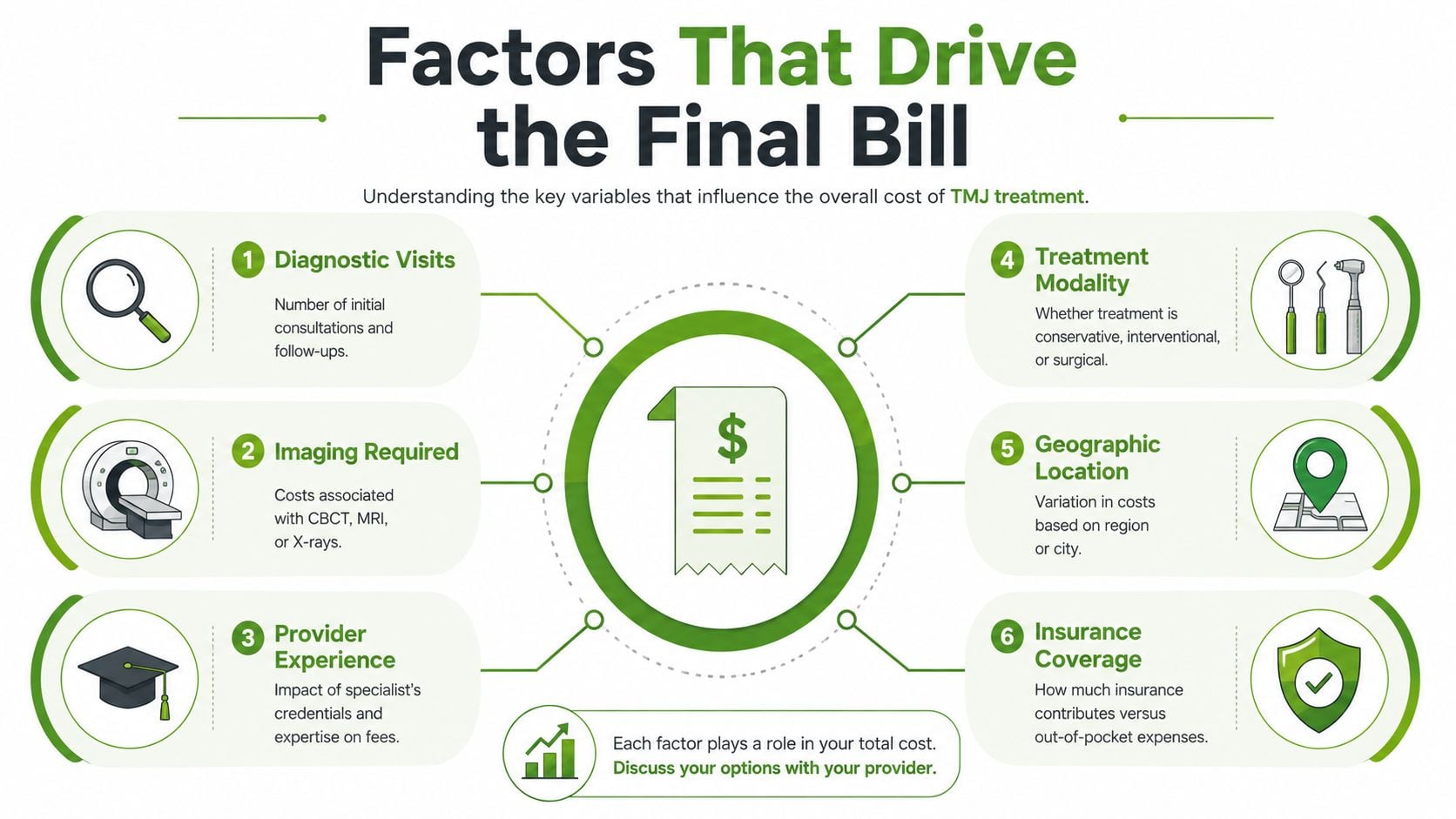
Two patients can start with the same TMJ diagnosis and still face very different final bills. The gap usually comes from how many visits are needed, what imaging gets ordered, how experienced the provider is, whether add-on therapies get layered in, and how much of the work happens in your region. The diagnosis matters, but the care pathway drives the bill.
Diagnostics and visit volume
The first cost driver is usually diagnosis, because TMJ care often starts with sorting out the problem rather than fixing it right away. Each office visit adds to the total, and imaging adds another layer when the joint, bite, or surrounding structures need a closer look. If you move between providers without a clear plan, you end up paying for uncertainty more than once.
Provider type and treatment intensity
Specialists often charge more than general practices because they bring deeper training, more diagnostic tools, and more complex treatment options. That higher fee does not always mean a higher total bill, since the right provider can shorten the path and prevent wasted visits or half-finished care. TMJ treatment costs are not standardized, and they can vary widely depending on the provider, the region, and how much treatment is needed (TMJ Association costs).
Geography and add-on therapies
Location changes the math fast, especially for procedures and repeated therapy visits. Regional pricing differences show up in exam fees, imaging, appliance work, and office procedures, so the same plan can cost more in one area than another. Add-on therapies like PRF, prolotherapy, or Botox also raise the total because they sit on top of diagnostics and follow-up rather than replacing them.
The cheapest plan usually starts conservatively and avoids unnecessary escalation. Early conservative triage limits imaging, specialist churn, and procedure creep, which is exactly where TMJ treatment cost tends to balloon.
Comparing Conservative, Interventional, and Surgical Pathways
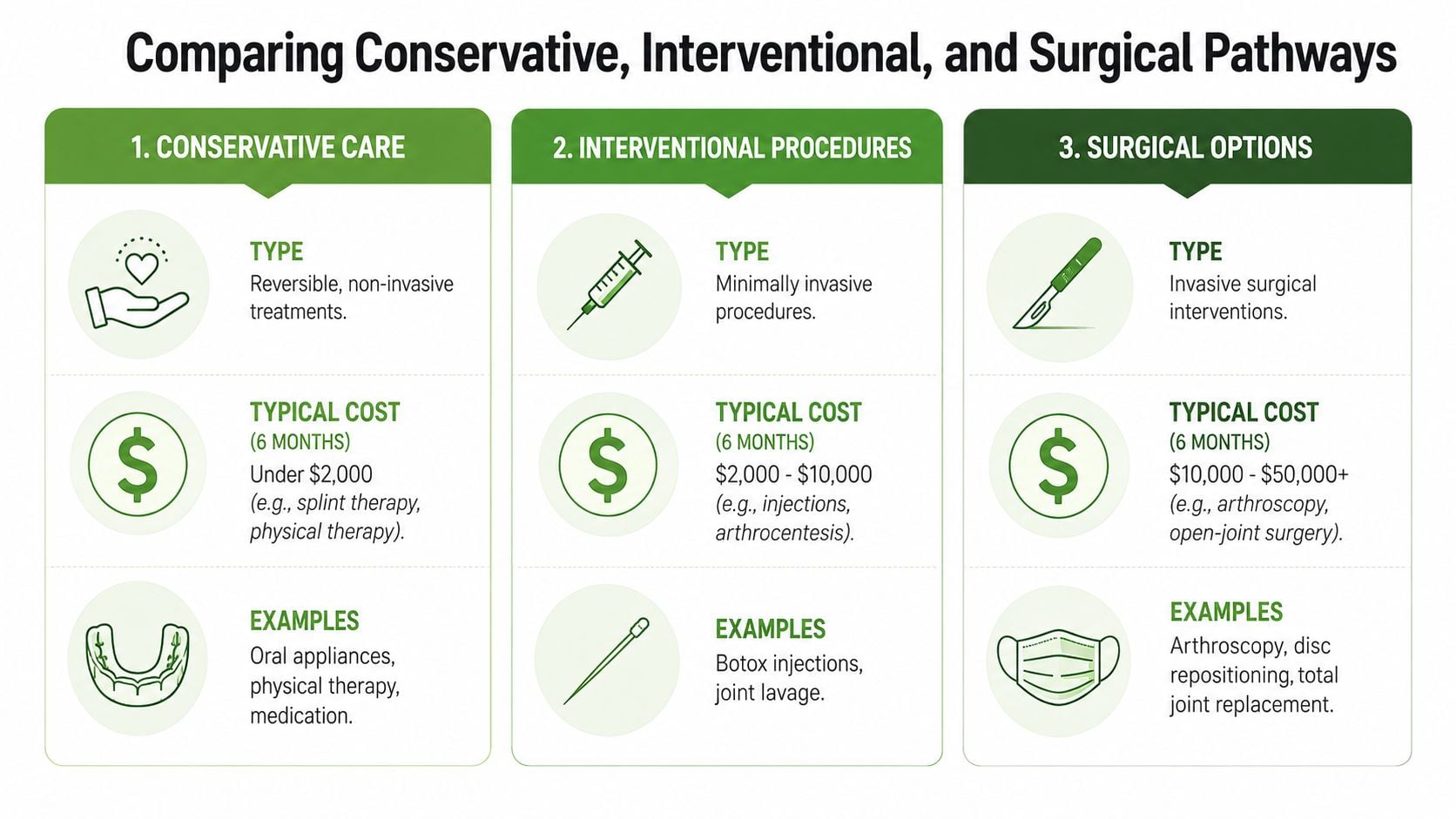
A smart TMJ budget starts with the treatment lane, not with a single office visit. Conservative care keeps spending lower because it uses reversible measures and fewer procedure fees. Interventional care raises the bill because each injection, reassessment, and follow-up lands on the ledger. Surgical care is the most expensive route, since planning, facility charges, anesthesia, and recovery all stack onto the procedure itself.
Conservative care
This lane fits jaw stiffness, clenching, mild muscle pain, and cases that still respond to reversible treatment. Rest, analgesics, and ice usually stay on the low end of the budget, while physical therapy adds a recurring visit cost that can build over time. A stabilization splint can also belong here, but once appliance fabrication and follow-up visits start adding up, the total no longer feels minor.
Interventional care
The bill gets harder to predict in this lane. Injections, PRF, prolotherapy, and Botox usually come after a conservative plan has not controlled symptoms well enough, and the total can climb quickly once you add office visits, repeat assessments, and procedure fees. These treatments do not replace the diagnostic work. They sit on top of it, which is why the episode-of-care cost jumps faster than patients expect.
Surgical care
Surgery belongs in the structural damage category, not the routine pain category. Arthroscopy, arthrocentesis, disc procedures, and total joint replacement cost more because they involve surgical expertise, facility time, and post-op care. Once a case reaches this point, the core question is not how much a TMJ visit costs, it is how much the full joint reconstruction episode will cost.
Persistent locking, recurrent closed lock, worsening limitation in opening, or pain that keeps returning despite a stable plan all push the case away from simple conservative care. That is the point to stop guessing and ask for a written, staged estimate before any procedure is scheduled.
Insurance Coverage, Payment Plans, and Financing
A TMJ bill usually gets split between medical and dental coverage, and that split is where patients lose money if no one explains the rules upfront. Medical plans are more likely to help with diagnostics and surgery when the care is medically necessary. Dental plans may cover splints or occlusal appliances, but they often stop short of ongoing therapy, repeated adjustments, and follow-up reassessment. If you do not ask which insurance is being billed, you cannot estimate your share with any accuracy.
A good clinic should tell you whether it bills medical insurance, dental insurance, or both, and it should do that before you commit to treatment. The estimate needs to show each piece of the episode of care, because TMJ treatment often includes separate charges for the exam, imaging, appliance fabrication, adjustments, therapy, and follow-up visits. If a balance shows up before you are ready for it, solutions for unexpected medical bills can help you think through your options without grabbing the first financing offer on the table.
Practical payment tools
- HSA or FSA funds: Good for eligible out-of-pocket expenses, especially when you already know a treatment course is coming.
- In-house payment plans: Useful when the clinic spreads costs over time instead of demanding one large upfront payment.
- Third-party medical financing: Works when the plan is clear and you need to bridge a bigger bill.
- Self-pay discounts: Some clinics reduce fees for patients paying directly, which can matter more than a weak insurance benefit.
The TMJ Association points out that TMJ costs are not standardized, which is why you should confirm benefits before treatment begins. Ask for a written estimate and compare it with your coverage rules, because that is where a significant difference between a manageable bill and an ugly surprise usually shows up. If you want to see how a clinic structures its terms, these payment plan details are the kind of thing you should ask about early, not after the bill arrives.
Medicare is another area where people make assumptions they should not make. It does not automatically cover TMJ care, so verify the details before you schedule anything expensive.
Three Sample Patient Scenarios With Realistic Totals
The easiest way to think about TMJ treatment cost is to follow a real-world path from first visit to one year out. These scenarios aren't promises, they're the kinds of budgets patients usually need to build.

Patient A, mild but persistent symptoms
This patient is a working adult with morning jaw stiffness and occasional headaches. The plan stays conservative, a diagnostic visit, a stabilization splint, four physical therapy visits, and a stress-management routine. The total lands near $2,200 because the treatment stays reversible and doesn't spiral into repeated specialty referrals.
Patient B, chronic muscle pain with clenching
This patient has myofascial pain and nighttime clenching that doesn't settle with self-care alone. The plan adds office-based regenerative care and Botox on top of the early diagnostic work, then follows with reassessment. The total ends closer to $6,800, which is exactly how mid-care costs grow, not from one expensive decision, but from several moderate ones stacked together.
Patient C, joint degeneration and structural disease
This patient has disc displacement and degenerative joint disease, so conservative care only buys limited relief. Imaging, specialist planning, arthroscopy, and custom prosthetic planning push the total into a realistic band of $12,000-$20,000 before insurance. This is the point where delays get expensive, because every extra month of uncertainty can add another consultation or imaging step.
The money changes fastest when the treatment plan changes categories.
If you see yourself in Patient A, budget for reversibility. If you're closer to Patient B, expect a longer episode with layered office care. If you're in Patient C territory, stop shopping only for the cheapest visit and start shopping for the clearest plan.
Questions to Ask Your TMJ Clinic Before You Commit
Walk into the consult with a short list and get answers in writing. TMJ care gets expensive when patients agree to a plan without knowing what's included, how often they'll be seen, or what happens if the first treatment doesn't work.
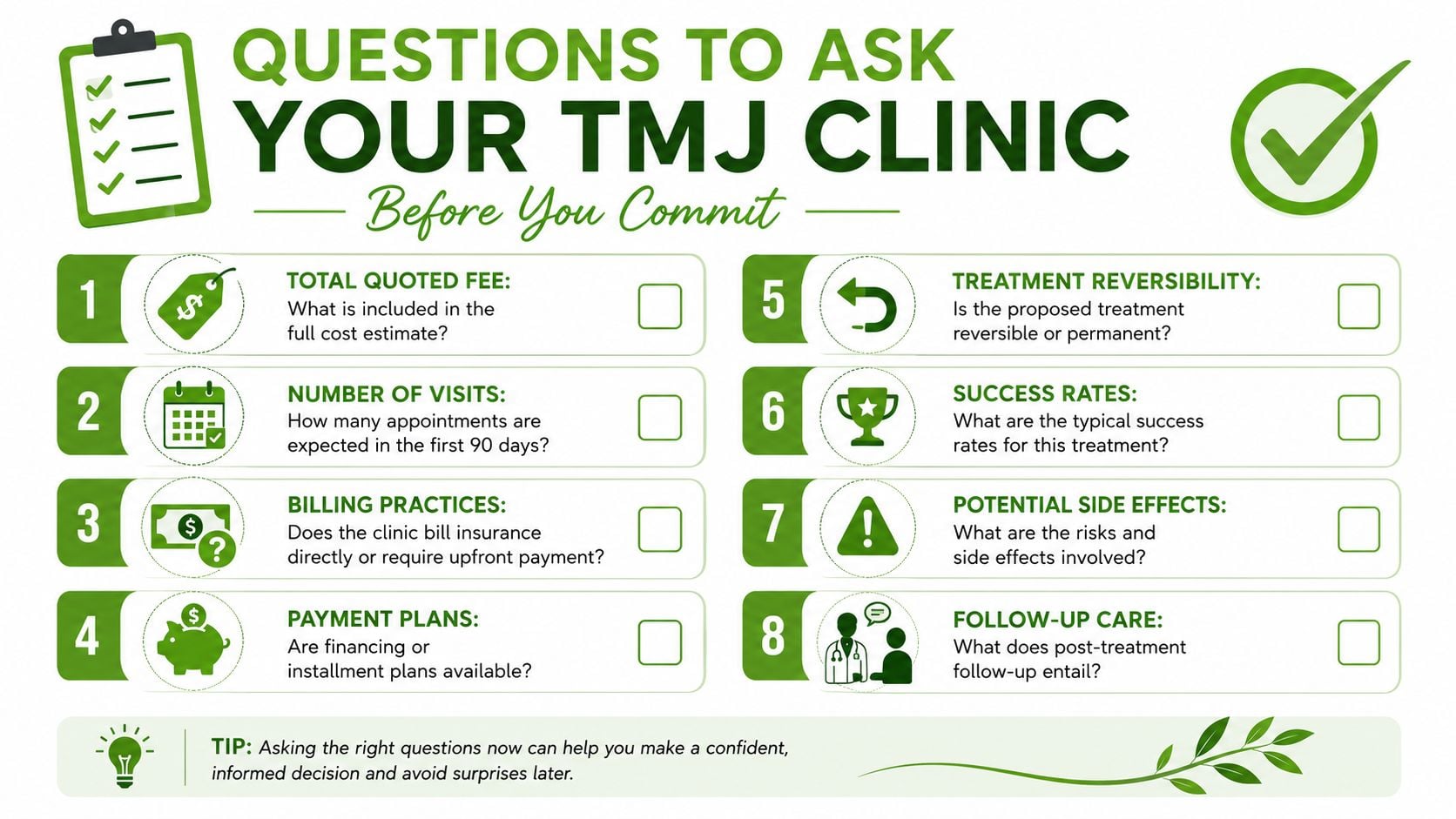
- Total quoted fee: What exactly is included in the estimate, and what is separate?
- Number of visits: How many appointments should I expect in the first 90 days?
- Billing practices: Do you bill medical insurance, dental insurance, or require upfront payment?
- Payment plans: What financing or installment options are available?
- Treatment reversibility: Is this plan reversible, or does it create permanent changes?
- Success criteria: What would count as improvement, and what would trigger a different treatment tier?
- Diagnostics used: Will I need X-rays, CBCT, or MRI, and why?
- Follow-up care: What happens if symptoms don't improve on schedule?
Ask for the written estimate before you buy an appliance or agree to a procedure. If a clinic can't explain the cost pathway clearly, that's a sign to slow down, not push through.
If you want a team that talks about TMJ costs the way patients experience them, Pain and Sleep Therapy Center in Charlotte offers evaluation, diagnostic planning, conservative TMJ care, and regenerative options with payment plans available. Visit Pain and Sleep Therapy Center to ask for a clear estimate and a treatment plan that matches your symptoms and your budget.