
You might be in your 30s or 40s, dealing with jaw tension, headaches, snoring, or the feeling that your tongue just never moves freely. Then a clinician lifts your tongue, looks under it, and points out a tight lingual frenulum you've probably had your whole life. That moment is common in adult tongue tie procedure consultations, and it usually raises the same questions, what is wrong, what can a release fix, and what still needs therapy after the procedure.
Why Adults Are Pursuing Tongue Tie Treatment Now
An adult usually does not walk into my office saying, “I have ankyloglossia.” They come in because something keeps getting in the way of daily life. A tight tongue can show up as jaw fatigue after talking, swallowing that feels awkward, snoring that a partner keeps noticing, or a sense that the mouth has always had to work harder than it should.
The adult scenario is usually symptom driven
In clinic, the finding is often incidental. A patient is evaluated for TMJ strain, speech effort, or sleep-related complaints, and the exam reveals a restricted frenulum that has been compensated for over years. That pattern is common in adults, because the restriction may have been present for a long time while the body adapted around it. The underlying issue is usually not the tissue alone, it is the way the restriction affects function and the strain that develops over time.
Practical rule: Adults usually do not seek a tongue tie procedure for the tissue alone, they seek it because the tissue seems to be linked to function, speech, swallowing, oral hygiene, or sleep.
Awareness has changed, and so has screening. Clinicians look for soft-tissue restrictions more often now, and tongue-tie is being diagnosed more frequently than it was a decade ago. A large U.S. inpatient trends study reported a 110.4% increase in diagnosed ankyloglossia from 2012 to 2016, with similar increases in lingual frenotomy procedures, which shows how much the topic has moved into mainstream care.
Who tends to start the conversation
The adults who usually benefit from an evaluation are the ones who can describe a functional problem, not just a visual one. That can include speech strain, swallowing difficulty, recurrent oral tension, or a history of compensatory habits that have never been addressed. Some people are also referred after airway-focused workup, especially when a tongue restriction seems to be part of a larger pattern.
Adults also ask because they want to know whether a release will change the whole picture or only one piece of it. That is where the trade-off matters. A tongue tie procedure can help when the restriction is real and the symptoms fit, but a release by itself does not solve airway mechanics, TMJ loading, or learned compensation. Those areas often need myofunctional therapy, dental input, or other interdisciplinary care alongside the procedure.
The broader concern is not hard to understand. Untreated oral restrictions can contribute to ongoing strain and secondary problems, as outlined in this overview of complications tied to untreated oral restrictions. The better question is whether the restriction is driving the adult symptoms in front of us, and whether the release is likely to improve function enough to justify the procedure.
Understanding Ankyloglossia in Adults
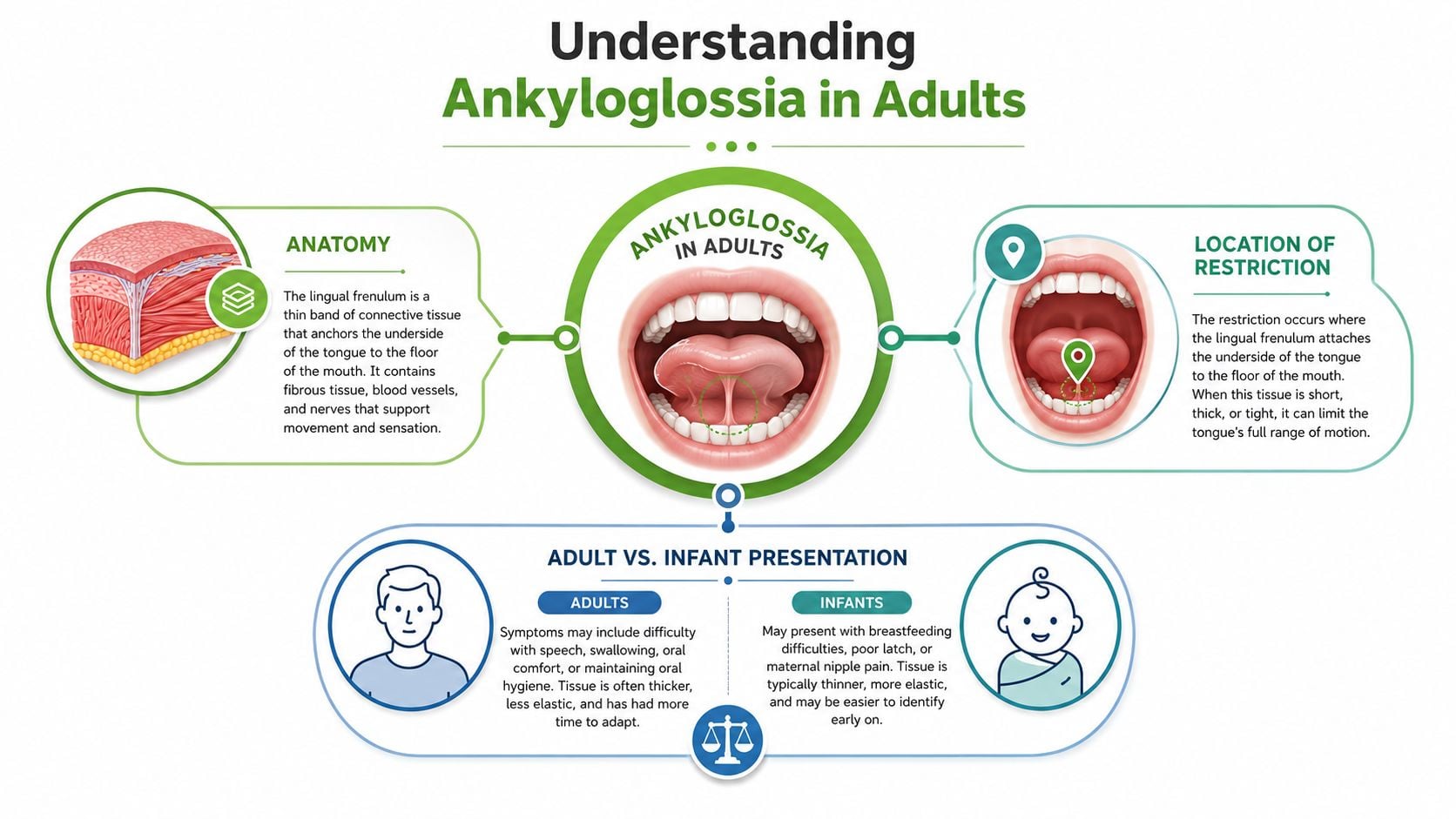
The lingual frenulum is the band of tissue under the tongue that connects it to the floor of the mouth. In ankyloglossia, that band is too short, too thick, or too restrictive, so the tongue cannot lift, protrude, or move side to side as it should. In adults, the problem is rarely anatomy alone. It is the anatomy plus years of compensation, which can mask the restriction until symptoms start to show up in daily function.
What clinicians look at
A good adult exam starts with a visual inspection, then moves into palpation and function. I want to know whether the frenulum is thin and elastic or dense and fibrous, whether the tongue can lift to the palate, and whether the floor of the mouth blanches or tightens with movement. That practical exam matters more than the label alone.
Clinicians often use structured tools such as the Hazelbaker Assessment Tool for Lingual Frenulum Function to organize findings, but no score should replace clinical judgment. The most useful question is not “Does it look tied?” It is “What can the tongue do, and what can't it do because of the restriction?” The NIH/StatPearls review also notes that diagnostic criteria vary, which is one reason adult cases are missed or described differently from one clinic to another.
A tight frenulum is like a sail tethered too low on the mast. The sail may still move, but it cannot catch wind efficiently, and the whole system compensates around the limit.
Why adult prevalence is easy to miss
Adult prevalence looks lower than childhood prevalence partly because the condition gets missed when symptoms are mild or compensations are strong. The best available prevalence data show that ankyloglossia across childhood, adolescence, and adulthood is typically 0.1% to 2.08%, while broader population estimates across all ages range from 0.1% to 10.7% because diagnostic criteria vary widely (NIH/StatPearls review). A 2022 meta-analysis summarized there found an overall prevalence of 5% across 71 studies, shifting from 7% in infants to 1% in children and 2% in adolescents, which is one reason adults can go undiagnosed unless someone specifically examines the frenulum.
That pattern matters in clinic. An adult may have lived with the restriction for decades without a formal diagnosis, especially if speech and swallowing adapted early enough to stay good enough. Some people only come into care when they develop tongue fatigue, oral tension, or airway and jaw symptoms that finally make the limitation harder to ignore.
Who Is a Good Candidate for a Tongue Tie Procedure
The adults who do best with a tongue tie procedure are the ones with measurable functional limitation. That group is different from someone who has a visible frenulum under the tongue. A release can help when the anatomy and the symptoms match, but it is a poor fit when the concern is vague, cosmetic, or disconnected from actual function.
Stronger indications
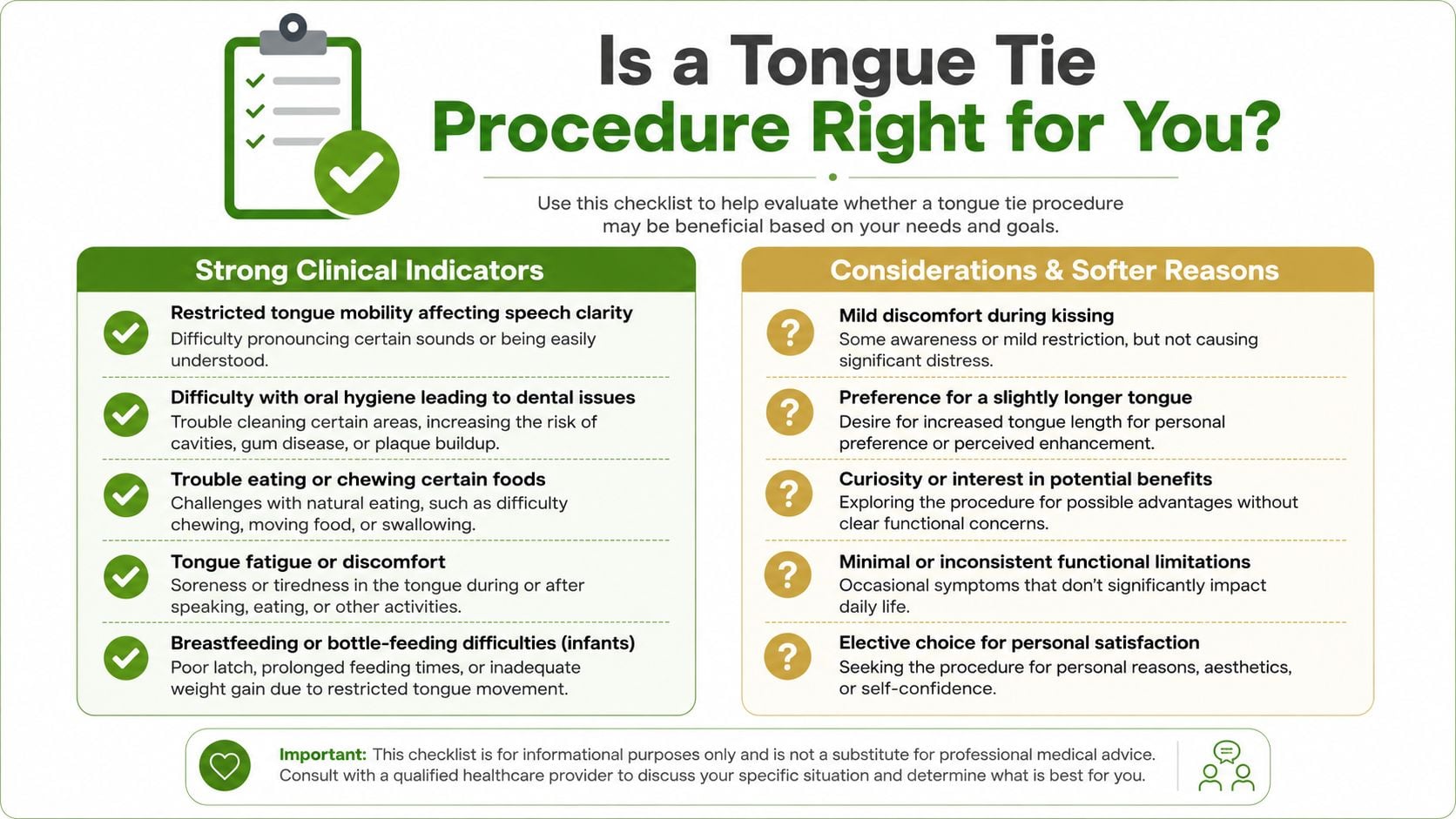
The clearest reasons to consider an adult tongue tie procedure are restricted mobility that affects speech clarity, swallowing mechanics, oral hygiene, or tongue posture. If a patient cannot lift the tongue to the palate, cannot sweep food from the teeth properly, or shows obvious compensation while speaking, the release becomes much easier to justify.
Symptoms matter most when they match the exam. An adult who reports jaw tightness and speech fatigue, then shows clear tethering on motion testing, is a stronger candidate than someone with intermittent discomfort and a short-looking frenulum but normal function.
Softer reasons that need caution
A release is much less convincing when the goal is general wellness, appearance, or a vague hope that everything from posture to breathing will improve. Adult evidence is still limited, and adults usually need surgery only if tongue-tie is causing problems, while there is still no widely accepted adult diagnostic or treatment framework as of 2025.
That is why I push back when a clinic treats every restricted-looking frenulum as a surgical case.
- Ask about function first: If the tongue moves well and symptoms are mild, the likely benefit of release falls quickly.
- Ask about alternatives: If myofunctional therapy or speech work has not been tried, the procedure may be premature.
- Ask what outcome is realistic: Better mobility is easier to defend than promises about sleep, jaw pain, or posture.
The adult diagnosis trend has accelerated, but faster treatment does not automatically mean better selection. Rising diagnosis and more procedures show that the topic is getting more attention, yet that alone does not prove every treated adult needed surgery.
A careful consultation should end with a plain answer. If the restriction is functionally meaningful, the release may be reasonable. If it is not, the honest next step is to keep looking for the cause of the symptoms.
A practical example is an adult with a tight frenulum, tongue fatigue, and mouth-breathing patterns that also show up in airway or jaw workup. In that setting, the procedure is one piece of care, and the better question is how it fits with airway evaluation, TMJ management, and myofunctional therapy rather than whether it can solve everything by itself. In clinics that offer a laser frenectomy procedure, the release itself may be technically straightforward, but the selection still depends on whether the tongue restriction is driving the problem or just sitting alongside it.
Procedure Options for Adults Compared
An adult tongue-tie release varies by case. The choice depends on the thickness of the frenulum, bleeding risk, how deep the restriction runs, and whether the goal is simple mobility or a more controlled tissue rearrangement. That is why adults often hear frenotomy, frenuloplasty, and laser-assisted release used in the same consultation.
Laser frenectomy procedure details show how clinics describe the procedural side, but the more useful question is what each option changes.
| Technique | Anesthesia | Best For | Invasiveness | Typical Recovery |
|---|---|---|---|---|
| Frenotomy | Topical or injected local anesthetic | Simpler, thinner restrictions | Lowest | Short initial soreness, then structured exercises |
| Frenuloplasty | Local anesthetic, sometimes with more extensive tissue control | Thick or dense frenula | Higher | More wound management, more emphasis on stretching |
| Laser-assisted release | Local anesthetic, with laser used for cutting and hemostasis | Cases where bleeding control matters | Variable, depending on depth | Similar healing goals, with careful follow-up |
Why the technique changes
In adults, a simple frenotomy is often enough for a thinner band of tissue. When the frenulum is thick or dense, clinicians often move toward frenuloplasty because deeper posterior ties tend to bleed more and may need suturing or laser-assisted hemostasis (adult tongue-tie resource). That is a practical response to anatomy.
Office-based treatment is common. Local anesthetic is usually enough, and the procedure itself generally takes only a few minutes in straightforward cases. The trade-off is straightforward, less tissue manipulation usually means easier healing, while more complex anatomy often needs more controlled repair.
How to choose between options
Use the least invasive option that still fully addresses the restriction. If the tissue is thin and the tongue lifts well after release, a simpler approach may be enough. If the release would be incomplete without suturing or tissue rearrangement, a more involved procedure makes more sense than repeating a minor one later.
The right procedure matches the depth of the restriction, not the flashiest label.
Adults should also ask whether the clinician expects to pair the procedure with follow-up therapy. A release that is not integrated into rehab often disappoints, especially when the frenulum has been compensating for years.
What to Expect Before, During, and After the Procedure
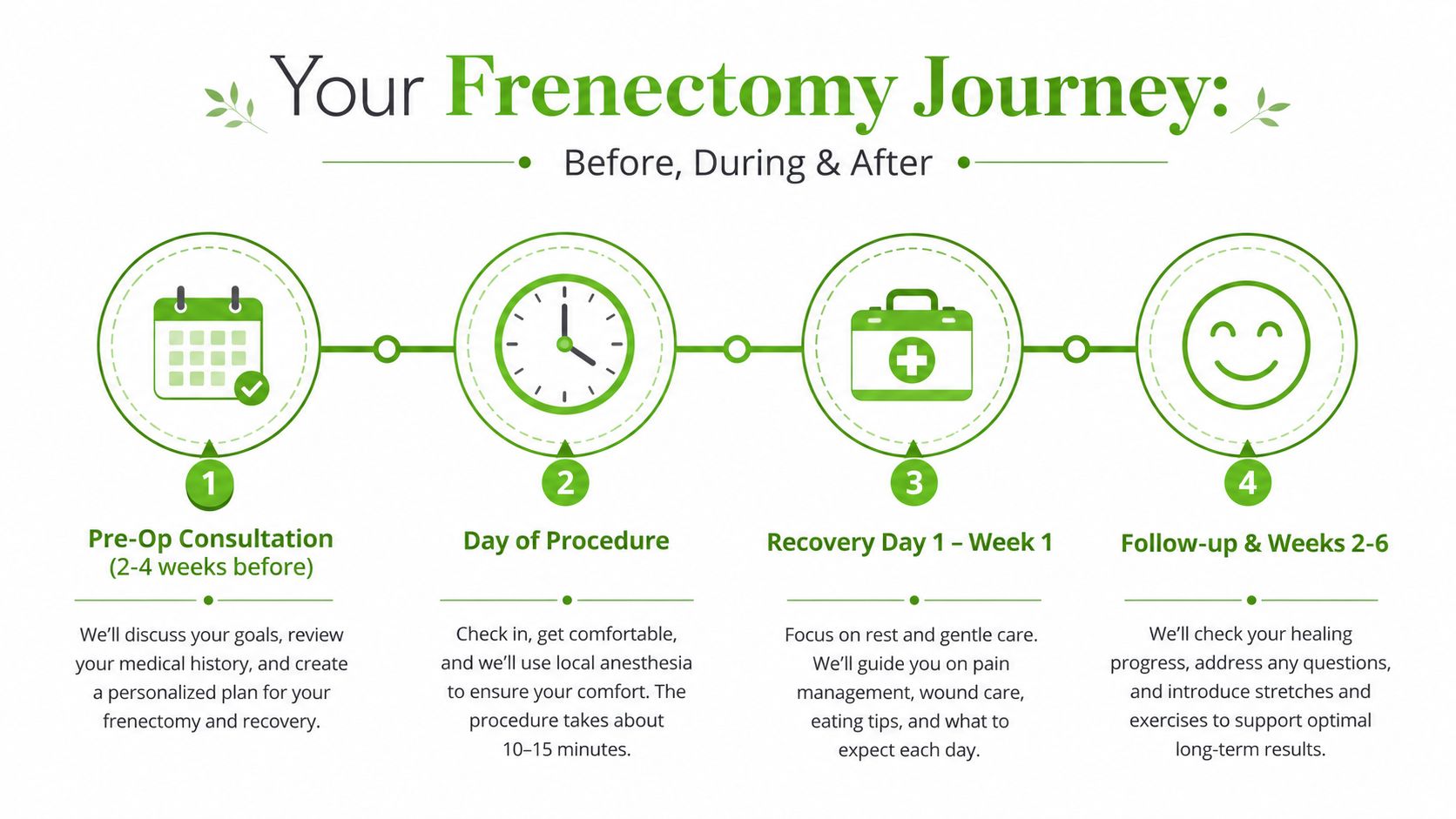
A first visit for adult tongue-tie care should feel structured. A clinician should review the symptoms that brought you in, check tongue mobility, and explain the likely procedure in plain terms. Adults do best when the plan also makes clear what the release can do, and what still depends on follow-up care and habit change.
The day of treatment
For straightforward cases, adults usually receive topical and, if needed, injected local anesthetic, then the release is completed in a few minutes. The experience is often easier than people expect, but that depends on anatomy. Thicker or denser ties can require more tissue handling and more careful control of bleeding, which is one reason technique selection matters.
The first day usually brings soreness under the tongue, mild swelling, and a temporary change in how speaking or eating feels. Soft foods and good hydration make that first stretch of healing easier to manage. A practical pre-op conversation should also cover how the mouth will feel in the hours after the procedure, especially if the patient already has jaw tension, airway complaints, or sensitivity around oral care.
Video guide for the frenectomy process
The first weeks matter most
Healing in adults is not only about closing the wound. Results depend heavily on neuromuscular retraining, and the usual rehab plan includes daily tongue elevation, lateralization, circular motions, and palate suction work after early healing to reduce the risk of re-adhesion and to interrupt old compensation patterns (adult rehab protocol). That is where the procedure connects with the broader picture, including myofunctional care and, in some adults, airway or TMJ evaluation.
Orofacial myofunctional therapy overview helps explain why the release is only part of the work. Adults have years of swallowing, resting, speaking, and breathing habits built into the system, so the tongue does not automatically adopt a better pattern just because the tissue is freer.
A simple timeline helps set expectations:
- Day 1 to 3: soreness, cautious eating, careful wound awareness
- Week 1 to 2: motion work begins after early healing, depending on the surgeon's protocol
- Weeks 2 to 6: stretching and mobility drills become the center of care
- Beyond 6 weeks: function is judged by what the tongue can now do consistently
The main mistake is assuming the release itself creates the result. It does not. The new range of motion has to be used, or the body often returns to the old pattern. Adults who stay consistent with the exercises, and who get help with breathing, jaw strain, or tongue posture when those issues are present, usually have a better chance of holding onto the change.
Clinical truth: Adults heal into patterns they repeat. If they skip the exercises, the tongue often returns to old compensation faster than they expect.
A written postop plan should be in hand before the procedure starts. Adults need clear instructions on when to begin stretches, how often to repeat them, what soreness is expected, and when to call the office. For day-to-day oral care during recovery, these fresh breath tongue care tips can help patients keep the area clean without being too aggressive.
The Role of Myofunctional Therapy and Interdisciplinary Care
A tongue-tie release by itself does not finish adult care. The procedure creates space, but myofunctional therapy teaches the tongue, lips, and swallowing pattern how to use that space. Adults have years of swallowing, speaking, resting, and breathing habits built into the system, so the tongue does not automatically adopt a better pattern just because the tissue is freer.
Orofacial myofunctional therapy overview fits naturally here, because the procedure and the retraining belong together.
Why release alone can disappoint
The adult evidence base is still limited, and that matters when setting expectations. Frenectomy alone has limited evidence for obstructive sleep apnea or TMJ pain, and downstream changes may depend on adjunctive therapy such as myofunctional rehabilitation.
That does not make the release unhelpful. It means the release is usually one part of a broader plan. If a patient has airway complaints, jaw clenching, or a history of mouth breathing, the result is more likely to hold when an airway-aware provider and a myofunctional therapist are involved.
What coordinated care looks like
A useful care team often includes an ENT, a sleep-aware dentist or physician, and a therapist who understands oral posture and retraining. In practical terms, one person tracks the anatomy, another tracks breathing and sleep symptoms, and another coaches the new movement pattern.
For simple daily habits, even hygiene matters. A resource like fresh breath tongue care tips can help patients understand how tongue cleaning fits into oral care without replacing the medical workup.
Adults do poorly with one-visit promises. They need a release when indicated, exercises they can follow, and honest follow-up when symptoms involve more than one system.
Risks, Costs, and Choosing the Right Specialist
Adult tongue-tie release is usually low risk, but low risk is not zero risk. Bleeding, infection, scarring, nerve injury, salivary duct injury, and reattachment can happen, especially when the frenulum is thick, deep, or more posterior than it first appears. The more dense the tissue, the more important technique and follow-up become.
What to ask before booking
The best specialist is the one who can explain why the release is indicated, how they'll control bleeding, and what they expect rehab to look like afterward. In adult care, that transparency matters as much as the procedural skill itself.
- Ask about training: Do they routinely evaluate adult tongue-tie, not just infant feeding cases?
- Ask about follow-up: Is there a real postop plan, or just a quick discharge sheet?
- Ask about coordination: Will they communicate with a myofunctional therapist if the case needs it?
Cost and billing realities
Many adults still pay out of pocket because insurers often treat tongue-tie release as self-pay. In practical terms, that means patients should ask about payment plans, HSA use, and whether the estimate includes follow-up visits or therapy referrals. If you're trying to decode medical and dental billing categories before choosing care, Happy Billing's dental billing guide is a helpful place to understand how offices categorize these services.
Some adults also choose a multidisciplinary clinic because it can reduce referral friction. Pain and Sleep Therapy Center is one example of a practice that evaluates tongue ties, TMJ problems, and sleep-related breathing concerns in the same care model. That doesn't make it the only option, but it does show why cross-training matters when the symptom picture is broader than the frenulum alone.
The major evidence gap still stands. Independent literature notes that adult tongue-tie research is sparse, with one review stating there was no publication concerning tongue-tie in adults and therefore insufficient information on adult speech outcomes, while a more recent review found no generally accepted definition, classification system, or management parameters as of 2025 (DOAJ review). That's exactly why a careful specialist matters. Good care is individualized because the evidence base still is.
Common Questions Adults Ask About Tongue Tie Release
Durability depends on the release plus the rehab. If the tongue stays mobile and the patient follows the stretching and retraining plan, the result is more likely to hold. If symptoms return, the first question is whether the exercises stopped too early or whether another diagnosis is driving the problem.
A second release is sometimes discussed, but it's not the first assumption I make. I'd rather re-examine healing, scar pattern, and function before jumping to repeat surgery. Speech therapy may help when old compensations are still active, especially if articulation or oral motor patterns lag behind mobility.
If you're unsure whether you're a candidate, bring one concrete symptom list, one example of how the restriction affects your day, and one question about follow-up care. That gives the specialist something useful to work with and helps you avoid a vague consultation.
Pain and Sleep Therapy Center evaluates adult tongue-tie in the context of TMJ pain, sleep-related breathing issues, and oral function, so the procedure is considered alongside the rest of the airway and jaw picture. If you're trying to figure out whether a tongue tie procedure in adults fits your symptoms, visit Pain and Sleep Therapy Center and ask for an individualized evaluation that looks at release, rehab, and the bigger functional cause.