Your child is half-awake, tugging at the blanket, and making a sound you can't place. It isn't quite a cough, isn't quite a wheeze, and breathing just seems harder than it should. That moment is exactly why pediatric airway obstruction matters, because parents need a way to tell a true emergency from a noisy but less urgent problem, and clinicians need a shared language for both.

Airway obstruction symptom patterns in children can look very different depending on where the blockage sits and whether it's sudden or gradual. A child can be perfectly fine one day, then struggle after a choking event, or slowly develop noisy sleep and mouth breathing that families dismiss as a “bad habit.” Both deserve attention.
Understanding Pediatric Airway Obstruction
A blocked airway in a child doesn't always look dramatic. Some children clutch their throat and panic, while others go quiet, sit forward, or stop playing because breathing takes too much effort. The problem is that the airway in children has very little margin for error, so even a partial blockage can turn into a serious emergency quickly.
The highest-risk age group is also the least able to protect the airway or explain what feels wrong. The National Safety Council data summarized in the medical reference notes that choking is most concentrated in very young children, with more than 75% of choking incidents occurring in children younger than 3 years and the highest rates in infants younger than 1 year, and it also reports 5,051 documented deaths in 2015 from foreign-body airway obstruction overall (NCBI Bookshelf). That's why parents, babysitters, teachers, and clinicians all need to know what the early warning signs look like.
Practical rule: if breathing looks hard, noisy, or suddenly different, treat the change as important even before you know the cause.
A useful way to think about this topic is to separate acute choking from chronic, subtle obstruction. Acute blockage happens fast and can follow food, toys, or small objects. Chronic obstruction builds more gradually, often through enlarged tissues, sleep-disordered breathing, or structural differences that narrow airflow little by little.
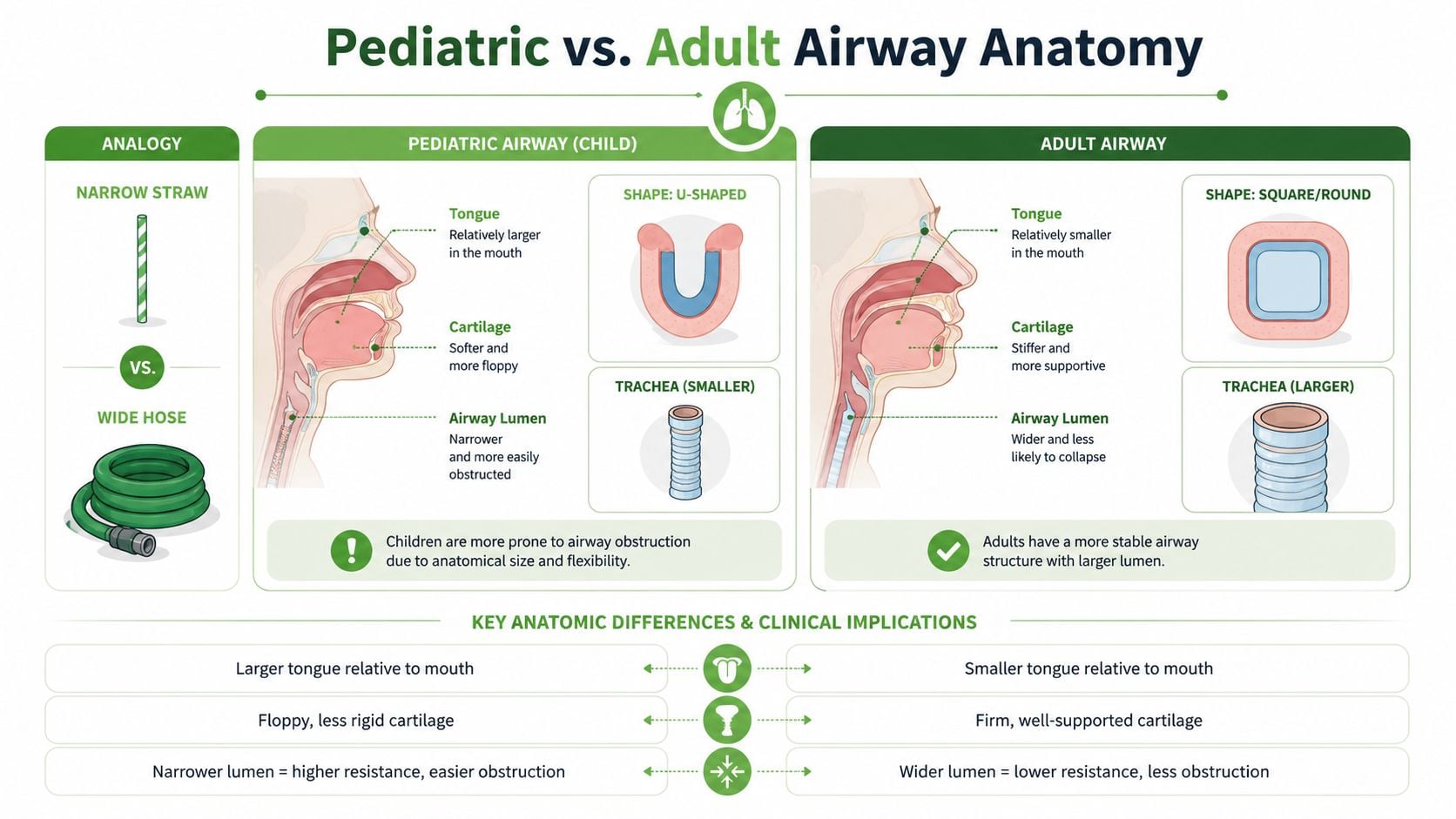
The image above helps explain why a child's airway behaves differently from an adult's. Think narrow straw versus wide hose. In a child, less space means a small amount of swelling, mucus, or a foreign body can cause a much bigger problem.
Anatomy and Vulnerability of the Pediatric Airway
The pediatric airway is not just a smaller version of the adult airway. It's a smaller, more compressible passage with less room to tolerate swelling, and that makes a child more vulnerable when anything goes wrong. In simple terms, a little narrowing matters more when the starting channel is already tight.
Where obstruction happens
Pediatric airway obstruction can sit at the nasal, pharyngeal, or laryngeal level, and the symptoms often point to the level involved (PMC7288604). Nasal obstruction tends to interfere most during feeding and sleep. Pharyngeal obstruction often makes a child sound noisy, with stertor or snoring-like breathing. Laryngeal obstruction is the one that more often causes stridor, the high-pitched sound many parents recognize but don't always know how to interpret.
The anatomy matters because the cause and the fix change by location. Enlarged adenoids don't behave like a vocal cord problem, and a child with a blocked nose won't present the same way as a child with swelling around the larynx. A careful clinician listens first, then localizes.
Why small bodies get into trouble fast
Young children breathe, swallow, and explore the world with the same mouth. That makes them prone to both aspiration and obstruction. Infants also have less reserve when breathing becomes difficult, so oxygen levels can fall quickly once airflow is compromised.
A good mental shortcut is this, the smaller the airway, the less room there is for error. Even mild swelling, thick secretions, or a tiny foreign body can create a disproportionate effect. That's why symptoms in a child shouldn't be minimized just because the child still looks “mostly okay.”
A noisy airway is a clue, not a diagnosis.
Common Causes of Pediatric Airway Obstruction
The causes fall into a few practical buckets, and the same child can have more than one at once. Some problems are present from birth, some come from infection or inflammation, and some are mechanical, meaning tissue or anatomy is physically narrowing the airway. Sorting them by category helps avoid the common mistake of assuming every noisy breather has the same problem.
Structural and developmental causes
Enlarged tonsils and adenoids are a classic source of chronic obstruction, especially in younger children. They crowd the back of the nose and throat, which can lead to snoring, mouth breathing, restless sleep, and a tired child during the day. Structural differences such as retrognathia or micrognathia can also crowd the airway, because the tongue sits in a smaller oral space and airflow has less room.
Children with neuromuscular disorders may struggle because the muscles that normally keep the airway open and coordinate swallowing don't work efficiently. That can create a mix of feeding difficulty, noisy breathing, and sleep disruption. A careful history matters here because the airway problem may be part of a broader pattern rather than a stand-alone issue.
Acute foreign-body obstruction
The most frightening cause is a swallowed or inhaled object. Food is a major culprit in severe choking cases, and the hospital analysis found 42% of admitted foreign-body airway obstruction cases were food-related, with a mean age of 3.5 years and 55% younger than 2 years (JAMA Otolaryngology study). Even though the condition is uncommon in hospital data, it can be devastating when it happens, with 3.4% in-hospital mortality in that analysis.
That's why choking prevention is so practical. Cut food appropriately, supervise eating, and keep small objects out of reach. For families seeking a deeper look at oral mechanics and swallowing-related risks, tongue-tie complications can also be part of the conversation when feeding, oral posture, and airway function seem connected.
Inflammatory and sleep-related causes
Inflammation from infection or allergy can narrow the airway temporarily, especially when swelling affects the nose, throat, or larynx. These children may sound congested, breathe through the mouth, or wake frequently at night. The important distinction is that not every child with noisy breathing is choking, but every child with persistent noisy breathing deserves a real evaluation.
Pediatric obstructive sleep apnea is also a major overlooked cause of chronic obstruction. It's described as frequently underrecognized, especially in children with neurodevelopmental delay, and the main drivers shift with age, from adenotonsillar hypertrophy in younger children to obesity in older children and adolescents, plus craniofacial and neuromuscular causes (NCBI Bookshelf). Loud snoring, fragmented sleep, and behavioral changes can be airway symptoms, not just sleep habits.
Red-Flag Symptoms and Emergency Recognition
A child with airway obstruction often tells the story with sound before words. A high-pitched noise when breathing in, visible pulling between the ribs, blue lips, or sudden silence after a choking episode all raise the urgency level. If the breathing pattern changed fast, parents shouldn't wait to see whether it passes.
For acute choking, speed matters because the airway can fail rapidly. The medical reference on pediatric first aid recommends 5 back slaps and 5 chest compressions for conscious infants under 1 year, abdominal thrusts for older children who are upright, and chest thrusts if the older child is supine, then CPR if the child becomes unconscious, with object removal only when visible because blind finger sweeps can push the obstruction deeper (SMC Health guidance). Those are the maneuvers families should know before an emergency happens.
Signs that need emergency care now
- Stridor at rest: a noisy, high-pitched inhale often means the upper airway is narrowed.
- Retractions: the skin between the ribs, above the collarbones, or at the base of the neck pulls in with each breath.
- Cyanosis: blue or gray lips, tongue, or face signal poor oxygenation.
- Inability to speak, cry, or cough effectively: this is especially concerning after a choking event.
- Sudden drooling or refusal to swallow: the child may be protecting a swollen or blocked airway.
A child who is still talking, playing, and improving with time may need prompt clinic review rather than ambulance care. A child who is tiring, becoming less responsive, or losing color needs emergency help immediately. Parents often hesitate because they don't want to overreact, but airway problems punish delay more than most pediatric complaints do.
If the sound changes and the child looks worse, call for help.
Diagnostic Pathway and Clinical Evaluation
The evaluation starts with listening carefully to the history. Clinicians ask when the problem began, whether it was sudden or gradual, what the child eats, how sleep looks, and whether there are feeding, growth, or developmental concerns. That history often points toward the right part of the airway before any device is used.
A physical exam then helps localize the obstruction. Does the child breathe through the nose or the mouth. Is there stertor, stridor, or both. Does the jaw look recessed, does the tongue sit low or forward, and are the tonsils clearly enlarged. These clues narrow the differential before testing starts.
The next step can include endoscopy, imaging, or sleep testing, depending on the symptom pattern. A child with suspected obstructive sleep apnea may need sleep-focused assessment, while a child with recurrent choking or structural concerns may need direct airway visualization. Multidisciplinary input is often the fastest way to get the right answer because airway symptoms can overlap with dental, sleep, feeding, and neurologic issues.
When families communicate across language barriers, accuracy matters even more. A resource on why medical translation errors matter is useful because airway histories depend on precise symptom descriptions, and a missed detail can change the interpretation of a child's breathing problem.

Treatment Options and Management Strategies
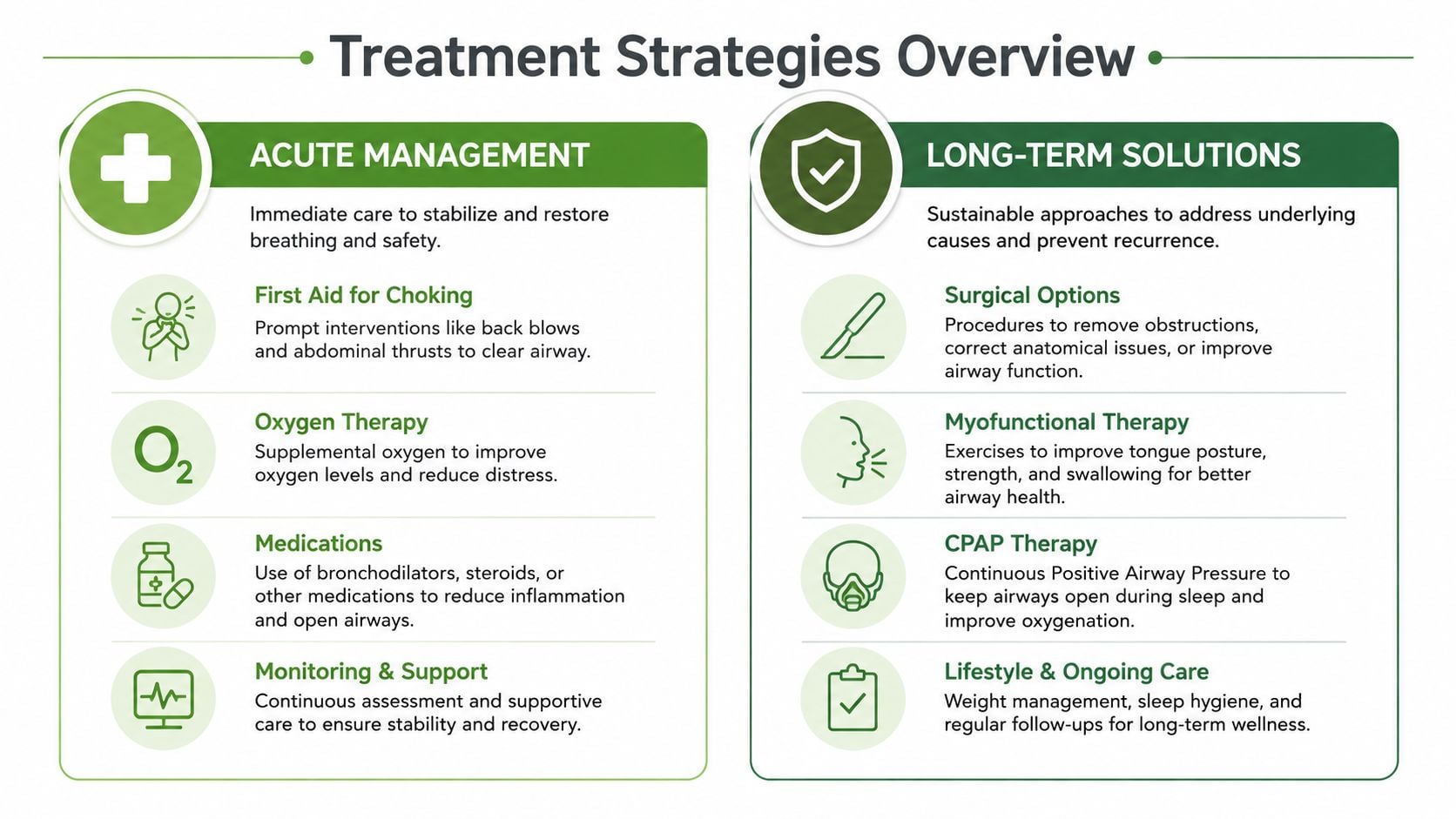
Treatment depends on whether the problem is a seconds-to-minutes emergency or a chronic airway issue that's reshaping sleep, feeding, and growth. Families often want a single answer, but airway care works better when the short-term rescue plan and the long-term plan are separated clearly. That keeps the wrong treatment from being applied to the wrong problem.
The acute side is straightforward. For choking, use age-appropriate first aid, then escalate to emergency care if the child becomes unresponsive or the object doesn't clear. In the hospital, oxygen, suction, airway support, and procedural removal may be needed if the obstruction is not resolved quickly.
The long-term side is broader. Enlarged tonsils or adenoids may lead to surgical discussion, while sleep-disordered breathing can require a combination of airway assessment, sleep medicine input, and sometimes positive airway pressure. In some children, the issue is not just tissue bulk but poor oral posture, mouth breathing, or dysfunctional swallow patterns, where orofacial myofunctional therapy and pediatric oral health assessment become part of a root-cause approach.
Clinical takeaway: the right treatment is the one that matches the level of obstruction, not the loudness of the symptom.
Families who are also weighing environmental contributors sometimes ask about home air quality. A practical resource on air cleaners for bacteria removal may be useful in that broader discussion, especially when congestion, allergy concerns, or recurrent irritation seem to worsen breathing comfort, but it shouldn't replace proper airway evaluation.
| Treatment Type | Best For | Key Benefits | Considerations |
|---|---|---|---|
| Age-specific choking first aid | Sudden foreign-body obstruction | Immediate mechanical relief, can be lifesaving | Must match the child's age and position |
| Emergency airway support and object removal | Persistent acute obstruction | Restores airflow when first aid fails | Needs trained clinicians and rapid escalation |
| Tonsillectomy or adenoidectomy | Enlarged tonsils or adenoids causing chronic blockage | Reduces anatomic crowding | Surgical risks and recovery need discussion |
| Sleep-focused therapy, including CPAP when appropriate | Pediatric sleep-disordered breathing | Supports breathing during sleep | Mask fit, tolerance, and follow-up matter |
| Orofacial myofunctional therapy | Mouth breathing, poor oral posture, swallow dysfunction | Targets habits and muscle patterns | Works best as part of a team approach |
| Pediatric oral health interventions | Crowded oral space, breathing and feeding coordination concerns | Supports long-term function and prevention | Needs coordination with ENT and dental teams |
For children with chronic sleep symptoms, pediatric sleep apnea treatment options often involve more than a single intervention, because airway function, oral posture, and sleep quality are linked.
When to Seek Specialty Care and Next Steps
Specialty care makes sense when the symptoms are repeated, unclear, or out of proportion to a simple cold. A child who snores loudly, mouths breathes most of the time, wakes unrested, or has recurrent choking episodes should be reviewed by a pediatric ENT or sleep specialist. If oral posture, swallowing, or tongue mobility seem abnormal, orofacial myofunctional therapy and pediatric oral health support can add important pieces of the puzzle.
Parents should ask one question at every visit, what is narrowing the airway. That keeps care focused on root cause instead of temporary symptom relief. Clinicians can use that same question to decide whether the next step is endoscopy, sleep testing, dental collaboration, or a combined plan.
A full airway evaluation is especially important when sleep, feeding, speech, and breathing problems travel together. Those children are often trying to compensate in multiple systems at once, which is why a narrow view misses the issue. The best outcomes usually come from coordinated care, not scattered advice.
Pain and Sleep Therapy Center evaluates airway-related concerns with a root-cause lens that fits this topic, especially when sleep, oral posture, and pediatric breathing patterns overlap. If your child snores, mouth-breathes, or seems to struggle with airway comfort, visit Pain and Sleep Therapy Center to explore a specialty approach that brings together thoughtful assessment and interdisciplinary care.