
You're exhausted, you snore, you wake up with a dry mouth or a headache, and you still can't tell whether you need a primary care visit, a dentist, an ENT, or a sleep disorder specialist. That uncertainty is common, because sleep problems often look like “just fatigue” on the surface while the underlying cause sits deeper, in the airway, jaw, breathing pattern, brain, or behavior.
A sleep disorder specialist is the clinician who sorts through that overlap. The specialty exists because sleep disorders affect huge numbers of people, and the evaluation often takes more than one kind of test, one kind of treatment, or one kind of clinician. The American Academy of Sleep Medicine reports about 6,000 board-certified sleep medicine physicians and more than 2,600 AASM-accredited sleep facilities in the United States, alongside the fact that nearly 60% of people have a chronic sleep disorder and only 15% of adults have discussed sleep with a sleep specialist (AASM fact sheet). That gap explains why many people stay stuck in self-management far longer than they should.
What a Sleep Disorder Specialist Actually Does
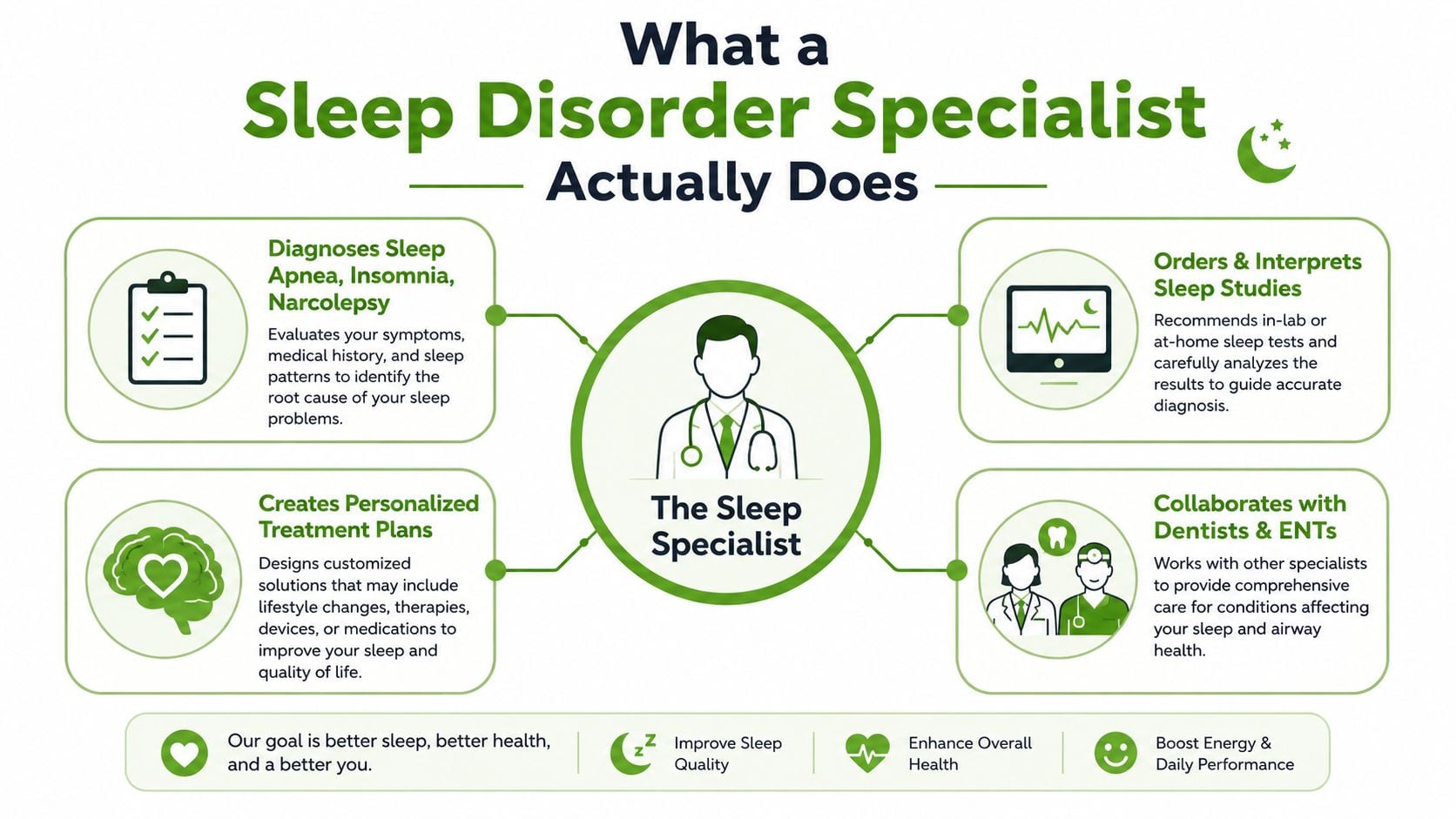
The simplest way to think about a sleep disorder specialist is this, they're the clinician who figures out why sleep is broken, not just how to nudge it a little better. Some specialists come from neurology, pulmonology, psychiatry, pediatrics, internal medicine, otolaryngology, or dentistry, and the work depends on interpreting polysomnography and other sleep tests to separate breathing issues from neurologic, behavioral, and airway-related causes (PubMed).
Why the specialty exists
Sleep complaints rarely have one clean cause. A person may snore because of airway narrowing, wake often because of breathing disruptions, feel wired at night because of circadian misalignment, or lie awake because insomnia has taken hold as a conditioned pattern. A good specialist doesn't assume the first symptom tells the whole story.
Practical rule: if poor sleep is still there after you've tried basic sleep hygiene, the next step is usually a diagnostic question, not another generic tip.
That's why this specialty sits at the intersection of breathing, neurology, behavior, and airway anatomy. In real practice, a sleep clinician is matching symptoms to the right test, then matching the result to the right therapy.
What that looks like in real life
A person who wakes exhausted after loud snoring needs a different evaluation than someone who can't fall asleep until 3 a.m. or a child who mouth-breathes, grinds teeth, and seems tired in school. The specialist's job is to notice those differences and decide who needs an airway-focused workup, who needs a neurologic lens, and who needs a behavioral treatment plan.
That's also why the title matters. A “sleep doctor” is a broad phrase. A sleep disorder specialist is a diagnostician trained to sort the cause, not just the complaint.
Common Sleep Disorders a Specialist Treats
Most patients don't walk in saying, “I think I have narcolepsy” or “My circadian rhythm is off.” They come in with a symptom cluster. Loud snoring, witnessed pauses in breathing, unrefreshing sleep, morning headaches, or daytime sleepiness usually tell the specialist where to look first.
Breathing-related problems
Obstructive sleep apnea is the condition people most often associate with sleep medicine, and for good reason. It often shows up as loud snoring, gasping, witnessed apneas, or waking unrefreshed. The key clue is that the sleep itself may be fragmented even when the person thinks they slept through the night.
Snoring alone doesn't prove apnea, but it does matter when a partner notices pauses or choking sounds. The same goes for a person who wakes with a dry mouth or morning headache and still feels sleepy after a full night in bed.
Non-breathing sleep disorders
Insomnia is different. People may have trouble falling asleep, staying asleep, or getting back to sleep after waking in the night. Restless legs syndrome tends to show up as a hard-to-describe urge to move the legs that makes bedtime miserable. Narcolepsy often enters the picture when daytime sleepiness is extreme or sudden muscle weakness appears in the symptom story.
Children can have their own airway pattern. Mouth breathing, snoring, grinding, and restless sleep may point toward a sleep or airway issue rather than a simple behavioral problem. Some children also look inattentive or “tired but wired,” which can confuse families who expect sleep disorders to look the same as they do in adults.
The pattern matters more than the label
A specialist doesn't start by forcing every symptom into the same bucket. They look for the pattern first, then decide whether the main issue is breathing, arousal, circadian timing, movement, or neurologic regulation. That's why the same clinic can evaluate a snorer, a night owl, a child with mouth breathing, and a person who can't stay asleep.
The value of specialty care is that it keeps the diagnosis broad enough to avoid missing the cause that matters.
How Specialists Diagnose Sleep Problems
Diagnosis usually starts with a question, not a device. The specialist listens for the pattern, then decides which test best fits that pattern. A home sleep apnea test can be enough for straightforward breathing concerns, while a full overnight polysomnography gives a more complete picture when symptoms are complex or mixed.
A home test is a little like a focused recorder. It captures the breathing signals that matter most when obstructive sleep apnea is the leading suspicion. An in-lab study is more like an all-night monitor with more channels, more context, and more detail, which is why it's often used when the picture isn't simple.
Which test fits which symptom
If the main concern is snoring, witnessed apneas, or gasping, the specialist may start with a sleep apnea study. If the person has unusual daytime sleepiness, possible narcolepsy, or a diagnosis that needs more nuance, the Multiple Sleep Latency Test can help the team understand how quickly sleep is happening during the day and whether the sleepiness pattern fits the story.
A diagnosis doesn't stop at the machine reading. The specialist also asks whether the jaw, palate, tongue posture, nasal airflow, and facial structure may be part of the problem. That's especially important in airway-focused practices, where a sleep complaint may be tied to TMJ symptoms, oral posture, or mouth breathing habits.
Why one test is rarely the whole answer
Sleep problems overlap. Someone can snore and also have insomnia. A child can have airway narrowing and poor oral posture. An adult can have fatigue from apnea, but the fatigue may persist if anxiety, breathing pattern dysfunction, or pain is also disrupting sleep.
The goal is accurate phenotyping, then a treatment plan that fits the physiology. A careful workup matters because the wrong test can miss the main issue, while the right test can steer the person toward a better match between diagnosis and treatment.
If you want a structured starting point, the sleep quality assessment used by airway-focused clinics can help organize symptoms before the first visit. That kind of prep makes the evaluation more efficient and often helps patients describe what's happening more clearly.
The Interdisciplinary Team Around Your Specialist
A sleep disorder specialist rarely works alone. In airway-focused care, the lead clinician often coordinates with people who handle the pieces that a single prescription can't fix. That team approach matters because sleep disruption may come from the airway, jaw position, tongue posture, breathing habits, or a neurologic sleep disorder.
| Team Member | Primary Role | When You See Them |
|---|---|---|
| Sleep disorder specialist | Leads diagnosis and treatment planning | When symptoms need medical evaluation and test selection |
| Dental sleep medicine provider | Fits and adjusts oral appliances | When a custom appliance is being considered for airway support |
| Orofacial myofunctional therapist | Retrains tongue, lip, and swallowing patterns | When oral posture and breathing habits need correction |
| Buteyko or breathing retraining coach | Works on breathing pattern control | When mouth breathing or dysfunctional breathing habits are part of the picture |
| Neurologist | Evaluates neurologic sleep issues | When symptoms suggest narcolepsy, movement disorders, or another neurologic cause |
| Pediatric oral health specialist | Addresses developing airway and oral issues | When a child has mouth breathing, grinding, or airway concerns |
Why collaboration changes the result
The team role is practical, not decorative. A dentist can make the appliance. A therapist can help the tongue rest in a more functional position. A breathing coach can reinforce nasal breathing patterns. The sleep specialist keeps the diagnosis anchored so the parts don't drift apart into disconnected advice.
A single prescription can reduce symptoms. Collaboration is what helps identify the root cause.
That's the difference between symptom suppression and root-cause care. Pain and Sleep Therapy Center in Charlotte uses that integrated model by bringing TMJ, airway, and sleep expertise into one setting, so the assessment can include both sleep-breathing concerns and jaw-related contributors when needed.
Who handles what
If the main issue is snoring plus airway narrowing, the specialist may coordinate with dental sleep medicine or ENT care. If the concern is a child with oral habits that keep the airway unstable, pediatric oral health and myofunctional support can matter just as much as the sleep study result. If the concern is a neurologic sleep pattern, a neurologist may need to help interpret the broader picture.
That's why root-cause work is rarely a one-person job. The right team makes the diagnosis more precise and the plan more usable.
Treatment Options Beyond the CPAP Machine
CPAP is one tool, not the whole toolbox. A sleep disorder specialist should match treatment to the airway, the jaw, the breathing pattern, and the symptom profile, because that's what changes how a person sleeps over time. For many people, the question is not “CPAP or nothing,” it's which combination fits their physiology best.
Matching treatment to physiology
Custom oral appliances can be useful when the jaw position and airway anatomy suggest that repositioning the lower jaw may help open the airway. ENT or surgical care may be appropriate when an anatomic obstruction needs correction. Behavioral approaches, including CBT-I, are a major part of insomnia care, and they belong in the conversation whenever sleep initiation or sleep maintenance is the primary problem (Career Explorer).
The most important point is that treatment choice should follow the cause. A person with insomnia doesn't need the same plan as someone with obstructive apnea, and someone with both may need a combination approach.
Beyond devices alone
Airway-focused practices often add myofunctional therapy, breathing retraining, and nasal or posture work to support more stable breathing during sleep. In TMJ-related sleep cases, regenerative or tissue-supportive options may also be part of the discussion, including Prolotherapy, Platelet-Rich Fibrin (PRF) injections, and cold laser therapy, when the clinician believes those tools fit the problem and the patient's goals.
These aren't interchangeable treatments. They're different levers for different problems. The specialist's role is to sequence them so the patient isn't trying three unrelated fixes at once.
If you're trying to understand the non-CPAP side of care, sleep apnea solutions without CPAP is a useful clinical overview of how airway-based options can be organized. For broader sleep-hygiene habits that support any treatment plan, local expert sleep advice can be a practical reference, especially when the goal is to improve the nightly routine rather than chase a single device.
Clinical note: the right therapy should feel targeted. If a plan ignores the jaw, tongue, nose, or breathing pattern when those are clearly part of the story, the plan may be too narrow.
Signs It Is Time to Seek a Referral
Some people can try basic changes at home for a while. Others already have enough warning signs that it makes more sense to stop guessing and get evaluated. The clearest referral patterns usually involve breathing signals, daytime impact, or persistent nighttime disruption.
Clear reasons to book an evaluation
- Breathing signals: Loud snoring, witnessed apneas, gasping, or choking during sleep are strong reasons to seek specialty input.
- Daytime impact: Persistent fatigue, morning headaches, and unrefreshing sleep suggest the problem is affecting function, not just comfort.
- Nighttime disturbance: Frequent awakenings, trouble staying asleep, or a bed partner noticing repeated pauses in breathing deserve attention.
- Lifestyle and safety: Dozing while driving, relying on self-management that isn't working, or feeling too sleepy to stay alert are not signs to ignore.
If the pattern is mostly fatigue, it helps to think about more than one possible cause. A helpful overview of causes of constant daytime fatigue can keep the conversation grounded in likely explanations rather than assumptions, especially when poor sleep, airway issues, and other medical factors may overlap (Purified Air Duct Cleaning).
Questions to bring to the first visit
Bring questions that force the plan to become specific. Ask which test fits the symptom pattern, whether an oral appliance could be appropriate, and how the team evaluates airway and jaw contributors. If a child is being seen, ask how the plan changes for mouth breathing, grinding, or attention concerns.
A few smart questions can save a lot of back-and-forth later. The goal is not to push for a particular treatment. The goal is to get the evaluation aligned with the symptoms you're already seeing.
If you're unsure whether your symptom pattern fits a sleep medicine visit, the sleep disorder specialist near me resource can help you think through the next step before you call.
Choosing the Right Specialist for Your Situation
The common mistake is assuming the first step has to be a sleep study. Sometimes it does. Often, though, the better first move is matching the specialist to the symptom pattern and the care setting, especially if you're dealing with airway, jaw, pediatric oral health, or treatment-access issues.
That matters because access isn't always simple. Specialty appointments can take time, sleep labs may be limited in some areas, and insurance can slow down a plan that should have started weeks earlier. In those situations, a clinic that combines sleep evaluation with airway and TMJ assessment can shorten the path from symptoms to answer.
Choosing the entry point
If loud snoring, witnessed apneas, or gasping are the main issue, a sleep medicine evaluation is usually the right door. If jaw pain, clenching, or facial tension is part of the story, a TMJ or airway-focused clinic may be more helpful than a generic sleep visit alone. If the concern is a child with mouth breathing or oral development issues, pediatric oral health and airway assessment may need to happen together.
Primary care, ENT, dentistry, orthodontics, and sleep medicine can all be valid entry points. The right one is the one that can recognize the symptom pattern you have, then route you efficiently to the next step.
A practical way to move forward
Start with the symptom cluster, not the label. If you already have a referral, bring it. If you don't, gather a few nights of notes on snoring, awakenings, daytime sleepiness, headaches, and mouth breathing, then use them to guide the visit.
A specialist who understands the airway, jaw, and sleep relationship can decide whether testing, an appliance, or a broader interdisciplinary plan makes the most sense. That approach is often more efficient than sending every patient straight into the same single-track workup.
Pain and Sleep Therapy Center helps adults and children evaluate sleep-disordered breathing, TMJ-related concerns, and airway contributors in one clinical setting. If you're dealing with snoring, unrefreshing sleep, or a symptom pattern that hasn't been explained yet, visit Pain and Sleep Therapy Center to look at the care options that fit your situation.