

You may be in this exact cycle right now. You get what should be enough time in bed, yet you wake with a sore jaw, a tight face, a dull headache behind the eyes, or that heavy, foggy feeling that makes the morning feel harder than it should.
For people with TMJ pain, clenching, facial tension, snoring, or suspected airway problems, “I'm tired” usually isn't the whole story. Sleep can look long enough on paper and still be fragmented, shallow, effortful, or medically disrupted. That's why sleep quality assessment matters. It helps us move from vague symptoms to something measurable, interpretable, and treatable.
Why "Tired" Is Not a Good Enough Answer
A common patient story goes like this. They say they slept all night, but they don't feel restored. They wake with jaw stiffness, temple pain, dry mouth, neck tension, or a feeling that they were “working” to sleep instead of resting.
That pattern matters because sleep duration and sleep quality are not the same thing. You can be in bed for hours and still miss the kind of sleep that allows the nervous system, muscles, and airway to settle. In TMJ and facial pain patients, that difference often shows up as morning clenching, tenderness in the chewing muscles, or headaches that seem unrelated until the sleep piece is examined.
The bigger picture supports that concern. In the United States in 2020, the CDC reported that 14.5% of adults had trouble falling asleep and 17.8% had trouble staying asleep most days or every day in the prior 30 days, which shows this is a broad public health issue and not a personal failure or lack of discipline (CDC sleep data).
What we are actually trying to answer
When I assess sleep clinically, I'm not only asking, “How many hours did you sleep?” I'm trying to answer questions like these:
- Was your sleep continuous? Frequent awakenings can leave you unrefreshed even if the clock suggests enough time in bed.
- Was breathing stable? Snoring, gasping, mouth breathing, and effortful breathing can fragment sleep without you fully remembering it.
- Did your muscles stay guarded? Jaw clenching and facial muscle activation often worsen when sleep is disrupted.
- Did you wake restored? The morning state matters. Headaches, jaw fatigue, and dry mouth are clues.
Poor sleep often hides inside “normal enough” routines. The patient may think the problem is stress, when the bigger issue is fragmented sleep or an unstable airway.
Some patients start by improving the bedroom routine, bedding, and evening environment. That can help, and a practical place to begin is to understand your true deep rest if you're sorting out what healthy sleep should feel like.
But when tiredness comes with TMJ pain, clenching, facial soreness, snoring, or morning headaches, the next step is not guessing. It's assessment.
Your Story Matters With Subjective Sleep Assessments
The first layer of sleep quality assessment is simple, but it's not superficial. Your own report is often the clearest map we have of what sleep feels like from the inside.
Machines can measure breathing, movement, oxygen, and brain activity. They cannot tell me whether your jaw feels locked in the morning, whether you wake with cheek soreness, or whether your partner notices a pattern of snoring followed by silence and a gasp. That part comes from you.
What to track before testing
A short sleep diary can be more useful than patients expect. It doesn't need to be fancy. It needs to be consistent.
Track items like:
- Bedtime and wake time so we can see your actual sleep window, not the ideal one.
- How long it seems to take to fall asleep because difficulty settling can mean something different from repeated waking.
- Night wakings including how many you remember and whether you wake to urinate, reposition, cough, or catch your breath.
- Morning symptoms such as jaw pain, temple pressure, dry mouth, headache, neck tightness, or tooth soreness.
- Breathing clues like snoring, mouth breathing, choking, or waking with a pounding heart.
- Clenching and grinding clues including worn teeth, sore masseters, cheek biting, or a partner hearing grinding.
Why your report is clinically useful
Subjective tools act like a witness interview. They give context that objective testing alone can miss.
For example, two patients might both report “poor sleep.” One falls asleep easily but wakes often with a dry mouth and morning headache. Another lies awake for long stretches with racing thoughts but breathes evenly once asleep. Those are not the same clinical problem, and they should not get the same treatment plan.
A questionnaire can also help organize symptoms into patterns. Some forms focus on daytime sleepiness. Others focus on breathing risk, insomnia features, or overall sleep disturbance. The value is not the paperwork itself. The value is that it turns a fuzzy complaint into something structured.
Practical rule: If your symptoms are worst in the morning, bring that up early. Morning jaw pain, facial tightness, headache, and dry mouth often point us toward nighttime breathing or muscle activity, not just daytime stress.
What doesn't work
What usually doesn't work is giving a broad answer like “I sleep badly” and hoping the cause will be obvious. It rarely is.
It also doesn't help to focus only on one symptom. A patient may come in for TMJ pain and ignore the snoring. Another may come in for fatigue and forget to mention years of tooth wear or clenching. Sleep quality assessment works best when we look at the pattern as a whole:
- nighttime breathing
- sleep continuity
- muscle activity
- morning symptoms
- daytime function
That full story is often what reveals whether a facial pain problem is just a jaw problem, or whether the airway is involved.
Gathering Data With Objective Sleep Assessments
Objective testing gives us data that memory and symptoms alone can't provide. I often explain this the way a mechanic uses different diagnostic tools. One tool gives a full system readout. Another checks a narrower issue. The right test depends on the question.
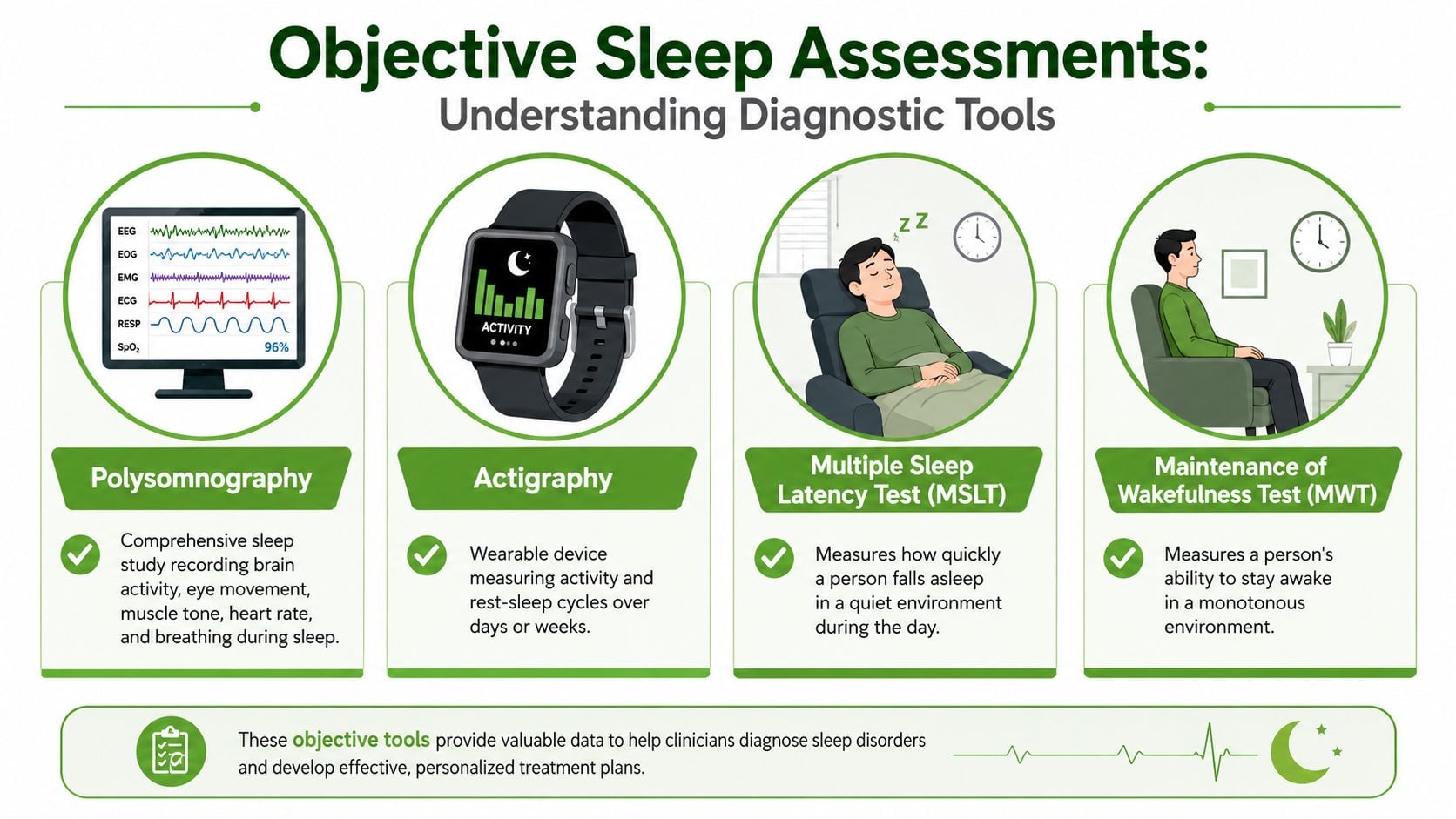
A side by side look at common tools
| Test | What it measures | Best use | Limits |
|---|---|---|---|
| Polysomnography | Brain activity, eye movement, muscle tone, heart rhythm, breathing, and more | Complex sleep concerns, unclear cases, suspected sleep apnea, movement disorders, unusual behaviors in sleep | More involved, usually done in a lab |
| Home sleep apnea test | Breathing-related signals during sleep at home | Suspected obstructive sleep apnea in the right patient | More focused. It does not answer every sleep question |
| Actigraphy | Rest-activity patterns over time through a wearable device | Irregular schedules, circadian concerns, estimating sleep patterns over days or weeks | It tracks movement, not sleep stages |
| Overnight oximetry | Oxygen levels during sleep | A screening clue when breathing-related sleep disruption is suspected | Helpful but incomplete by itself |
What each test can tell us
Polysomnography, often called PSG, is the most detailed study. If a patient has TMJ pain, headaches, witnessed breathing pauses, leg movements, unusual nighttime behaviors, or a complicated history, PSG can help separate overlapping problems. It shows whether the brain is reaching and staying in restorative sleep stages and whether breathing or arousals keep interrupting that process.
Home sleep apnea testing, often called HSAT, is narrower but often more convenient. If the main concern is obstructive sleep apnea and the patient's history fits, this can be an efficient next step. If you're wondering what that process looks like outside a lab, this guide on how to diagnose sleep apnea at home gives a practical overview.
Actigraphy is useful when the schedule itself may be part of the problem. Patients sometimes say, “I'm exhausted, but I can't tell whether I'm sleeping badly or sleeping at the wrong times.” A wearable movement tracker can help clarify patterns over multiple days or weeks.
Overnight oximetry can show whether oxygen drops are happening during sleep. That can be a useful clue when someone wakes with headaches, dry mouth, or sudden arousals. But it is not a full sleep study, and I don't treat it as one.
What patients often worry about
Understanding that testing is not a performance tends to reduce anxiety. You are not being graded on how well you sleep.
The test is there to capture your usual physiology. In fact, imperfect sleep during a study can still be very informative. We're looking for patterns, not a “perfect night.”
Some patients also try consumer tracking first. That's reasonable for noticing habits and trends, especially if you want to enhance your night's sleep with apps. Just keep expectations realistic. Consumer tools can support awareness, but they don't replace medical interpretation when symptoms suggest apnea, airway resistance, or another disorder.
The right objective test should answer a real clinical question. More data isn't automatically better if it's the wrong data.
How We Score Your Sleep With Common Metrics
Once we collect history and testing, we need a way to organize it. That's where scoring tools help. Good sleep quality assessment doesn't stop at “better” or “worse.” It uses shared metrics so symptoms can be tracked over time.
One of the most established tools is the Pittsburgh Sleep Quality Index, or PSQI.
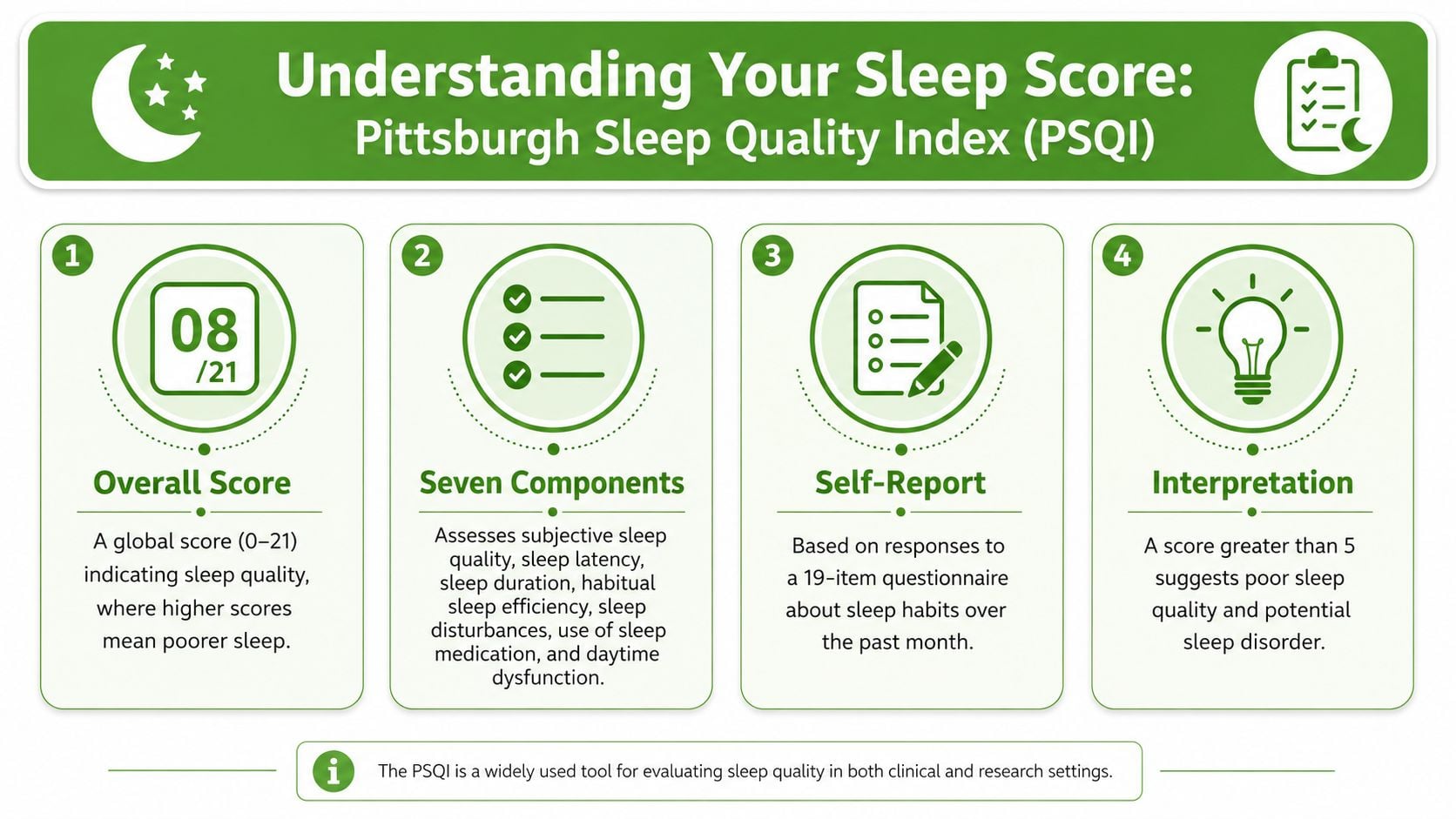
How the PSQI works
The PSQI was developed in 1989 at the University of Pittsburgh and has been cited in over 34,000 peer-reviewed articles. It uses 19 self-reported items to assess sleep over the prior month across seven components, with each component scored from 0 to 3 and the total score ranging from 0 to 21. A score greater than 5 suggests significant sleep difficulties (University of Pittsburgh PSQI overview).
The seven components are:
- Subjective sleep quality
- Sleep latency
- Sleep duration
- Habitual sleep efficiency
- Sleep disturbances
- Sleep medication use
- Daytime dysfunction
That list matters because sleep quality is rarely just one thing. A patient may sleep long enough but take too long to fall asleep. Another may fall asleep quickly but have disturbed, inefficient sleep with poor daytime function.
What the score means in real life
A PSQI score is not a diagnosis by itself. It's a structured summary of how sleep has been going.
For a TMJ or facial pain patient, a high score often fits the lived experience: restless nights, nonrestorative sleep, daytime fog, and mornings that begin with soreness instead of relief. It helps validate that the complaint is measurable, not vague or exaggerated.
Here's how I usually frame it:
- Low score means sleep complaints are less pronounced on that measure.
- Higher score means sleep difficulties are broader or more persistent.
- Change over time matters. If treatment helps, the score should move in the right direction along with symptoms.
Why scoring helps treatment decisions
Scoring tools are useful because they let us compare your starting point with your follow-up. If we address airway stability, clenching triggers, breathing mechanics, sleep habits, or pain drivers, we want to know whether your sleep quality changed in a meaningful way.
Another common measure looks at daytime sleepiness rather than nighttime sleep quality. That matters because some patients underreport fatigue until they realize how much effort it takes to stay alert in meetings, while driving, or in the late afternoon.
A sleep score is not a label. It's a baseline. Good care uses it to track progress, not to reduce you to a number.
Making Sense of the Results From Your Sleep Test
A sleep report can feel technical fast. Patients see terms such as arousals, oxygen drops, respiratory events, and sleep stages, then wonder what any of that has to do with jaw pain or morning headaches.
The key is translation. Test results matter because they explain symptoms you already feel.
When breathing disruption shows up as pain and fatigue
If a study shows repeated breathing disturbances, that means the body is being pulled out of deeper sleep over and over. Sometimes the brain wakes fully enough for you to remember it. Often it doesn't. You wake unrefreshed.
That pattern can line up with:
- Morning headaches
- Dry mouth
- Jaw clenching or bracing
- Neck and facial muscle soreness
- Daytime brain fog
- Irritability and poor concentration
Patients with milder or harder-to-detect breathing problems sometimes fit the pattern of upper airway resistance syndrome. In those cases, the complaint may not be “I stop breathing.” It may be “I sleep, but I never feel recovered.”
Why TMJ patients should pay attention to arousals
Arousal means your sleep is being interrupted. You may not remember it, but your nervous system does.
When that happens repeatedly, the body may spend the night in a more guarded state. In some people, that's where clenching, grinding, and facial muscle overuse become part of the picture. The jaw isn't always the starting problem. Sometimes it's responding to unstable sleep and breathing.
What results actually change care
Not every abnormality leads to the same treatment. That's why interpretation matters more than receiving a report alone.
A useful sleep quality assessment helps answer questions like:
- Is this primarily a breathing issue?
- Is the sleep fragmented without obvious apnea?
- Are the jaw and facial muscles reacting to poor sleep, or driving part of the problem themselves?
- Do we need to look beyond sleep hygiene and evaluate the airway, bite, oral posture, or nasal breathing?
For some patients, the most important outcome of testing is not the label. It's relief. Relief that there is a coherent explanation for years of morning pain, fatigue, or poor-quality sleep.
Recognizing Red Flags and When to See a Specialist
Some sleep complaints are frustrating but mild. Others deserve prompt medical attention, especially when they overlap with jaw pain, headaches, and airway symptoms.

Signs I don't want patients to ignore
If any of these sound familiar, it's time to move beyond general advice and get evaluated:
- Loud persistent snoring especially if a bed partner notices pauses, choking, or gasping
- Morning headaches that happen often or feel tied to poor sleep
- Severe daytime sleepiness including dozing off unintentionally
- Waking with jaw pain or facial tension on a regular basis
- Dry mouth on waking which often points to mouth breathing
- Repeated awakenings with a sense of panic, air hunger, or a racing heart
- Tooth wear, clenching, or grinding that keeps progressing despite a night guard
- Restless, unrefreshing sleep even when time in bed seems adequate
A major reason not to delay is that poor sleep can reflect something undiagnosed. One study of an at-risk population found that 30% of participants qualified for untreated sleep apnea, which is a strong reminder that sleep assessment is often a diagnostic step, not just a wellness exercise (discussion of untreated sleep apnea in an at-risk group).
Why “just try to relax” is not enough
Patients with TMJ pain often hear advice that targets only stress reduction or basic sleep hygiene. That advice isn't useless. It's just incomplete when the airway is unstable or a breathing disorder is present.
If the issue is disordered breathing, then meditation, a new pillow, or a magnesium supplement won't solve the whole problem. They may help around the edges. They won't correct the root cause.
This short video gives a helpful overview of warning signs worth taking seriously:
If you snore, clench, wake with headaches, and still feel exhausted, assume the symptoms are connected until proven otherwise.
Your Next Steps Toward Restorative Sleep
The next step doesn't have to be dramatic. It just needs to be deliberate.

Start with a quick personal check. If you have several of the following, a formal sleep quality assessment is worth discussing:
- You wake unrefreshed even after what seems like enough time in bed
- Your jaw, temples, or face hurt in the morning
- Someone reports snoring or breathing pauses
- You wake with dry mouth or a headache
- You feel sleepy, foggy, or irritable during the day
Then gather a few basics before your visit:
- Bring a symptom timeline with when the fatigue, TMJ pain, or headaches are worst
- List what you notice on waking because morning clues are often the most useful
- Ask your bed partner what they see and hear if anyone shares your room
- Bring prior sleep testing if you've had any
- Note what you've already tried such as mouth guards, nasal strips, apps, supplements, or bedtime routine changes
Some people also benefit from practical home habit changes while they pursue evaluation. If you want a general wellness resource, Groen's Fine Furniture guide on sleep is a reasonable starting point for environmental and routine factors. For a more clinical look at habit-based strategies, this page on how to improve sleep quality naturally can help you think through next steps.
When the pattern points to airway-related sleep disruption, a clinic such as Pain and Sleep Therapy Center may evaluate breathing, TMJ mechanics, oral posture, and sleep-related symptoms together, then match treatment to the findings. That might include oral appliance therapy, myofunctional therapy, breathing retraining, or other non-surgical options, depending on the problem identified.
If your sleep leaves you tired, sore, headachy, or clenched no matter how hard you try to “sleep better,” it's time for answers. Schedule an evaluation with Pain and Sleep Therapy Center to look at the full picture of your sleep, airway, and jaw function so treatment can target the cause, not just the symptoms.