
A sudden bolt of pain across the cheek can make ordinary life feel unsafe. You try to eat, speak, brush your teeth, or even rest your face on a pillow, and now every small movement seems suspicious. For many people, the hardest part isn't only the pain itself. It's not knowing whether they're dealing with a nerve problem, a jaw problem, or something in between.
That uncertainty is common with trigeminal neuralgia and TMJ disorder. Both can affect the same general region of the face. Both can disrupt sleep, eating, concentration, and mood. Both are often described with words like severe, frustrating, and hard to explain. But they are not the same condition, and the right next step depends on telling them apart carefully.
The Challenge of Identifying Your Facial Pain
When patients search for trigeminal neuralgia vs TMJ, they're usually trying to answer a practical question. "What is this pain, and who can help me?" That question matters because these conditions call for very different evaluations and very different treatments.
One pattern tends to point toward a neuropathic pain disorder. The other usually points toward a musculoskeletal and joint disorder. The pain may seem to come from the same area of the face, but the underlying driver can be entirely different.
A lot of confusion starts with location. People assume that pain in the jaw must be TMJ, or that any severe facial pain must be trigeminal neuralgia. In practice, clinicians have to look at the full pain behavior. We look at what it feels like, how long it lasts, what sets it off, whether the pain is one-sided or more diffuse, and whether jaw mechanics are part of the picture.
Severe facial pain shouldn't be guessed at from location alone. Pattern matters more than pinning a finger to one sore spot.
A useful way to think about it is this:
- If the pain acts like a nerve misfire, the diagnosis may move toward trigeminal neuralgia.
- If the pain acts like an overloaded joint and muscle system, TMJ disorder becomes more likely.
- If the story is mixed, the workup has to stay broad until the cause is clear.
That gray zone is why rushed labeling often leads people in the wrong direction. Some are treated for jaw dysfunction when the primary issue is nerve-related. Others are told they have trigeminal neuralgia when their jaw muscles and joint mechanics are driving much of the pain.
Clarity usually comes from a disciplined differential diagnosis, not from one symptom in isolation.
Symptom Profiles Trigeminal Neuralgia vs TMJ
A patient may point to the same cheek, jaw, or temple and describe two very different pain disorders. That is why symptom pattern matters more than pain location alone. In clinic, I listen for how the pain behaves over time, what provokes it, and whether the jaw itself shows signs of strain or dysfunction.
| Feature | Trigeminal Neuralgia | TMJ Disorder |
|---|---|---|
| Pain quality | Sharp, stabbing, electric-shock-like | Dull, aching, pressure-like, muscular or joint-based |
| Pain timing | Brief, sudden attacks that recur | More continuous or lingering discomfort |
| Pain side | Usually one side of the face | Often felt on both sides or across jaw and temples |
| Typical triggers | Light touch, chewing, speaking, brushing, gentle facial contact | Prolonged jaw use, clenching, chewing strain, yawning |
| Common associated signs | Trigger zones without mechanical jaw findings | Jaw stiffness, clicking, popping, locking, limited opening |
Pain type
The first question is usually simple. What does the pain feel like?
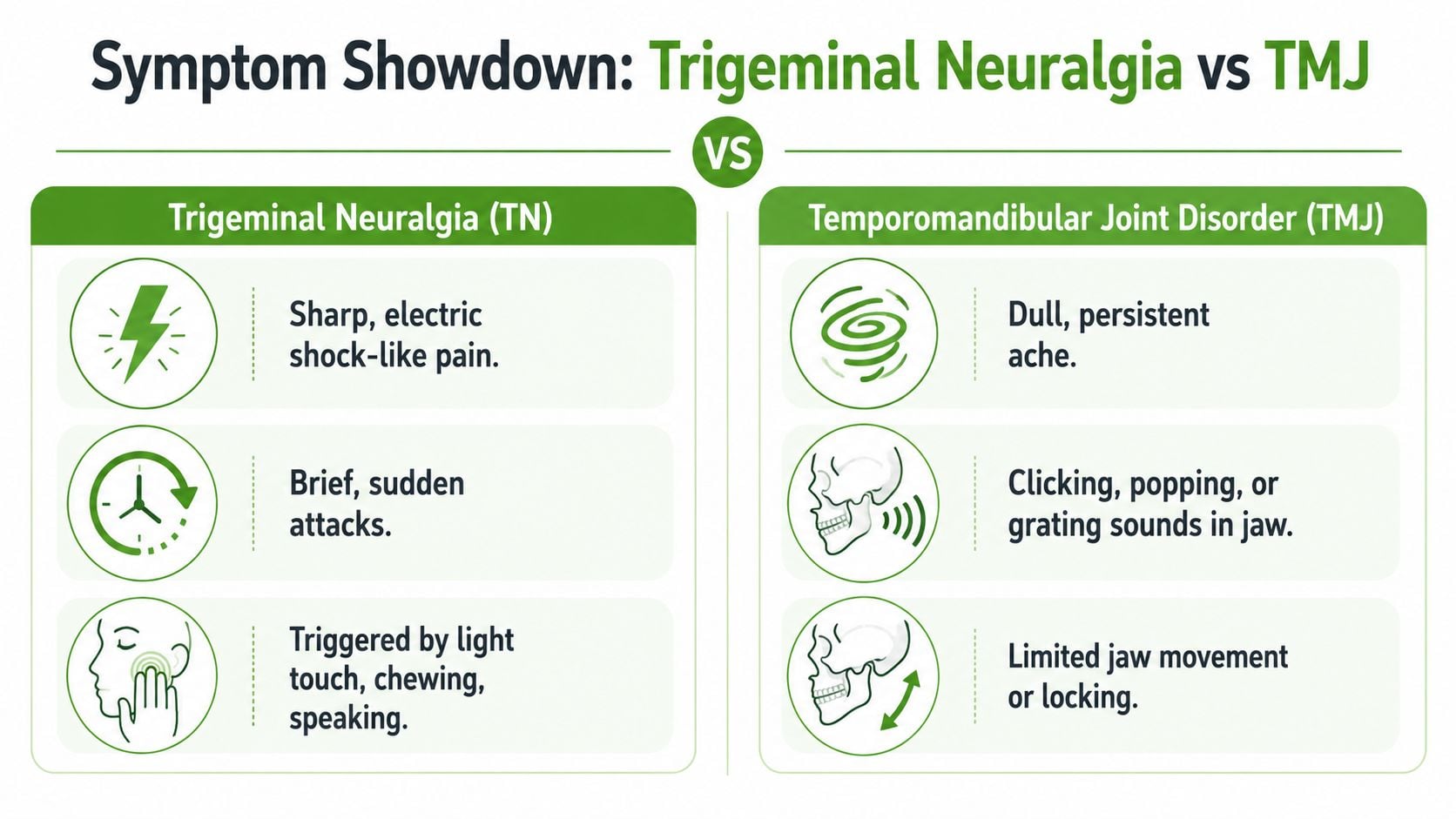
Trigeminal neuralgia tends to cause sudden, severe bursts of pain described as electric, stabbing, or shock-like. TMJ disorder more often feels sore, tight, heavy, fatigued, or pressure-based. Patients trying to distinguish between trigeminal neuralgia and TMJ are usually describing this difference, even if they do not have the language for it yet.
That distinction matters because it changes the workup. Electric, shock-like pain raises concern for a nerve disorder. A pain pattern that builds with jaw use points more toward muscles, joints, bite forces, clenching, or related strain.
Clinical clue: “It feels like a lightning bolt” and “my jaw gets more sore the more I use it” are not minor wording differences. They point us down different diagnostic paths.
Pain distribution
Trigeminal neuralgia is usually felt on one side of the face and often follows a nerve distribution. TMJ pain is more likely to spread across the jaw muscles, temples, around the joint in front of the ear, or both sides of the face.
The gray area is real. Some patients with TMJ disorder feel pain mainly on one side. Some with trigeminal neuralgia also guard the jaw and develop secondary muscle pain because they are trying not to trigger another attack. That is one reason specialist centers do not rely on a single symptom or a quick label. We examine the full pattern and place it in a broader framework for modern patient care, especially when nerve pain, muscle pain, sleep bracing, and stress reactivity overlap.
If you are sorting through a wider list of possibilities, this guide on what causes facial pain gives helpful context before a formal exam.
Triggers and time course
The timing of the pain often separates these conditions faster than location does.
Trigeminal neuralgia usually comes in short attacks. A light touch, brushing the teeth, speaking, chewing, or even a breeze across the face may trigger a sudden burst. Between episodes, some patients feel normal, while others remain anxious about provoking the next one.
TMJ pain usually behaves differently. It tends to build with talking, chewing, clenching, yawning, poor sleep, or a long day of jaw use. Patients often report stiffness, popping, catching, or a tired feeling in the face, especially later in the day or on waking if sleep-related clenching is part of the picture.
A practical way to separate them is this. Trigeminal neuralgia is often fast and explosive. TMJ disorder is often cumulative and mechanically aggravated.
Associated signs that help sort the diagnosis
Jaw findings matter. Clicking, popping, restricted opening, deviation on opening, morning jaw fatigue, and tenderness in the chewing muscles all make TMJ disorder more likely. Trigeminal neuralgia, by contrast, may produce intense pain without obvious joint noise or major limitation in jaw motion.
A careful exam prevents detours in care. If the history sounds neuropathic but the exam shows strong mechanical provocation of the joint and muscles, both issues may need attention. At Pain and Sleep Therapy Center, that mixed presentation is common enough that we approach it as a differential diagnosis problem first, not a one-condition assumption.
The goal is not to force your symptoms into one category too early. The goal is to identify the dominant pain mechanism so treatment starts in the right place.
Understanding the Root Cause of Your Pain
The reason trigeminal neuralgia vs TMJ can be confusing is that the face is a crowded neighborhood. Nerves, joints, teeth, muscles, bite forces, breathing patterns, and sleep-related clenching can all influence what you feel.

Trigeminal neuralgia as a nerve problem
Trigeminal neuralgia is primarily a nerve-based disorder. A practical analogy is faulty insulation on a wire. When the trigeminal nerve becomes irritated, compressed, or otherwise sensitized, the signal can misfire. The result is pain that feels out of proportion to the trigger because the problem is in the nerve signaling itself, not in the amount of force applied.
That matters because nerve pain doesn't respond well to treatments aimed only at joint alignment or muscle tension. A night guard alone won't calm an actively misfiring sensory nerve if the core issue is neurological.
TMJ disorder as a joint and muscle problem
TMJ disorder is different. Think of it more like a strained door hinge with surrounding cables under tension. The temporomandibular joint, disc, bite relationships, chewing muscles, oral posture, airway influences, and parafunctional habits can all contribute to overload.
In that setting, the pain often reflects movement, tension, compression, inflammation, guarding, or poor coordination. The treatment target isn't the same. Instead of quieting an unstable nerve, clinicians may need to improve jaw mechanics, reduce muscle overload, change oral habits, support better breathing patterns, or address clenching behavior.
For patients whose facial pain doesn't fit a simple category, it's often useful to review how clinicians approach atypical facial pain treatment when symptoms cross categories.
Why a whole-person view matters
Pain in the face doesn't exist in a vacuum. Sleep disruption, stress reactivity, breathing dysfunction, postural habits, and muscle guarding can amplify symptoms even when they aren't the primary cause. That's one reason many specialists use a framework for modern patient care that considers biological, behavioral, and functional contributors instead of reducing every case to a single structure.
This short overview helps visualize the nerve side of the equation:
The key is not to force every patient into one box too early. Some present with a textbook pattern. Others don't. Good diagnostic work stays open long enough to identify the actual driver.
The Path to a Clear Diagnosis
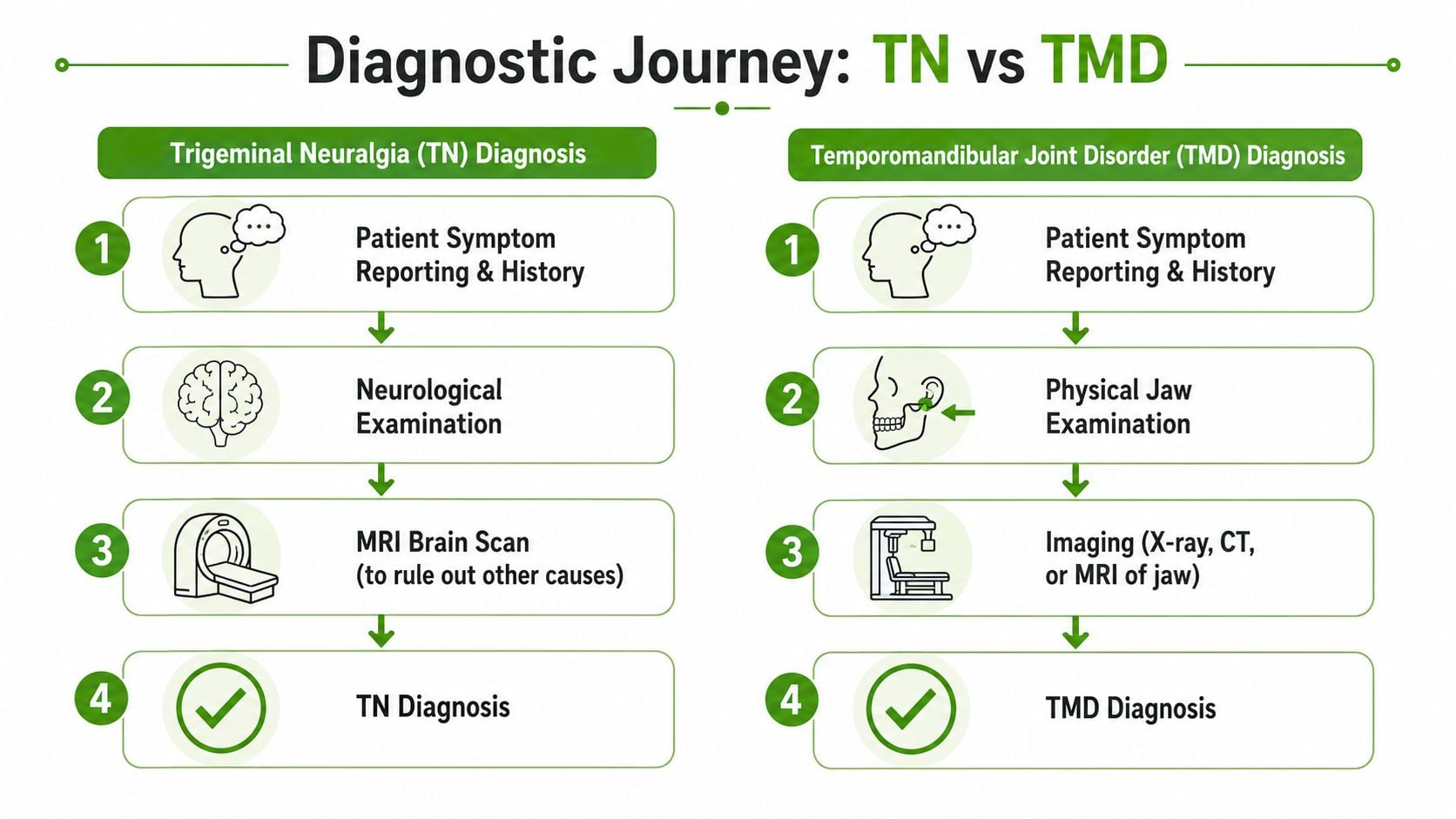
A proper diagnosis starts with disciplined listening. Before any imaging is ordered, the clinician needs the pain story in plain language. What does it feel like. How long does an episode last. Is it always on one side. Does a light touch trigger it. Does chewing fatigue the jaw. Does the jaw click, catch, or lock.
That history often narrows the field quickly, but it shouldn't be the end of the process.
What the TN workup looks for
When trigeminal neuralgia is suspected, the diagnostic benchmark is different from a jaw disorder workup. According to this clinical overview of TN and TMJ diagnosis, TN evaluation relies on detecting neurovascular compression through high-resolution MRI and may also involve nerve conduction studies to identify superior cerebellar artery impingement causing demyelination.
A neurological exam also matters. Clinicians look for sensory changes, pain distribution, trigger patterns, and features that might suggest a secondary cause rather than a classic primary TN presentation.
What the TMJ workup looks for
TMJ diagnosis follows a more mechanical pathway. The same clinical overview notes that TMJ evaluation uses bite analysis, jaw imaging such as CT or MRI of the joint, and physical assessment of muscle strain involving the masseter, temporalis, and lateral pterygoid.
That exam is hands-on and functional. It often includes:
- Jaw range of motion: How far the mouth opens, whether the opening path deviates, and whether motion is smooth.
- Joint sounds: Clicking, popping, crepitus, or episodes of locking.
- Muscle palpation: Tenderness and overload in chewing muscles and related head and neck structures.
- Load response: Whether symptoms worsen with chewing, clenching, resisted movement, or prolonged talking.
Where the gray areas show up
Some patients don't read like a textbook. They may have jaw pain plus sudden flares. They may have trigger sensitivity plus clear signs of clenching and muscle overload. They may have an old TMJ problem and a newer neuropathic pain process layered on top.
A diagnosis shouldn't be awarded to the loudest symptom. It should fit the entire clinical pattern.
This is why multidisciplinary thinking matters. A clinician who only thinks in dental terms may miss a nerve disorder. A clinician who only thinks in neurological terms may miss a major mechanical driver in the jaw system. The most useful assessments rule in what fits and rule out what doesn't.
When the workup is done well, the patient usually leaves with something more valuable than a label. They leave with a treatment direction that matches the cause.
Comparing Treatment Pathways for Lasting Relief
A common pattern in clinic looks like this: someone has spent months treating the wrong problem with reasonable care, yet the pain keeps winning. That usually happens when the treatment plan follows the symptom label instead of the pain mechanism.
For trigeminal neuralgia, the main goal is to reduce abnormal nerve firing. First-line care often starts with anticonvulsant medication, such as carbamazepine or oxcarbazepine. If the history, examination, or imaging raises concern for a secondary cause, treatment has to address that driver as well, which may involve neurology, neurosurgery, or both. In practice, medication response, side effects, age, imaging findings, and pattern of pain all influence the next step.

TMJ treatment follows a different logic. The target is mechanical strain, joint irritation, muscle overload, or a combination of those factors. Care often includes physical therapy, a well-designed oral appliance when indicated, behavior change around clenching or bracing, and selective use of injections for the joint or masticatory muscles. If airway issues, sleep-related grinding, tongue posture, or cervical dysfunction are feeding the problem, those pieces need attention too or progress tends to stall.
At a center that focuses on orofacial pain, treatment is rarely one-size-fits-all. A patient with joint loading and muscle guarding may need jaw rehabilitation and habit retraining. A patient with classic electric-shock attacks may need a neurology-based pathway first. A patient with both can need coordinated care across disciplines. That gray zone is exactly why many patients benefit from evaluation by an orofacial pain specialist who can sort out whether the main driver is neuropathic, musculoskeletal, or mixed.
Here is the trade-off patients deserve to understand. Nerve pain treatment can reduce attacks but does not restore a strained jaw system. TMJ therapy can improve movement and reduce overload but will not calm a hyperexcitable trigeminal nerve if that is the primary source.
Mismatch keeps people stuck.
Someone with true trigeminal neuralgia may go through bite changes, soft foods, massage, and splints with little improvement because the nerve remains the source of the severe flares. Someone with a mechanical TMJ disorder may be given medication alone and still deal with clicking, fatigue, stiffness, and chewing pain because the jaw never gets rehabilitated.
The most durable relief usually comes from matching the plan to the diagnosis, then adjusting it as the response becomes clearer. In facial pain care, precision matters more than trying more treatments.
When to Consult a Facial Pain Specialist
Some facial pain can be monitored briefly. Some shouldn't wait. If the pain is severe, disruptive, or hard to classify, specialist evaluation is usually the most efficient step.
A few scenarios deserve prompt attention:
- Electric-shock facial pain: Especially when episodes are triggered by light touch, brushing, chewing, or speaking.
- Jaw locking or major limitation: If opening, chewing, or normal jaw movement is becoming difficult.
- Pain that keeps shifting labels: You've been told it's sinus, dental, TMJ, or nerve pain, but nothing has clearly fit.
- Treatment that hasn't matched the result: You've tried standard TMJ care or medication and the response doesn't make sense.
- Mixed symptoms: You have both sudden facial flares and clear jaw dysfunction signs.
A facial pain specialist can sort through overlapping symptoms with a broader lens. That includes the teeth, jaw joints, muscles, bite behavior, breathing pattern, sleep-related clenching, and neuropathic pain features. In complicated cases, that kind of full-system evaluation is often what finally separates a surface symptom from the actual driver.
If you're looking for the right type of clinician, this guide to an orofacial pain specialist explains what that role includes and when it makes sense to seek one out.
The practical goal is simple. Get the right diagnosis early enough that treatment can be specific, not scattered.
Your Facial Pain Questions Answered
Can someone have both TMJ disorder and trigeminal neuralgia
Yes, that can happen. A person may have an underlying jaw disorder and also develop a nerve-based pain condition, or one condition may make the other harder to recognize. That's why a mixed symptom pattern deserves a careful exam instead of a quick label.
My pain feels like a mix of both. What should I do
Track the pattern before your appointment. Note whether the pain is one-sided or more widespread, whether it comes in bursts or lingers, what triggers it, and whether jaw clicking, stiffness, or locking is part of the picture. That history helps the clinician decide whether the problem is primarily neuropathic, mechanical, or overlapping.
Why did my previous TMJ treatment fail
Failure doesn't always mean the treatment was poorly delivered. Sometimes the diagnosis was incomplete. A splint, exercises, or joint-focused care won't solve a nerve disorder. On the other hand, medication alone may not fix a jaw system that remains overloaded by clenching, poor mechanics, or dysfunctional muscle patterns.
Does severe pain always mean trigeminal neuralgia
No. TMJ disorders can be very painful, especially when the joint is inflamed or the muscles are in prolonged spasm. Severity alone doesn't separate the two. The timing, trigger pattern, associated jaw findings, and diagnostic exam carry much more weight.
If you're dealing with persistent facial pain, jaw dysfunction, or symptoms that don't fit neatly into one category, Pain and Sleep Therapy Center offers thorough evaluation for TMJ disorders, orofacial pain, and related airway and sleep factors. Their multidisciplinary approach is designed to identify the root cause, clarify confusing symptom patterns, and help patients move toward targeted relief instead of more guesswork.