You may be in that frustrating middle stage of recovery right now. You can start the movement, but you can't quite finish it. Your arm lifts partway after surgery, then stalls. Your jaw begins to open, then pain or tightness stops it. You're trying, but your body needs a little help.
That's where active assistive range of motion can make recovery feel possible again. It gives you support without taking over the movement. For people with TMJ symptoms, facial tension, or post-surgical stiffness, that distinction matters. Too much force can irritate sensitive tissues. Too little support can leave you stuck in the same limited pattern.
Used well, this kind of exercise helps you move in a safer, smarter way. It can teach your muscles and nervous system how to work together again, especially when pain has started to interfere with normal motion.
What Is Active Assistive Range of Motion
A simple way to understand active assistive range of motion is to think of it as a helping hand during movement.
You're not completely relaxed while someone else moves you. You're also not expected to do the whole motion alone. Instead, you begin the movement yourself, and then a therapist, a tool, or another body part gives just enough help to complete it.
That's often exactly what a person needs after an injury, surgery, or pain flare. You may have enough strength or control to get started, but not enough to move smoothly through the full, comfortable range. In jaw rehab, this can happen when the muscles try to protect an irritated joint. In shoulder rehab, it often shows up when the arm feels weak or heavy halfway through a lift.
What it feels like in real life
If your jaw has been sore for weeks, opening your mouth for a meal may feel uncertain. You might get partway open, then feel a quick warning from the joint or surrounding muscles. A gentle assist, done correctly, can help you practice the motion without forcing the area.
The same idea applies outside the face and jaw. After a shoulder procedure, many people can start lifting the arm but can't finish the movement without compensation, strain, or discomfort. A dowel, pulley, towel, or therapist's hand can bridge that gap.
Active assistive range of motion is the middle ground between doing nothing and doing too much.
Why this matters for recovery
This approach is useful because it keeps you involved. Your muscles still activate. Your brain still practices the movement. But the assistance reduces the load enough that the motion can happen more cleanly and with less guarding.
That's especially important in regions that are sensitive and easy to overprotect, like the jaw, tongue, neck, and facial muscles. If you're exploring broader rehabilitation for breathing, swallowing, and oral posture, orofacial myofunctional therapy often connects closely with how assisted movement is used in this area.
AAROM vs Passive and Active Range of Motion
People often hear three similar terms and assume they mean the same thing. They don't. The difference matters because each one asks something different of your body.
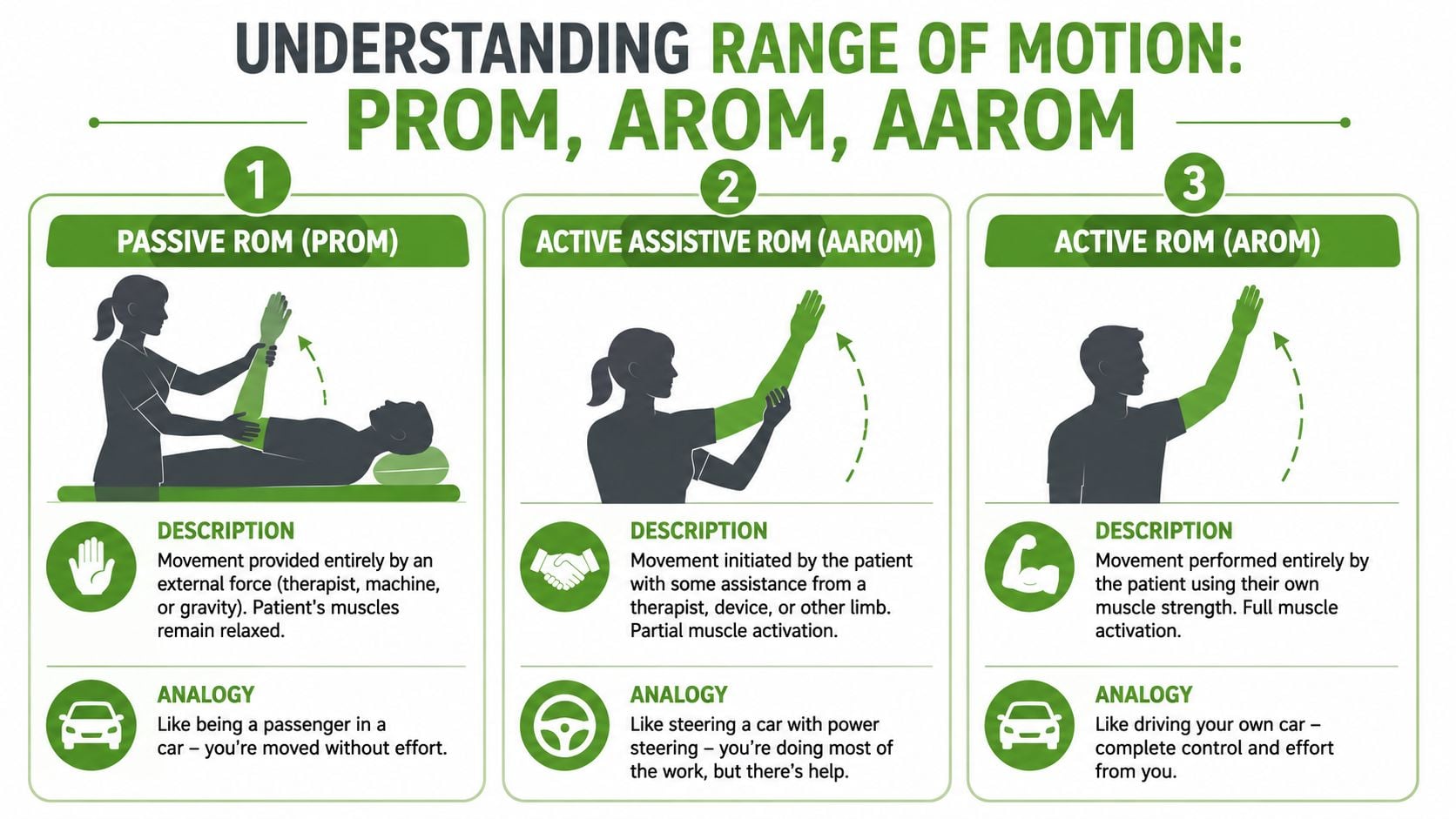
Three types of movement help
Think of range of motion like traveling from one point to another.
| Type | Who does the work | What it means |
|---|---|---|
| Passive ROM | External force only | Someone or something moves you |
| Active assistive ROM | You start, help finishes | You do part of the work |
| Active ROM | You alone | Your muscles complete the motion independently |
Passive range of motion
With passive range of motion, your muscles stay relaxed while an outside force moves the joint. That outside force might be a therapist, a machine, gravity, or your other hand.
This is useful when you can't safely participate much yet. Maybe the area is too weak, too painful, or under early protection. Passive motion helps maintain mobility, but it doesn't ask your muscles to lead.
It's like riding in the passenger seat. You're being moved, but you're not controlling the drive.
Active range of motion
With active range of motion, you perform the full movement yourself. No one lifts the limb for you. No device gives extra support. Your muscles generate the motion from start to finish.
That's the goal in many rehab programs, but it may not be the right starting point. If your muscles aren't ready, or pain interrupts the motion early, active movement alone can become sloppy, guarded, or frustrating.
This is like driving your own car. You're in charge of the entire trip.
Active assistive range of motion
Active assistive range of motion sits in the middle. You begin the movement. Then help is added only as needed.
Definition: Active assistive range of motion is movement initiated by the patient with partial help from a therapist, device, or another body part so the motion can be completed more effectively.
This is often the best fit when a muscle can contribute, but can't yet do the full job. According to Connecticut clinical range of motion guidelines, AAROM is specifically indicated for muscle weakness graded as “poor to fair minus” on manual muscle testing, and protocols specify 5 repetitions per exercise set to avoid over-fatiguing weakened muscles.
Why patients get confused
A lot of people think assistance means they're failing or “cheating.” It isn't. The point is to match the exercise to what your body can do today.
AAROM is often the best option when:
- You can initiate movement but can't complete the range well.
- Pain changes your motion pattern and makes you stop early.
- You compensate by shrugging, clenching, or twisting.
- You need practice without overload so your system can relearn the motion.
For jaw and facial rehab, that middle category is especially important. A person may be able to open slightly, but not enough to chew, yawn, or speak comfortably. Help has to be precise, not forceful.
Clinical Indications for AAROM Therapy
AAROM shows up in many rehab settings because a lot of people don't fit neatly into “can't move” or “can move normally.” They're somewhere in between.
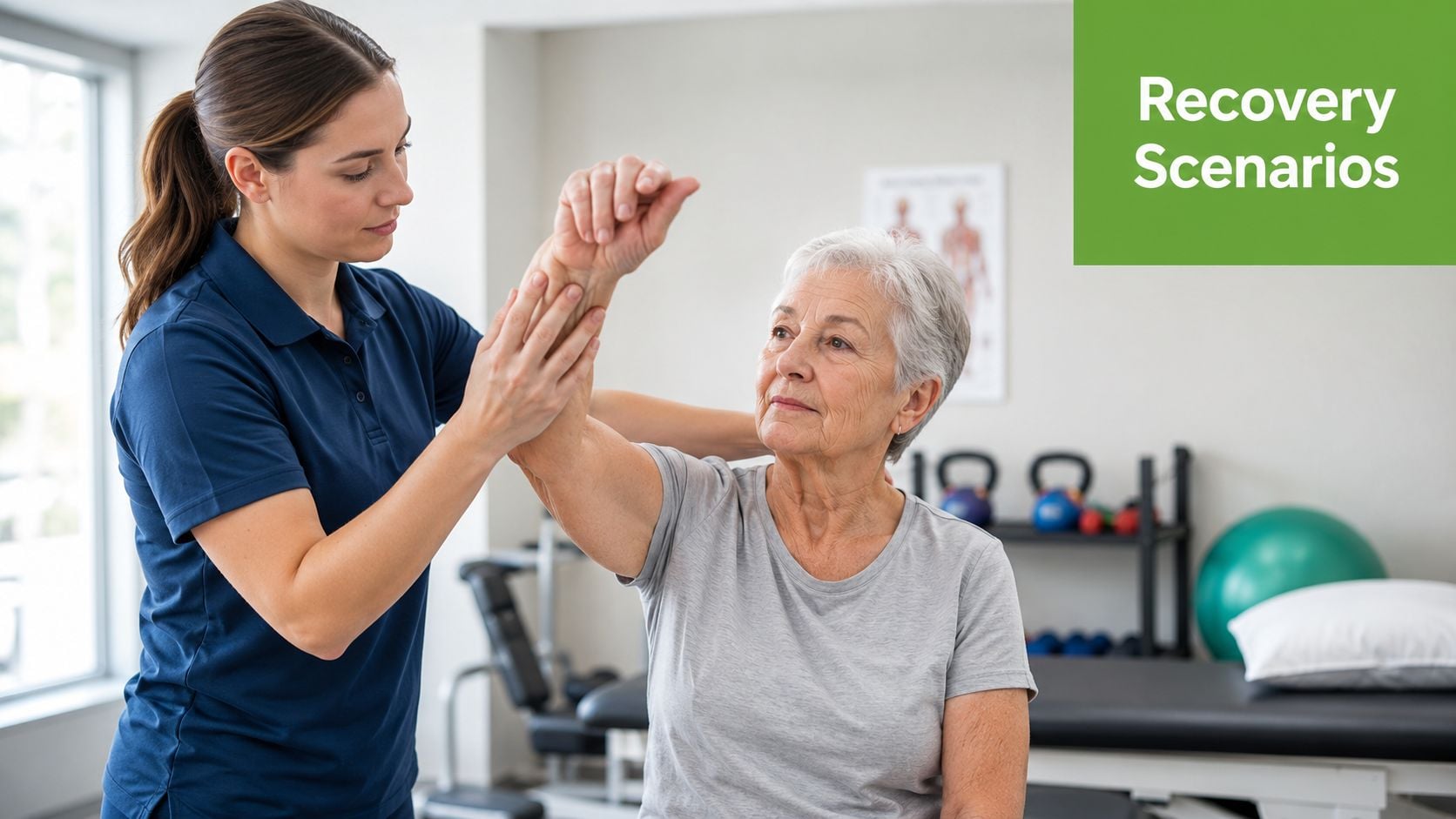
When clinicians commonly use it
A therapist may choose active assistive range of motion when movement is available, but limited by weakness, poor motor control, post-surgical caution, or pain. That can include:
- After surgery when a joint needs gentle movement before full strengthening
- After a flare of joint pain when stiffness builds quickly
- During neurologic recovery when the brain and muscles are reconnecting
- In early shoulder or knee rehab when the person can help, but not fully lift against gravity
- In jaw rehabilitation when pain and guarding interrupt a normal opening pattern
In more general orthopedic cases, people sometimes benefit from education that overlaps with other movement conditions. For example, BionicGym's exercise guide for arthritis offers practical context on joint-friendly exercise thinking, especially for readers trying to understand how support and pacing fit into painful movement.
Where TMJ rehab needs extra precision
Jaw pain changes the rules a bit.
A shoulder can often tolerate broad, visible movement testing. The jaw is smaller, more reactive, and tied closely to chewing, swallowing, breathing, and speaking. A person with TMJ symptoms may stop opening not because the muscles are solely weak, but because pain signals appear first and the body protects the joint.
That's why the distinction between the pain threshold angle and the functional assistive angle matters. As described in this range of motion resource, the pain threshold angle is the point where pain stops voluntary movement, while the functional assistive angle is the range where external help should be applied. If force goes beyond the pain threshold, the body may react with protective muscle guarding. If assistance stays inside the pain-free arc, it supports neuromuscular re-education without feeding a pain-spasm cycle.
For TMJ and facial pain, more force isn't better. Better timing is better.
Who tends to benefit most
AAROM often makes sense when a patient says things like:
- “I can start the motion, but then it catches.”
- “It doesn't feel blocked exactly. It just won't go farther comfortably.”
- “If I push harder, the muscles tighten up.”
- “I can do it with a little support, but not on my own yet.”
Those are useful clues. They suggest the body may need a graded assist, not a hard stretch.
Benefits and Contraindications of AAROM
AAROM can be a very effective tool, but only when it fits the problem in front of you. It's not something to force through every painful movement.
Why it helps
One of the biggest benefits is that it keeps movement active enough to retrain the system. You're not just being moved around. Your muscles are still participating, and your brain is still practicing the pattern.
That matters because recovery isn't only about flexibility. It's also about timing, coordination, confidence, and reducing protective habits like clenching, shrugging, or bracing.
AAROM may help by:
- Reducing stiffness through gentle repeated motion
- Supporting cleaner movement patterns when full strength isn't there yet
- Improving body awareness so you notice when you're substituting
- Building confidence because the movement becomes possible again
- Creating a bridge to independence instead of leaving you stuck between rest and overload
For jaw patients, there's often another emotional benefit. Painful opening can feel unpredictable. A carefully assisted motion can make the jaw feel less threatening, which helps people stop fighting every movement.
AAROM works best when the assistance is small, specific, and temporary.
When it should be modified or avoided
Not every painful or limited joint is ready for active assistive work. Timing matters. Tissue irritability matters. The reason for the restriction matters.
Be cautious and get professional guidance if:
- Pain is sharp, shooting, or escalating rather than mild and controlled
- The joint feels unstable or recently injured in a way that hasn't been evaluated
- Inflammation is highly reactive and even small movements cause a flare
- The jaw locks, shifts abruptly, or clicks with pain
- You're pushing to “gain range” by forcing through symptoms
AAROM also needs to stay within the plan set by the treating clinician after surgery or acute injury. The wrong exercise at the wrong time can irritate healing tissue, even if the exercise itself is normally useful.
A simple safety check
Before and after the motion, ask yourself:
- Did the movement feel controlled?
- Did I stay out of a sharp pain response?
- Did the area settle afterward, or did it tighten more?
If the answer to that third question is no, the exercise may need less range, less assistance, less frequency, or a different approach entirely.
Sample AAROM Exercises and How to Progress
The best AAROM exercise is one that matches your current limit without provoking a flare. The examples below show the principle, not a one-size-fits-all prescription.
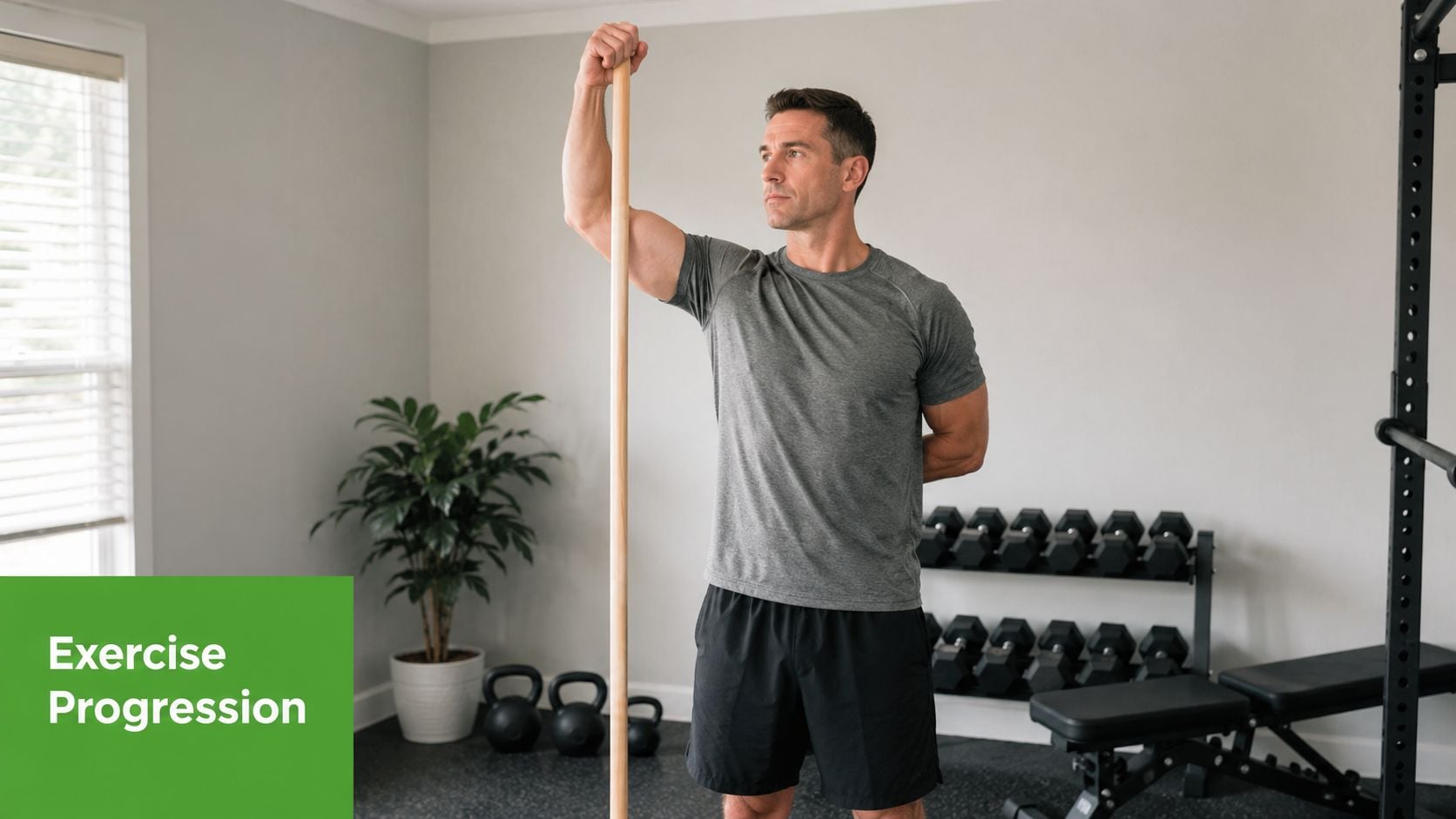
Example one with a shoulder dowel assist
This is a common orthopedic AAROM exercise for shoulder flexion.
How to do it
- Lie on your back or sit upright with a dowel, cane, or broomstick in both hands.
- Keep your affected arm relaxed but participating.
- Use the stronger arm to help guide both arms upward.
- Stop before you hit a pinch, shrug, or protective tightening.
- Lower slowly with control.
What matters most isn't how high the arm goes. What matters is that the motion stays smooth and doesn't turn into a neck or upper trap workout.
If shoulder and neck tension travel together for you, a resource on effective neck pain stretches can be helpful alongside guided rehab, because many people compensate through the neck when the shoulder isn't moving well.
Example two with guided jaw opening
Jaw AAROM has to be lighter and more precise than many body exercises.
A gentle version might look like this:
- Sit upright with your tongue relaxed and shoulders down.
- Begin opening your mouth slowly on your own.
- When you feel the point where the motion wants to stop, use a very light assist from your fingers, or follow a therapist's guidance, only within a comfortable arc.
- Pause briefly in that supported range.
- Close with control, without dropping or snapping shut.
You shouldn't feel a forceful stretch. You also shouldn't feel that you have to “win” against the joint. The purpose is to teach comfortable movement, not to overpower resistance.
For readers working on the connection between jaw and neck function, these jaw and neck exercises offer related support strategies.
What progression actually looks like
Many handouts tell people to repeat AAROM regularly, but they often stop there. That leaves patients wondering when to keep assisting, when to do less, and when to move on.
According to this CNA ROM training resource, many resources prescribe AAROM 2 to 3 times daily but don't explain a frequency-tapering plan as strength improves. That gap matters because the goal isn't to stay dependent on assistance. The goal is to transition to fully independent active range of motion without burnout or plateau.
Signs you may be ready for less help
A therapist often looks for patterns like these:
- You initiate and finish the motion with better control
- You need less external help to reach the same comfortable range
- You recover well after sessions without increased guarding
- You stop compensating with nearby muscles
- The movement starts to feel familiar instead of threatening
Here's a short demonstration video that helps show the general feel of assisted shoulder work:
A practical way to think about tapering
Progression usually isn't dramatic. It's subtle.
At first, the assist may guide a meaningful portion of the motion. Later, the assist becomes more of a backup. Then it becomes a check-in rather than a necessity. Eventually, the same motion is performed actively and independently.
The right time to reduce assistance is when your body can keep the motion clean without paying for it later.
That last part matters. Being able to perform a movement once isn't the same as being ready to progress. If your jaw tightens for hours afterward or your shoulder becomes more guarded later in the day, your system may still need support.
When to Seek Specialized Care for Your Recovery
Some movement problems respond well to simple home guidance. Others need a trained eye because the underlying issue isn't just stiffness.
Jaw and facial pain often fall into that second category. A person may think they need stretching, when the actual problem involves joint irritation, muscle guarding, airway factors, bite mechanics, neck tension, or a habit pattern that keeps re-triggering symptoms.

Signs that self-guided exercise may not be enough
It's time to get more specialized help if:
- Your pain keeps returning even when you're careful
- Your jaw clicks, locks, or deviates during opening
- You're unsure whether the limit is pain, weakness, or joint restriction
- Exercises make the area feel more guarded instead of more mobile
- Headaches, facial tension, snoring, or sleep issues show up with the jaw symptoms
That last group is easy to overlook. Jaw function doesn't live in isolation. It's connected to breathing, oral posture, sleep quality, and cervical muscle behavior.
Why specialization matters in TMJ and orofacial care
A general movement program may help some people, but complex jaw cases usually need more precise assessment. The clinician has to identify whether assistance should target motion, muscle coordination, pain-free control, or a broader pattern involving the airway and surrounding structures.
That's why seeing an orofacial pain specialist can change the course of recovery. The right plan doesn't just ask, “How far can you move?” It asks, “Why does the movement stop, and what happens if we push it?”
When progress stalls, the issue usually isn't effort. It's that the treatment target isn't specific enough.
A good recovery plan gives you more than exercises. It gives you the right exercise, in the right range, at the right stage of healing.
If jaw pain, facial tension, headaches, or sleep-related breathing problems are making recovery feel confusing, Pain and Sleep Therapy Center can help you find the root cause. Their team focuses on personalized care for TMJ disorders, orofacial pain, and related airway issues, so your treatment plan matches what your body needs.