
You wake up with a sore jaw again. By lunch, your temples ache. Dinner feels like work because chewing on one side is easier than chewing on both. Someone has already told you to “just wear a night guard,” but the clicking is still there, the headaches keep coming, and your sleep may be getting worse instead of better.
That pattern is common for people searching for a TMJ specialist in Raleigh, NC. The problem often doesn't stay limited to the jaw. It can show up as facial tension, neck pain, ear symptoms, broken sleep, clenching, or a sense that your bite never feels settled. Many people spend months, sometimes years, treating each symptom separately without anyone stepping back to ask why all of them started happening together.
TMJ disorders are rarely simple. Some cases are mostly muscle-driven. Others involve the joint itself, the bite, the airway, or damaged connective tissue that never healed correctly. If the diagnosis is shallow, the treatment usually is too. That's why temporary relief can feel so disappointing. You may get a little less pain for a while, but not a clear answer and not a durable plan.
Real progress starts when the provider looks for the root cause instead of chasing the loudest symptom. That means understanding how the jaw joints move, how the muscles compensate, whether the airway is involved, and whether the joint tissues are irritated, unstable, or worn down.
Introduction The Search for Jaw Pain Relief in Raleigh
In Raleigh, many patients start the same way. They mention popping near the ear, pressure in the face, or tension that seems to spread from the jaw into the head and neck. They've tried softer foods, over-the-counter pain relief, maybe a generic guard, and they still don't feel normal.
That frustration makes sense. TMJ pain is disruptive because it affects things you do all day without thinking. Talking, chewing, yawning, sleeping, even concentrating at work can become harder when your jaw muscles are overworking or the joint isn't tracking the way it should.
When simple fixes stop working
A basic night guard can protect teeth from grinding damage. It doesn't automatically diagnose why you're clenching, why the joint clicks, or why your headaches start in the morning. Pain medication can dull symptoms for a time, but it doesn't restore joint stability or improve poor breathing patterns during sleep.
Many patients aren't failing treatment. They're stuck in treatment that was never designed to answer the real problem.
That's the difference a specialist approach makes. Instead of asking only, “How do we reduce pain this week?” the better question is, “What is driving the pain cycle in the first place?”
Why specialization matters
A thorough TMJ evaluation looks beyond the jaw hinge itself. It considers muscle strain, joint loading, bite forces, posture, airway issues, and sleep quality. In a city the size of Raleigh, that level of detail matters because generic dental care and true orofacial pain care are not the same thing.
If you're looking for lasting relief, the right provider won't just hand you an appliance and hope for the best. They'll identify whether your symptoms are muscular, structural, airway-related, tissue-related, or some combination of all four. That clarity changes everything about treatment.
Recognizing the Hidden Signs of a TMJ Disorder
Jaw clicking gets the most attention, but it's often the least important symptom. Some people with loud clicking have little pain. Others have severe dysfunction with almost no noise at all. The more important question is whether your jaw system is under strain and pulling other parts of your body into that strain with it.

Symptoms that point directly to the jaw
Some signs are clearly local:
- Pain with chewing that gets worse later in the day
- Clicking, popping, or catching when opening or closing
- Jaw locking in an open or closed position
- Tender muscles along the cheeks or temples
- Limited opening or a bite that suddenly feels off
These are the symptoms commonly suspected of being TMJ-related. The missed cases are usually the ones with less obvious patterns. A more complete symptom overview can help you connect those dots, especially if your symptoms seem scattered across the head and neck, as described in this guide to signs of temporomandibular joint dysfunction.
Symptoms that don't look like TMJ at first
The jaw joints sit in a crowded neighborhood. They share muscular and neurologic relationships with the temples, ears, neck, tongue, and airway. When the jaw is overloaded, those nearby systems often react.
You may notice:
- Temple headaches that feel like tension or migraine triggers
- Ear fullness or ringing
- Neck and shoulder tightness
- Facial fatigue after talking or eating
- Poor sleep, especially if you clench or wake with soreness
Clinical clue: Morning jaw pain often means the problem isn't limited to daytime habits. It can point to nighttime clenching, poor airway support, or both.
One of the most overlooked links is sleep. Data from the American Academy of Sleep Medicine shows that 60% of adults with obstructive sleep apnea have concurrent TMJ disorders, and up to 40% of adults with chronic TMJ pain suffer from OSA according to the American Academy of Sleep Medicine. That bidirectional relationship matters. If breathing is unstable during sleep, the jaw and facial muscles may brace all night. If the jaw position is unstable, it can also complicate airway function.
The pattern matters more than one symptom
A single symptom can mislead. A pattern usually doesn't. If you have headaches, jaw tension, poor sleep, and intermittent ear symptoms, those issues may be connected even if different providers treated them as separate problems.
That's why a TMJ workup should never start and end with, “Do you click?” The more useful question is, “What whole-body pattern is your jaw revealing?”
The Modern Diagnostic Process for Jaw Pain
A quick glance at your bite and a few minutes of jaw opening and closing isn't enough for chronic TMJ pain. A modern evaluation should separate muscle pain from joint damage, and functional habits from structural problems. If that distinction is missed, treatment becomes guesswork.
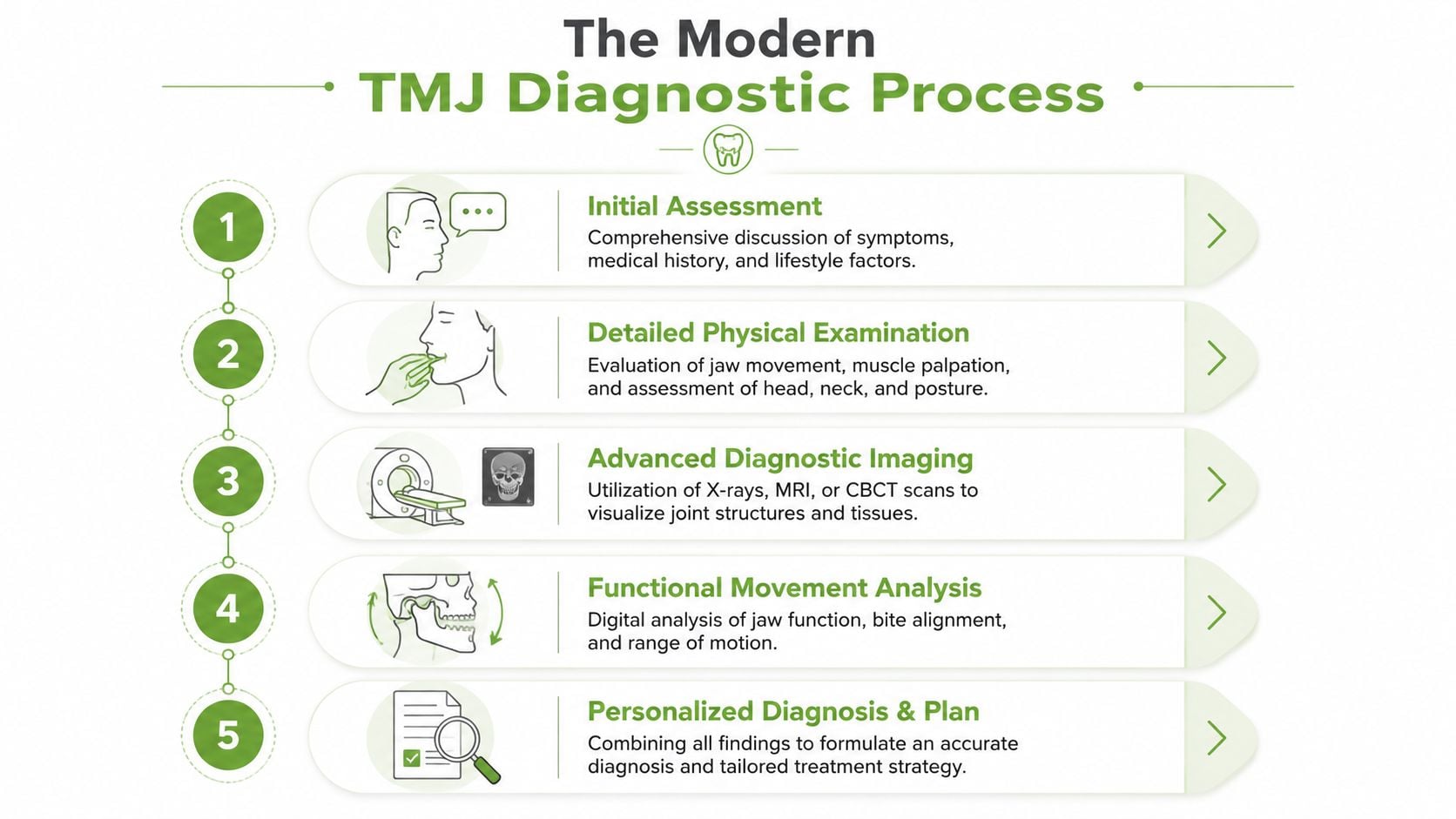
What a thorough workup includes
A strong diagnostic process usually combines several layers of information:
History first
The provider asks when symptoms began, what worsens them, whether mornings are worse than evenings, whether there's locking, trauma, clenching, snoring, or disrupted sleep.Hands-on exam
This includes measuring opening range, checking joint tenderness, palpating the masseter and temporalis muscles, and watching whether the jaw deviates during movement.Bite and function review
The provider looks at how your teeth meet, whether one side loads more heavily, and whether your muscles are compensating for an unstable closing pattern.
A specialist may also evaluate head posture, tongue posture, and breathing habits, because those can influence jaw loading all day and all night.
Why 3D imaging changes the quality of the diagnosis
Some structural joint problems do not show up well on standard 2D films. According to Duke Health's TMJ overview, approximately 40% of patients with chronic TMD exhibit irreversible degenerative changes that are invisible on conventional 2D radiographs. The same source notes that 3D CBCT imaging and electronic bite mapping provide a 25% higher diagnostic accuracy rate for structural damage.
That matters in practical terms. If a patient has condylar flattening, erosion, arthritic remodeling, or a joint space problem, the treatment plan should be different from what you'd prescribe for a purely muscular case.
A sore jaw muscle and a damaged jaw joint can feel similar to the patient. They are not the same problem, and they should not get the same plan.
The key distinction specialists look for
A modern diagnosis usually sorts the case into one or both of these buckets:
| Diagnostic category | What it often means |
|---|---|
| Myogenous TMD | Muscles are overworking, guarding, or spasming |
| Arthrogenous TMD | The joint itself shows internal or structural pathology |
Many patients have overlap. That's why the best evaluations don't rely on one finding alone. They combine history, exam, imaging, and functional analysis so treatment matches the actual source of pain.
What to Expect at Your First TMJ Consultation
Many patients arrive tense. They're not just dealing with pain. They're worried they'll be dismissed, rushed, or told to “wait and see” one more time. A good first consultation should feel methodical and calm, not intimidating.
The first conversation
The visit usually starts with your story. Expect questions about when the pain began, whether it's constant or intermittent, whether you clench, whether chewing is difficult, and whether you wake with headaches, facial soreness, or unrestful sleep.
This part matters more than patients think. The timeline often reveals the mechanism. Pain after dental work, after an injury, during a high-stress stretch, or alongside snoring and poor sleep can point the evaluation in very different directions.
The physical exam
Next comes a hands-on exam of the jaw and surrounding muscles. The specialist may measure how wide you open, whether your jaw shifts to one side, where the joints are tender, and which muscles reproduce your pain when pressed.
They may also assess the neck, shoulders, posture, and bite contacts. TMJ disorders rarely stay isolated to one small area, so a narrow exam misses too much.
Imaging and digital records
If advanced imaging or digital bite analysis is appropriate, it's usually quick and noninvasive. Patients often expect something uncomfortable, but these records are typically straightforward. The goal isn't to add technology for appearance. It's to avoid guessing.
After the records are complete, the provider should explain the findings in plain language. You should hear what appears to be muscular, what looks structural, whether the airway seems relevant, and what the treatment priorities are.
If you leave your first visit with a device recommendation but no clear diagnosis, ask more questions before moving forward.
Questions worth bringing with you
A short list can make the visit more productive:
- What seems to be the main driver of my pain
- Do my symptoms suggest a muscle problem, a joint problem, or both
- Is sleep-disordered breathing part of this picture
- What treatment is meant to protect, and what treatment is meant to heal
- What should I avoid doing right now
The right consultation should lower uncertainty. Even if treatment takes time, you should leave understanding the problem far better than when you arrived.
A Full Spectrum of TMJ Treatment Options
Not all TMJ treatments do the same job. Some reduce symptoms. Some protect the teeth. Some calm irritated muscles. Some aim to improve airway stability during sleep. Others target damaged connective tissue and joint function more directly.
That distinction matters because patients often assume every device or every injection is designed to heal the joint. It isn't.
What symptom management does well, and where it falls short
Pain relievers, soft diet changes, heat, massage, and a basic night guard can all be useful. They often help reduce overload in the short term. For an acute flare, that can be appropriate.
The problem comes when temporary tools get mistaken for a complete strategy. A generic guard may reduce tooth wear while doing little to improve condylar position, muscle balance, or nighttime breathing. Medication may quiet the pain cycle while the underlying strain remains unchanged.
Why conservative care is still the standard starting point
For most patients, surgery should not be the opening move. Clinical research involving 2,104 patients found that 88% of individuals with TMJ disorders and related sleep issues experienced significant quality-of-life improvement with non-surgical, airway-focused therapies rather than invasive interventions, based on the cited Brown and Gaudet clinical studies described in the verified data.
That supports what experienced clinicians see every week. Many jaw pain cases respond best when the treatment addresses mechanics, airway, muscle function, and tissue healing before anyone talks about surgery.
The right non-surgical plan is not “doing less.” It's choosing the treatment that matches the biology of the problem.
Root-cause options that go beyond masking pain
When care is individualized, treatment may include a combination of the following:
- Custom oral appliances that do more than separate the teeth. The design can support a more stable jaw position and, in selected cases, help address airway-related strain during sleep.
- Targeted physical and behavioral strategies such as jaw rest protocols, chewing modification, posture correction, and exercises that reduce protective muscle overactivity.
- Cold laser therapy and other noninvasive modalities aimed at calming irritated tissues while function is being restored.
- Regenerative therapies for tissue damage that won't improve from inflammation reduction alone.
One under-discussed category is chronic TMJ tendinosis, where the connective tissue is degenerative rather than just inflamed. In those cases, anti-inflammatory care alone may not solve the underlying issue.
A 2025 meta-analysis reported that Platelet-Rich Fibrin (PRF) injections improved joint tissue integrity and reduced pain by 68% in patients with chronic TMJ tendinosis, offering a tissue-healing alternative to surgery, according to the Journal of Oral Rehabilitation article available through NCBI.
For patients comparing options, this overview of modern TMJ treatment approaches is a useful companion resource.
TMJ treatment philosophies compared
| Approach | Symptom Management (e.g., Basic Night Guards, Painkillers) | Root-Cause Healing (e.g., Regenerative Therapy, Custom Appliances) |
|---|---|---|
| Main goal | Reduce discomfort quickly | Improve function and address the driver |
| Best use | Acute flare control, short-term support | Chronic or recurring cases needing a broader plan |
| Strength | Fast relief, simple to start | More individualized and often more durable |
| Limitation | May not change the underlying mechanics or tissue health | Requires a more careful diagnosis and follow-through |
What usually works best in practice
The strongest plans are layered. A patient may need short-term symptom control, but also a custom appliance, airway evaluation, and regenerative support if the tissues are chronically damaged. That's very different from handing every patient the same splint and hoping time does the rest.
If your symptoms keep returning, the next step usually isn't “try harder.” It's getting more precise about what kind of TMJ disorder you have.
How to Choose the Right TMJ Specialist in Raleigh
Finding a provider for jaw pain in Raleigh isn't just about location. It's about training, diagnostic depth, and whether the doctor understands that TMJ disorders can involve sleep, airway mechanics, and structural joint disease. Those details matter because the pool of true specialists is small.
In North Carolina, there are only 4 dedicated TMJ specialists board-certified in orofacial pain at major institutions, which is why patients need to verify credentials carefully through resources such as the American Board of Orofacial Pain directory for North Carolina.
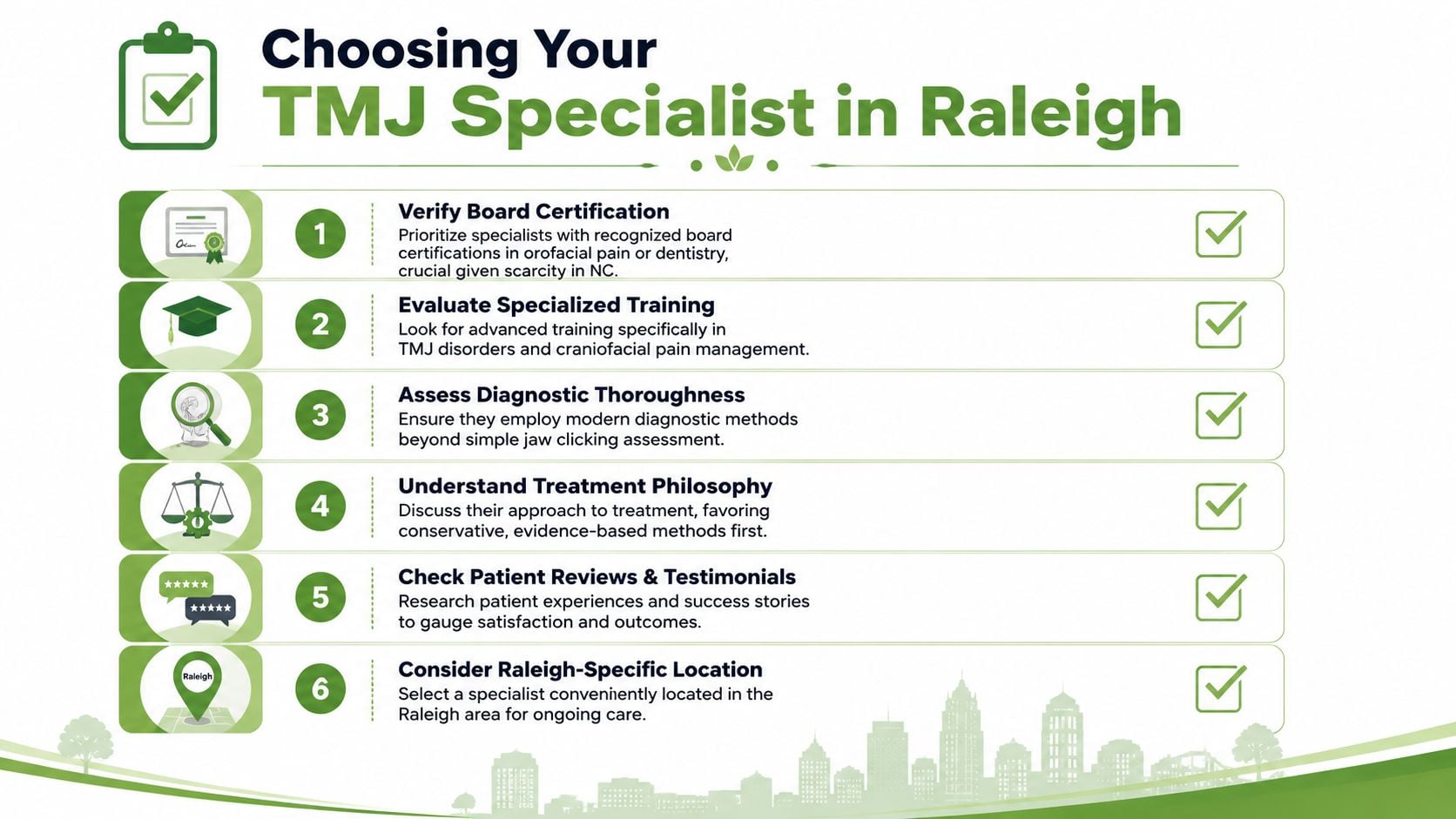
What to verify before you book
A polished website doesn't tell you enough. Ask specific questions.
Board certification
Ask whether the provider is board-certified in orofacial pain or has equivalent focused training for complex TMJ cases.Diagnostic tools
Ask whether they use 3D CBCT, digital bite analysis, or other tools beyond a simple clinical exam.Treatment range
Ask whether they only provide standard splints, or whether they also address airway issues, muscle dysfunction, and regenerative care.Sleep awareness
Ask how they evaluate the overlap between jaw pain, clenching, snoring, and possible sleep apnea.
Many patients searching for a TMJ specialist near them don't realize how much provider skill varies until after they've already spent time and money on incomplete care.
Questions that separate a specialist from a generalist
This is what I'd want a patient to ask any office:
- How do you determine whether my case is muscle-based or joint-based?
- Do you use 3D imaging when the history suggests structural damage?
- What is your approach if sleep-disordered breathing is contributing to clenching?
- Do you offer only symptom management, or do you also treat tissue injury and instability?
- How often do you manage complex TMJ cases as a core part of your work?
Later in your research, it can help to hear a clinician explain this process in plain terms:
Choose the doctor who can explain why they're recommending a treatment, not just the doctor who recommends one quickly.
The trade-off patients should understand
A general dentist may be a reasonable starting point for mild, straightforward symptoms. But if you've had persistent pain, locking, bite changes, repeated appliance failures, or signs that sleep may be involved, a narrow approach often prolongs the problem.
For a serious TMJ case, convenience should rank below expertise. In a market with limited specialist availability, careful vetting isn't excessive. It's necessary.
Your Next Step Toward Relief in Raleigh
TMJ care works best when it stops treating the jaw like an isolated hinge. Chronic jaw pain often involves a bigger pattern. Muscle strain, joint mechanics, connective tissue injury, clenching, and sleep-disordered breathing can all interact. If one part is ignored, relief may be partial or short-lived.
That's why the search for a TMJ specialist in Raleigh, NC should focus on three things. First, the diagnosis has to be precise. Second, treatment should be conservative when possible, but not superficial. Third, the provider should understand when pain is being sustained by airway or sleep problems, not just bite pressure.
What patients should carry forward
If your symptoms have lingered, keep these principles in mind:
Temporary relief isn't the same as resolution
A treatment can help and still be incomplete.Jaw pain and poor sleep may be connected
If mornings are your worst time, that connection deserves attention.Advanced imaging and thoughtful exam findings matter
You want a diagnosis that distinguishes muscle overload from structural joint damage.Healing-focused care exists
Some cases need more than symptom control. They need restoration of function and support for damaged tissues.
You don't need to accept recurring headaches, a guarded jaw, and broken sleep as your baseline. Relief is possible, but it usually starts with better questions and a more complete evaluation than most patients receive at the beginning.
If you've been cycling through short-term fixes, the next smart move is a specialist consultation that looks at the full picture.
If you want a root-cause evaluation for jaw pain, facial tension, headaches, clenching, or sleep-related breathing issues, Pain and Sleep Therapy Center offers interdisciplinary care led by Dr. Greg D. Larson. The practice focuses on precise diagnosis, non-surgical TMJ treatment, airway-centered care, and advanced options such as custom appliances, PRF, prolotherapy, and cold laser therapy. If you're in Raleigh and ready for a more complete path forward, contact the office to schedule a consultation and discuss the next best step for your case.