You wake up tired, even after what should have been a full night in bed. By midmorning, you're fighting to stay focused. Your partner says you snore, pause, choke, or gasp. Maybe you've blamed stress, aging, weight gain, or a busy schedule. Many people do.
But obstructive sleep apnea isn't just noisy sleep. It's a condition in which the upper airway repeatedly narrows or collapses during sleep, cutting off airflow, lowering oxygen, and forcing the brain to keep pulling you out of deeper sleep to reopen the airway. That pattern can leave you exhausted in ways coffee can't fix.
Beyond Snoring An Introduction to Sleep Apnea Treatment
For many adults, the first clue isn't snoring. It's the slow drift in how they feel and function. They stop waking up refreshed. They need naps they never used to need. They get irritable, forgetful, and less patient. Blood pressure becomes harder to control. Exercise feels harder than it should.
That pattern matters because sleep apnea affects more than sleep quality. Repeated breathing disruptions strain the cardiovascular system, fragment sleep architecture, and interfere with the body's normal recovery overnight. If the symptoms sound familiar, it helps to review the common sleep apnea causes and symptoms so you can recognize the full picture.
What treatment actually changes
Treatment works by stopping or reducing those repeated airway blockages. When breathing becomes more stable, oxygen levels stabilize, sleep becomes less fragmented, and the body doesn't have to keep cycling through alarm mode all night.
The result isn't one single benefit. It's a chain reaction that can affect:
- Daytime alertness: Less sleepiness, fewer unplanned dozing episodes, better morning function.
- Mental performance: Better concentration, steadier attention, less brain fog.
- Mood and relationships: Less irritability, less snoring-related disruption, more patience.
- Long-term health: Lower strain on the heart and blood vessels when treatment is used consistently.
Sleep apnea treatment benefits are real, but they aren't magic. They depend on matching the right therapy to the right patient, then using it consistently enough for the body to respond.
Some people feel changes quickly. Others improve more gradually. That difference doesn't mean treatment failed. It usually means we need to think about timing, adherence, severity, anatomy, and which treatment type fits best.
Reclaiming Your Day With Better Sleep Quality
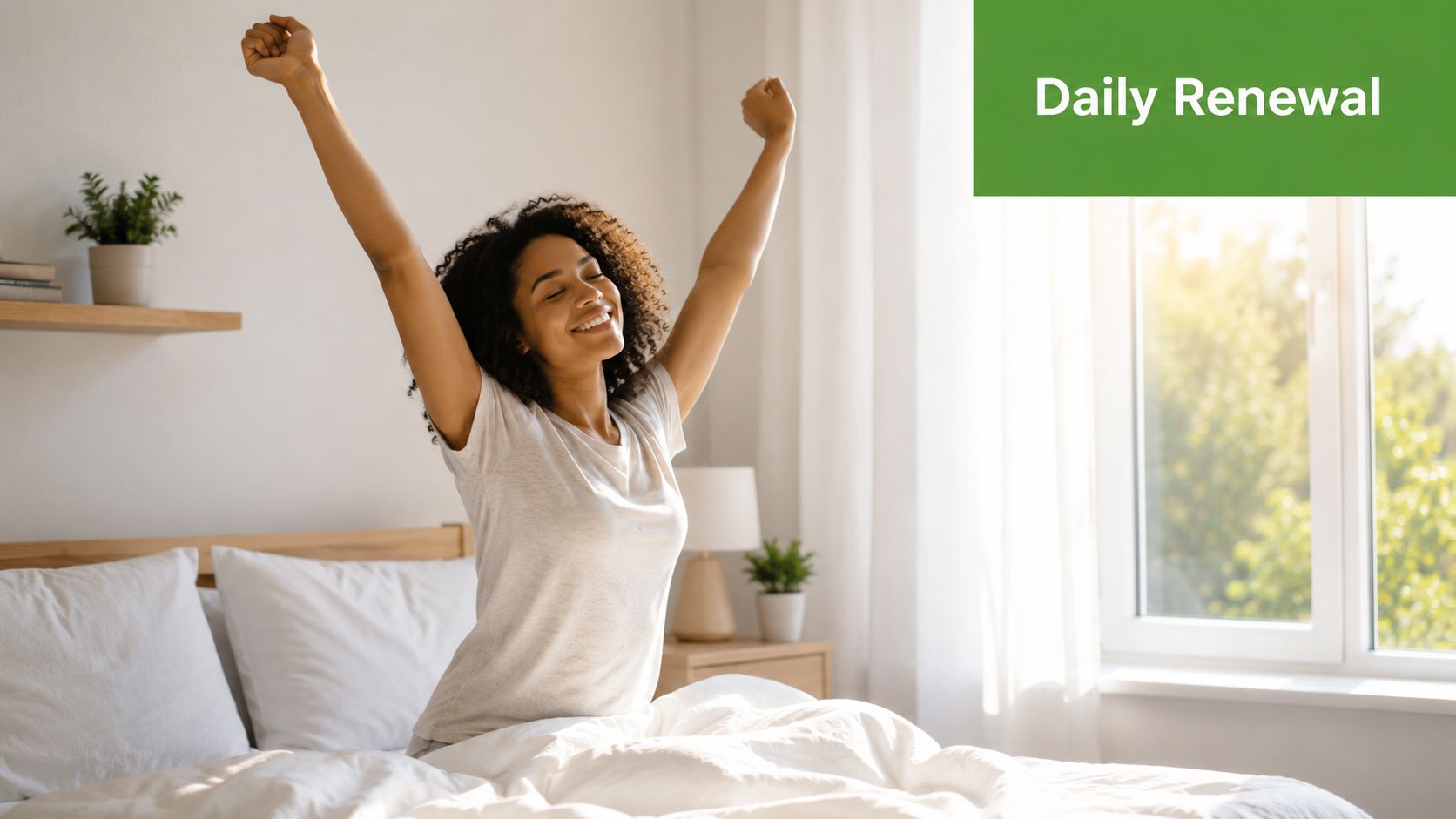
The earliest sleep apnea treatment benefits usually show up during the day. People often notice that they stop feeling like they're operating on a drained battery. Morning headaches may ease. Driving feels safer. Work takes less effort.
Why energy can improve quickly
When sleep apnea is untreated, the brain keeps getting pulled toward lighter sleep to reopen the airway. Even if you don't remember waking up, your body does. CPAP helps by splinting the airway open so those interruptions drop sharply while the device is on. Clinical evidence shows that CPAP produces measurable, rapid improvements in sleepiness and daytime function, and a peer-reviewed study found that CPAP adherence was associated with significant reductions in Epworth Sleepiness Scale scores, reflecting meaningful improvement in excessive daytime sleepiness in people with OSA (peer-reviewed CPAP adherence findings).
That fast response is one reason treatment can feel so dramatic. You're not adding energy from the outside. You're finally allowing sleep to do its normal restorative job.
If daytime exhaustion has become your normal, it also helps to look at the overlap between sleep-disordered breathing and chronic fatigue and sleep apnea, because many patients don't realize how tightly those problems connect.
What tends to improve first
Some benefits are front-loaded. They often improve before the deeper long-range health effects do.
- Sleepiness: Many patients notice this first. They stop nodding off on the couch or feeling dangerous behind the wheel.
- Clarity: Attention and recall often improve once sleep becomes less fragmented.
- Mood stability: Poor sleep amplifies irritability. Better sleep can soften that quickly.
- Snoring: For many households, this is the first change a bed partner notices.
Bedroom comfort also matters more than people think. Dry air, congestion, and nasal irritation can make PAP use harder, so practical steps that support indoor air quality for better rest can make nighttime treatment easier to stick with.
Practical rule: The treatment only works during the hours you use it. A great device with poor nightly use won't outperform a good setup you can tolerate every night.
A brief visual overview can help if you're new to the basics of treatment and how it changes sleep quality:
What doesn't improve overnight
Not every symptom vanishes in a week. If you've had untreated sleep apnea for a long time, it may take longer to feel mentally sharp again. Mood can improve, but it may not if depression, anxiety, chronic pain, medications, alcohol use, or insufficient sleep are also in the mix.
That's where expectations matter. Good treatment often feels like stepping out of a fog, but it still has to be the right treatment, fitted well, and used enough hours to cover most of the night.
Protecting Your Heart and Long Term Health
The most important sleep apnea treatment benefits aren't always the ones you can feel right away. Some of the biggest gains happen subtly in the background, inside the cardiovascular system.
Every obstructive event stresses the body. Oxygen drops. The chest works harder against a blocked airway. The nervous system fires up to rescue breathing. Blood pressure can surge. Night after night, that pattern becomes a repeated strain event.
Why untreated sleep apnea affects more than sleep
OSA doesn't stay confined to the bedroom. It influences how the heart, blood vessels, and metabolism respond over time. That's why sleep specialists take it seriously even when the main complaint is snoring.
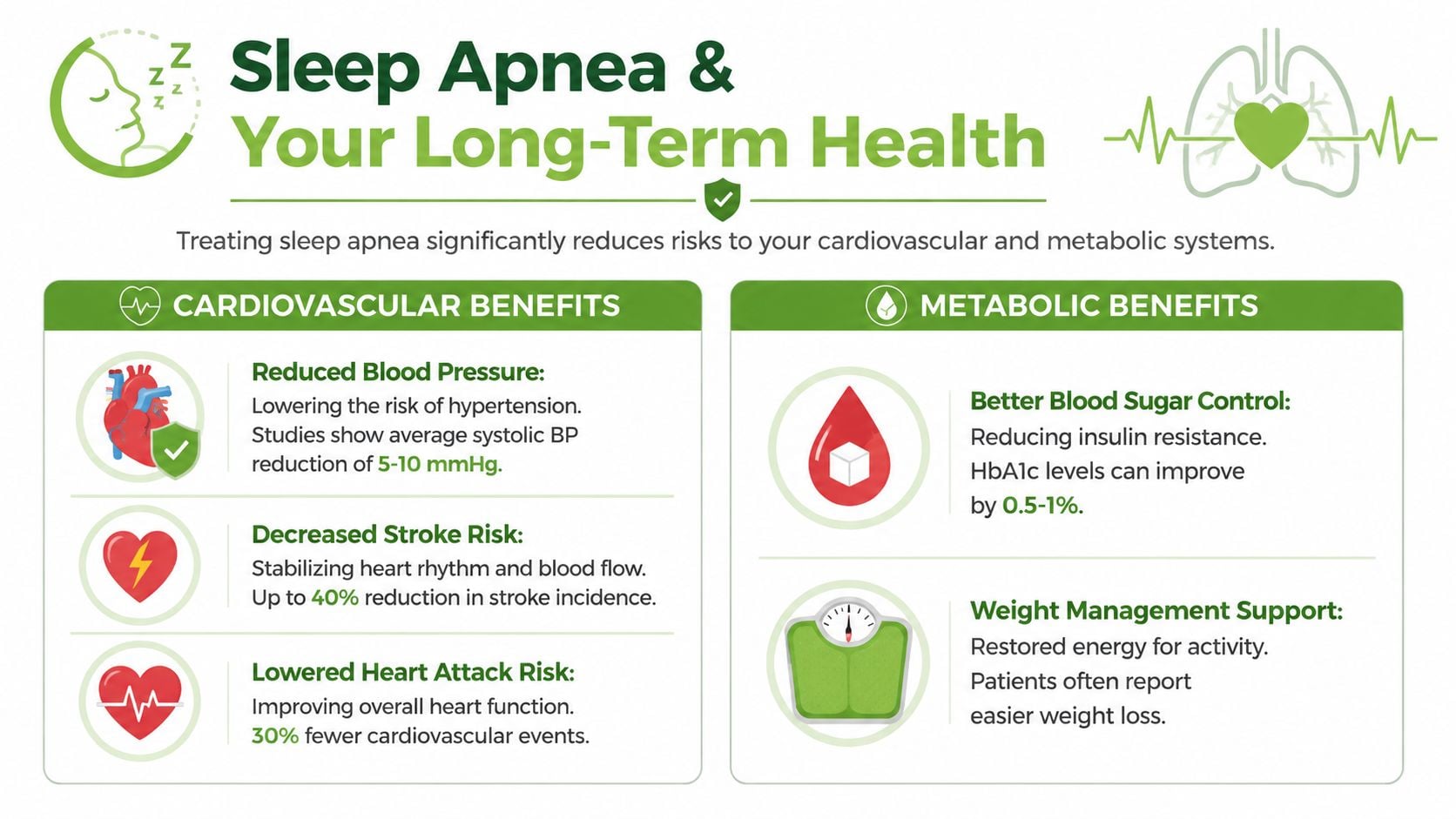
A major 2019 observational study of Medicare beneficiaries found that starting CPAP was associated with about half the risk of dying over the next five years, along with a 16% lower risk of myocardial infarction and about a 10% lower risk of a cardiovascular event in people without a prior major cardiovascular event. The benefit was strongest among patients who kept using CPAP consistently during the first year (Medicare CPAP outcomes summary).
That finding gets to the core issue. Treatment isn't only about symptom relief. For the right patient, it can function as a risk-modifying therapy.
What the long game looks like
Long-term benefit depends on reducing repeated airway collapse often enough to lower the body's nightly stress load. That's why sleep apnea should be approached with the same seriousness people bring to cholesterol, hypertension, or diabetes management.
If you want a broader picture of the stakes, these long-term effects of untreated sleep apnea help explain why "I'll deal with it later" can become a costly decision in health terms.
Weight management also deserves a realistic place in the discussion. Weight loss can improve airway mechanics in some patients, but it usually works best as part of a broader plan rather than as a stand-alone promise. For people who need structured nutrition support, sustainable weight loss meal plans can be a useful complement to medical treatment when excess weight is part of the picture.
Trade-offs patients should know
Long-term protection doesn't mean every person gets the same result, or that every treatment fits every anatomy.
Consider these practical realities:
- CPAP has the strongest evidence base for moderate to severe OSA: It works well when patients can wear it consistently.
- Benefits take longer when use is inconsistent: Starting treatment matters, but continued use is what drives durable health gain.
- Lifestyle change helps, but it rarely replaces evaluation: Some patients improve substantially. Others still need a device even after weight loss or behavior changes.
- Symptom relief and risk reduction don't always move at the same speed: You might feel better quickly while heart and vascular benefits accumulate more gradually.
Better sleep is the visible part of treatment. Lower cardiovascular strain is often the invisible part, and it's one of the reasons treatment matters so much.
Comparing Your Sleep Apnea Treatment Options
The best treatment isn't the one with the strongest headline. It's the one that matches your airway, your severity, your symptoms, and what you can practically use.
Some patients do best with CPAP from the start. Others succeed with an oral appliance. Some need a combination approach that addresses breathing pattern, tongue posture, nasal function, and sleep position. For these varied approaches, realistic guidance matters more than generic advice.
Sleep Apnea Treatment Options at a Glance
| Treatment | How It Works | Best For | Benefit Timeline |
|---|---|---|---|
| CPAP | Delivers continuous positive pressure to keep the upper airway from collapsing during sleep | Many patients with moderate to severe OSA, especially when consistent nightly use is realistic | Daytime sleepiness may improve quickly; broader health benefits depend on sustained nightly use |
| Oral appliance therapy | Repositions the jaw or tongue to help maintain a more open airway | Many patients with mild to moderate OSA, snoring, or CPAP intolerance, depending on anatomy and sleep study findings | Snoring and comfort-related improvements may be noticed early; objective effectiveness should be confirmed with follow-up |
| Myofunctional therapy | Trains oral and facial muscles to improve tongue posture, nasal breathing, and upper-airway function | Selected patients, often as an adjunct rather than a stand-alone solution | Gradual; depends on exercise quality, consistency, and whether underlying obstruction is also addressed |
| Lifestyle intervention | Targets weight, habits, and contributing health factors that can worsen airway collapse | Patients with excess weight or modifiable contributors, often alongside another therapy | Gradual; disease-course change can take sustained effort over time |
CPAP and why it remains the reference treatment
CPAP is still the benchmark because it directly prevents airway collapse while you're wearing it. For patients with significant OSA, that mechanical reliability matters. It doesn't require perfect anatomy. It requires a workable mask, good pressure settings, and enough nightly use.
The downside is practical, not theoretical. Some people struggle with mask comfort, mouth leak, pressure intolerance, or claustrophobia. Those barriers are solvable more often than patients expect, but they need active troubleshooting.
Oral appliances and where they fit well
Custom oral appliances move the lower jaw forward or help stabilize the tongue and airway. They're often more portable and easier for some people to tolerate than PAP. That can make them a strong option when anatomy is favorable and OSA severity is in the right range.
Their limitation is that they aren't equally effective for everyone. The fit has to be individualized, and the only reliable way to know whether they're controlling the disorder is follow-up testing, not guesswork based on reduced snoring alone.
Myofunctional therapy and the role of muscle function
Myofunctional therapy is useful when poor tongue posture, oral muscle dysfunction, mouth breathing, or dysfunctional swallowing contribute to airway instability. Reviews report that myofunctional therapy can reduce the apnea-hypopnea index by about 50%, and the same clinical review notes that intensive lifestyle intervention led to 10-year remission in 34.4% of patients in a large randomized study, compared with 22.2% in the comparison group (clinical review of OSA therapies and remission data).
Those numbers are encouraging, but they need context. Myofunctional therapy isn't a universal replacement for CPAP. In practice, it often works best as part of a layered treatment plan, especially when the airway problem has both structural and functional components.
How to think about choice
A useful way to decide is to ask four questions:
- How severe is the OSA? More severe disease usually pushes treatment toward options with more predictable airway control.
- What does the anatomy suggest? Jaw position, tongue size, palate shape, nasal resistance, and weight distribution all matter.
- What will the patient use? The most elegant prescription fails if it sits on the nightstand.
- How will success be checked? Symptom improvement matters, but objective follow-up matters too.
A treatment plan should fit the patient, not the other way around.
Why Consistent Treatment Is the Key to Success
Sleep apnea therapy is dose-dependent. That means the benefit rises and falls with actual use. This is one of the biggest gaps in online discussions of sleep apnea treatment benefits.
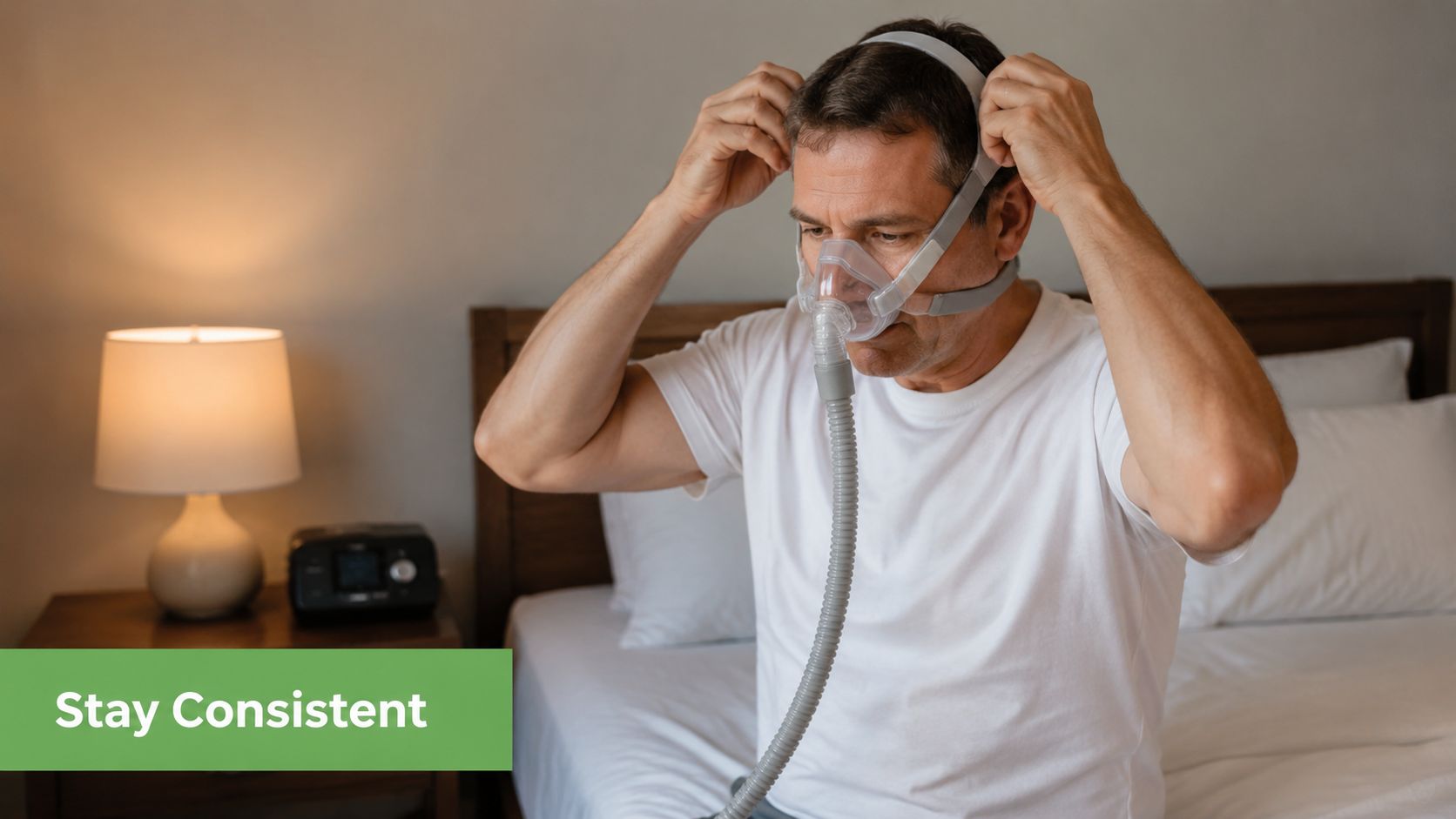
If you take blood pressure medicine only occasionally, you wouldn't expect steady control. CPAP works the same way. It can only prevent airway collapse during the hours it's on your face.
The adherence threshold matters
A large global cohort study reported that people with OSA who used CPAP had a 37% lower all-cause mortality risk and a 55% lower cardiovascular mortality risk than comparable OSA patients who did not use CPAP. The same source notes that more than 4 hours per night is commonly used as a minimum effectiveness threshold associated with better symptom control and improved outcomes (global CPAP mortality and adherence findings).
That doesn't mean four hours is ideal. It means less than that often leaves much of the night untreated. Many people cluster more apnea events in the later part of sleep, especially during REM, so taking the mask off early can erase a lot of the intended benefit.
What helps patients stay with treatment
Adherence isn't about willpower alone. Most failures come from fixable problems.
- Mask issues: Wrong size, poor seal, pressure points, and skin irritation push patients away quickly.
- Pressure problems: Some people need desensitization, humidification, or setting adjustments.
- Nasal obstruction: Congestion and mouth leak can make a good prescription feel impossible.
- Unclear expectations: Patients who expect instant perfection often quit before normal adaptation occurs.
Partial use gives partial treatment. Consistent use is what turns a prescription into a health benefit.
The good news is that adherence usually improves when clinicians troubleshoot early instead of telling patients to just "try harder." The first weeks matter most because habits, comfort, and confidence get built there.
Your Next Steps Toward Evaluation and Treatment
If you're waking unrefreshed, snoring heavily, feeling sleepy during the day, or hearing from a partner that you stop breathing at night, the next step is evaluation, not self-diagnosis. Sleep apnea can overlap with insomnia, nasal obstruction, circadian issues, medication effects, chronic pain, and other sleep disorders. The right answer starts with measuring what happens while you sleep.
What a proper workup usually includes
A specialist may recommend an at-home sleep study or an in-lab sleep study, depending on your symptoms and medical context. The goal is to identify whether breathing disturbances are present, how severe they are, and what treatment path makes sense.
Harvard Medical School has highlighted a problem many patients run into. They don't just want to know whether treatment can help. They want a practical comparison of how much benefit they can expect from different options, especially for outcomes like memory, mood, and safety. That's exactly why a personalized evaluation matters (Harvard sleep education on practical treatment expectations).
A simple roadmap
- Notice the pattern: Snoring, gasping, morning headaches, dry mouth, brain fog, and daytime sleepiness all deserve attention.
- Get tested: Choose the study type your clinician recommends rather than the one that sounds easiest.
- Review the results in plain language: You should understand what was found, how significant it is, and what treatment choices fit your case.
- Start treatment with follow-up built in: Early adjustments often determine whether treatment becomes sustainable.
The right plan should feel clear, not confusing. Most patients don't need more internet searching. They need a precise diagnosis and a treatment path they can realistically live with.
Frequently Asked Questions About Treatment Benefits
Can treating sleep apnea help with weight loss
It can help indirectly. When sleep improves, people often have more energy for activity, better daytime function, and more stable routines. But treatment isn't a direct weight-loss therapy. Weight and sleep apnea influence each other, so the best results usually come from treating both when excess weight is part of the problem.
How long does it take for blood pressure to improve
There's no universal timetable. Some people notice change earlier than others, while some need longer-term consistent treatment before broader cardiovascular effects become apparent. Blood pressure also depends on medication, sodium intake, stress, alcohol, kidney health, and genetics, so it's important not to use one reading as the sole measure of progress.
Will I need treatment forever
Not always, but many adults do need long-term management. The answer depends on why the airway is collapsing. Weight change, nasal treatment, oral appliance response, myofunctional progress, and other factors can shift the plan over time. What shouldn't happen is stopping therapy because symptoms improved, without confirming whether the apnea itself improved.
Can benefits reverse if I stop using my device
Yes. If the treatment is what keeps your airway open, the underlying breathing problem often returns when treatment stops. That means snoring, fragmented sleep, and daytime symptoms can return quickly, while longer-range health protection may also fade with prolonged nonuse.
The best sign that treatment is working isn't just "I own the device." It's "I use the treatment that fits me, and my follow-up shows it's controlling the problem."
If you're ready to find out which sleep apnea treatment fits your symptoms, anatomy, and goals, Pain and Sleep Therapy Center offers evaluation and personalized care for adults dealing with snoring, obstructive sleep apnea, chronic fatigue, and related airway concerns. A clear diagnosis and a treatment plan you can use are the fastest path to feeling better and protecting your long-term health.