

You want relief, but you don’t want needles in your face, jaw, or anywhere else. That hesitation is common, especially when you’re already dealing with TMJ pain, tight chewing muscles, headaches, poor sleep, or a nervous system that feels stuck on high alert.
Many people assume acupuncture only counts if a needle enters the skin. In practice, the important question is different. Can a treatment stimulate the same therapeutic points and calming pathways without penetration? In many cases, yes.
That matters for people with complex orofacial pain. The jaw, temples, cheeks, and neck are sensitive areas. If you already clench, guard, or brace, the idea of facial needling can feel like too much. Needle-free acupuncture gives you another path. It aims for the same therapeutic target with less intimidation and, for the right patient, a much easier starting point.
The Promise of Acupuncture Without Needles
If you’re skeptical, that’s healthy. There are plenty of wellness trends that sound gentle but don’t hold up. Acupuncture without needles is different because it grows out of a treatment system that already has broad clinical acceptance.
Between 2002 and 2022, acupuncture use among U.S. adults more than doubled from 1.0 percent to 2.2 percent, and the World Health Organization reports acupuncture is used in 103 of 129 countries that provided data. The same review notes that acupuncture has shown effectiveness for pain conditions such as back pain, neck pain, and osteoarthritis, with results comparable to NSAIDs in some settings, according to the NCCIH review of acupuncture effectiveness and safety.

That doesn’t mean every version of acupuncture works for every problem. It does mean the field is no longer fringe. It has moved into mainstream pain care, and that has created room for modern, lower-friction options.
Why this appeals to TMJ and sleep patients
When someone has jaw pain or sleep disruption, the goal usually isn’t just “feel better for an hour.” The goal is to settle irritated tissues, reduce guarding, and calm a system that may be amplifying pain and tension.
Needle-free methods can fit that need well because they’re often:
- Less threatening to start if you have needle anxiety
- Better tolerated in sensitive facial regions where tissue is already sore or reactive
- Easier to combine with other conservative care such as jaw exercises, breathing work, oral appliances, or manual therapy
Practical rule: If fear of the treatment keeps you from starting the treatment, the gentler option is often the smarter option.
The promise here isn’t magic. It’s access. More people are willing to try care when it feels manageable, and that alone can change the trajectory of a chronic pain problem.
How Can Acupuncture Work Without Needles
The simplest way to think about it is this. Traditional acupuncture uses a needle as a tool to stimulate a point. Acupuncture without needles changes the tool, not the target.
A useful analogy is a key versus a remote. If a needle is one way to trigger a response at an acupuncture point, pressure, light, or electrical stimulation can act like a remote control. The signal changes. The intention stays the same.
The effect comes from stimulation of the point
People often focus on the object used in treatment. Clinically, the more important issue is whether the point is being stimulated in a way the body responds to.
Needle-free acupuncture may use:
- Manual pressure over a point
- Low-level laser light aimed at a point
- Surface electrical stimulation delivered through the skin
- Microcurrent stimulation applied with a probe or electrode
Some methods feel like gentle pressure. Some feel warm or tingly. Some are barely noticeable. For patients with facial pain, that can be a major advantage because the treatment experience itself doesn’t add another layer of stress.
What the research suggests
One of the strongest objections I hear is, “If there’s no needle, how can it be real acupuncture?” That’s a fair question, and it’s exactly where comparative research matters.
A clinical study involving patients with myofascial shoulder pain found that needle-free acupuncture produced pain reduction comparable to conventional needle treatment, while patients reported “less anxiety, less discomfort, and fewer adverse events”, as summarized in this report on the needle-free acupuncture study.
That doesn’t prove all needle-free methods are equal in every setting. It does support an important point. Penetrating the skin is not the only way to produce a therapeutic response.
For many patients, better tolerability isn’t a minor perk. It’s the difference between avoiding care and completing a course of treatment.
Where expectations should stay realistic
Needle-free acupuncture isn’t a cure-all. It also doesn’t mean every patient should skip traditional needling forever.
What tends to work best is matching the method to the person:
| Situation | Needle-free approach may help because |
|---|---|
| Needle anxiety | It lowers the barrier to starting care |
| TMJ flare-up | It avoids adding stress to already guarded facial tissues |
| Post-procedure sensitivity | It offers a non-penetrating way to stimulate treatment points |
| Very reactive patients | It lets the clinician start with a gentler input |
What doesn’t work is treating all jaw pain as the same problem. A patient with muscle-driven clenching, a patient with joint inflammation, and a patient with airway-related sleep disruption may all have jaw pain, but they don’t need identical care.
Exploring Your Needle-Free Acupuncture Options
Needle-free acupuncture isn’t one treatment. It’s a category of treatments. Some rely on touch. Some use light. Some use electrical current. What’s best depends on the area being treated, how sensitive you are, and what problem the clinician is trying to influence.

A quick comparison
| Method | What it uses | What it usually feels like | Best fit |
|---|---|---|---|
| Acupressure | Finger or tool pressure | Firm pressure, release, tenderness at times | Home care, mild tension, point-specific relief |
| Laser acupuncture | Low-level laser light | Usually little to no sensation | Sensitive areas, children, patients who want a very gentle approach |
| Surface electroacupuncture | External electrodes and mild current | Tingling or pulsing | Muscle tension, pain modulation, broader regional treatment |
| MPS | Low-frequency direct current | Brief focused stimulation | Short-term pain relief, point-by-point treatment |
| SSP | Needle-free electroacupuncture with controlled current and frequency | Stronger but controlled surface stimulation | Postoperative pain and chronic myofascial pain |
Acupressure
Acupressure is the most familiar option because it requires no device. A clinician uses fingers or a small tool to stimulate specific points for a set period.
For jaw and facial pain, acupressure can be useful when tissues are irritable and the patient needs a low-intensity introduction to treatment. It also translates well into home care. That matters because TMJ symptoms often flare between appointments, not just during them.
A good example outside the jaw world is natural pregnancy nausea relief, where point stimulation is used without penetration. Different condition, same practical principle. Stimulate the right point in a tolerable way.
Laser acupuncture
Laser acupuncture uses low-level light to stimulate acupuncture points without breaking the skin. Patients usually prefer it when they want the gentlest possible sensory experience.
This can be a strong option in the face, around the jaw, or near sensitive trigger zones where pressure may feel too intense. It’s also useful for people who shut down the moment they anticipate pain. If you want a closer sense of how this technology is used in conservative pain care, this overview of cold laser therapy for pain relief is a practical reference.
Surface electrical stimulation
Some clinicians use surface electrodes rather than needle-based electroacupuncture. The principle is straightforward. The current is delivered through the skin to influence points, nerves, and painful muscle regions without insertion.
This is often a better fit for broad, tense areas such as the masseter, temporalis, upper trapezius, or neck support muscles that contribute to jaw mechanics. The sensation usually feels like a mild pulse or tapping.
MPS and SSP
Two device-based methods deserve special mention because they’re especially relevant to complex facial pain.
Microcurrent Point Stimulation, or MPS, uses low-frequency direct current to activate acupuncture points without penetration. It’s distinct from needle electroacupuncture because it doesn’t require insertion. It has been described as useful for short-term pain relief and is particularly relevant for TMJ disorders when needle anxiety or tissue sensitivity would make other methods harder to tolerate, as discussed in this overview of needleless acupuncture and microcurrent point stimulation.
Silver Spike Point, or SSP, is a needle-free electroacupuncture method designed to deliver controlled current and frequency parameters through the skin. Research reviewed in this PMC article on SSP therapy describes pain-relieving effects comparable to traditional electroacupuncture and notes its value in postoperative pain management and chronic myofascial pain.
The practical difference between devices matters. Some are best for very gentle point activation. Others are better for sustained stimulation over a painful muscular region.
What tends to work best
In real practice, the best results usually come from matching the tool to the moment.
- During an acute flare a clinician may start with laser or acupressure.
- For tense chewing muscles surface electrical work or SSP may make more sense.
- For point-specific pain modulation MPS can be a precise option.
- For highly sensitive patients the least provocative input usually wins early on.
What doesn’t help is chasing a trendy device without a diagnosis. The method matters, but the treatment plan matters more.
Treating TMJ Pain and Sleep Issues Needle-Free
Most online information about acupuncture without needles stays stuck on back pain, shoulder tension, or general wellness. That misses one of the most useful applications. The face and jaw are exactly where a non-invasive approach can make the most sense.
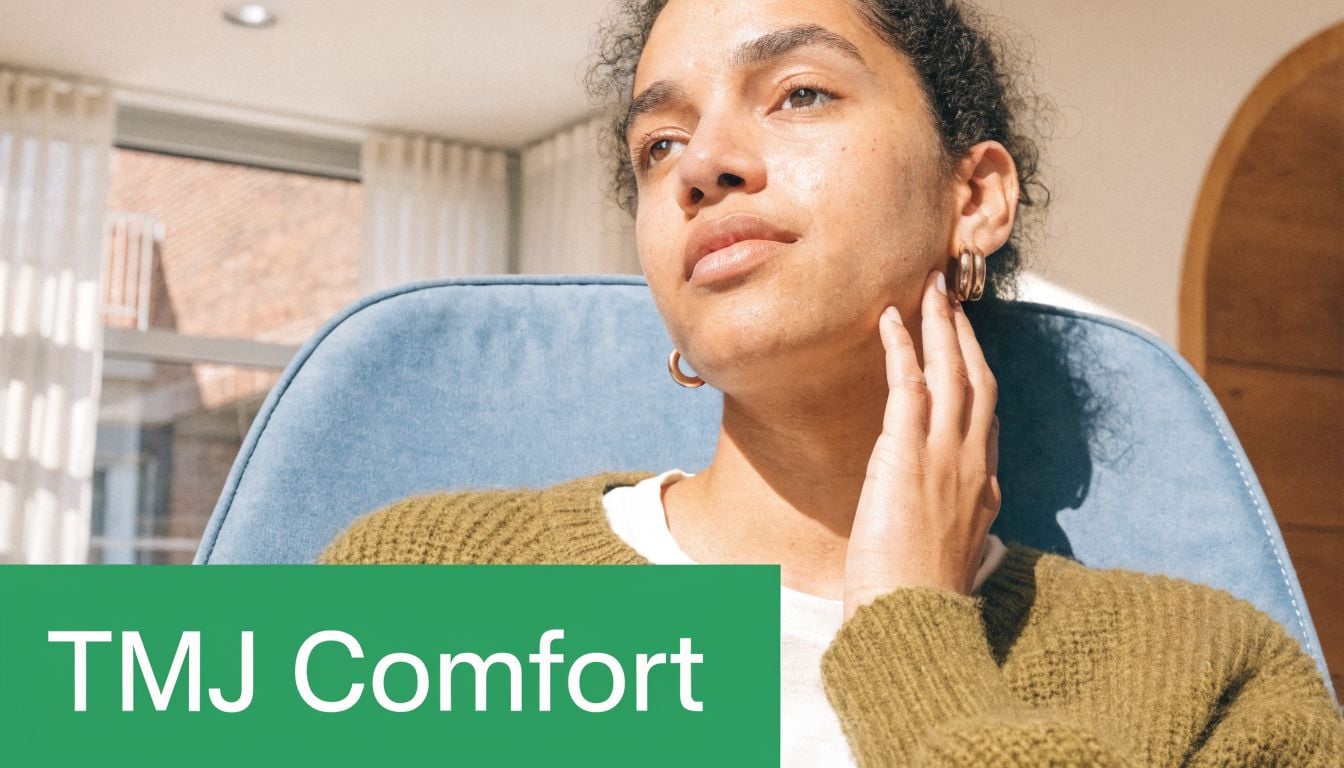
People with TMJ disorders often arrive with a mix of problems. Jaw joint pain. Tight masseters. Temple headaches. Neck strain. Ear pressure. Sleep disruption. Clenching. Sometimes they also have real fear about anyone putting a needle near facial structures.
That concern isn’t irrational. A consumer-facing review on this topic notes a clear gap in discussion of TMJ and orofacial pain, even though these patients often have heightened sensitivity and fear of facial needling. It also points out the superior tolerability of needle-free methods, including reports of “less anxiety, less discomfort” in patients receiving non-needle approaches, as described in this discussion of acupuncture without needles for sensitive patients.
Why the jaw responds differently than the low back
The jaw isn’t just another joint. It’s tied to breathing, swallowing, speech, head posture, and sleep. It’s also close to areas where people feel vulnerable.
That changes treatment strategy. For a guarded TMJ patient, a clinician often needs to reduce threat before reducing pain. Needle-free stimulation can help because it allows treatment of facial points and related neck points without asking the patient to brace against an invasive sensation.
A few practical examples:
- Masseter and temporalis tension may respond better when the patient can stay relaxed instead of anticipating a needle.
- Post-procedure tenderness may be easier to address with non-penetrating stimulation.
- Pain linked to clenching and sleep disruption often improves more consistently when treatment also considers breathing patterns, oral posture, and nighttime habits.
If grinding is part of your picture, conservative support often includes bite protection as well. Resources on solutions for teeth grinding can help you understand where mouth guards fit, especially when bruxism is worsening jaw soreness.
Where sleep fits into the picture
Many patients think of acupuncture only as a pain treatment. For people with jaw issues, sleep often sits right in the middle of the problem.
Poor sleep can increase pain sensitivity. Airway struggle can increase muscle tension. Mouth breathing can affect tongue posture and jaw function. Nighttime clenching can leave the chewing muscles overworked by morning. That means a useful needle-free plan often aims at more than local pain spots.
It may support:
| Problem pattern | Why needle-free treatment may be useful |
|---|---|
| Jaw tightness at bedtime | Gentle stimulation may help downshift a tense nervous system |
| Morning jaw soreness | Surface treatment can address painful muscle groups without irritating tissue |
| Headaches linked to clenching | Point stimulation may reduce muscle guarding in connected regions |
| Sleep-related breathing strain | It can complement airway-focused care rather than replace it |
Some people also benefit from guided self-care between visits. If your jaw muscles feel locked up, these strategies for loosening tight jaw muscles can help you understand what belongs in a broader care plan.
Here’s a useful patient education video to round out the topic:
What needle-free treatment can and can’t do for TMJ and sleep
Needle-free acupuncture can be a good fit for reducing pain, calming reactivity, and improving tolerance for care. It can support better muscle relaxation and make treatment more acceptable for patients who would otherwise avoid it.
It won’t fix every driver of TMJ pain by itself. If your problem is heavily shaped by airway obstruction, disc mechanics, oral habits, bite forces, trauma history, or inflammatory joint change, those issues still need attention. The treatment works best as part of an integrated plan, not as a stand-alone shortcut.
A gentle treatment can still be a serious treatment. The test isn’t whether it looks dramatic. The test is whether it fits the biology and the patient in front of you.
Choosing a Provider and What to Expect
The quality of needle-free acupuncture depends less on the gadget and more on the clinician using it. For TMJ and sleep-related symptoms, that distinction matters even more because the jaw rarely exists as an isolated pain site.

What to look for in a provider
Start with training, but don’t stop there. You want someone who understands both point-based treatment and orofacial diagnosis.
Look for a provider who can answer questions like these clearly:
- Do they treat TMJ and facial pain regularly rather than only general body pain?
- Can they explain why they’re choosing laser, MPS, SSP, or pressure for your specific case?
- Do they screen for sleep-related breathing issues, clenching, posture, and oral habits instead of focusing only on the painful spot?
- Do they coordinate with dental, airway, or physical medicine care when needed?
If your pain involves the jaw, face, headaches, or sleep disturbance, specialist evaluation matters. A good benchmark is reviewing what an orofacial pain specialist is trained to assess and manage.
What a first visit should include
A strong first appointment usually feels more like an investigation than a quick treatment add-on.
Expect the clinician to ask about:
Pain pattern
When it started, where it travels, what aggravates it, and whether chewing, talking, stress, or sleep make it worse.Jaw function
Clicking, locking, limited opening, deviation, clenching, morning tightness, and habits like gum chewing or nail biting.Sleep clues
Snoring, dry mouth, unrefreshing sleep, morning headaches, fatigue, and whether symptoms are worse after poor sleep.Sensitivity and treatment preferences
Needle fear, facial tenderness, sensory overload, and whether you prefer the gentlest option possible.
What treatment itself may feel like
Needle-free treatment usually isn’t dramatic. That’s part of the point.
Depending on the method, you may feel:
- Pressure during acupressure
- A mild pulse or tingling with surface electrical stimulation
- Almost nothing at all with laser acupuncture
- Brief focused sensation with microcurrent tools
The jaw and face may feel softer afterward. Sometimes the first change is easier opening, less temple pressure, or reduced guarding when you swallow or rest your teeth apart.
Clinical insight: If a treatment for TMJ pain leaves you more guarded than when you arrived, it may be the wrong dose, the wrong method, or the wrong diagnosis.
Questions worth asking before you start
Patients do better when they ask direct questions. Try these:
| Question | Why it matters |
|---|---|
| What are you treating in my case, muscle, joint, nerve irritation, or a sleep-related contributor? | It shows whether the provider has a real working diagnosis |
| Why is this needle-free method the best fit for me? | It reveals whether the plan is individualized |
| What should I expect to feel during and after treatment? | It helps you judge whether the response is normal |
| What other therapies might need to work alongside this? | It prevents overpromising |
A careful provider won’t promise a miracle. They should be able to explain the trade-offs, describe realistic goals, and tell you when another discipline needs to be involved.
Is Needle-Free Acupuncture Right for You
If you want conservative care but keep stopping at the word acupuncture because of the needles, you may be ruling out a useful option too early. Acupuncture without needles can offer a practical middle ground. It respects the sensitivity of the jaw and face while still aiming at meaningful therapeutic targets.
This approach may be a good fit if you relate to any of these:
- You want non-invasive care for TMJ pain, facial tension, or headaches
- You’ve avoided acupuncture because of needle anxiety
- Your face or jaw is too sensitive to tolerate a more aggressive treatment style
- You’re looking for support around sleep-related tension, clenching, or nighttime jaw strain
- You prefer treatment that can be integrated with broader airway, dental, and rehabilitation care
It may be less helpful if you’re looking for a stand-alone fix without diagnosis, self-care, or follow-through. Jaw pain and sleep problems usually involve more than one driver. The method works best when it’s chosen thoughtfully and placed inside a bigger plan.
Ask yourself a few direct questions. Are you more likely to start care if it doesn’t involve skin penetration? Do your symptoms worsen when you’re stressed, guarded, or sleep-deprived? Does the idea of a gentler treatment make you feel relieved rather than doubtful? Those reactions matter because comfort affects consistency, and consistency affects outcomes.
The right next step isn’t guessing from social media or trying to self-diagnose from symptom lists. It’s getting evaluated by someone who understands orofacial pain, jaw mechanics, and the sleep side of the picture, then deciding whether a needle-free approach fits your case.
If you’re dealing with TMJ pain, facial tension, headaches, clenching, or sleep-related symptoms and want a non-invasive path forward, Pain and Sleep Therapy Center offers specialized evaluation for complex jaw and airway-related issues. Their team focuses on root-cause care, not one-size-fits-all symptom management, so you can find out whether needle-free therapies belong in a personalized treatment plan.