You may be sitting on the couch, driving home, or trying to fall asleep when it happens. You breathe in, but the breath doesn’t feel satisfying. You try again. Maybe you yawn, sigh, sit up straighter, or open your mouth wider, yet you still feel like you can’t get enough air.
That sensation is frightening. It often gets labeled too quickly as stress, panic, or overthinking. Sometimes anxiety is part of the picture. But when someone repeatedly feels an unsatisfied need to breathe, especially at rest or during sleep, I take it seriously as a real airway and breathing regulation problem until proven otherwise.
Many patients describe air hunger symptoms long before anyone connects them to nasal obstruction, TMJ dysfunction, upper airway resistance, mouth breathing, poor tongue posture, or sleep-disordered breathing. Others have been told everything is normal because their oxygen level looked okay. That can be misleading. You can have normal oxygenation and still feel a powerful, distressing urge to breathe more fully.
What Is This Unsettling Feeling of Air Hunger?
A common story goes like this. Someone says, “I’m not exactly out of breath, but I can’t get a deep breath.” They’re not sprinting. They’re not climbing stairs. They’re sitting still, and yet the body feels unsatisfied, almost alarmed.
That sensation is what clinicians often call air hunger. It’s a severe form of dyspnea, but it feels different from ordinary breathlessness after exertion. People often say it feels like the body is demanding more air even when they’re already breathing.

Why it feels so alarming
Air hunger is not imaginary, and it’s not a character flaw. It’s a primal alarm signal generated by the brain and body when breathing regulation feels off. That’s why people can feel fear, urgency, and loss of control so quickly.
Patients often use vivid descriptions because the sensation is hard to capture with standard medical language. They say things like “I can’t fill my lungs,” “I have to keep trying to inhale,” or “it feels like breathing through a straw.” Many also notice repeated sighing, yawning, chest tension, or an urge to open the mouth to pull in more air.
Air hunger is one of those symptoms that can make a person feel unsafe in their own body, even when nobody around them can see what’s happening.
Why proper evaluation matters
A common point of confusion arises here. If the symptom sounds anxious, it gets placed in the anxiety bucket. But the feeling itself doesn’t tell you the cause. The same distressing sensation can show up with panic physiology, poor nasal airflow, sleep-disordered breathing, upper airway resistance, jaw-related airway compromise, or other cardiopulmonary problems.
That’s why I prefer to treat air hunger symptoms as a diagnostic clue, not a final diagnosis. The question isn’t just “Are you anxious?” The better question is “Why does your breathing system feel unsatisfied?”
Patterns in daytime breathing often overlap with nighttime dysfunction, including the kinds of abnormal breathing patterns that fragment sleep, strain the airway, and keep the nervous system on alert.
The key point
If you feel a recurring need to take deep breaths, can’t get a satisfying inhale, or wake feeling like you’re starving for air, that deserves a thoughtful workup. Relief usually starts when we stop arguing with the symptom and start investigating what’s driving it.
Decoding Air Hunger and Its Common Symptoms
A patient may be sitting in front of me with a normal oxygen reading, speaking in full sentences, and still describe a frightening sense that the next breath will not satisfy. That mismatch is part of what makes air hunger so confusing to patients, families, and even clinicians who are focused only on visible distress.
Air hunger is a felt mismatch between the brain’s demand for ventilation and the relief the breath provides. The chest moves, air may be coming in, but the nervous system still registers, "not enough."
That is why the symptom can feel urgent even when pulse oximetry looks fine. Oxygen level and breathing comfort are not the same thing.
What air hunger usually feels like
Patients tend to describe air hunger in plain, practical terms:
- An inhale that does not feel complete: the breath comes in, but there is no sense of relief
- Repeated attempts to fix the breath: frequent yawning, sighing, or trying to force one deep inhale
- Tightness in the chest, throat, or lower ribs: breathing feels restricted rather than easy
- Resistance to airflow: "like breathing through a straw" or through a partially blocked nose
- A suffocating sensation at rest: symptoms can happen while sitting still, not just with exercise
Research on dyspnea has shown that air hunger can trigger intense fear and panic-level distress, which matches what many patients report during severe episodes in the National Library of Medicine review on air hunger. The fear is real. It does not mean the symptom is imaginary.
Symptoms that often come with it
Air hunger often shows up as a pattern rather than a single complaint. The associated symptoms help narrow the cause.
- Frequent yawning or sighing
- Hyperawareness of breathing
- Mouth breathing, especially at night or during stress
- A need to sit upright, lift the chin, or stretch the neck
- Lightheadedness or a floating sensation
- Panic symptoms, sweating, or a racing heart
- Throat clearing, cough, or a sense of blockage high in the airway
- Trouble falling asleep because breathing feels wrong
- Waking unrefreshed, dry-mouthed, or with a sense of overnight air starvation
Often, the symptom gets mislabeled. A patient feels panicky, so the conclusion becomes anxiety. In practice, I often see the reverse sequence. Poor nasal breathing, jaw position, tongue posture, upper airway resistance, or TMJ-related changes in the airway create a mechanically unsatisfying breath first. The nervous system reacts second.
That distinction matters because treatment changes when the breathing mechanics are part of the problem.
Common symptoms versus red flags
Some episodes are chronic and pattern-based. Others need urgent evaluation right away.
| Symptom Type | Signs to Watch For | Recommended Action |
|---|---|---|
| Common | Repeated sighing, yawning, unsatisfying deep breaths, chest tightness, mouth breathing, feeling worse when lying down, waking unrefreshed | Schedule a medical evaluation focused on breathing pattern, airway structure, and sleep |
| Common | Air hunger linked to stress, crowded indoor settings, poor posture, nasal blockage, or bedtime, with partial relief from slower breathing or position change | Track the pattern and get assessed rather than assuming it is only anxiety |
| Red flag | Chest pain, fainting, blue-tinged lips, severe dizziness, sudden confusion, or rapidly worsening breathing distress | Seek emergency care immediately |
| Red flag | New shortness of breath with one-sided leg swelling, severe illness, or inability to speak comfortably | Go to the ER or call emergency services |
Practical rule: New, severe, or fast-worsening air hunger, especially with chest pain, fainting, or blue lips, needs emergency care.
Why the symptom feels so overpowering
Breathing discomfort has a direct threat signal built into it. Patients do not experience air hunger as a minor nuisance. They experience it as danger.
That intensity also explains why reassurance alone usually fails. If the airway is narrow, the nose is blocked, the jaw is retruded, the tongue is crowding the airway, or breathing chemistry has shifted into overbreathing, the body keeps sending the same alarm. The answer is not to argue with the sensation. The answer is to identify why the breathing system feels unsatisfied and correct the drivers, which may include nasal treatment, TMJ and bite evaluation, osteopathic or myofunctional support, breathing retraining such as Buteyko, and sleep-focused airway assessment.
The Root Causes Behind Your Breathing Discomfort
A common office story goes like this. The patient says, “I know my oxygen is fine, but I still feel like I cannot get a full breath.” That symptom often gets pushed into either the anxiety box or the lung box. Real cases are usually more layered.
Air hunger sits at the intersection of breathing chemistry, nervous system arousal, upper-airway anatomy, sleep quality, and standard cardiopulmonary medicine. If evaluation stays siloed, the treatment often stays shallow.
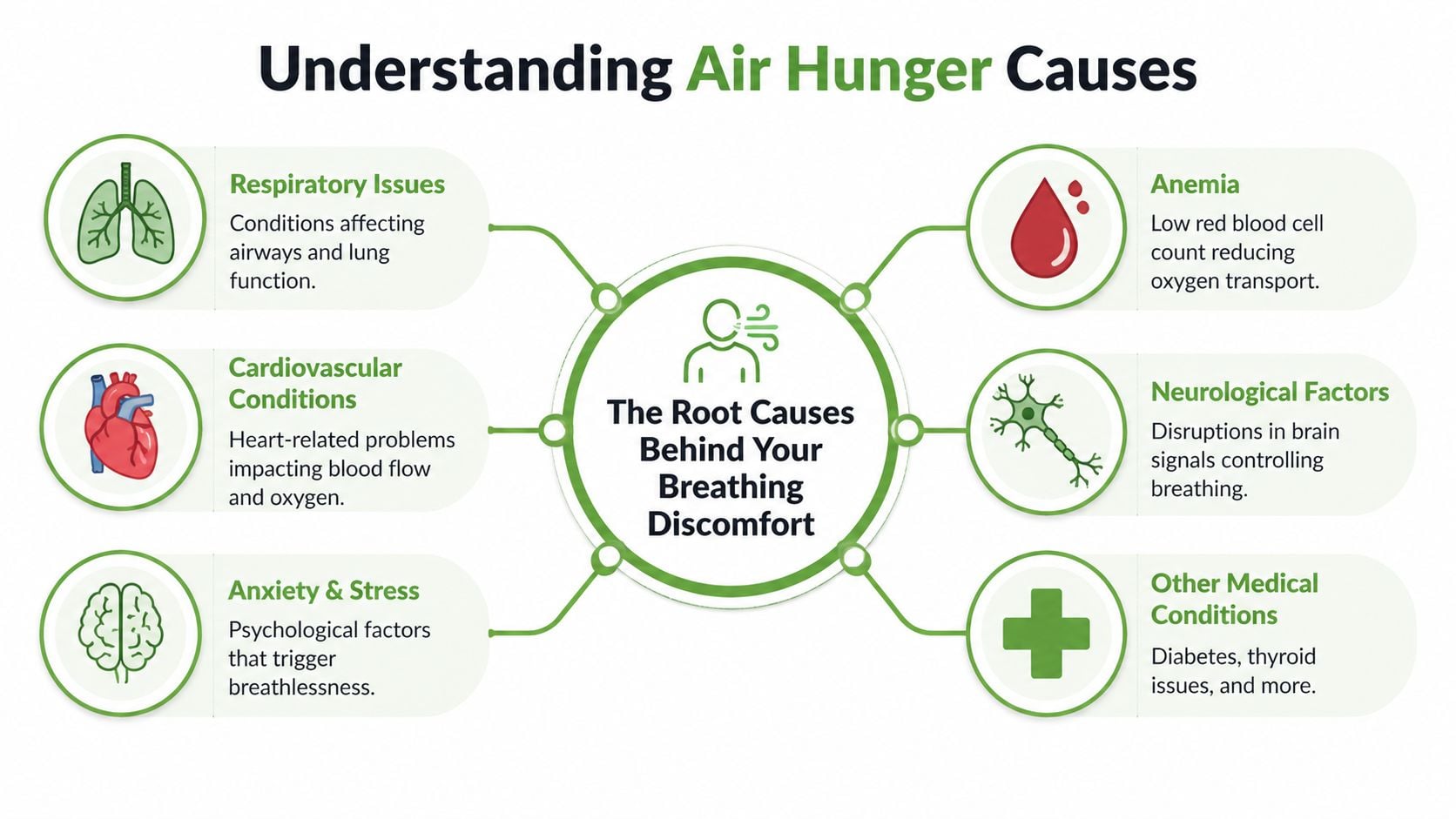
Anxiety and autonomic dysregulation
Anxiety can trigger real air hunger. The mechanism is a shift in breathing control and threat perception. Breathing becomes faster, higher in the chest, less tolerant of carbon dioxide, and more closely monitored. Once that loop starts, every breath can feel unsatisfying.
The University of Cincinnati discussion of air hunger causes and symptoms describes this autonomic pattern well and notes that slow, paced breathing can reduce symptoms in some patients.
What gets missed is the reason the nervous system became so reactive in the first place. In practice, I often see anxiety layered on top of poor nasal airflow, jaw retrusion, tongue crowding, clenching, or fragmented sleep. The patient feels panicky because breathing is unstable. Anxiety is part of the picture, but it is not always the starting point.
Sleep-disordered breathing and upper airway resistance
Nighttime air hunger deserves a sleep-focused review, even in patients who have never been told they snore or stop breathing. Repeated flow limitation can increase breathing effort enough to wake the brain without causing the classic oxygen drops people associate with sleep apnea.
That pattern is common in upper airway resistance syndrome. The airway narrows just enough to raise resistance, disturb sleep, and keep the body in a light defensive state. Patients may report insomnia, morning headaches, jaw tension, nonrestorative sleep, or a sense that they keep “chasing” a satisfying breath.
For a broader medical review of reasons for shortness of breath, remember that airway causes are only one part of the differential and should be considered alongside heart, lung, blood, and systemic conditions.
Structural and functional airway problems
This is the piece many patients find most validating. A symptom that feels emotional can still come from mechanics.
Three contributors show up repeatedly in airway-focused practice:
- Poor nasal breathing: Congestion, turbinate enlargement, septal deviation, chronic inflammation, or habitual mouth breathing reduce the nose’s ability to condition and regulate airflow.
- TMJ and jaw position problems: A retruded mandible, bite instability, clenching, or temporomandibular joint dysfunction can reduce tongue space and make the upper airway less stable.
- Low tongue posture and oral dysfunction: Poor resting tongue position, dysfunctional swallowing, and weak oral muscle coordination can worsen airflow during both wakefulness and sleep.
These issues matter because breathing is not just about the lungs. It also depends on how air enters, how much resistance the upper airway creates, and how hard the body must work to move that air. When the nose is blocked or the jaw-tongue relationship is unfavorable, the brain often reads the extra effort as “not enough air.”
This is why some patients are told they are anxious for years while the underlying driver remains untreated.
Other medical causes that must stay on the radar
Air hunger can also come from pulmonary disease, cardiac conditions, anemia, metabolic disorders, infection, medication effects, or acute emergencies such as pulmonary embolism. Those causes move higher on the list when symptoms are new, rapidly progressive, clearly exercise-limiting, or paired with red-flag features.
The practical point is simple. Air hunger deserves respect. It may reflect dysregulated breathing, a structurally compromised airway, a sleep-related breathing problem, another medical disorder, or several at once.
The pattern that changes treatment
Different root causes can produce the same distressing sensation. The treatment only works well when it matches the driver.
A patient with overbreathing and autonomic arousal may improve with breathing retraining such as Buteyko-style work, sleep stabilization, and nervous system downtraining. A patient with nasal resistance, TMJ dysfunction, and tongue crowding may need nasal treatment, oral appliance or bite evaluation, osteopathic or myofunctional support, and a sleep-airway assessment. Many need a combination plan. That is the trade-off in this symptom. Quick labels are easy, but they miss the mechanism that needs treatment.
How We Get the Right Diagnosis for Air Hunger
A common referral pattern goes like this. The patient says, “I feel like I cannot get a satisfying breath.” Pulse oximetry is normal. A basic cardiopulmonary workup does not show an obvious emergency. The symptom gets filed under anxiety, and the patient is left with the same frightening sensation.
That approach misses a problem I see often in practice. Air hunger can feel psychogenic and still have a mechanical driver, especially when nasal breathing is poor, the jaw and tongue posture are unfavorable, or sleep-related airway resistance is disrupting breathing around the clock.

The history matters more than people think
The first pass is not a fishing expedition. It is pattern recognition.
I want to know when the sensation shows up, what the patient means by “can’t breathe,” and what is happening around it. Air hunger at sleep onset suggests a different mechanism than air hunger during exercise, long conversations, or periods of nasal congestion. Repeated yawning, throat tightness, frequent sighing, dry mouth on waking, jaw pain, clenching, and morning headaches all change the differential.
Small details matter here. A patient who feels worse lying flat, sleeps with an open mouth, and has TMJ symptoms may need a different workup than a patient whose symptoms flare mainly during stress and improve with slower nasal breathing. Some have both patterns at the same time.
Examining the airway, not just the lungs
A useful exam goes beyond listening to the chest and checking oxygen saturation. It looks at whether the patient can breathe well through the nose, keep the lips comfortably closed, rest the tongue on the palate, and maintain an open upper airway without excess strain.
That assessment can include:
- Nasal airflow and congestion pattern
- Lip seal and habitual mouth breathing
- Tongue posture and oral crowding
- Palate shape and arch width
- Jaw position and bite relationship
- Signs of clenching, bruxism, or TMJ dysfunction
- Neck, facial, and accessory breathing muscle tension
- Breathing pattern at rest, including rate, depth, and upper-chest dominance
Patients often feel relief when someone finally examines these pieces together. The symptom stops sounding vague once you connect it to poor nasal airflow, oral crowding, jaw tension, or a breathing pattern that is working too hard.
Distinguishing psychogenic and structural patterns
This part requires discipline. Anxiety can amplify air hunger. It can also be a consequence of struggling to breathe comfortably for months or years.
I do not treat those possibilities as competing explanations. I sort out how much each one is contributing. A patient may have overbreathing, autonomic arousal, and a structurally narrowed airway at the same time. That overlap is common in sleep and airway medicine, and it is one reason single-label diagnoses fail.
When a patient says, “I know I’m anxious, but my breathing still doesn’t feel mechanically right,” that statement deserves a real airway review.
The practical question is straightforward. Is the nervous system creating a false alarm, is the airway creating real resistance, or are both feeding each other? The answer determines whether the next step should focus on breathing retraining, nasal treatment, TMJ and bite evaluation, sleep testing, osteopathic or myofunctional support, or a combination.
The role of sleep testing and functional assessment
Sleep testing becomes more useful when the history points in that direction. Snoring, waking up gasping, dry mouth, fragmented sleep, morning headaches, and unrefreshing sleep all raise concern for sleep-disordered breathing. Home sleep apnea testing can help in the right patient, although it does not capture every form of upper-airway resistance or subtle sleep fragmentation.
That trade-off matters. A “normal” or mildly abnormal study does not automatically clear the airway if the clinical picture still suggests flow limitation, poor nasal breathing, jaw-related restriction, or effortful breathing during sleep. In those cases, the diagnosis comes from combining test results with the exam and symptom pattern, not from outsourcing judgment to a single report.
The most useful diagnostic process usually has three parts:
- Medical safety screening for urgent cardiac, pulmonary, hematologic, infectious, and metabolic causes
- Airway and sleep assessment for obstruction, resistance, nasal dysfunction, and oral-facial contributors
- Breathing pattern evaluation for overbreathing, mouth breathing, and autonomic dysregulation
That is how the picture becomes clear enough to treat the cause instead of chasing the sensation.
Immediate Relief and Long-Term Treatment Strategies
Patients usually ask two urgent questions. How do I get through this episode, and how do I stop it from coming back?
I separate those on purpose. A maneuver that settles the nervous system in the moment is helpful, but lasting relief usually comes from correcting the reason breathing feels mechanically unsatisfying in the first place. In practice, that often means treating both breathing pattern dysfunction and the airway problem underneath it, especially in people with chronic mouth breathing, nasal blockage, TMJ strain, or sleep-disordered breathing.

What to do during an episode
Start by reducing effort. Air hunger often gets worse when a person keeps trying to force a satisfying breath.
A practical sequence is:
Change your position
Sit upright with your neck neutral, jaw unclenched, and feet on the floor. If you are slumped, chin-forward, or tight through the upper chest, the sensation often intensifies.Breathe through the nose if you can
Keep the lips gently together and let the breath stay quiet. Mouth breathing can dry the airway, increase upper chest tension, and make the breath feel less controlled.Slow the exhale
Take a gentle inhale through the nose, pause briefly, then exhale longer than you inhaled. The exact count matters less than the pattern. A soft, unforced breath with a longer exhale usually settles the alarm response better than repeated deep sighs.Stop chasing a “full” breath
That urge is common. It also feeds the cycle. Repeated rescue breaths can lower carbon dioxide tolerance and make the next breath feel even less satisfying.Escalate care if warning signs are present
Chest pain, fainting, blue lips, one-sided weakness, severe wheezing, or fast worsening symptoms need urgent evaluation.
What tends to make it worse
Patients often do what feels intuitive. They pull harder for air, monitor every breath, and assume they need more volume. That approach can backfire.
Common problems include:
- Large repeated mouth breaths, which can increase dryness, chest tightness, and overbreathing
- Constant checking, which raises threat perception and keeps the nervous system activated
- Treating it as anxiety alone, which can miss nasal obstruction, jaw restriction, or sleep-related flow limitation
- Using sedating quick fixes without follow-up, which may blunt the sensation without identifying the driver
Long-term therapies that address root causes
The right long-term plan depends on why the body keeps signaling air shortage. I see the best results when treatment improves function at more than one level: nasal airflow, tongue posture, jaw mechanics, sleep breathing, and carbon dioxide tolerance.
Buteyko breathing and breathing retraining
Breathing retraining is useful for patients who sigh often, overbreathe, feel unable to complete a breath, or switch quickly into mouth breathing under stress. The goal is not bigger breathing. The goal is quieter, more efficient breathing with better tolerance for normal shifts in carbon dioxide.
That distinction matters. Many patients with air hunger have been told to “just take a deep breath,” but deep breathing drills can worsen symptoms if the underlying pattern is chronic overbreathing layered onto a narrow or unstable airway.
Orofacial myofunctional therapy
Orofacial myofunctional therapy, or OMT, helps restore lip seal, tongue posture, swallowing mechanics, and oral rest posture. Those details affect the airway more than people realize.
A low tongue posture, open-mouth posture, and jaw tension can reduce airway support throughout the day and during sleep. If that pattern is present, learning how to breathe through your nose becomes part of treatment, not a lifestyle extra.
Sleep, nasal, and TMJ support
Some patients need more than retraining because the breathing mechanics are being disrupted by structure. If the nose is blocked, the jaw sits in a strained position, or the airway narrows during sleep, the plan may include:
- Custom oral appliances
- Targeted TMJ care
- Nasal treatment through appropriate medical referral
- Sleep-focused behavioral changes
- Coordination with ENT, sleep medicine, dental sleep, or myofunctional providers
This is the point many patients find validating. A symptom that feels psychological can still have a structural driver. Anxiety may amplify air hunger, but poor nasal breathing, tongue position, bite issues, and upper airway resistance often create the sensation that something is wrong. The body is not inventing that signal.
For older adults, people recovering from illness, or anyone with poor posture and chest wall stiffness, global mechanics matter too. Broader rehab support such as physical therapy for seniors can complement airway-specific care when endurance, rib mobility, balance, or conditioning are part of the problem.
A short visual explanation can also help patients understand how calmer breathing practice fits into a larger treatment plan:
The best treatment plan matches the mechanism. Breathing retraining helps dysregulation. Airway treatment helps resistance and collapse. Many patients need both.
Your Next Steps Toward Breathing Freely
Air hunger symptoms are not something you should have to normalize. If you keep needing deep breaths, wake up feeling starved for air, or notice that anxiety and breathing discomfort feed each other, that’s a signal worth following.
The important shift is this. Don’t ask only whether the symptom is psychological. Ask whether your airway, sleep, jaw function, nasal breathing, and breathing pattern have been evaluated thoroughly enough.
A sensible next move
Start with a practical checklist:
- Seek urgent care now if symptoms are severe, sudden, or tied to red-flag signs
- Track the pattern if episodes are recurring, including time of day, sleep position, nasal congestion, jaw tension, and stress triggers
- Request evaluation if you snore, mouth breathe, clench, wake unrefreshed, or feel worse lying down
- Look for root-cause care that considers sleep, airway structure, oral function, and breathing behavior together
For referring doctors, recurrent air hunger symptoms deserve more than reassurance when the story suggests sleep-disordered breathing, upper airway resistance, TMJ-related airway compromise, or dysfunctional breathing. The patient may need multidisciplinary assessment rather than another short trial of symptom suppression.
Relief is possible. The path usually gets clearer when the symptom is treated as valid, the airway is examined carefully, and therapy is aimed at function instead of guesswork.
Frequently Asked Questions About Air Hunger
Can anxiety really cause air hunger symptoms?
Yes. Anxiety can alter breathing rhythm, increase threat sensitivity, and make normal sensations feel unsafe. But that doesn’t mean the symptom should automatically be written off as psychological only. Anxiety and structural airway issues often overlap, and both may need treatment.
How can I tell whether it’s anxiety or an airway problem?
The pattern helps. If symptoms happen mostly in moments of stress and improve with paced breathing, anxiety-related dysregulation may be a large part of the picture. If symptoms show up during sleep, while lying down, with mouth breathing, snoring, jaw tension, nasal blockage, or chronic fatigue, airway and sleep causes need investigation.
The distinction is not always clean. Many patients have both.
Can TMJ dysfunction contribute to air hunger symptoms?
Yes. TMJ dysfunction can affect jaw posture, muscle tension, tongue position, and the way the upper airway is supported. Some patients with jaw pain, clenching, facial tension, and poor sleep also report an unsatisfied need to breathe. In those cases, treating the jaw without considering the airway misses part of the problem.
Does poor nasal breathing really matter that much?
It often does. The nose conditions airflow, supports more stable breathing, and helps maintain better oral posture. When nasal breathing is poor, people often switch to mouth breathing, especially during sleep or stress. That can increase dryness, snoring, unstable breathing patterns, and the feeling that breathing never quite settles.
Can children have air hunger-related patterns too?
Yes. Children may not describe “air hunger” the way adults do, but they can show the pattern through mouth breathing, restless sleep, snoring, dark circles, frequent sighing, daytime irritability, and poor oral rest posture. In some cases, tongue-tie, nasal issues, or craniofacial development concerns contribute to the pattern and deserve evaluation.
What does Buteyko actually do?
Buteyko breathing is a retraining method. It aims to reduce habitual overbreathing, improve tolerance to normal breathing sensations, and restore quieter nasal breathing. For the right patient, it can reduce the constant urge to “grab” deep breaths and make breathing feel less effortful and more automatic.
If I’ve been told it’s just anxiety, what should I do next?
Take the symptom seriously anyway. Ask whether anyone has evaluated your sleep, nasal airflow, jaw position, tongue posture, and breathing pattern in a structured way. “Just anxiety” is often what people hear when the workup stopped too early.
Is weight the only real reason people develop nighttime breathing problems?
No. Weight can contribute in some patients, but it is far from the only factor. Jaw anatomy, tongue posture, nasal obstruction, oral habits, muscle tone, sleep position, and airway structure all matter. Thin patients can have meaningful sleep-disordered breathing, and larger patients can also have strong functional breathing issues that need more than a single explanation.
Can I fix air hunger symptoms on my own with breathing exercises?
Sometimes you can improve the intensity of episodes, especially if overbreathing is part of the problem. But self-treatment has limits. If symptoms are recurrent, sleep-related, associated with TMJ issues, or causing fear and functional impairment, you need a proper medical and airway-focused evaluation.
If air hunger symptoms are affecting your sleep, breathing comfort, jaw tension, or daily quality of life, Pain and Sleep Therapy Center offers root-cause evaluation for TMJ disorders, airway dysfunction, and sleep-related breathing issues. Their team focuses on non-surgical, function-based care, including sleep assessment, orofacial myofunctional therapy, and breathing retraining, so patients can move toward steadier breathing and more restorative sleep.