
You're standing by the crib or the bed, listening to a child breathe, and something doesn't sit right. The snoring is loud enough to hear through a closed door, the sleep looks restless, and mornings feel harder than they should. Parents often get told a child will “grow out of it,” but when sleep keeps looking messy night after night, it's worth taking a closer look at the airway, not just the noise.
Pediatric sleep apnea is often missed because the signs don't always look like adult sleep apnea. A child may not complain about being sleepy, but instead shows up as cranky, inattentive, hard to wake, or wired at bedtime. That's why families can spend months or even years solving the wrong problem while the actual one keeps disrupting sleep.
A lot of online advice frames this as a tonsil issue or a weight issue. Those can matter, but they're only part of the story. The bigger picture is airway development, how the nose, mouth, jaw, tongue, and throat are all growing together, and why a team approach often finds what a single exam misses. If you've already been searching for answers, an airway-focused evaluation like the one described in this pediatric airway obstruction resource can help make the next steps clearer.
When a Child's Sleep Doesn't Look Right
The pattern is often familiar. A parent notices snoring, pauses, mouth breathing, or a child who seems sweaty and restless all night, then shrugs it off because the child still sleeps for hours. By morning, though, the story doesn't match the hours in bed, there's dragging out of bed, moodiness, and a child who seems tired in a way that never fully lifts.
What parents usually notice first
The first clue is rarely a formal complaint. It's the sound, the posture, or the way a child seems to fight sleep rather than settle into it. Some children sleep with their mouths open, some toss and turn, and some seem to wake up less refreshed than you'd expect after a full night.
Then the school concerns start. A teacher may mention inattention, daydreaming, or behavior that looks like defiance when the core issue is fragmented sleep. That's one reason pediatric sleep apnea gets missed in routine visits, especially when a child looks fine sitting on the exam table.
Practical rule: if a child's sleep sounds loud, looks effortful, or leaves them oddly worn out in the morning, treat it as an airway clue, not just a bedtime habit.
Pediatric sleep apnea is often underrecognized unless someone specifically asks about breathing during sleep. Even then, parent reports and confirmed disease don't always line up, which is why the diagnosis can be delayed. The important shift is to stop thinking of snoring as harmless background noise and start thinking about whether the airway is staying open through the night.
The families who feel stuck in this loop usually aren't overreacting. They're noticing a pattern that deserves a real workup, especially when the child's daytime behavior, energy, or school performance doesn't fit the amount of sleep they're supposedly getting.
Understanding Pediatric Sleep Apnea
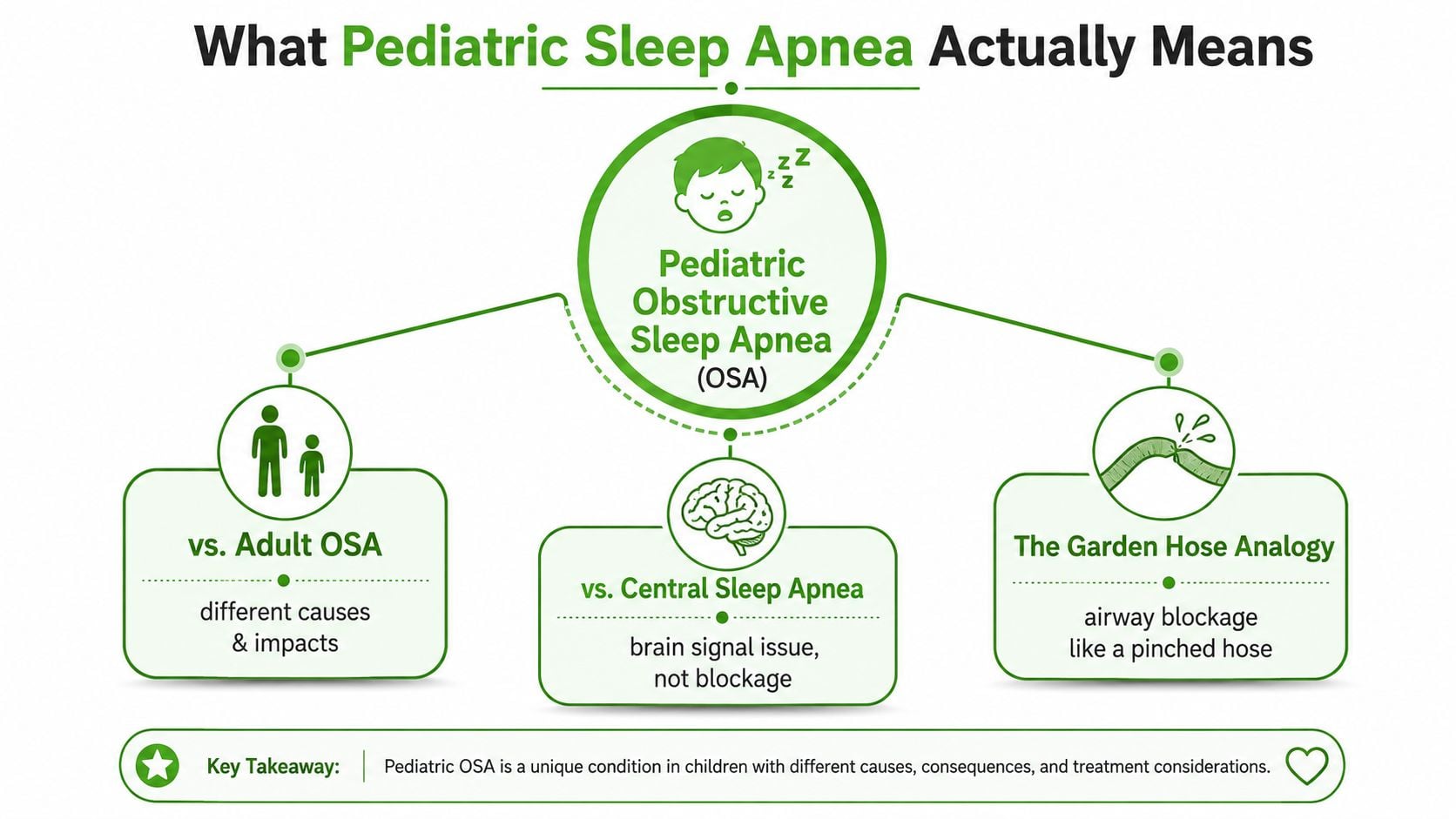
Pediatric obstructive sleep apnea means a child's airway narrows or closes during sleep often enough to disturb breathing, sleep quality, or both. A child may snore and still breathe adequately, but sleep apnea means the airway is not staying open reliably through the night. It is also different from central sleep apnea, where the brain's breathing signal is the main problem rather than a physical blockage. A simple way to picture it is a partly pinched garden hose, water still gets through, but not smoothly or consistently.
Why children are scored differently than adults
Children are not judged with the same sleep study thresholds used for adults. In pediatric sleep medicine, AHI ≥ 1 event per hour is often considered abnormal, according to polysomnography criteria and pediatric thresholds. Severity is commonly described as mild at AHI 1 to 4.9, moderate at AHI 5 to 9.9, and severe at AHI > 10. That matters because a child can have meaningful disease at numbers that would look small on an adult sleep report.
A child's sleep study also looks beyond airflow alone. Pediatric sleep medicine pays close attention to oxygen levels and carbon dioxide because some children do not just pause breathing, they hypoventilate, which means they do not move enough air for part of the night. One pediatric criterion used in sleep labs is PₑdETCO2 > 50 mm Hg for more than 25% of sleep time, sometimes along with desaturation, snoring, and paradoxical chest movement.
A child's sleep study is not just asking, “Did breathing stop?” It is asking, “Was breathing steady enough to support healthy sleep architecture, oxygenation, and gas exchange?”
Why this matters to parents
If your child snores, that does not automatically mean they have sleep apnea. If they do have sleep apnea, they usually need a real airway evaluation, not just reassurance. The exam often has to look at the whole airway, since the problem can involve the nose, adenoids, tonsils, jaw position, tongue posture, and the way the airway develops over time.
That is why a team approach matters. ENT, sleep medicine, dental sleep, and orofacial myofunctional therapy can each see a different part of the same problem, and together they help explain why a child's airway is struggling during sleep.
Why Children Get It and How Causes Shift With Age
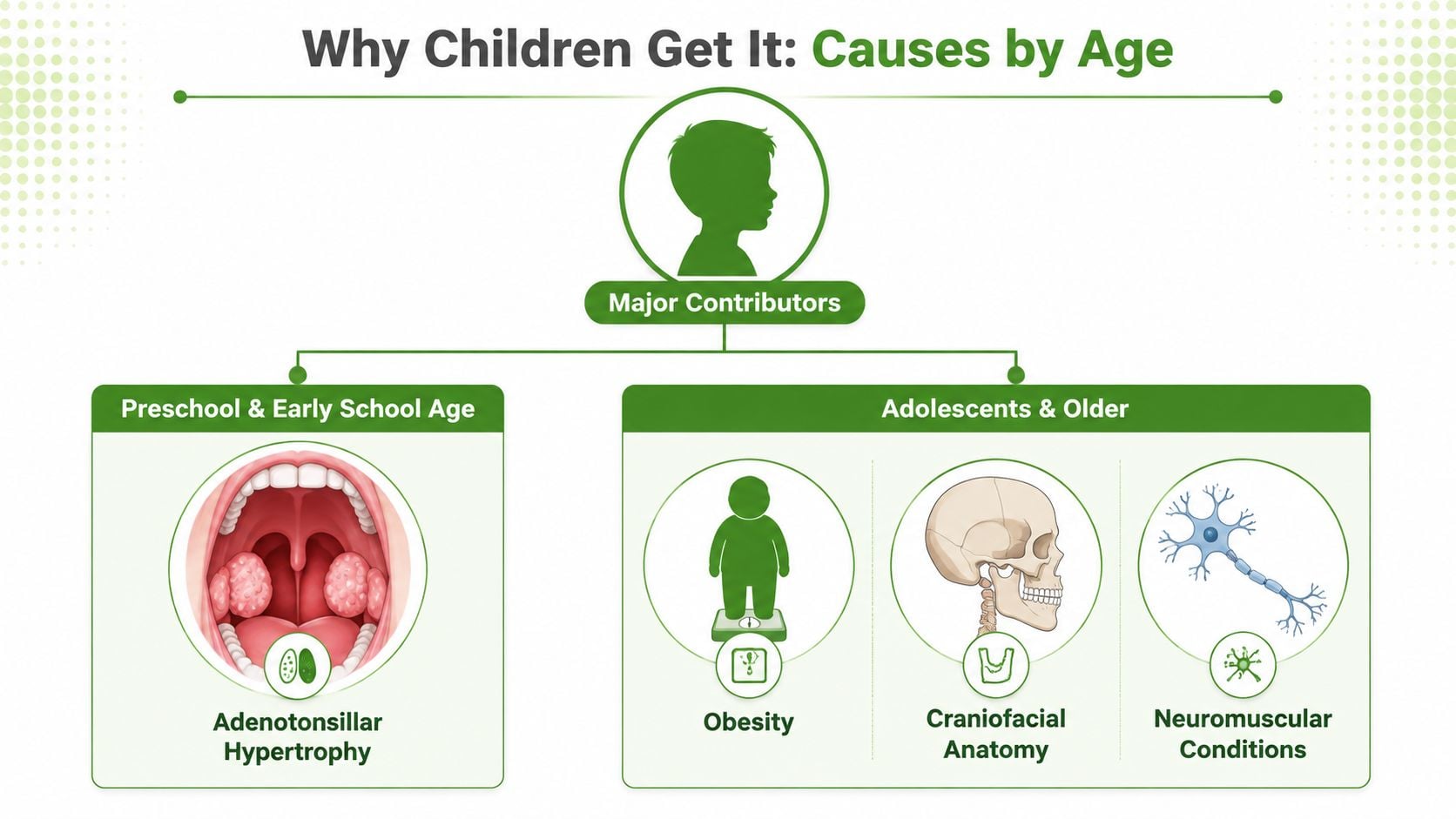
A child's airway is not a fixed tube. It grows, changes shape, and responds to the tissues around it, so the main drivers of pediatric sleep apnea shift as children get older. In younger children, adenotonsillar hypertrophy is the leading cause. In older children and adolescents, obesity becomes the leading cause (age-related pathophysiology).
The dominant cause changes as the airway develops
That age pattern helps explain why a 5-year-old and a 13-year-old can both snore, but for very different reasons. A younger child may have enlarged tonsils and adenoids crowding the airway, while an older child may have several contributors at once, including body habitus, airway tone, and structural narrowing. Pediatric sleep apnea is often reported in the preschool and early school-age years, with peak prevalence commonly described around ages 2 to 8 (epidemiology review).
This airway-development view changes what treatment should target. If the main problem is lymphoid tissue, removing that tissue may help a great deal. If the child's airway is narrow for other reasons, surgery alone may not solve the whole problem, and a plan that includes orthodontics, sleep medicine, or CPAP can make more sense.
Other contributors that shape the airway
Craniofacial structure can make a big difference. A narrow palate, a smaller jaw, or a more recessed chin leaves less room for the tongue and soft tissues, which makes the airway easier to crowd during sleep. Allergic rhinitis, neuromuscular weakness, and secondhand smoke exposure can also raise risk by making nasal breathing harder or reducing airway stability.
A child's airway can be more vulnerable during growth spurts and orthodontic transitions because the mouth, jaw, and nose do not all grow at exactly the same pace. That is why a child who seemed fine at one stage can become much noisier or more symptomatic later. The key point is simple. There is not one pediatric sleep apnea profile, there are several.
Symptoms That Are Obvious and Symptoms That Are Easy to Miss
Some symptoms are loud enough to wake the whole house. Others look like personality, behavior, or school trouble until someone connects the dots. Parent-reported habitual snoring is much more common than confirmed disease, typically 5% to 12% overall, while parent-reported apneic events are estimated at 0.2% to 4%. That gap is one reason “just snoring” can still deserve a workup.
What to listen for at night
The obvious signs are the ones families usually describe first, habitual snoring, gasping, choking sounds, witnessed pauses, and restless sleep. Mouth breathing, night sweats, odd sleeping positions, and a child who seems to work hard just to keep sleeping are also important clues.
The subtler signs are the ones that confuse families and clinicians. A child might be irritable, inattentive, or hard to settle in the evening. Some children wake with headaches, some struggle in school, and some act exhausted but never say they're sleepy.
Clinician screen: ask whether the child snores more than half the nights, sleeps with an open mouth, gasps or pauses in sleep, wakes sweaty, struggles to wake up, or has daytime behavior or school problems that don't match their age.
A practical parent checklist
- Snoring pattern: Is the snoring frequent, loud, or nearly nightly?
- Breathing effort: Do you see gasps, choking, or pauses?
- Sleep quality: Does the child toss, turn, or sleep in unusual positions?
- Morning function: Is waking up hard, even after enough hours in bed?
- Daytime behavior: Are there attention, mood, or school concerns that keep getting labeled as “behavior”?
If you want a parent-friendly overview to compare with what you're seeing at home, this child sleep apnea symptoms guide is a useful companion to bring to the conversation with your pediatrician.
The main trap is assuming a child who slept all night can't have a sleep problem. In pediatric sleep apnea, the key question is airway stability during sleep, because sleep only restores the body when breathing stays steady enough for it to do its work.
The Diagnostic Path for Pediatric Sleep Apnea
A child usually enters the diagnostic path through primary care, where the first job is to decide whether the breathing pattern during sleep points toward an airway problem. The pediatrician asks about snoring, mouth breathing, behavior, and school performance, then decides whether the child should be seen by an ENT or a sleep specialist. If allergies or chronic nasal congestion are part of the picture, those concerns are folded into the evaluation too, because the airway is a connected system, not a single narrow spot.
A helpful way to picture the workup is as a map of the whole airway. Tonsils and adenoids may be the most visible landmarks, but the nose, jaw, tongue posture, and breathing pattern can also shape how well air moves during sleep. That is why the diagnosis often needs more than one set of eyes.
Why the sleep study matters most
For most children, overnight polysomnography is the gold standard because it measures far more than airflow. It tracks brain activity, breathing, oxygen, carbon dioxide, sleep stages, and movement, which is why a child's report can look very different from an adult home test. Home sleep tests can sometimes fit older, otherwise healthy adolescents with classic snoring, but they are not the usual starting point for younger children or for children with complex symptoms, including some of the sleep challenges in autistic children.
Here is the basic grading used in many pediatric reports.
| Severity | AHI (events/hour) | Other PSG criteria |
|---|---|---|
| Mild | 1 to 4.9 | Abnormal for children, interpreted with symptoms and gas exchange |
| Moderate | 5 to 9.9 | Often more likely to affect daytime function and sleep quality |
| Severe | >10 | Higher burden of obstruction or hypoventilation concerns |
The report also includes oxygen nadir, carbon dioxide patterns, and sleep architecture, which help the sleep physician judge how disruptive the night really was. That is why pediatric PSG is typically interpreted by sleep medicine specialists rather than by the ordering clinician alone. In practice, the study helps separate simple snoring from breathing that fragments sleep and strains the airway.
Who should be in the room
A full airway evaluation often benefits from more than one specialty. Pediatricians screen and coordinate, ENTs assess obstructive anatomy, sleep medicine interprets the study, dental sleep medicine looks at oral structure and growth patterns, and orofacial myofunctional therapy can address tongue posture, lip seal, and nasal breathing habits.
That team approach matters because pediatric sleep apnea is often an airway-development problem, not just a tonsil problem or an obesity problem. A child may need the ENT to look at adenoids and nasal blockage, the sleep physician to read the overnight study, and the dental or myofunctional clinician to assess whether the tongue and jaws are growing in a way that supports stable breathing. The question is not only what blocks the airway tonight, but what is shaping it over time.
Evidence-Based Treatment Options From Adenoids to Airway Therapy
A child's treatment plan should follow the cause of the airway problem, not just the loudest symptom. If enlarged tonsils and adenoids are the main blockage, adenotonsillectomy is often the first treatment used in children. If obesity or collapse at more than one level of the airway is contributing, surgery alone may leave part of the problem in place, so CPAP, weight management, and ongoing airway support may still be needed.
Matching the treatment to the airway problem
A child with craniofacial contributors may need orthodontic input, such as maxillary expansion or a mandibular advancement device, depending on age and anatomy. These approaches try to widen or reposition the space the air has to move through, which can matter when the jaw and palate are part of the crowding. A child whose tongue posture, lip seal, or nasal breathing pattern is part of the problem may benefit from orofacial myofunctional therapy, which retrains the muscles that help keep the airway stable during sleep and at rest.
Tongue-tie evaluation can fit into that plan when limited tongue movement affects feeding, oral posture, or resting mouth position. It is not a universal fix for sleep apnea, and it should not be treated that way. It is one possible piece of a broader oral-restoration plan when the exam supports it.
Weight management and allergy control belong in the same conversation because both can change airway load and nasal breathing. Positional therapy can help in selected cases, especially when a child's sleep position makes obstruction worse. For families looking at comfort measures alongside medical care, the wedge pillow benefits medical guide can provide useful background, though it does not replace an airway evaluation. If a family needs a place to start, a pediatric sleep apnea treatment resource can help show how these options are commonly organized into one plan.
Why interdisciplinary care matters
Practical rule: if the treatment plan only targets one structure, ask what the rest of the airway is doing.
An ENT may clear blocked tissue, a sleep physician may confirm whether breathing improved, and a dental or myofunctional team may help the mouth and jaw function in a way that supports nasal breathing over time. Pain and Sleep Therapy Center is one example of a clinic model that combines sleep-related breathing care with dental sleep medicine, pediatric oral health support, and orofacial myofunctional therapy.
That team approach fits the bigger picture well because pediatric sleep apnea is often an airway-development problem, not just a tonsil problem or an obesity problem. A child may need the ENT to look at adenoids and nasal blockage, the sleep physician to read the overnight study, and the dental or myofunctional clinician to assess whether the tongue and jaws are growing in a way that supports stable breathing. The question is what blocks the airway tonight, and also what is shaping it over time.
Why Treating Pediatric Sleep Apnea Early Changes a Child's Trajectory
Untreated pediatric sleep apnea can affect more than sleep. It can show up as inattention, irritability, school struggles, and a child who looks tired but never gets the kind of sleep that restores them. When breathing stays disrupted night after night, the effects can also spill into growth and cardiovascular strain, which is why early treatment is about more than comfort.
The developmental cost of waiting
A child's airway is still changing, so early treatment can work with growth instead of against it. That matters because habits also form early, breathing through the nose, keeping the mouth closed at rest, and sleeping with a stable posture are all easier to establish when the airway is addressed sooner. Once those patterns harden, they can be harder to change.
The other reason to act early is equity. Pediatric sleep-disordered breathing is underrecognized, PSG access isn't equal in many places, and racial, ethnic, and socioeconomic disparities affect who gets diagnosed and how quickly they're treated (disparities review). Earlier attention can reduce the chance that a child's symptoms get dismissed because the family had to push harder for answers.
Practical rule: if a child has persistent snoring plus behavior, school, or growth concerns, don't wait for the problem to “declare itself” more clearly.
That waiting period is often where children lose time. A careful airway evaluation can turn a vague label into a plan with a real target.
Follow-Up Care and When to Refer to a Specialty Airway Clinic
Follow-up matters because a child's airway can change after treatment. After adenotonsillectomy, persistent snoring or daytime symptoms can mean residual disease, and that's when a repeat sleep study may be appropriate. If CPAP is part of care, kids often need desensitization, mask fitting, and steady coaching so the equipment becomes tolerable rather than a nightly battle.
What good follow-up looks like
- Post-op reassessment: ask whether symptoms improved, not just whether surgery was completed.
- Repeat PSG when indicated: persistent snoring, restless sleep, or daytime issues deserve objective re-checking.
- Ongoing myofunctional work: tongue posture, lip seal, and nasal breathing habits may need reinforcement.
- Orthodontic coordination: if expansion or other dental airway work is part of the plan, the timeline should be clear.
- Family questions: ask who is monitoring symptoms, who owns the follow-up, and what the next trigger for re-evaluation is.
A specialty airway clinic makes sense when the story is more complex than a single obstructive site. That includes persistent snoring after surgery, residual findings on repeat PSG, complex craniofacial anatomy, suspected tongue-tie affecting feeding or airway function, TMJ or facial pain symptoms, or a family that wants an interdisciplinary second opinion. If you're looking for a gentle pediatric dental partner to coordinate that kind of evaluation, gentle childrens dentist New York is one example of the kind of referral resource some families explore when oral health and airway questions overlap.
The right next step is usually not “wait and see.” It's a follow-up plan that matches the airway problem your child has, and that plan works best when ENT, sleep medicine, dental sleep, and myofunctional care are aligned.
Pain and Sleep Therapy Center works with families who are trying to sort out snoring, pediatric airway concerns, TMJ symptoms, and sleep-related breathing issues in one place. If your child's sleep doesn't look right, visit Pain and Sleep Therapy Center to learn how an interdisciplinary airway evaluation can help you figure out what's happening and what to do next.