You've probably lived some version of this already. The ibuprofen takes the edge off for a while, the muscle relaxer makes you groggy, the night guard protects your teeth, and the jaw still clicks when you chew. The headaches still show up at 3 a.m., sleep still feels broken, and by morning the pain is back exactly where it started.
That pattern is why pain management without medication matters so much in jaw pain, headache care, and sleep-disordered breathing. The goal isn't to prove that medication has no place. The goal is to stop treating pain like a standalone symptom and start asking what is driving it, including airway strain, posture, muscle dysfunction, and ongoing tissue irritation.
A lot of people get stuck because they're only offered symptom control. If the source is a clenching pattern, a blocked airway, a tongue posture problem, or a sensitized joint, pills can mute the alarm without changing the fire. Root-cause care looks different. It asks what happens at night, how the jaw rests, how the neck and shoulders are loading the system, and whether the tissue has a real chance to settle and heal.
When the Pill Bottle Stops Being the Answer
A common TMJ story starts with a dull ache near the ear and a headache that seems to come from the temples. A few weeks later, the person notices morning jaw fatigue, tighter neck muscles, and sleep that never feels restorative. They try anti-inflammatories, maybe a muscle relaxer, maybe a splint, and every one of those tools gives partial relief without closing the loop.
That's the moment I usually hear the same sentence in different forms. “It helps, but it doesn't fix it.” That's not a failure of the patient, and it's not always a failure of the medication. It usually means the pain is being fed by more than one mechanism at once.
Root causes are usually layered
In jaw and facial pain, the usual layers are pretty familiar. Airway compromise can drive mouth breathing and clenching. Postural compensation can load the neck, the jaw, and the base of the skull. Muscle dysfunction can keep the system locked in a protective pattern. Inflammation and tissue irritation can make everything feel sharper than it should.
Practical rule: if the pain keeps returning at the same time every day, look at the habits and positions that repeat at that time, especially sleep and work posture.
That's why the most useful version of pain care is rarely a single intervention. A splint might protect the teeth. A headache medicine might help on a bad day. But if the airway is collapsing at night or the tongue is resting low and forward all day, the system keeps reloading the same tension.
Pain relief is not the same as healing
Medication can be appropriate, and I'd never tell someone to white-knuckle through pain just to prove a point. Still, relief and repair are different jobs. Relief lowers the signal. Repair changes the tissue environment, the breathing pattern, the muscle tone, and the loading pattern that created the signal in the first place.
That's the frame I use with TMJ, headache, and sleep-disordered patients. We're not asking, “What can cover this up?” We're asking, “What lets the jaw unclench, the airway open, the neck unload, and the tissue calm down enough to heal?” That's the promise of pain management without medication.
Why Non-Drug Pain Care Has Gone Mainstream
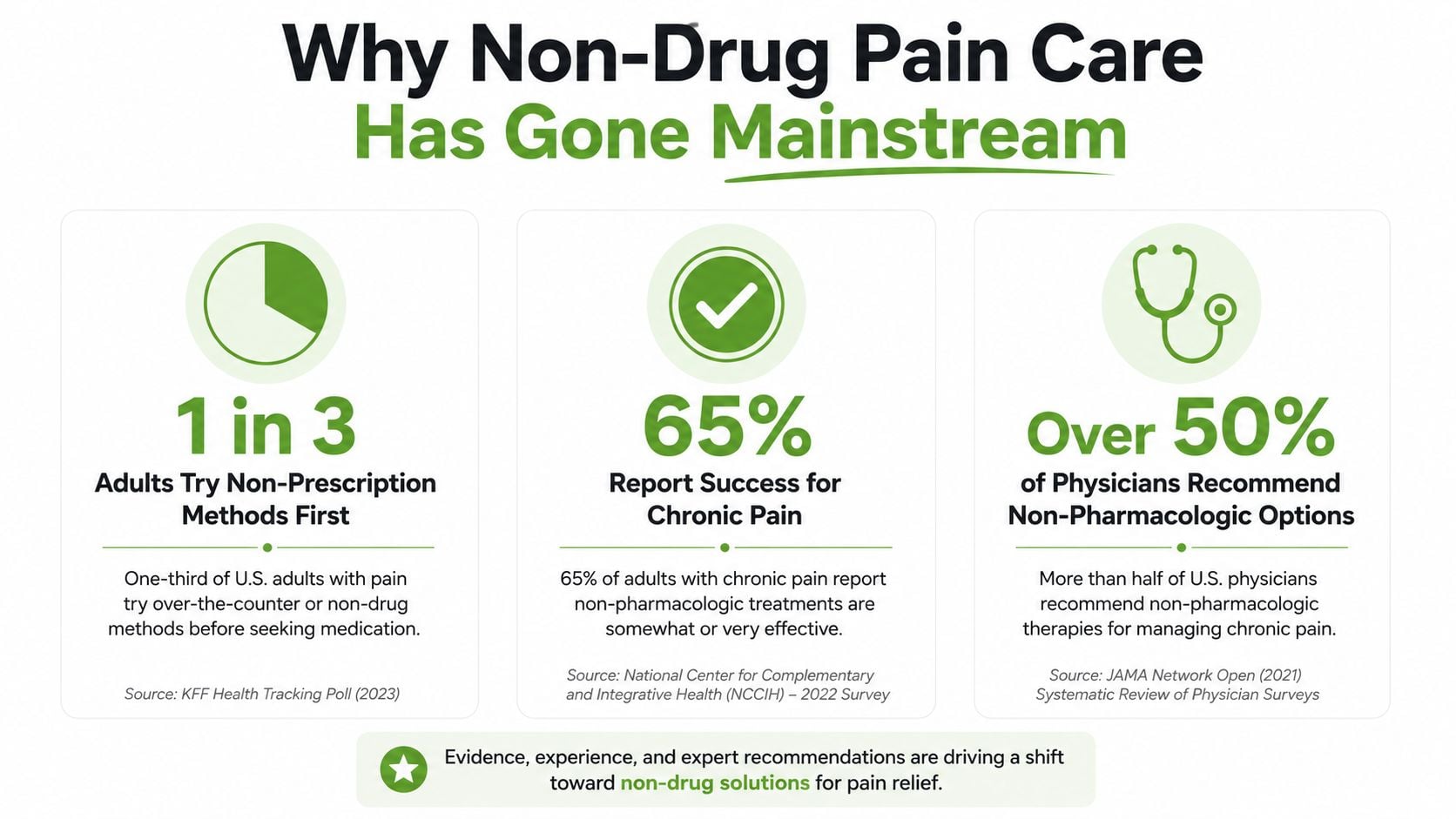
I see this shift every week in clinic. A patient arrives after trying pills, braces, or repeated quick fixes, then asks for something that treats the pattern underneath the pain. That question has moved from the margin to the center of care because the evidence and the lived experience now point in the same direction.
The evidence base is no longer niche or experimental. In a serial cross-sectional study of 46,420 adults using Medical Expenditure Panel Survey data from 2011 to 2019, any nonpharmacologic use reached 43.84% of adults with pain by 2019, and exclusive opioid use for chronic pain fell from 14.43% in 2014 to 10.57% in 2017 while nonpharmacologic treatments rose from 18.50% to 22.50% over the same period, with chiropractic care and physical therapy among the most common approaches (JAMA Network Open). That is a mainstream pattern, not a fringe one.
Patients are also telling us what they want first. In a separate U.S. survey, 78% of adults said they preferred to try other ways to address physical pain before taking doctor-prescribed pain medication, compared with 22% who preferred medication first (AHRQ-backed summary). That does not mean people are anti-medication. It means many want a plan that improves function, breathing, sleep, and tissue loading, not just a temporary drop in symptoms.
What the durability data means in practice
The more useful question is whether the relief lasts. A separate systematic review found that several nonpharmacological interventions can produce small to moderate improvements in pain or function that persist beyond a month, and in some studies up to a year after treatment ends (AHRQ-backed summary). That matters because short-lived relief is not the same as a change in the system.
In practice, the therapies that keep showing up are the ones that change load, movement, attention, and stress reactivity at the same time. Exercise, physical therapy, complementary therapies, and behavioral approaches can all help, but the match has to fit the problem. A painful jaw joint, a migraine pattern, and a sleep-disordered patient with morning headaches do not respond to the same sequence of care.
For some people, the right starting point is airway and sleep support, and an easy place to begin is a guided sleep-breathing exercises resource. For others, the first useful step is myofunctional retraining, posture correction, or targeted manual care.
Mainstream doesn't mean one-size-fits-all
The key lesson is selection, not hype. A pain plan should match the source of the load, the way the muscles are holding, and whether airway or posture are part of the problem. In a migraine-prone patient, I also like to check your daily migraine risk when the pattern is changing, because timing, sleep disruption, and trigger stacking often matter more than people expect.
The more a pain pattern reflects airway dysfunction or muscle dysfunction, the more important it is to use the right non-drug tool in the right order. That is how non-medication care stops being a generic checklist and starts acting like real treatment.
Building Your Daily Non-Medication Foundation
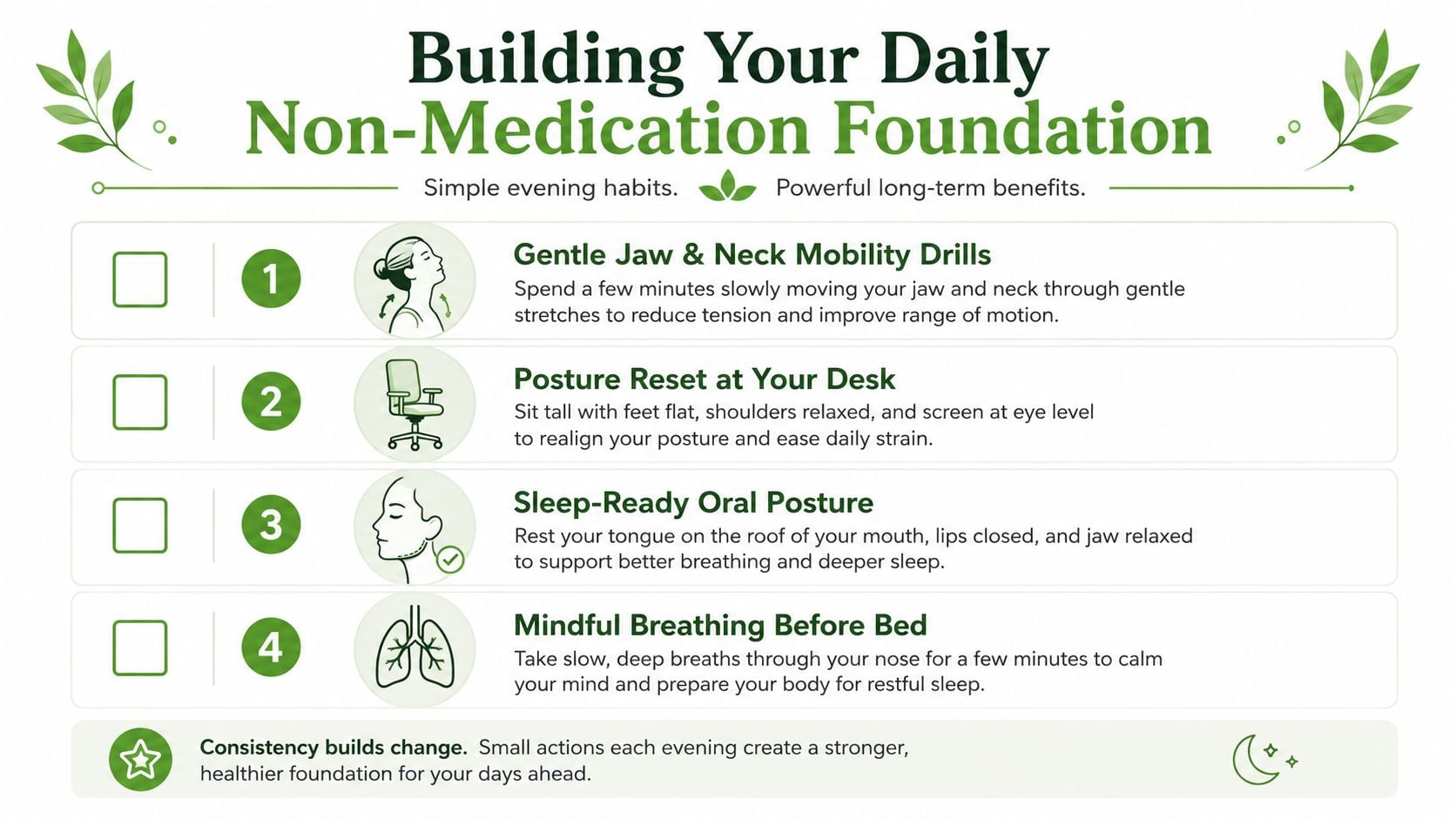
The first layer is boring in the best way. It's the stuff that makes the rest of treatment work better, whether the next step is breathing retraining, myofunctional therapy, or office-based regenerative care. If the day is organized around tension, shallow breathing, and poor sleep position, every other therapy has to fight uphill.
Start with the jaw, neck, and desk posture
On waking, the first job is to notice whether the jaw is already braced. Let the tongue rest gently on the palate, keep the teeth apart, and move through a few slow jaw-opening and side-glide motions without forcing range. Add neck rolls only if they're comfortable, and keep them small and smooth.
During the workday, posture resets matter more than perfect posture. A desk chair can't fix a pain problem by itself, but it can stop the accumulation of load. Set the monitor higher, keep the feet supported, and break up long sitting stretches before the neck stiffens into compensation.
Make sleep do part of the healing
Sleep is where jaw tension, airway collapse, and headache triggers often converge. A flatter pillow, side-lying support, and a calm, nasal-breathing setup are often more useful than another gadget or another medication taken at bedtime. If you want a practical place to start, use check your daily migraine risk to notice how sleep disruption, stress, and routine changes may be shaping your headache pattern.
If breathing during sleep is a concern, the routine has to fit the airway, not just the jaw. The internal guide on sleep breathing exercises can help you think about how nasal breathing and night-time airway support work together.
Keep the basics steady enough to matter
Hydration, regular meals, and lower-inflammatory food choices won't solve a structural problem on their own, but they reduce the background noise. Stress-downregulation is similar. Five minutes of slow breathing before bed won't rebuild a joint, but it can lower the muscle guarding that keeps the joint irritated.
A useful standard: if a habit is too complicated to repeat on a bad day, it probably isn't part of your core pain plan yet.
This is also where people sometimes overreach. They stack ten self-care tips, get inconsistent, and conclude nothing works. A better approach is a short daily sequence, same order each day, so the body learns what calm feels like before you ask it to change.
Retraining Breathing and Oral Function for Lasting Relief
A lot of jaw pain, morning headaches, and facial tension make more sense once you look at breathing and oral posture. If someone spends hours mouth breathing, bracing the jaw, or swallowing inefficiently, the muscles around the face and neck keep rehearsing tension. That is why breathing retraining and orofacial myofunctional therapy often sit near the center of durable non-drug care.
If you want the clinical definition, the overview of what orofacial myofunctional therapy is is a good companion to this section.
Buteyko-style retraining starts with less, not more
The goal is calmer, lighter breathing through the nose, with less upper-chest effort and less overbreathing. Practice while sitting upright, one hand on the belly, one on the upper chest, and aim for a quiet nasal inhale with a longer, easy exhale. The point isn't breath-holding contests or forceful technique, it's reducing the nervous system's “revved up” baseline.
A patient usually notices early progress in a few places. Mouth breathing drops at night, the jaw feels less locked on waking, and sleep may feel less fragmented. Those are useful markers because they show the airway and the muscle tone are changing, not just the mood around the pain.
Myofunctional therapy rebuilds oral habits
Tongue posture, lip seal, and swallow pattern sound small, but they're not trivial. A tongue resting low in the mouth gives the jaw less support and can reinforce open-mouth breathing. A proper swallow pattern, with the tongue up and the lips relaxed, reduces unnecessary recruitment of the cheeks and jaw.
For patients whose sleep symptoms overlap with facial pain, a resource on sleep apnea help from Amanda Family Dental can be useful because it shows how oral function and airway treatment are often linked in real-world care.
The video below is a helpful reminder that breathing practice should feel calmer, not performative.
Progress shows up in function
I look for function before I look for intensity. Can the patient keep the lips closed without strain, breathe through the nose at rest, and wake with less jaw tightness? Can they swallow without visible facial effort? Those changes usually matter more than chasing the perfect exercise routine.
Regenerative and Office-Based Treatments Worth Considering
When self-care, breathing work, and myofunctional therapy are in place but the tissue still won't settle, office-based care can add a different kind of pressure on the problem. These options are not about masking pain. They're aimed at tissue repair, inflammation control, and improving the local environment so the jaw and surrounding structures can calm down.
The relevant overview of orthobiologic therapy is one way to understand why regenerative tools are often discussed together.
Comparing the main options
| Treatment | Mechanism | Best Fit | Typical Course |
|---|---|---|---|
| Platelet-Rich Fibrin, PRF | Uses the patient's own concentrated growth factors to support tissue healing | TMJ degeneration, irritated soft tissue, areas that need biologic support | Usually delivered in a series, depending on the joint or tissue involved |
| Prolotherapy | Creates a controlled repair response in lax or injured ligaments | Chronic ligament irritation, instability patterns, recurring joint strain | Often done over multiple visits, with reassessment between sessions |
| Cold laser therapy | Uses light energy to help reduce pain and inflammation at the cellular level | Persistent facial or jaw inflammation, sore muscle tissue, recovery support | Typically repeated sessions rather than a one-time treatment |
How to think about trade-offs
PRF makes the most sense when the tissue needs biologic help, especially around a joint that has stayed irritated for a long time. Prolotherapy is more of a mechanical repair strategy, useful when ligament laxity or repeated strain keeps reactivating pain. Cold laser therapy is usually the gentlest of the three, and it can be a good fit when pain is active but the tissue needs time and repeated calming input.
None of these should be sold as magic. Their value is in matching the tool to the tissue problem. When they're paired with breathing retraining and oral posture work, the effect is often more durable because the repair work isn't being undone by the same dysfunctional loading pattern.
What patients should ask before they start
Ask what the treatment is trying to change, the tissue, the pain signal, or both.
That one question keeps the conversation grounded. If a clinic can't explain the mechanism, the expected course, and how the treatment fits with the rest of the plan, the patient usually ends up paying for isolated procedures instead of a coordinated strategy.
Matching the Right Approach to Your Type of Pain
The biggest mistake I see is treating every pain pattern like the same problem with a different label. TMJ pain, migraine-like headache, neck tension, and sleep-related facial pain can overlap, but they do not respond to the same sequence of care. The right match depends on what is driving the system, not just where it hurts.
TMJ and jaw pain
Jaw pain usually responds best when oral posture, jaw mobility, and airway work are addressed together. A guard may protect the teeth, but it will not teach the jaw to stop bracing. If the pain is driven by clenching, a low tongue posture, or sleep-disordered breathing, the mouth has to relearn what rest looks like.
Tension and migraine-like headaches
Headache care often needs a mix of breathing retraining, sleep stabilization, and nervous system downregulation. That fits the broader pattern seen in non-drug pain care, where benefits are usually modest rather than dramatic one-step cures. The practical lesson is to combine tools instead of hoping a single one will do everything, especially when the headache pattern is tied to stress, jaw tension, or poor sleep.
Neck, shoulder, and sleep-related facial pain
Neck and shoulder dysfunction often sit downstream of prolonged airway strain and posture compensation. Desk setup, breathing pattern correction, and targeted physical therapy usually matter more than random stretching videos. If the pain is worse in the morning, sleep mechanics deserve as much attention as daytime posture.
A quick way to think about it is this.
| Pain pattern | Most useful emphasis |
|---|---|
| TMJ and jaw pain | Oral posture, jaw mobility, airway support |
| Tension or migraine-like headaches | Breathing retraining, sleep routine, stress control |
| Neck and shoulder dysfunction | Posture alignment, movement breaks, myofunctional support |
Why combination therapy usually wins
The AHRQ evidence summary points in the same direction. Non-drug therapies can help, but the evidence is spread across physical, psychological, and newer approaches, so one-size-fits-all advice usually overpromises and underdelivers (AHRQ evidence summary). A layered plan works better because it matches your symptom map instead of chasing a universal cure.
Red Flags and When to Seek Specialty Care
Self-directed care has limits. If pain is suddenly worse, progressively worsening, or paired with a locked jaw, numbness, weakness, facial asymmetry, or other neurological symptoms, it's time to be seen. The same is true when sleep is disrupted night after night and the pattern points toward suspected sleep apnea or another airway problem.
Pediatric airway concerns and tongue-tie questions also belong in specialty care, not internet guesswork. Low-income and rural patients often have a harder time finding nonpharmacological resources, and the access gap has been recognized in broader pain care discussions, including a National Academies workshop on uneven access to nonpharmacological pain resources (National Academies workshop summary).
What to bring to the appointment
Bring a short symptom timeline, the names of what you've already tried, and a simple note about when the pain is worst. If sleep, jaw function, or snoring are part of the picture, say that directly. Those details help a clinician decide whether the next step is breathing assessment, oral function work, physical therapy, imaging, or a combined plan.
The right referral usually saves time because it cuts out the trial-and-error phase that keeps pain patterns stuck.
If you're ready to move beyond temporary relief, Pain and Sleep Therapy Center works with TMJ pain, facial pain, headaches, sleep-disordered breathing, and root-cause care that includes oral posture, breathing, and regenerative options. If that sounds like the kind of evaluation you've been missing, visit Pain and Sleep Therapy Center and schedule a consultation to start mapping your pain to a real treatment plan.