Acetaminophen poisoning is common enough to look routine, but it isn't routine when the clock is running. In U.S. data, it accounts for about 56,000 to 75,000 emergency department visits annually, around 2,600 hospitalizations, and roughly 500 deaths each year, with about half of cases being unintentional overdoses, so bedside decisions matter long before liver failure becomes visible (PMC review). The key clinical reality is that early N-acetylcysteine, or NAC, changes the outcome dramatically, with hepatotoxicity very low when treatment starts within 8 hours and mortality less than 2% when patients are treated promptly, while delayed treatment pushes hepatotoxicity to about 40% after 16 hours (StatPearls and LiverTox summary).
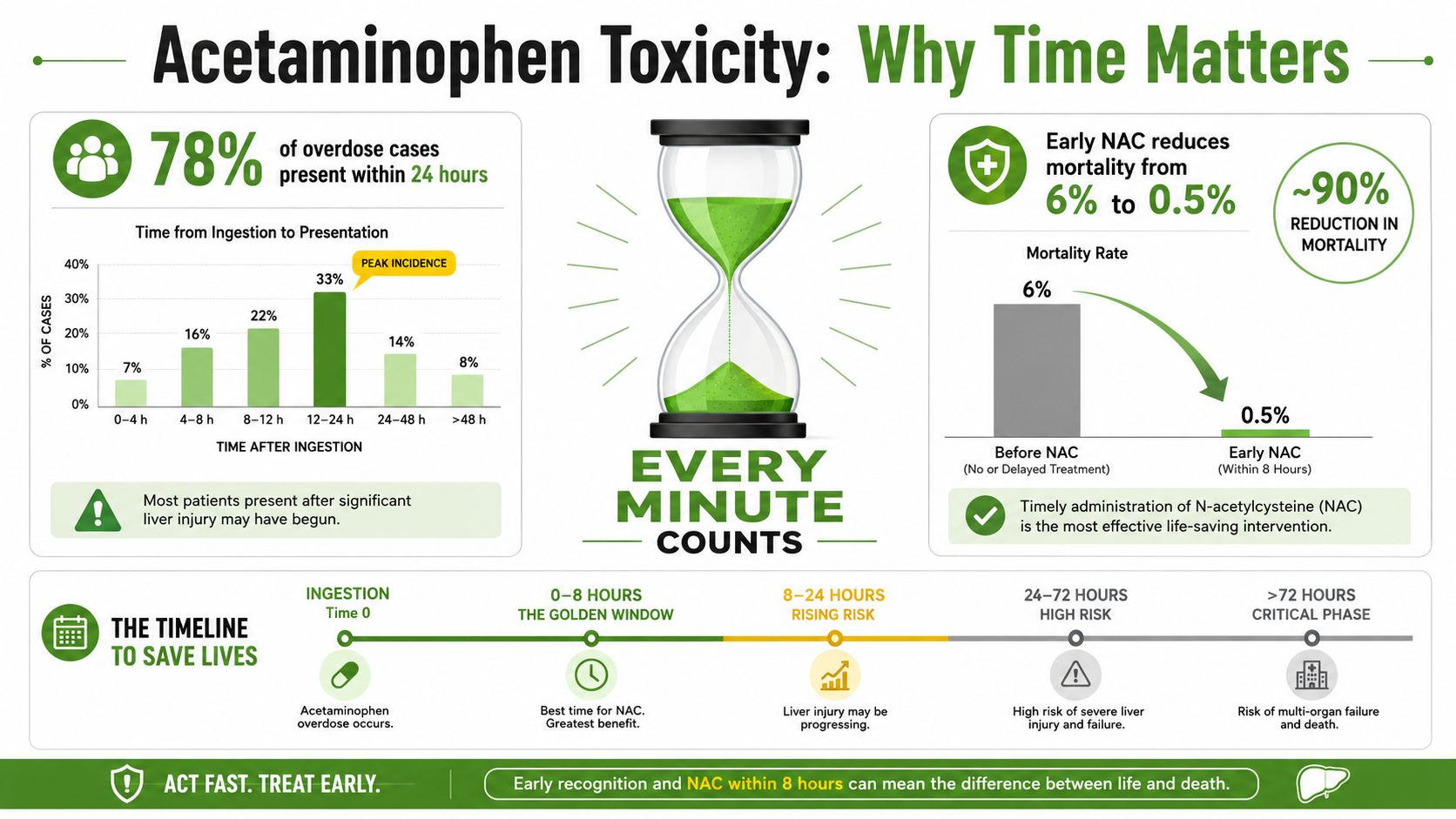
The old model of “wait and watch” doesn't hold up. Timely antidotal therapy is the standard because acetaminophen overdose is usually survivable if clinicians recognize the case early enough and treat before injury declares itself. For a concise reminder of why timing and metabolism matter, the Ace Med Boards P450 guide is a useful companion when you're thinking through toxic intermediates and co-ingestants.
Why Acetaminophen Toxicity Demands Immediate Action
The burden is large, but the bigger point is that the burden is time sensitive. In a nationwide multicenter study summarized in LiverTox, 25% of acetaminophen overdoses, 112 out of 416, had toxic levels, yet no deaths occurred among 100 patients treated with NAC within 24 hours (LiverTox summary). That contrast is why this diagnosis should trigger immediate workflow, not casual observation.
The bedside consequence of delay
When treatment starts early, the toxic metabolite burden can be neutralized before hepatic injury becomes established. When treatment slips, the same ingestion can move from a manageable overdose to progressive liver injury, coagulopathy, and encephalopathy. The clinical lesson is straightforward, and it should shape triage every time a patient reports acetaminophen use that might be excessive.
A patient's story is often the first trap. People commonly understate dose, misremember timing, or don't realize that combination products contain acetaminophen. In that setting, the safest assumption is not that the history is reassuring, it's that the history may be incomplete.
Practical rule: if the timing is uncertain and the product could contain acetaminophen, treat the encounter as a toxicology problem until proven otherwise.
Another reason urgency matters is that acetaminophen toxicity remains common even in systems with poison-center support and established antidote pathways. The treatment is not novel, but the cases are still frequent enough that every emergency clinician needs a low-friction mental algorithm. That means knowing when to send a level, when to call poison control, and when to start NAC without waiting for perfect clarity.
Initial Triage and Emergency Decontamination Decisions
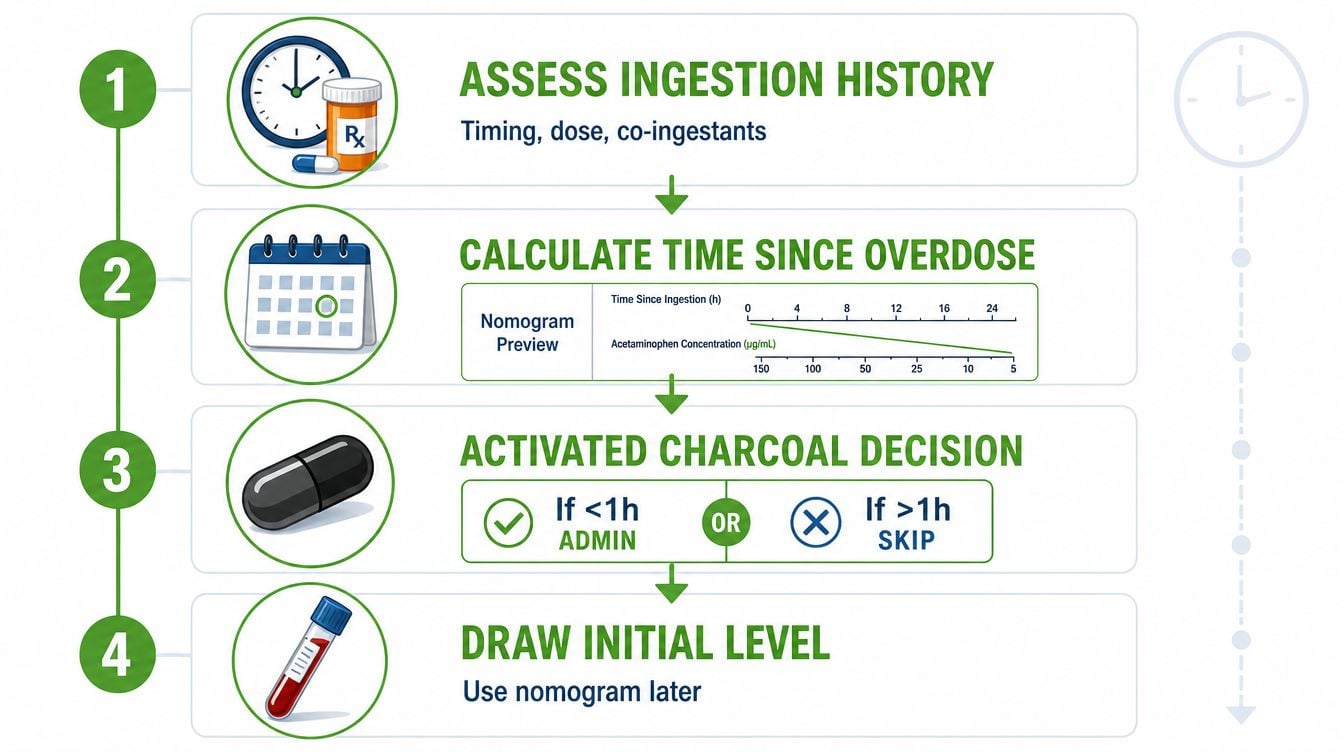
The first decision is whether this is an acute ingestion, a repeated ingestion, or an unreliable history masquerading as an acute case. A story that sounds neat on paper often falls apart once you compare the reported dose, formulation, co-ingestants, and symptoms. If the patient has taken a combination product, an extended-release formulation, or anything alongside an opioid or anticholinergic, the timeline can be misleading.
Start with the history you can defend
Document the exact product, the estimated maximum dose, the time the ingestion ended, and whether the event was a single ingestion or repeated dosing over more than 24 hours. If the patient can't give a reliable timeline, or the story conflicts with symptoms or labs, treat the history as unreliable. That matters because the Rumack-Matthew nomogram only applies when the ingestion is acute and the timing is dependable.
A patient who presents very early can still be hard to triage. If acetaminophen was drawn before 4 hours, an undetectable level after more than 2 hours can be reassuring, but poison center or toxicology input is still the right move when doubt remains. If you can't establish a trustworthy exposure window, repeat the level later rather than anchoring on the first result.
Decide on charcoal before you decide on comfort
Activated charcoal has the best chance of helping when it's given early, and the practical cutoff is the first few hours after ingestion. It can still be useful later in high-risk or sustained-release situations, especially if absorption seems ongoing, but that decision should be deliberate rather than automatic. Patients with vomiting, declining mental status, or aspiration risk need a separate airway discussion before anyone reaches for charcoal.
If the patient is awake, cooperative, and within the early window, charcoal is a reasonable decontamination step. If the history is late, unclear, or clearly repeated over time, charcoal becomes much less attractive.
Combination products deserve special caution because the acetaminophen component is easy to miss while the sedative or anticholinergic component slows gastric emptying. For practical bedside counseling on charcoal tolerance and GI side effects, the internal overview at activated charcoal bloating is a useful adjunct for teams that frequently handle decontamination questions. The bigger point remains clinical, though, charcoal is a tool for selected patients, not a default ritual.
Interpreting Levels and Administering N-Acetylcysteine
A single acetaminophen level only helps if the timing is reliable and the ingestion was a true one-time event. The Rumack-Matthew nomogram is built around the 150 ug/mL at 4 hours treatment threshold, and values above that line support acetylcysteine therapy. Higher concentrations, including the 300 ug/mL at 4 hours line, raise concern for more severe toxicity and deserve toxicologist input.
Plot the level, not the story
The nomogram earns its place because it gives a decision point that is less subjective than the bedside narrative. It breaks down when the time is wrong, when ingestion was repeated over time, or when absorption is delayed by extended-release products or co-ingested opioids. In those settings, a single level below the line may still miss ongoing absorption.
If the patient took an extended-release product and the level is drawn between 4 and 12 hours, a concentration below the treatment line but above 10 ug/mL should be repeated 4 to 6 hours later. The same approach applies when an opioid or anticholinergic is likely slowing absorption, if the first level is above 10 ug/mL but still below the treatment threshold, repeat it 4 to 6 hours later. If the first late level is under 10 ug/mL, further measurement may not be needed in that pattern.
Give NAC early when the nomogram is uncertain
NAC works by replenishing glutathione and interrupting progression toward liver injury. The benefit is greatest when treatment starts early, but it still has value later, even after hepatic failure has begun. Waiting because the level does not look dramatic yet is a common error, especially when the history is unclear or the ingestion was staggered.
Route choice should follow the patient's actual ability to finish treatment. A standard oral regimen uses a loading dose of 140 mg/kg, followed by 70 mg/kg every 4 hours for 17 doses, but vomiting often makes that path impractical. The IV regimen is often the better emergency and inpatient choice because it bypasses absorption problems and avoids the smell and GI intolerance that can keep oral therapy from being completed.
You can see the full stepwise dosing logic in this short video walkthrough, which is especially helpful for staff who do not dose NAC every day.
For reference, a thoughtful overview of glutathione shots and preventive health helps explain why cysteine and glutathione pathways keep coming up in toxicology and wellness discussions, even though acute overdose care is a very different clinical problem. In practice, marketing language should not distract from the central question, whether the patient needs immediate antidotal treatment.
IV and oral routes are not interchangeable in the same way every time
The standard IV regimen is 150 mg/kg over 60 minutes, then 50 mg/kg over 4 hours, then 100 mg/kg over 16 hours, and many centers continue the last infusion until stopping criteria are met. Oral NAC remains acceptable when the patient can keep it down, but nausea and vomiting are common reasons to switch. The key decision is which route the patient can complete, rather than which one looks cleaner on paper.
Clinical shortcut: if the patient is actively vomiting, choose IV NAC early rather than trying to force oral dosing and losing hours to repeated emesis.
Monitoring Labs and Managing Extended-Release Complications
Once NAC is running, the job shifts from starting therapy to proving it's safe to stop. That means trending acetaminophen concentration, ALT, INR, and renal function, not just repeating the same level until it falls. NAC itself does not lower the acetaminophen concentration, so a downward drug level alone doesn't prove the liver is protected (UCSF Hospital Handbook).
What to follow during treatment
| Key Monitoring Parameters During NAC Therapy | ||
|---|---|---|
| Lab Parameter | Frequency | Clinical Significance |
| Acetaminophen level | Repeat when absorption may be delayed, especially with extended-release products or co-ingestants | Confirms whether acetaminophen is still present and whether ongoing absorption is happening |
| ALT | Often followed at intervals when hepatotoxicity is suspected | Tracks liver injury and recovery |
| INR | Follow with liver injury or concern for synthetic dysfunction | Reflects hepatic synthetic failure, not just enzyme leak |
| Renal function | Follow when liver injury is evolving or kidney injury is suspected | Identifies renal involvement and guides supportive care |
Extended-release and delayed absorption change the script
The trap with extended-release products is false reassurance. A single early concentration can look low even while absorption is still ongoing, which is why repeat testing matters if the timing and formulation don't behave like a simple immediate-release overdose. The same issue shows up when opioid or anticholinergic co-ingestion slows gastric emptying, and the delayed rise catches teams that treated one level as definitive.
NAC should continue until acetaminophen is undetectable and liver injury or coagulopathy is clearly improving. In practice, that means you're watching for a clinical direction, not chasing a one-off lab. If ALT or INR is still worsening, or if the story suggests continued absorption, stop thinking in protocol hours and start thinking in physiology.
Don't use a falling acetaminophen level as a stop signal by itself. Use the level, the transaminases, and the INR together.
Some pathways recommend q12h labs when hepatotoxicity is suspected, which is a reasonable cadence in a sick patient who's trending the wrong way. If the patient is stable and labs are reassuring, you still need enough repeat testing to show that both the toxin burden and the liver response are improving. That distinction matters most in late presenters, extended-release exposures, and anyone whose history never quite made sense.
Adapting Protocols for Special Populations
A straightforward acute ingestion fits the nomogram well enough, but special populations do not. Children, repeated-dosing patients, and people with liver disease follow different risk patterns, and the bedside decisions change with them. Chronic ingestion also needs a separate frame, because the nomogram does not apply the same way once exposure stretches beyond a single event.
Acute overdose is not the same as repeated overuse
Repeated supratherapeutic ingestion behaves differently because the liver may be dealing with a longer, quieter depletion of glutathione rather than a single peak exposure. That pattern is easy to miss when a patient says they are taking “just a little extra” for pain. In those cases, the usual nomogram logic can fail, so management leans more heavily on clinical judgment, labs, and toxicology guidance.
Pediatric cases require the same toxicology discipline as adult cases, but dosing errors can happen faster because weight-based calculations matter so much. Careful weight confirmation is critical before NAC is started. Families often ask about other medication safety questions at the same visit, and a practical example is the counseling covered in Afrin and breastfeeding, even though acetaminophen overdose itself is a separate emergency problem.
Liver disease and polypharmacy change the threshold for caution
Pre-existing liver disease, chronic alcohol use, malnutrition, and enzyme-inducing medications can all lower the margin for error. The patient may not need a radically different antidote, but they do need a lower threshold for toxicology involvement and a higher index of suspicion for liver injury. A “normal-looking” history is less comforting when baseline hepatic reserve is already limited.
Polypharmacy can also obscure the picture. Some agents alter metabolism, some slow gastric emptying, and some hide the acetaminophen inside a combination product. For patients already navigating complex medication regimens, pharmacogenomic testing in psychiatry can help in broader medication management conversations, but it does not replace acute toxicology assessment when an overdose is on the table.
Comparison point: acute single ingestion can often be nomogram-driven, while chronic or repeated ingestion is lab-driven and history-dependent.
The practical takeaway is to escalate earlier when the exposure pattern is not clean. If the history spans multiple doses, the formulation is delayed-release, or the patient has significant hepatic vulnerability, stop trying to force the case into a standard box. That is when poison control and local toxicology advice become part of the treatment plan, not an optional add-on.
Prevention Strategies and When to Escalate Care
Prevention starts with medication reconciliation, because acetaminophen is everywhere. Combination cold products, sleep aids, and analgesic blends are common sources of accidental overuse, and patients often do not realize they are stacking the same ingredient across multiple bottles. The safest counseling is plain and specific, use one acetaminophen-containing product at a time, check the label every time, and do not assume “over-the-counter” means harmless.
Know when the case is getting worse
Escalation is driven by clinical deterioration, not by the acetaminophen number alone. Rising transaminases, coagulopathy, encephalopathy, renal dysfunction, hypoglycemia, shock, and worsening lactate all point toward liver failure and should trigger a higher level of concern. Patients with severe liver injury need discussion with a regional transplant center or local transplant team when encephalopathy, pH below 7.3, INR above 3, or renal failure is present.
Poison control should be involved early when the dose is unknown, the timeline is unclear, the product is extended-release, or the patient has a repeated ingestion pattern. That call often keeps a borderline case from being under-treated, and it also helps avoid the opposite error, stopping NAC before the liver has clearly turned the corner.
Finish with a discharge mindset that prevents relapse
Discharge planning should focus on why the overdose happened in the first place. If the patient used acetaminophen for pain, review the risks of combination products and make the regimen explicit, including a clear review of medication choices after wisdom tooth extraction when that is part of the pain story. If the exposure was unintentional, write out the maximum daily plan in plain language and make sure the patient can repeat it back.
For the sick patient, the endpoint is stable labs, improving clinical status, and confidence that the injury is receding, along with a plan the patient can follow after discharge. The right frame is simple: identify early, treat immediately, keep monitoring until the liver is improving, and escalate before the patient crosses into irreversible failure.