You're standing by the crib at 2 a.m., listening.
Your baby isn't crying, but the breathing sounds different than it did yesterday. Maybe it's squeaky. Maybe there's a little tugging at the neck. Maybe feeding has felt harder this week, and now every sound seems louder in the dark. Parents notice these things long before anyone else does, and that instinct matters.
Some infant breathing noises are harmless and temporary. Others deserve a closer look because babies have very little room for error when airflow is reduced. That's one reason this topic matters so much. Airway obstruction injury is the leading cause of accidental injury-related death among infants under age 1, and 60 percent of infant suffocation occurs within the sleeping environment, according to Safe Kids York County.
That statistic shouldn't create panic. It should create clarity. Parents need a practical way to tell the difference between normal newborn noisiness, a medical issue that needs evaluation, and a true emergency. They also need clear guidance on sleep safety, which is why I often point families to these essential safe sleeping rules as a useful starting point for reducing preventable risk.
Is My Baby's Breathing Normal
Newborn breathing is rarely silent. Babies snort, sigh, squeak, grunt, and pause in ways that can sound alarming if you've never heard them before. A healthy infant may breathe irregularly, especially during light sleep, then settle into a smoother rhythm a few minutes later.
What matters is context. A brief noisy inhale after crying is different from persistent effort with feeding, color change, or a repeated high-pitched sound every time your baby breathes in. Parents often describe the difference well before they know the medical terms. They'll say, “It sounds tight,” or “He seems to work harder when lying down,” or “She can't stay latched and breathe comfortably.”
Sounds that are often benign
Some noises happen because infant airways are tiny and easily amplified.
- Soft nasal stuffiness: Mild congestion can make breathing sound louder without meaning the lungs or throat are blocked.
- Occasional squeaks: A short squeak during stretching or repositioning can happen in otherwise well babies.
- Irregular rhythm: Brief pauses followed by a few quicker breaths can be normal if the baby remains pink, relaxed, and comfortable.
Signs that deserve closer attention
The pattern changes when noise is joined by effort or dysfunction.
- Breathing that looks labored: Skin pulling in at the ribs, base of the throat, or under the breastbone.
- Feeding that becomes a struggle: Frequent unlatching, coughing, gulping, or tiring before a feed is finished.
- Poor settling: A baby who seems comfortable only in one position or becomes distressed when calm and quiet.
- Color change: Pale, dusky, or blue lips require urgent attention.
Parents are often told, “babies are noisy.” That's sometimes true. It's not enough if the noise is paired with effort, poor feeding, or repeated distress.
Why an Infant's Airway Is So Unique
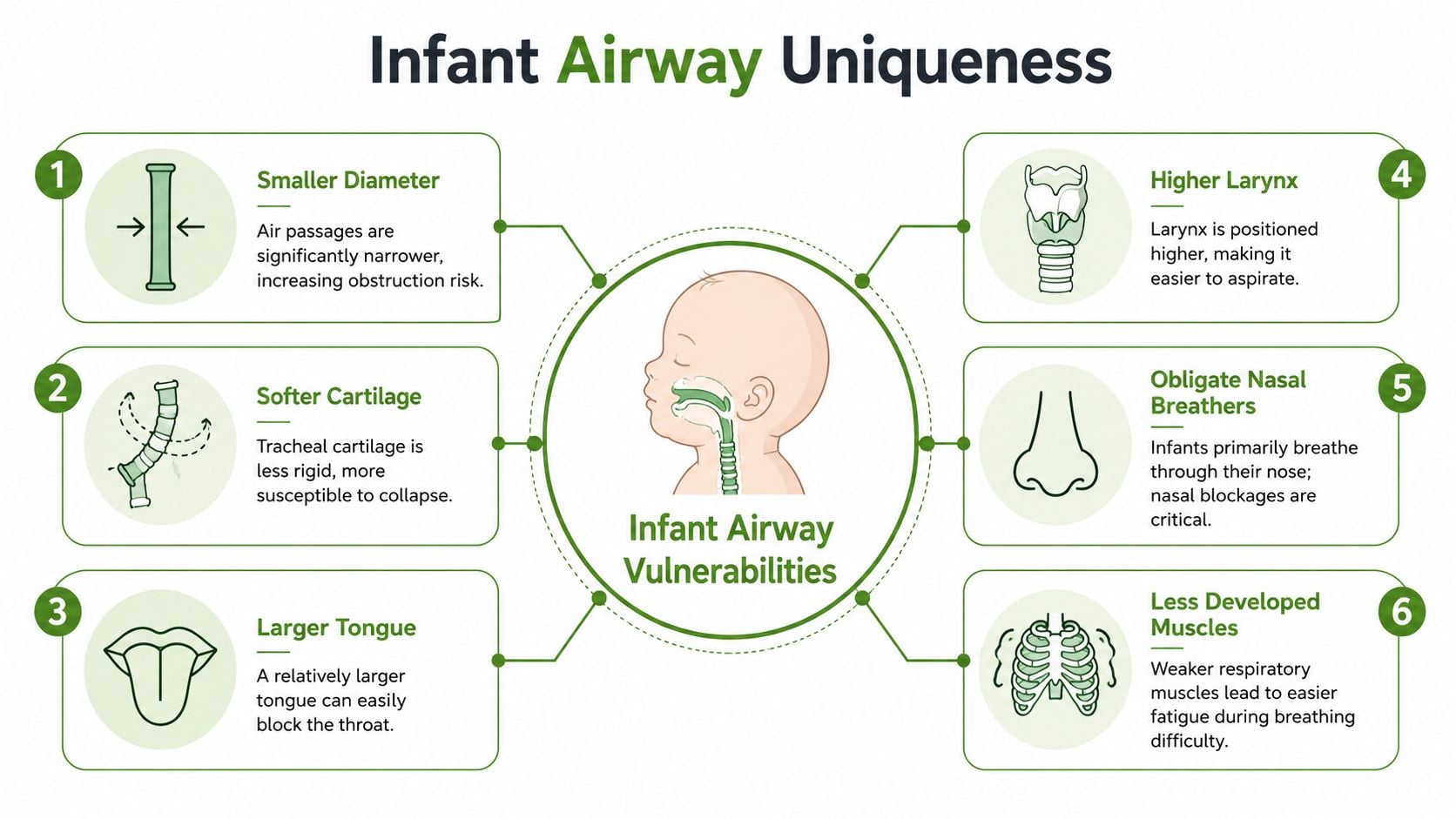
An infant airway is small, soft, and easily affected by anatomy. A useful way to picture it is a new garden hose with a narrow opening and flexible walls. If you press on it slightly, kink it, or let soft tissue crowd the opening, flow changes fast.
Adults have more rigid structures and more space. Babies don't. A little swelling, a little poor tongue position, or a little nasal blockage can have an outsized effect on breathing and feeding.
Why small changes matter so much
Infants are strongly dependent on nasal airflow, especially during feeding and rest. If the nose is blocked, the baby has fewer good backup strategies than an older child. That's one reason families notice distress during nursing or bottle feeding long before they hear obvious stridor.
Their tongue also takes up proportionally more space in the mouth. If tongue posture is low, restricted, or pulled backward, it can narrow the airway behind it. Add in soft tissues that collapse more easily, and the breathing tube becomes less forgiving.
A congenital example shows how little room there is. In full-term neonates, a pyriform aperture width of less than 11 mm on CT confirms congenital nasal pyriform aperture stenosis, a fixed nasal blockage caused by bony narrowing, as described in this review of neonatal upper airway obstruction. The same review notes that the infant airway is already very narrow, with the cricoid around 4 mm in diameter, which helps explain why even modest narrowing can create major symptoms.
The practical takeaway for parents and clinicians
When a baby struggles to breathe, don't think only in terms of “is something in the throat?” Think in layers.
- Nasal layer: Is the nose open enough for comfortable airflow?
- Oral layer: Can the tongue move and rest where it should?
- Throat layer: Is soft tissue collapsing when the baby relaxes or feeds?
- Coordination layer: Can the baby suck, swallow, and breathe in a smooth rhythm?
Practical rule: In infants, a “small” airway issue can act like a “big” problem because the airway starts out so narrow.
Common Causes of Infant Airway Obstruction
Not all airway obstruction in infants comes from the same place. Some problems are structural, meaning the anatomy itself narrows the passage. Others are functional, meaning the anatomy, muscle pattern, and feeding mechanics don't work together well. In real life, those categories often overlap.
Laryngomalacia and soft tissue collapse
Laryngomalacia is one of the most common reasons for noisy infant breathing. The tissue above the vocal cords is softer than normal and tends to fall inward during inhalation. Parents often hear a high-pitched inspiratory sound that becomes more obvious with crying, feeding, or positioning changes.
Many babies with laryngomalacia do well with monitoring and supportive care. Others need specialist evaluation because the noise isn't the whole story. The bigger issues are work of breathing, reflux-related irritation, poor feeding endurance, and growth.
Tongue-tie, oral posture, and the airway
Tongue-tie is often discussed only as a feeding problem, but that's too narrow. A restricted tongue can alter latch, swallowing, and the way the tongue rests in the mouth. If the tongue can't lift well, babies may compensate with jaw tension, inefficient sucking, clicking, leaking milk, or gulping air.
Over time, poor oral posture can influence how the palate develops and how the airway is shaped. That doesn't mean every tongue-tie causes airway obstruction in infants. It does mean the evaluation shouldn't stop at “can the tongue stick out?” A functional assessment matters more than appearance alone.
Nasal obstruction and fixed narrowing
Some babies struggle because airflow through the nose is physically restricted. Congenital narrowing, swelling, or blockage can create significant distress because infants rely heavily on nasal breathing. Fixed problems are especially important to identify because no amount of feeding coaching will solve a bony bottleneck.
Glossoptosis and tongue-based blockage
In some infants, the tongue sits or falls backward and narrows the airway behind it. This is more likely to show up when the baby is relaxed, poorly positioned, or trying to coordinate feeding while breathing through a crowded upper airway. Parents may notice noisy breathing, difficulty staying latched, or a baby who seems to fight certain positions.
Adenoids, tonsils, and related crowding
In older infants and young children, enlarged lymphoid tissue can contribute to obstruction, mouth breathing, and disrupted sleep. This usually isn't the first diagnosis in a newborn, but it becomes part of the discussion as babies grow and persistent symptoms continue.
Why root cause matters
The same symptom can come from very different mechanisms.
- Stridor may reflect soft tissue collapse.
- Mouth breathing may point to nasal blockage, poor oral posture, or both.
- Feeding stress may come from airway limitation, tongue restriction, or discoordinated swallowing.
- Restless sleep may be a downstream effect rather than the primary problem.
That's why a checklist approach often falls short. A baby may need input from an ENT, a pediatric dentist familiar with infant oral function, and an orofacial myofunctional therapist who can see how posture, tongue motion, and breathing pattern fit together.
How to Recognize the Signs and Symptoms
Parents are often told to listen for noisy breathing during sleep. That's incomplete advice.

A more useful approach is to watch your baby during the moments that place the highest demand on the airway. Feeding is one of those moments. Crying and agitation are another. These are the times when a narrow or unstable airway gets exposed.
What to watch with your own eyes
Breathing problems in infants often reveal themselves through effort before they show up as dramatic noise.
- Retractions: Skin pulling in at the neck, between the ribs, or under the chest.
- Nasal flaring: Nostrils widening with each breath.
- Head bobbing: A sign the baby is recruiting extra muscles to breathe.
- Persistent mouth opening: Sometimes a clue that nasal breathing isn't working well.
- Frequent pauses during feeding: The baby stops often to recover rather than to rest.
Parents can also watch function.
- Latch quality: Repeated slipping off the breast or bottle.
- Swallowing pattern: Coughing, choking, sputtering, or wet-sounding feeds.
- Recovery time: A baby who stays unsettled after feeds may be working hard to breathe.
- Growth and stamina: Poor weight gain or feeding fatigue should never be brushed off.
For a broader checklist of airway obstruction symptoms in children and infants, families often find it helpful to compare what they're seeing at home with a structured symptom guide.
Sleep isn't always the trigger parents think it is
One common assumption is that upper airway obstruction gets worse mainly during sleep. In neonates, that's often not the case. In one study, only 1.1% worsened during sleep, while 52.9% worsened with agitation and 21.8% during feeding, according to this neonatal upper airway obstruction study.
That shifts how parents should observe their baby. Don't only stand over the crib. Watch the first minutes of a feed. Watch what happens when your baby cries hard, settles, then tries to recover. Watch whether breathing sounds increase when coordination demands go up.
This short video helps parents understand what increased work of breathing can look like in an infant.
If a baby sounds noisy but feeds well, grows well, and breathes comfortably, the urgency is different. If the noise comes with struggle, the picture changes.
Emergency Red Flags Versus Watchful Waiting
Parents need a decision tool, not just a diagnosis list. The most useful question isn't “What could this be?” It's “Do I watch, call, or go now?”
A chronic or intermittent airway issue usually builds a pattern over time. A foreign body event is different. If an infant under age 1 has a suspected object blocking the airway, standard care is 5 back blows and 5 chest thrusts, and abdominal thrusts are not used because of the risk of liver injury, as outlined in the StatPearls review on upper airway obstruction.
Infant Breathing When to Watch vs When to Go
| Symptom | Watch and Call Doctor During Office Hours | Seek Emergency Care Immediately |
|---|---|---|
| Noisy breathing | Mild, occasional noise without distress | Sudden noisy breathing with obvious struggle or rapid worsening |
| Feeding difficulty | Some clicking, leaking, or tiring but still feeding adequately | Choking repeatedly, unable to coordinate sucking and breathing, poor responsiveness |
| Color | Normal pink color between feeds and during rest | Blue, dusky, gray, or sudden color change |
| Retractions | Mild pulling only when upset, then fully resolves | Deep retractions at rest or worsening effort |
| Breathing pauses | Brief irregular newborn breathing without limpness or color change | Any pause with limpness, color change, or difficulty arousing |
| Congestion | Mild stuffiness with otherwise normal feeding and comfort | Severe distress that doesn't improve, or concern for blockage after a choking event |
A few practical distinctions
Not every congested infant has an airway emergency. Many have uncomplicated nasal stuffiness. If you're sorting through whether symptoms sound more like routine congestion or something more concerning, this guide on a 5 month old congested baby can help parents think more clearly about what they're seeing.
Call emergency services or seek emergency care right away if your baby has color change, becomes difficult to wake, stops breathing normally, or appears unable to move air effectively. Trust the visual signs. Babies can look sick before numbers are ever checked.
Fast breathing alone doesn't tell the whole story. Effort, color, responsiveness, and feeding safety matter more.
Your Path to Diagnosis and Modern Treatment
Good treatment starts with precise diagnosis. “Noisy breathing” isn't a diagnosis. “Trouble feeding” isn't a diagnosis either. Those are clues.
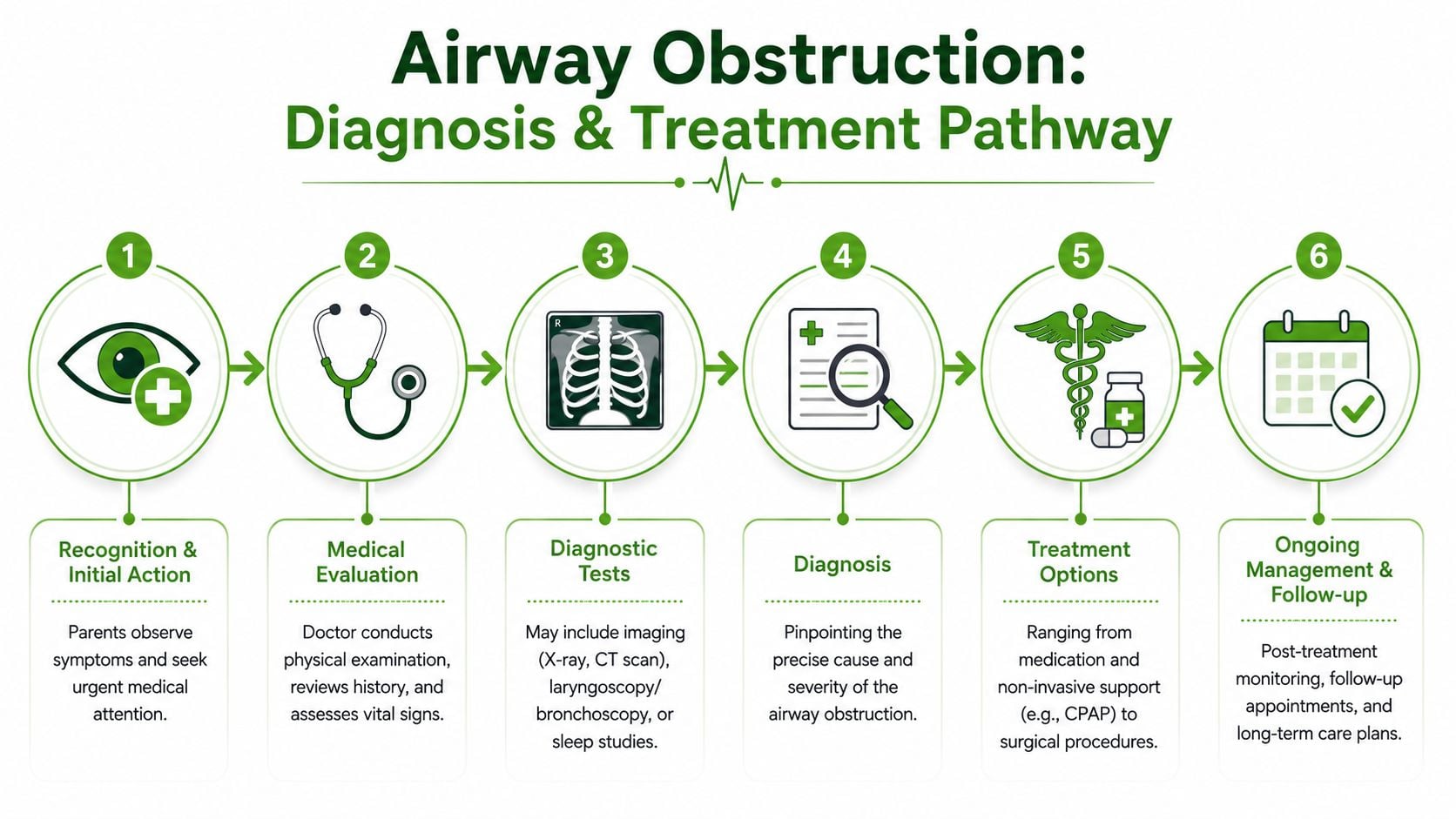
A careful workup usually begins with a detailed history. Clinicians ask when the symptoms started, whether they're worse with feeds or crying, what positions help, whether there are color changes, and how weight gain is going. They also watch a feed whenever possible, because some airway problems are easiest to recognize during the actual suck-swallow-breathe sequence.
What specialist evaluation often includes
If upper airway symptoms persist, an ENT evaluation is often the next step. One of the most important tools is awake flexible nasopharyngoscopy, which is the most effective way to visualize supraglottic problems such as laryngomalacia, assess vocal cord movement, and guide treatment decisions. The same source notes that laryngomalacia causes 70% of infant respiratory distress, making direct visualization especially valuable in the babies who present with stridor or feeding-linked airway symptoms, according to this Egyptian Journal of Otolaryngology review.
Other testing depends on the suspected cause. Some infants need imaging when fixed anatomic narrowing is suspected. Others benefit from swallow evaluation, feeding therapy input, or sleep-focused assessment if nighttime symptoms, snoring, or repeated arousals are part of the picture.
For families dealing with ongoing disrupted breathing during sleep, this overview of pediatric sleep apnea treatment offers a useful explanation of how sleep-related airway problems are approached beyond simple symptom management.
Treatment works best when it matches the mechanism
Many families often become frustrated. They're given a generic plan for a very specific problem.
A baby with mild laryngomalacia and strong growth may need observation, feeding support, and follow-up. A baby with significant obstruction may need surgical intervention. A baby with tongue restriction, poor oral posture, shallow latch, and air swallowing may need a different path that includes functional oral assessment, lactation support, and sometimes frenectomy when the restriction is clearly contributing to dysfunction.
Why collaborative care matters
The best outcomes often come from coordinated care rather than isolated opinions.
- ENTs identify structural narrowing, dynamic collapse, and vocal cord issues.
- Pediatric dentists with airway training evaluate oral structure, tongue mobility, and palate form.
- Orofacial myofunctional therapists assess how the lips, tongue, jaw, and breathing pattern are functioning together.
- Feeding specialists and lactation professionals help translate anatomy into daily feeding success.
This root-cause model matters because procedures alone don't always restore function. Releasing tissue without retraining posture and movement can leave part of the problem unresolved. On the other hand, therapy without identifying a fixed blockage can waste valuable time. Infants do best when clinicians ask both questions at once. What is physically narrowing the airway, and what is functionally reinforcing the problem?
Frequently Asked Questions on Infant Airway Health
Can my baby outgrow laryngomalacia
Some babies do improve as airway tissues mature. That doesn't mean every noisy baby should be watched. If there's poor feeding, retractions, color change, or growth concerns, the child needs a more complete airway evaluation rather than reassurance alone.
Is tongue-tie screening enough to rule out a functional problem
No. A quick visual check can miss how the tongue moves during feeding and rest. The better question is whether the tongue can lift, cup, seal, and coordinate with swallowing and nasal breathing. Form matters, but function matters more.
What does a myofunctional therapist do for an infant
An orofacial myofunctional therapist looks at the mechanics many people overlook. Tongue posture, lip seal, jaw compensation, sucking pattern, and breathing route all affect airway stability. Therapy can help families understand why a baby is struggling, even when the baby has already seen multiple providers.
Parents who want a broader perspective on airway-centered oral development may also appreciate the educational resources from Seven Oaks Dentistry and Sleep Medicine, which explain how airway-focused dentistry fits into long-term breathing and facial growth.
If your child has noisy breathing, feeding difficulty, suspected tongue-tie, or signs of sleep-related airway issues, Pain and Sleep Therapy Center offers collaborative, root-cause evaluation with a focus on function, airway health, and long-term relief.