
You're home after a frenectomy, and now the hard part starts. Maybe your baby is sleepy, fussy, and hard to position. Maybe you're the patient, staring at the mirror and wondering if you're doing the stretches correctly or making the area angrier. That uncertainty is common.
The procedure releases restricted tissue. Healing decides whether that new mobility stays useful. That's why post frenectomy exercises matter so much. They aren't a minor add-on after treatment. They are the daily work that helps the mouth heal with freedom instead of healing back into restriction.
Most families feel better once they understand what they're looking for. You don't need a long list of random movements. You need clear reasons, simple cues, and a way to tell whether the exercise is doing its job. If you're tracking appointments, provider instructions, and follow-up notes across multiple family members, this guide on how to keep family medical records organized can make the recovery phase easier to manage.
Your Guide to Healing After a Frenectomy
A frenectomy creates opportunity, not automatic function. The tissue is released in the office, but the tongue, lip, jaw, and swallowing pattern still need guidance afterward. That's true for infants learning to feed more effectively and for older children or adults who've spent years compensating around restriction.
Many people expect immediate change. Some do notice it. Others feel discouraged because feeding, speech, oral rest posture, or tongue movement still seem awkward at first. That doesn't mean the procedure failed. It usually means the body is learning a new pattern while the tissue is healing at the same time.
If you're still deciding what a release involves, this overview of the laser frenectomy procedure helps connect the treatment itself to the aftercare that follows.
What patients and parents often miss
The most important part of aftercare is understanding the difference between mobility and function.
- Mobility means the tongue or lip can physically move farther than before.
- Function means that new movement gets used well during feeding, swallowing, speech, oral rest posture, and breathing.
- Healing has to support both. If the wound contracts too tightly, mobility drops. If the muscles never learn the new range, function stays limited.
A successful release without consistent follow-through can still leave a patient using the same old movement pattern.
That's why a simple checklist isn't enough. You need to know what each stretch is supposed to feel like, what a healthy wound usually looks like, and when a movement is helping versus when force is replacing precision.
The mindset that helps most
Good post frenectomy exercises are calm, deliberate, and repeatable. They're not dramatic. They don't depend on strength. They depend on timing, clean technique, and consistency.
For parents, that often means building the exercises into a routine instead of waiting for the “perfect” calm moment. For older children and adults, it means respecting the schedule even when the site looks better and soreness has faded.
Why These Exercises Are Non-Negotiable
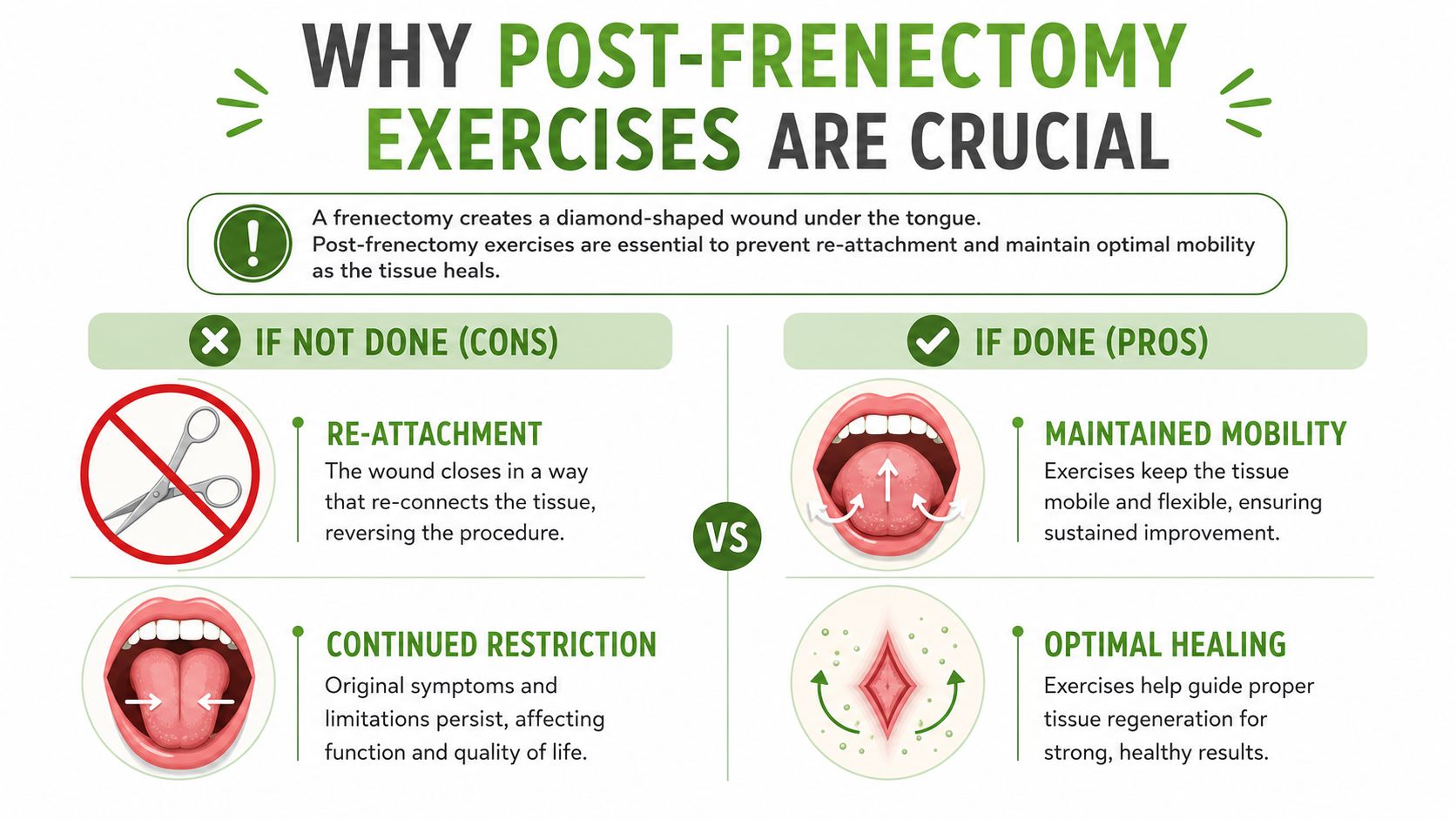
A frenectomy leaves a small wound that needs to heal in an open, mobile shape rather than shrinking back into a tight band. The body's job is to close wounds. It doesn't automatically know that this wound needs space preserved under the tongue or lip.
That's the central trade-off. If you do nothing, the body still heals. It just may heal in the wrong direction.
What the exercises are actually doing
Think of the release site as a healing space that wants to narrow. Repeated stretching reminds the tissue that the space must stay open. According to a post-op care guide from Tooth Squad, post-frenectomy stretching protocols mandate 5 to 6 sessions per day for the first 3 weeks, and that 3-week window is critical because rapid fibroblast activity can allow scar tissue to contract and fuse the tissue back into restriction if stretching is inconsistent (Tooth Squad post-op guide).
That's why the exercises are not optional “extra credit.” They are the mechanical signal that guides healing.
What works and what doesn't
Here's where many families get mixed messages. Some people hear “stretch the wound” and assume more force must be better. It isn't. Force often makes technique worse.
What works:
- Consistent frequency according to the prescribed schedule
- Full exposure of the wound so the tissue opens
- Brief, purposeful holds rather than rough pulling
- Stable positioning so the lift comes from the target tissue, not from body compensation
What doesn't work:
- Quick surface swipes that never open the diamond
- Skipping sessions because the site “looks fine”
- Overly forceful stretching that increases distress without improving the stretch
- Letting the jaw substitute for tongue movement in active exercises
Practical rule: The exercise should create a clear stretch. It should not look frantic or feel like a battle of force.
Why the first weeks matter so much
The early healing phase is when tissue changes happen quickly. If the wound gets repeated, clean opening during that phase, the scar is more likely to stay longer and more flexible. If the wound sits undisturbed for long stretches, contraction can take over.
That's also why families often feel the schedule is intense. It is intense. But it's time-limited, and it protects the value of the procedure you just went through.
Post-Frenectomy Exercises for Infants
With infants, you're doing the therapy for them. Your job isn't to make the stretch look dramatic. Your job is to make it effective, brief, and repeatable.
A commonly used infant aftercare protocol states that the first exercise session should happen the evening of the procedure, followed by a second session the next morning when the infant wakes. It also notes that infant stretches are held for 1 to 2 seconds and performed at about every 3 hours throughout the day, including during the night, to reach 5 to 6 sessions daily (infant frenectomy aftercare instructions).
Before you start
Set up the same way each time so your hands and your baby know the routine.
- Wash your hands well.
- Get good light. A phone flashlight or bright lamp helps.
- Position your baby securely. Most parents do best with baby in the lap, feet toward the parent, head supported.
- Stay calm and quick. Babies read your tension fast.
If feeding has been rocky, families often need support that goes beyond the wound itself. This expert guide on infant feeding can help you think through feeding behavior while healing is underway. If you're looking for procedure-specific pediatric support, this page on pediatric frenectomy gives useful clinical context.
A visual demonstration can also help you connect the hand placement to the movement.
Lip stretch and what to look for
For an upper lip release, gently lift the lip upward toward the nose until the wound opens.
Sensory cues that usually tell you the stretch is correct:
- You can see the diamond open
- The lip rolls up rather than just outward
- Your fingers stay controlled instead of slipping across the surface
- The hold is brief and clear, not dragged out
If the lip only flares forward and you never see the wound bed open, you're probably moving around it instead of stretching through it.
Tongue lift and what to look for
For a tongue release, use a scoop-and-lift motion. Place your fingers under the tongue on either side of the release area and lift toward the roof of the mouth so the wound opens fully.
Watch for these cues:
- The middle of the tongue lifts, not just the tip
- The diamond shape becomes visible
- The lift comes upward, not forward
- The movement is clean and short
Many parents accidentally pull the tongue forward. Forward traction can look impressive, but it often misses the tissue that needs to open vertically.
If you can see the wound open deeply for a brief moment, you're usually doing more good than with a longer, messy stretch.
Making it easier on your baby and on you
Some fussing is normal. Crying does not automatically mean you harmed your baby. Babies dislike being held still and having their mouths handled. That's different from injury.
A few practical adjustments help:
- Do the stretch before a feeding so relief comes right after
- Use the same sequence every time so the routine becomes familiar
- Keep your motions efficient rather than hesitating mid-stretch
- Soothe immediately afterward with feeding, holding, or skin-to-skin
If you dread each session, simplify the process. Set reminders. Keep a note on your phone. Use the same chair, light, and towel each time. Recovery gets easier when the routine becomes automatic.
Active Exercises for Children and Adults
Once a child can follow directions, or when the patient is an adult, post frenectomy exercises shift from passive stretching into active retraining. The tongue now has more room to move, but it may still default to old habits. That's why these exercises matter beyond scar management.
A post-op myofunctional protocol from Nebula Dental Clinic includes specific exercises such as wonder bread scrapes, tongue propellers, and suction holds, with 10 scrapes, 10 clockwise and 10 counter-clockwise rotations, and a 60-second suction hold against the hard palate. The same protocol also requires manual counter-pressure on the mandible during extension exercises so the tongue works without jaw compensation (lingual frenectomy post-operative exercises).
The first principle is isolation
If the jaw slides, juts, or helps, the tongue often cheats.
That's why many exercises work better when the chin or jaw stays gently stabilized with a hand. The goal is not rigid bracing. The goal is preventing substitution. A patient can look like they're doing a strong tongue movement when the jaw is doing half the work.
Mobility and coordination drills
Here are the core patterns many clinicians use after release.
| Exercise | What to do | Why it matters | What you should feel |
|---|---|---|---|
| Wonder bread scrapes | Scrape the tongue from the alveolar ridge backward 10 times | Builds awareness of the tongue's path along the palate | A broad contact path, not just tongue tip flicking |
| Tongue propellers | Circle around the labial vestibule with lips closed, 10 clockwise and 10 counter-clockwise | Improves range and directional control | Smooth circles without jaw swinging |
| Suction holds | Seal the tongue to the hard palate and hold for 60 seconds | Trains oral rest posture and palate contact | Even suction across the tongue, not just tip suction |
What each one is teaching
Wonder bread scrapes teach the tongue where “up” and “back” are. That matters because many restricted tongues learned to thrust forward or stay low in the mouth. During a good scrape, the tongue should feel broad and connected to the palate, not pointy and rushed.
Tongue propellers build precision. They reveal whether the tongue can move through space without the lips, head, or jaw trying to help. If the movement is jerky, smaller circles with better control are often more useful than fast sloppy ones.
Suction holds train one of the most important post-release skills. Resting the tongue on the palate. A correct suction hold should feel like the whole tongue is lifting and sealing, not just the front edge clicking up.
A free tongue that still rests low in the mouth won't deliver the full functional benefit of the release.
One common error to catch early
Patients often push harder when a movement feels unfamiliar. That usually creates neck tension, lip strain, or jaw motion. Better execution looks quieter than is commonly anticipated.
Use a mirror if needed. If the tongue is working but the jaw stays calm, you're on the right track.
Your Healing Timeline and What to Expect
Healing after a frenectomy looks unusual before it looks normal. That catches many people off guard, especially when the release site turns white or yellowish. In most cases, that appearance reflects normal healing tissue rather than infection.
The timeline matters because what you see in the mouth changes before function fully settles. The appearance, the tenderness, and the amount of effort required at home won't stay the same.
What the early weeks often look like
During the first stretch of recovery, many patients notice:
- A white or yellow wound bed
- Tenderness with exercises
- Temporary frustration with feeding or oral movements
- An urge to back off because the area looks “raw”
That visual stage can be unsettling, but it often reflects the normal wound surface. What matters more is whether mobility is being maintained and whether symptoms are trending in the right direction over time.
Why hold time matters
One of the biggest mistakes in post frenectomy exercises is confusing intensity with effectiveness. A recent surgical instruction summary notes that current guidance favors exercises that are “efficient and precise, not forceful,” and it cites 5 to 10 seconds per hold as an effective range to help prevent reattachment while keeping holds under 10 seconds to avoid damaging the wound bed (frenectomy surgical instructions).
That applies most directly to active exercises in older children and adults. Infants usually use shorter holds, as noted earlier.
A simple timeline to follow
Early healing period
The site often looks the most dramatic here. This is when consistency matters more than appearances. A wound can look striking and still be healing normally.
Middle healing period
The area often begins to look smaller and pinker. This is when families are tempted to relax the routine because things appear better. Don't assume better appearance means the risk is gone.
Later healing period
The wound blends more into surrounding tissue, and function becomes the bigger focus. According to the Tooth Squad post-op guide referenced earlier, the protocol then shifts to tapering by removing one stretch session per day starting in the fourth week until the routine is discontinued.
If you want a broader overview of recovery milestones, this guide to laser frenectomy recovery time can help you match wound healing with functional changes.
Healing is not just about the tissue closing. It's about the tissue closing while preserving movement.
Troubleshooting and When to Call Your Provider
A hard stretch session can shake a parent's confidence fast. A baby cries, an older child resists, or an adult starts guarding the area, and the immediate fear is that something has gone wrong. In many cases, the issue is technique, timing, or tension in the rest of the mouth rather than injury to the site.
What matters is the quality of the movement and what you feel during it. The lift should open the wound fully enough to preserve mobility, without twisting, scraping, or dragging through the tissue. In older children and adults, active drills should stay small and precise. If the tongue starts compensating with jaw thrust, head movement, or lip tightening, the target muscles are no longer doing the work you want.
Problems you can often correct at home
Several common problems improve once the mechanics improve.
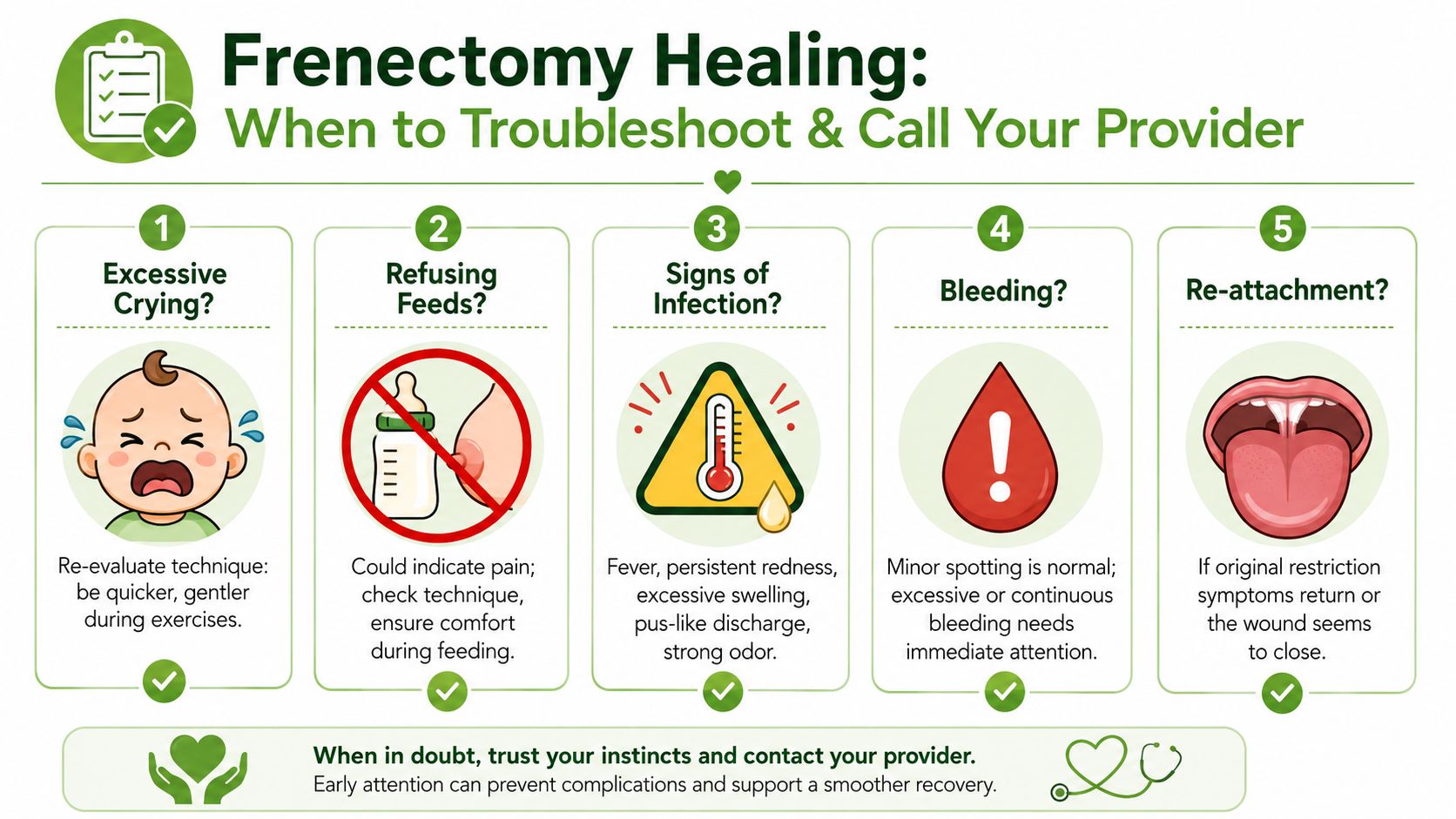
- Excessive fussing during stretches often settles when your hand placement is more secure and the stretch is done cleanly instead of hesitantly. The sensory cue to watch for is a quick, direct lift with a full opening of the diamond, not repeated poking at the site.
- Feeding refusal after exercises can improve when the routine is timed more thoughtfully and soothing begins right away. Many infants regulate better when they know feeding follows the stretch.
- Awkward tongue drills in older patients often improve when the jaw is stabilized and the range of motion is reduced. Look for isolated tongue movement rather than a whole-face effort.
A clinical discussion in a video resource on diamond stretches notes that skipping the stretch can contribute to re-tethering, and that allowing the mandible to protract during extension can reduce the effectiveness of genioglossus activation compared with static jaw protocols (diamond stretch and jaw stabilization discussion).
Signs that deserve a call
Contact your provider if you notice any of the following:
- The wound appears to be healing over and mobility is decreasing
- Original symptoms start returning, such as shallow latch, poor tongue lift, speech compensation, or increased tension
- Bleeding is more than light spotting
- There are signs of infection, such as fever, pus-like drainage, strong odor, or swelling that is getting worse
- Pain or distress keeps increasing instead of easing over time
Pain and Sleep Therapy Center offers evaluation and exercise-based guidance for frenectomy recovery as part of its orofacial myofunctional and pediatric oral health services.
Ask early if you are unsure. The best time to correct a healing problem is when you first notice that movement is slipping, not after the tissue has tightened back down.