You wake up with a clenched jaw. By lunch, the ache has moved into your temples. By evening, your face feels overworked, your neck is tight, and the thought of “just relax” makes you want to roll your eyes. If you also snore, mouth-breathe, wake up unrefreshed, or feel worse when you lie flat, generic meditation advice can miss the mark completely.
That's where many people get stuck. They've tried mouth guards, stretching videos, heat, softer foods, maybe medication, maybe physical therapy. Some things help for a while. Then the pain returns, often mixed with poor sleep, irritability, and the low-grade vigilance that chronic pain creates.
Meditation for chronic pain can help, but not in the way one might hope at first. It's rarely a switch that turns pain off. It works more like a trainable skill that changes how the nervous system relates to pain signals, how much distress gets layered onto them, and how reactive the body stays through the day and night.
A New Path Beyond Chronic Pain
At our pain and sleep center, many patients describe the same pattern. The jaw is sore in the morning, the temples tighten by afternoon, and by night the face, tongue, throat, and neck all feel like they have been working too hard. If nasal breathing is poor, sleep is fragmented, or lying flat makes symptoms worse, standard meditation instructions can backfire.
For people with TMJ pain, facial pain, headaches, and airway-related sleep problems, the problem is rarely one symptom in isolation. Sleep disruption can raise pain sensitivity. Breathing strain can increase muscle activity in the jaw and neck. Clenching and guarding can keep the nervous system on alert long after the original trigger has passed.

Meditation has a place here, with the right goal and the right setup. It is less useful as a way to force the pain away, and more useful as a skill for reducing alarm, softening protective tension, and giving the body fewer reasons to stay braced. That distinction is important because chronic facial pain does not only hurt. It also shrinks attention, shortens patience, disturbs sleep, and makes small sensations feel bigger than they are.
In practice, the first gains are often modest but meaningful. A patient may still feel tenderness with chewing, talking for a long stretch, or waking after a poor night of sleep. What changes first is often the reaction to the flare, not the complete presence of the sensation.
Common early shifts include:
- Less alarm around pain: discomfort is easier to notice without tracking it all day
- Less muscle guarding: the jaw, tongue, throat, and neck do not grip as hard
- Better recovery after flares: symptoms interfere less with mood, focus, and routine decisions
I often tell patients that meditation succeeds when it becomes more adaptable than generic advice. Someone with TMJ irritation may do better with eyes open, shorter sessions, and a supported posture. Someone with airway concerns may need to avoid long breath holds, forced nasal breathing, or lying flat. Patients who need a broader multidisciplinary approach to pain management usually improve more steadily when meditation supports physical treatment, sleep care, breathing work, and habit change instead of trying to replace them.
Some people also benefit from simple calming mind techniques between formal sessions, especially on high-stress days. The key is fit. A practice that relaxes one person can increase jaw tension, air hunger, or symptom monitoring in another.
Meditation is attention training that can be adjusted to the body you have today. For chronic orofacial pain, that makes it a practical treatment tool, not just a wellness suggestion.
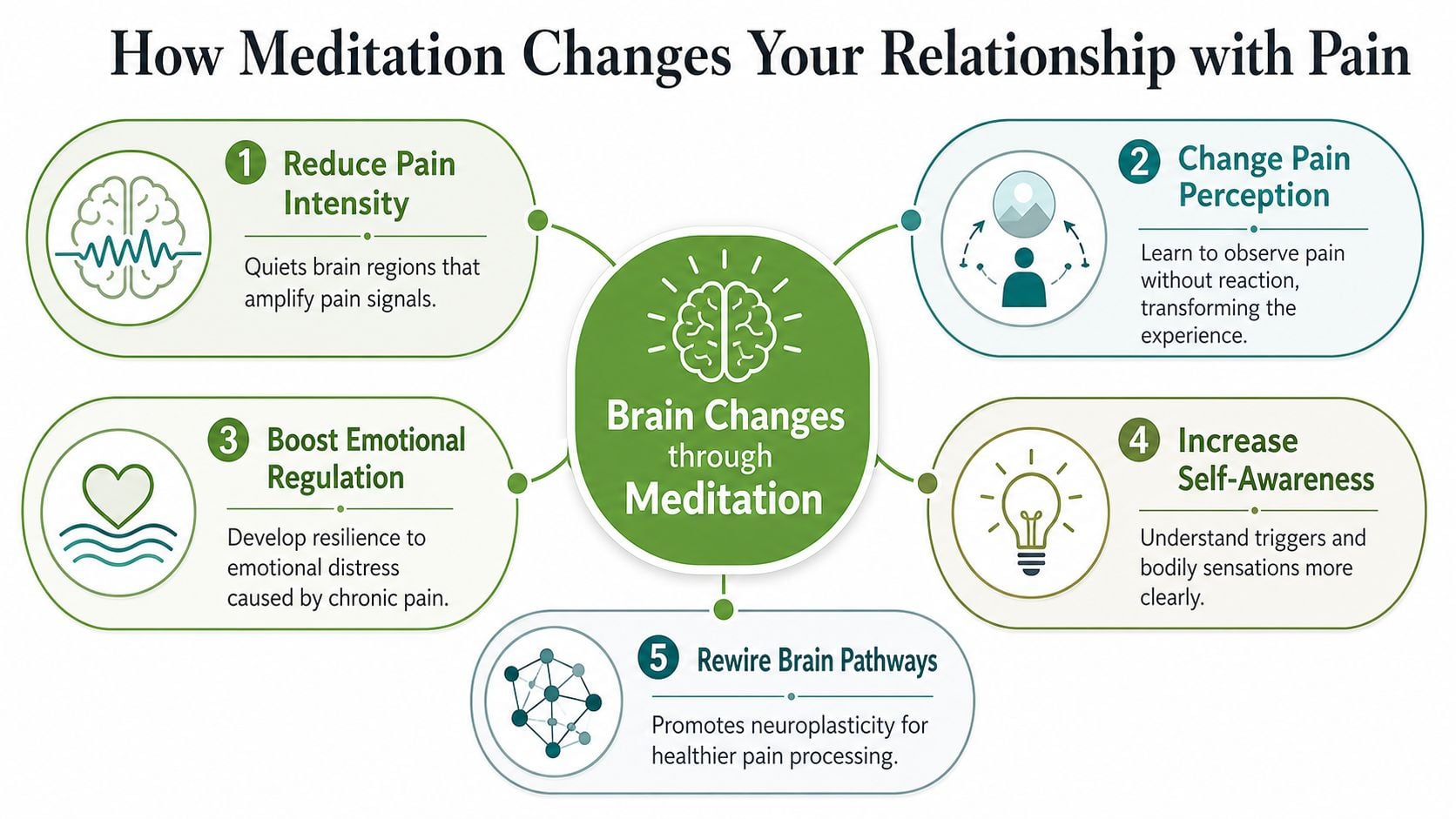
How Meditation Changes Your Relationship with Pain
You wake up with the jaw already working. The teeth are close together, the tongue is pushing, the cheeks feel tired, and one bad breath through a congested nose can make the whole face tense harder. In that state, pain is not only a signal from tissue. It becomes a full-body threat response.
Meditation helps at the level of that response. For patients with TMJ pain, burning mouth symptoms, facial muscle overuse, throat tension, or airway-related sleep disruption, the goal is not to force calm or pretend the pain is minor. The goal is to reduce the extra layers the nervous system adds, especially bracing, vigilance, fear, and the urge to keep checking the pain every few seconds.
Sensation versus reaction
A useful clinical distinction is the difference between pain sensation and pain reaction.
| Channel | What it includes | What meditation can influence |
|---|---|---|
| Sensation | Pressure, aching, throbbing, tightness, burning | How steadily you notice it without chasing it |
| Reaction | Fear, anger, clenching, catastrophic thoughts, body-wide tension | How much the brain amplifies the experience |
Meditation may not remove the sensation channel. It often changes the reaction channel enough that the pain stops driving every decision in the day.
That shift is especially important in orofacial pain. The jaw, tongue, throat, and upper neck can tense in milliseconds. Patients often tell me they are not choosing to clench. They are discovering they were clenching after it has been happening for minutes or hours. Meditation trains earlier detection, which creates a small but meaningful window to release effort before the pain cycle builds.
What actually changes
In practice, the first gains are often subtle.
Pain may still be present, but it feels less fused with alarm. A flare may still interrupt concentration, but it no longer pulls the entire day off course. The jaw may still tighten under stress, but the tightening is noticed earlier and unwinds faster.
For patients with facial pain and breathing issues, generic meditation advice often falls short. A standard instructor may say to close your eyes, take a deep breath, and scan the body while lying flat. That can be the wrong setup for someone whose jaw tightens with mouth breathing, whose throat narrows when fully relaxed, or whose anxiety spikes when breathing is observed too closely. A better practice is one that lowers threat without increasing air hunger, jaw effort, or symptom monitoring.
What to watch for during practice
Use meditation as observation training. Watch for these changes:
Earlier awareness of clenching
Notice the first hint of tooth contact, tongue pressing, lip tightening, or cheek tension.Cleaner language around symptoms
“My left masseter feels tight” is more useful than “Something is wrong and getting worse.”A pause before the fix-it response
One easy breath, one softened swallow, or one unclenched exhale can interrupt automatic guarding.Less whole-body recruitment
Facial pain often pulls in the neck, shoulders, chest, and even the hands. Meditation can help you catch that spread sooner.
Practical rule: If a session leaves you more rigid, more breathless, or more preoccupied with doing the technique correctly, change the method. Shorter practice, open eyes, more support under the head and neck, or less breath focus usually works better than pushing through.
Sleep has a direct effect on pain sensitivity, muscle recovery, and threat reactivity. Patients with nighttime clenching, upper airway resistance, or fragmented sleep often make slower progress if that piece is ignored. The overlap between chronic pain and insomnia helps explain why meditation works better when sleep problems are treated alongside pain.
Some patients also do better when formal meditation is paired with brief reset skills during the day. These calming mind techniques can support attention and downshift stress between longer sessions, without requiring you to sit still through worsening jaw tension or strained breathing.
Three Core Meditation Techniques for Pain Management
Many individuals start meditation with the wrong question. They ask which technique is best. The better question is which technique fits the problem you have right now.
If your pain is scattered and body-wide, one method helps. If your jaw is overworking and your breathing feels strained, another is safer. If lying down makes symptoms worse, the standard instructions may need to be ignored.
The gap is real. A review in this analysis of mindfulness for chronic pain notes that most meditation guides assume standard seated or supine postures, yet for patients with TMJ or sleep apnea, lying flat can exacerbate pain or trigger apnea. Very few studies address posture-modified meditation for airway-limited patients.
Body scan for muscle guarding
A body scan is useful when you feel pain everywhere and nowhere at once. It slows the urge to chase symptoms and helps you spot hidden bracing patterns.
Try it this way:
- Sit in a supported chair or recline with your head raised, rather than lying flat if that position worsens jaw pain, congestion, or breathing.
- Rest your hands loosely. Let the teeth stay slightly apart if that feels natural.
- Bring attention to the forehead, eyes, cheeks, jaw, tongue, throat, neck, and shoulders.
- Don't ask those areas to relax immediately. First, just name what you notice: pressure, gripping, warmth, pulsing, fatigue.
- Move slowly downward through the chest, ribs, belly, pelvis, and legs.
- If you find a painful area, stay curious for one or two breaths, then move on.
The key mistake is trying to force release. That often creates more effort in the face. Observation usually works better than command.
Best use case
Use body scan meditation when pain is tied to tension, overprotection, or end-of-day buildup. It's also helpful for people who don't realize how much they contract their tongue, lips, brow, or throat.
Breath awareness for pain flares
Breath awareness works well during spikes. Not because it erases pain, but because it gives the nervous system one steady anchor.
Basic version:
- Choose a comfortable upright position: A chair with head and neck support works better than unsupported floor sitting for many pain patients.
- Let the breath stay quiet: You're observing the breath, not manufacturing a dramatic one.
- Notice where the breath is easiest to feel: Nostrils, rib movement, or the gentle rise and fall under the hands.
- Count lightly if needed: Inhale, one. Exhale, one. Up to five, then restart.
If the mind jumps back to the pain every few seconds, that's normal. The practice is the return.
When attention comes back to pain, don't call it failure. That return is the repetition that builds the skill.
Adapting breathwork for TMJ and facial pain
Generic advice, such as being told to take big deep breaths, drop the jaw, or lie on the floor and breathe into the belly, often causes trouble. For someone with TMJ irritation, facial pain, mouth breathing, jaw instability, or airway sensitivity, that can backfire.
A safer approach is gentler and smaller.
What to avoid
- Deep mouth breathing: It can dry tissues, increase upper airway irritation, and create more jaw movement than needed.
- Aggressive jaw dropping: This may provoke joint or muscle irritation.
- Lying flat if symptoms worsen there: That position can increase airway resistance or pain.
- Forced breath holds: These aren't appropriate when they create panic, strain, or air hunger.
What to try instead
- Nasal breathing first: Keep the lips together comfortably if possible, with no tooth clenching.
- Minimal effort: Think “quiet breath” instead of “big breath.”
- Tongue and jaw softness: Let the tongue rest lightly and the jaw stay unforced.
- Supported posture: Head lifted, chin neutral, shoulders relaxed.
A paced approach can also help some patients regulate without overbreathing. For those interested in slow, structured breathing, this guide to 6 breaths per minute is a useful reference, especially when practiced gently rather than mechanically.
Open monitoring for persistent pain thoughts
This technique is different. Instead of focusing on one anchor, you let thoughts, sensations, emotions, and sounds come and go without chasing them.
It can be powerful for people whose pain is wrapped in anticipation. The mind says, “What if dinner hurts? What if sleep is terrible? What if tomorrow starts the same way?” Open monitoring helps you see those as events in awareness, not commands.
A simple version:
| Step | What to do |
|---|---|
| Settle | Take a stable seat and soften the eyes |
| Notice | Let pain, thought, sound, or feeling arise |
| Name lightly | “Tightness,” “planning,” “frustration,” “throbbing” |
| Return to observing | No debate, no fixing |
This method isn't usually the first one I'd give a patient with high distress. But once the basics feel safer, it can reduce the habit of building an entire future around the current flare.
Your Progressive 4-Week Meditation Practice Plan
A good meditation plan should feel doable on a bad day. That matters more than ambition. Many people with jaw pain or facial pain quit because they start with sessions that are too long, too rigid, or too uncomfortable to repeat.
The standard Mindfulness-Based Stress Reduction framework uses daily practice of 40 to 45 minutes and that dose is linked with better outcomes, while inconsistent adherence weakens the effect, according to this review of mindfulness protocols and dose-response. But it is not necessary to begin there. Starting smaller is often what allows someone to stay with it long enough to benefit.
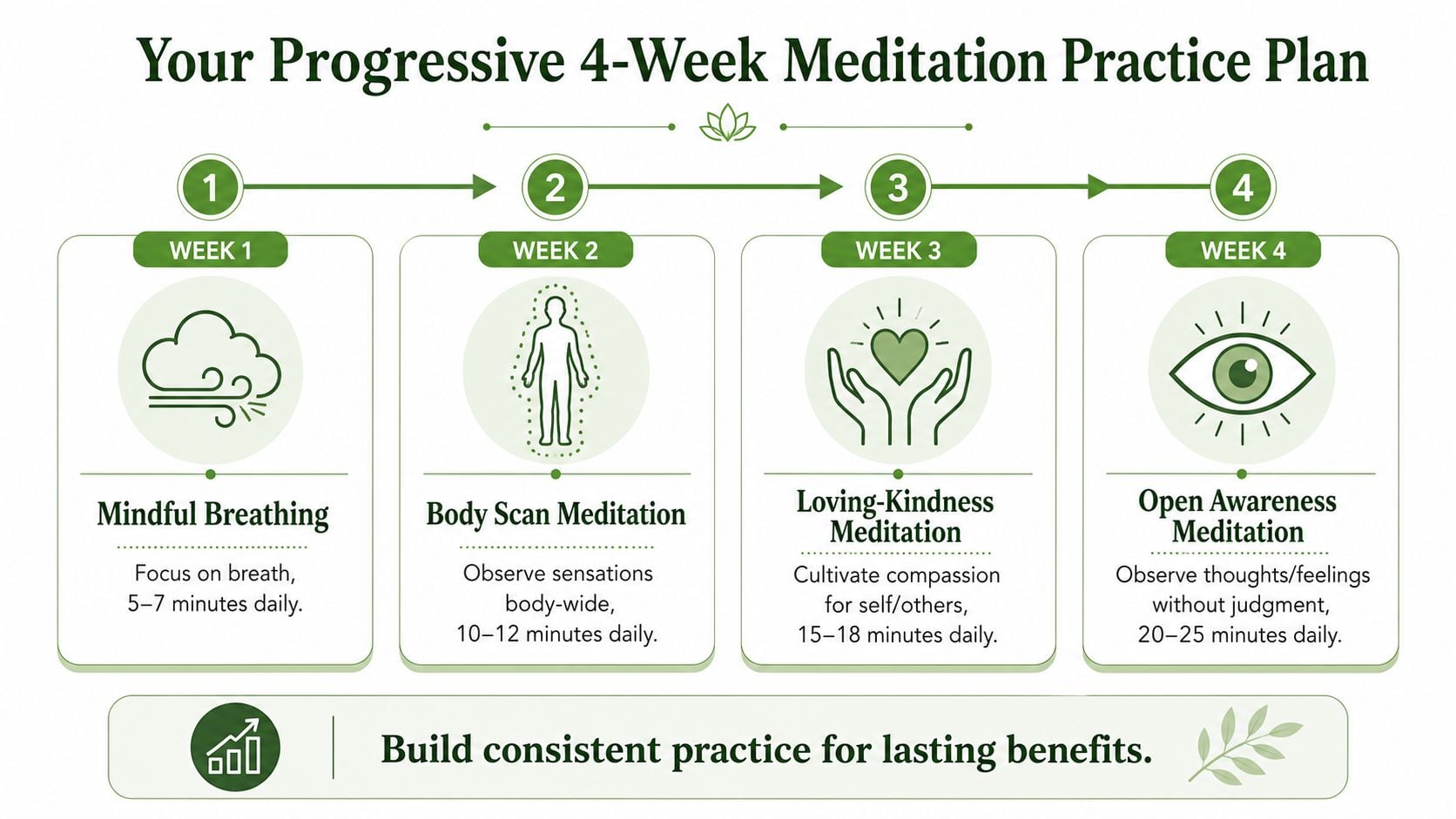
Week 1 with almost no friction
Keep it short. Your goal is to prove that practice can fit into real life.
- Days 1 to 3: Sit in a supported chair for 5 minutes. Notice contact points, then your face, jaw, throat, and shoulders.
- Days 4 to 7: Add quiet nasal breath awareness for the last minute or two.
- Main aim: Learn the setup. Same place, same chair, same time if possible.
A useful benchmark is simple: after practice, do you feel even slightly less urgent? If yes, the method is starting to land.
Here's a brief guided option if you prefer to follow a voice rather than self-direct from the start.
Week 2 with clearer body awareness
Move up only if the first week feels tolerable.
This week, practice for around 8 to 10 minutes. Spend most of the time on body scan, but keep your attention especially on the areas that chronic facial pain patients often skip over too fast: temples, masseters, tongue, throat, neck base, and upper chest.
A simple rhythm
- First phase: Settle posture and let the jaw be unclenched, not forced open.
- Middle phase: Scan top to bottom, naming sensations briefly.
- Last phase: Rest attention on one easy breath area.
Week 3 with one skill for flares
Now build flexibility. Keep one longer daily session, then add one mini-practice during a real symptom spike.
Use this format:
| Practice | Duration | When |
|---|---|---|
| Primary session | 10 to 12 minutes | Morning or early evening |
| Flare reset | 1 to 3 minutes | During jaw tension, headache onset, or stress surge |
The flare reset can be as simple as: feel feet on floor, loosen forehead, let teeth separate, observe three quiet nasal breaths, and stop scanning for danger.
Don't wait for a perfect environment. A short practice done in the car before walking into work often beats the ideal practice you never start.
Week 4 with a sustainable routine
This week, combine methods rather than increasing complexity for its own sake.
A practical sequence is:
- Start with body scan
- Shift to breath awareness
- End with open observation for a brief period
If you're feeling steadier, you can extend the session modestly. If you're not, keep the same duration and focus on consistency. The principle isn't to “graduate” as fast as possible. It's to create a routine your nervous system recognizes.
What success actually looks like
Success doesn't mean every session feels calm. It means you're becoming less reactive and more skillful. Signs you're on track include:
- Earlier awareness of clenching or bracing
- Less need to fix every sensation immediately
- More stable breathing during pain spikes
- Less dread around bedtime or waking symptoms
For chronic pain, repetition matters. Even a modest daily practice often works better than occasional long sessions followed by long gaps.
Important Modifications and Safety Considerations
Meditation is often marketed as universally safe, universally calming, and universally helpful. That isn't careful enough for chronic pain patients, especially those with trauma histories, sensory hyperarousal, TMJ pain, headaches, or sleep-disordered breathing.
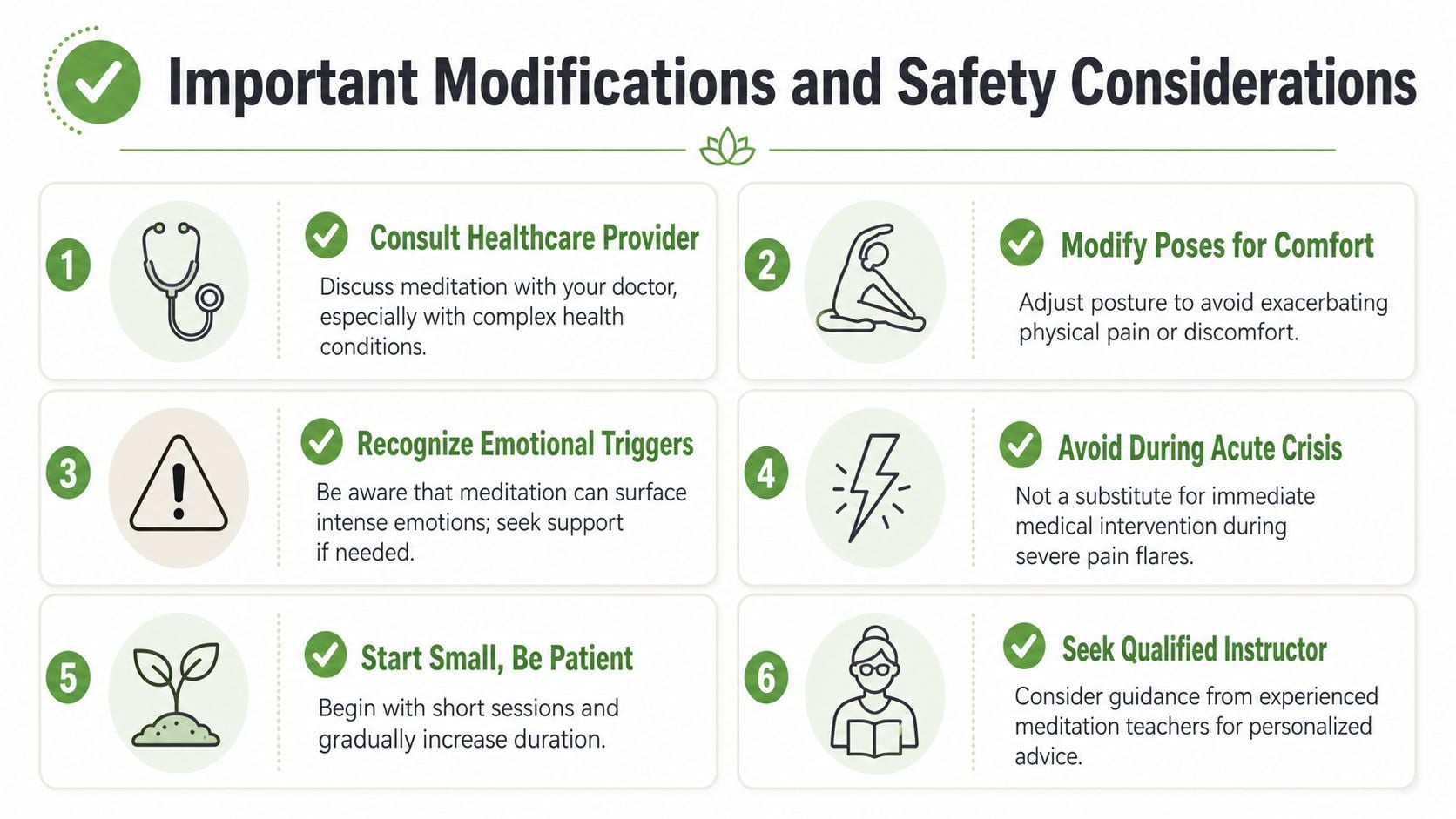
A 2022 report on mindfulness and pain mechanisms highlighted an important limitation. For some individuals whose brain networks linking sensation and self-identity are disrupted by trauma or hyperarousal, mindfulness can fail or even cause distress, including a risk of retraumatization. That point is missing from most mainstream guidance.
When meditation can feel worse, not better
If you've ever tried to “sit with your body” and felt more panicked, more trapped, or more focused on pain, you didn't do it wrong. The method may have been wrong for your current state.
Watch for these responses:
- Pain vigilance increases: You become more fixated on every pulse, click, or shift in the jaw.
- Breathing feels threatened: Attention to breath creates air hunger or panic.
- Memories or strong emotions surface fast: Stillness opens material you aren't ready to hold alone.
- Body scanning feels invasive: Sensation awareness becomes too intense rather than grounding.
In those cases, less internal focus may be safer at first.
Better starting points for sensitive nervous systems
Try external anchors before deep interoception.
- Sound-based attention: Notice a fan, rain, quiet music, or room tone.
- Visual grounding: Keep eyes open and rest attention on a stable object.
- Movement-based mindfulness: Slow walking, gentle stretching, or hand-on-chair contact can be more tolerable than stillness.
- Short intervals: Thirty seconds to two minutes may be enough initially.
If internal focus makes you feel flooded, switch to an external anchor. Safety comes before technique purity.
Posture matters more than most guides admit
For TMJ, facial pain, reflux tendencies, congestion, or sleep apnea, meditation posture is not a minor detail. It can determine whether the practice calms the system or aggravates it.
Use this checklist:
| Problem during meditation | Likely issue | Better option |
|---|---|---|
| Jaw aching in seated practice | Unstable head and neck position | Add head support and reduce chin jutting |
| Pressure when lying flat | Supine posture aggravates pain or airway | Elevate head and torso |
| Dry mouth or strain | Mouth breathing during practice | Return to quiet nasal breathing if tolerated |
| Temple or facial tightening | Trying too hard to relax | Shift from “release” to simple noticing |
When to pause and ask for help
Meditation should be stopped or modified if it repeatedly triggers distress you can't settle within a short period. That includes escalating panic, strong dissociation, severe breath discomfort, or a sense that the practice is intensifying your pain focus every time.
Situations that call for clinical input include:
- Complex trauma history
- Marked sensory hyperarousal
- Sleep apnea symptoms or breath-holding concerns
- Jaw locking, severe facial pain, or major headache provocation
- Persistent worsening after multiple attempts at adaptation
This is also not a substitute for acute medical care during a severe pain flare, neurological change, or urgent breathing concern.
A safer mindset for practice
A lot of people approach meditation like rehab homework they must pass. That mindset creates strain. Better questions are:
- Is this position sustainable?
- Can I breathe without effort?
- Do I feel more organized afterward, even a little?
- Am I practicing with curiosity instead of force?
For the right patient, meditation is a strong tool. For the wrong method or the wrong timing, it can be counterproductive. Responsible care means telling the truth about both.
Integrating Meditation into Your Comprehensive Care Plan
Meditation for chronic pain works best when it's treated as one piece of a larger plan. For TMJ disorders, facial pain, headaches, clenching, and sleep-related breathing issues, symptoms rarely come from one cause alone. They usually reflect an interaction between structure, function, sleep, stress, breathing patterns, muscle behavior, and nervous system sensitivity.
That's why meditation is most useful as a self-regulation tool, not a stand-alone fix. It can reduce reactivity, improve coping, and make other treatments easier to tolerate and apply. But if you also have airway problems, fragmented sleep, significant jaw dysfunction, or a trauma-sensitive nervous system, the technique should be adapted to you rather than copied from a generic app.
Supportive habits can also help create a calmer baseline between sessions. Some patients like pairing meditation with sensory cues such as scent, and this overview can help you discover aromatherapy for stress relief in a simple, non-complicated way.
The main goal is control. Not perfect control over pain itself, but more control over your response to it. When that starts to improve, daily life often becomes more manageable long before symptoms are gone.
If jaw pain, facial tension, headaches, clenching, snoring, or sleep-disordered breathing are all showing up together, a personalized evaluation can make the difference between partial relief and a plan that fits how your body works. Pain and Sleep Therapy Center helps patients in Charlotte and beyond address TMJ disorders, facial pain, and airway-related sleep issues with root-cause care that goes beyond temporary symptom management.