You open your mouth to yawn, take a bite of something chewy, or turn to answer a question, and there it is. A click. Sometimes a pop. Sometimes loud enough that you notice it immediately. Sometimes subtle enough that you only register it once it starts happening over and over.
A common first reaction is the same. “Did something just slip out of place?” That concern is understandable. The jaw is one of those joints you use all day, and when it starts making noise, it can feel like a warning.
The reassuring part is that jaw clicking is common. The more important part is that context matters. A painless click is often very different from a click that comes with pain, stiffness, locking, or headaches. Understanding that difference is what helps people stop guessing and start making good decisions.
That Startling Click What Your Jaw Is Trying to Tell You
A lot of patients describe the first episode the same way. They were eating a sandwich, laughing, or brushing their teeth, and suddenly the jaw made a distinct sound that hadn't been there before. After that, they couldn't stop noticing it. Every meal became a test. Every yawn felt risky.
That reaction makes sense. The sound feels dramatic. But the sound alone usually isn't the whole story.
About 30% of adults report experiencing TMJ clicking, and only a fraction need clinical intervention because the sound is often a mechanical symptom rather than a sign of severe damage, according to research on temporomandibular disorders and disc displacement. The same source notes that TMD is at least twice as common in women, and more than 90% of patients seeking treatment are women in their childbearing years.
A click is a message from the joint, not an automatic sign of injury.
The temporomandibular joint, or TMJ, sits just in front of each ear and helps your jaw open, close, slide, and chew. When it clicks, something in that movement pattern isn't perfectly smooth. That can be mild and manageable. It can also be the beginning of a more significant problem if pain and restricted motion show up with it.
If you're new to this topic, a basic overview of what TMJ disorder is can help put the symptom into a bigger picture.
For now, the key point is simple. TMJ clicking and popping can be harmless, but it shouldn't be ignored if the pattern changes. The sound matters less than the combination of sound, pain, function, and what else your body is doing around the jaw.
Anatomy of a Click Understanding Your Jaw Joint
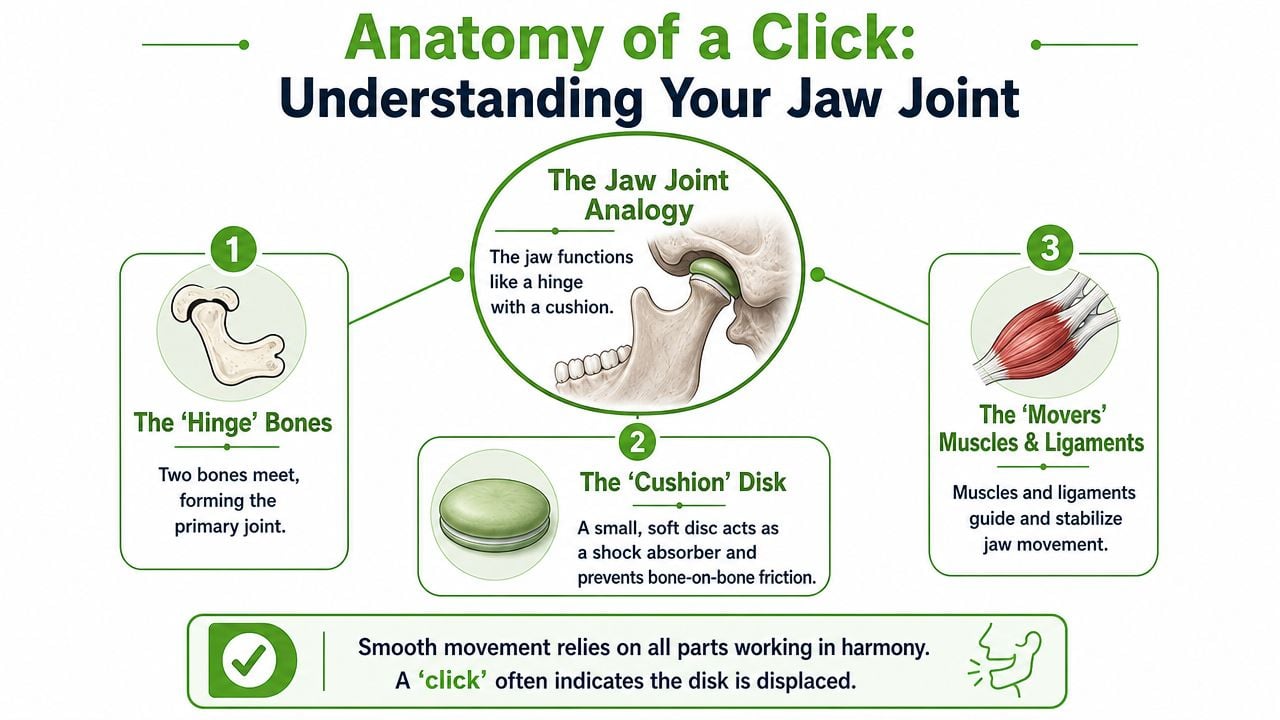
The easiest way to understand jaw clicking is to think of the joint as a moving hinge with a small cushion inside it. That cushion is a disc. It helps the jaw glide smoothly so the bones don't rub directly against each other.
When everything tracks well, opening and closing feel quiet and controlled. When the disc shifts out of its ideal position and then slips back during movement, you may hear the click.
The parts that create the sound
Three structures matter most:
- The joint surfaces: These are the bony parts that meet and move.
- The disc: This soft structure works like a cushion or gasket.
- The muscles and ligaments: They guide movement and help keep the disc aligned.
A simple analogy helps. Think of a coaster sitting between a glass and the table. If the coaster slides partly off center and the glass shifts over it, you can feel and hear that repositioning. The jaw does something similar when the disc is displaced and then reduces back into position.
What a typical click often means
The common mechanical pattern is called disc displacement with reduction. In plain language, the disc isn't staying where it should at the start of movement, but it still snaps back into a workable position as the jaw opens or closes.
According to the National Institute of Dental and Craniofacial Research, TMJ clicking and popping without pain is often considered a clinically normal finding, but when clicking is paired with pain or reduced mouth opening, it points toward internal derangement and painful clicking is a red flag that may warrant imaging such as MRI or CT to assess structural damage and inflammation, as outlined by the NIDCR guidance on TMD.
Practical rule: Noise tells you about mechanics. Pain and limitation tell you about consequences.
That distinction is why two people can both have clicking jaws but very different treatment needs. One may need reassurance and habit changes. The other may need a full workup because the disc, joint lining, and surrounding tissues are no longer tolerating the strain.
Why Is My Jaw Clicking The Most Common Causes
Clicking rarely comes from a single isolated cause. In practice, the jaw is usually responding to a stack of influences. Habits load the joint. Muscles change the pull on the disc. Breathing patterns and posture alter head and neck mechanics. An old injury may have started the whole cycle.

Habits and daily loading
Clenching and grinding are major contributors. So is chewing gum for long periods, biting nails, leaning your chin into your hand, or repeatedly opening wide enough to trigger the click. These behaviors don't just irritate muscles. They can change how the disc and joint surfaces meet.
One pattern I see often is the patient who says, “It only clicks when I move my jaw sideways to make it pop.” That self-testing becomes part of the problem. Repeatedly forcing the joint through the noisy path can keep irritated tissues from settling down.
Injury and overstretching
Not every jaw injury looks dramatic. A big yawn, prolonged mouth opening during dental care, oral intubation, or a sports impact can overload the joint. An estimated 85% of TMJ cases are acquired through lifestyle, injury, or environmental factors rather than genetics, and incident jaw injuries are strongly associated with TMD onset with a Hazard Ratio of 3.94, based on reported TMJ epidemiology and injury associations.
That matters because many people assume a clicking jaw just “runs in the family” or happened for no reason. More often, there's a mechanical or behavioral explanation.
Airway, posture, and the bigger system
A root-cause approach becomes useful. The jaw doesn't work alone.
If you breathe through your mouth, hold your tongue low, or carry your head forward, the muscles of the face, neck, and jaw often compensate. A narrowed airway can drive tension patterns. Forward head posture can change the resting position of the jaw. Tight neck muscles can feed into facial pain and uneven joint loading.
A few common contributors often travel together:
- Poor nasal breathing: Mouth breathing can alter oral posture and muscle balance.
- Forward head posture: The jaw often shifts to accommodate the neck and airway.
- Sleep-related clenching: People may wake with tight cheeks, temple pressure, or jaw fatigue.
- Asymmetrical chewing: Favoring one side can overload the noisier joint.
This is why treating only the click rarely solves the whole issue. The best outcomes usually come from asking what the jaw is compensating for.
When to See a Doctor Red Flags for TMJ Clicking
A painless click that happens occasionally is very different from a click that comes with pain, a jaw that won't open well, or a bite that suddenly feels off. People get into trouble when they assume all clicking is harmless, or when they panic over a sound that's purely mechanical. You need a clear line between those two.
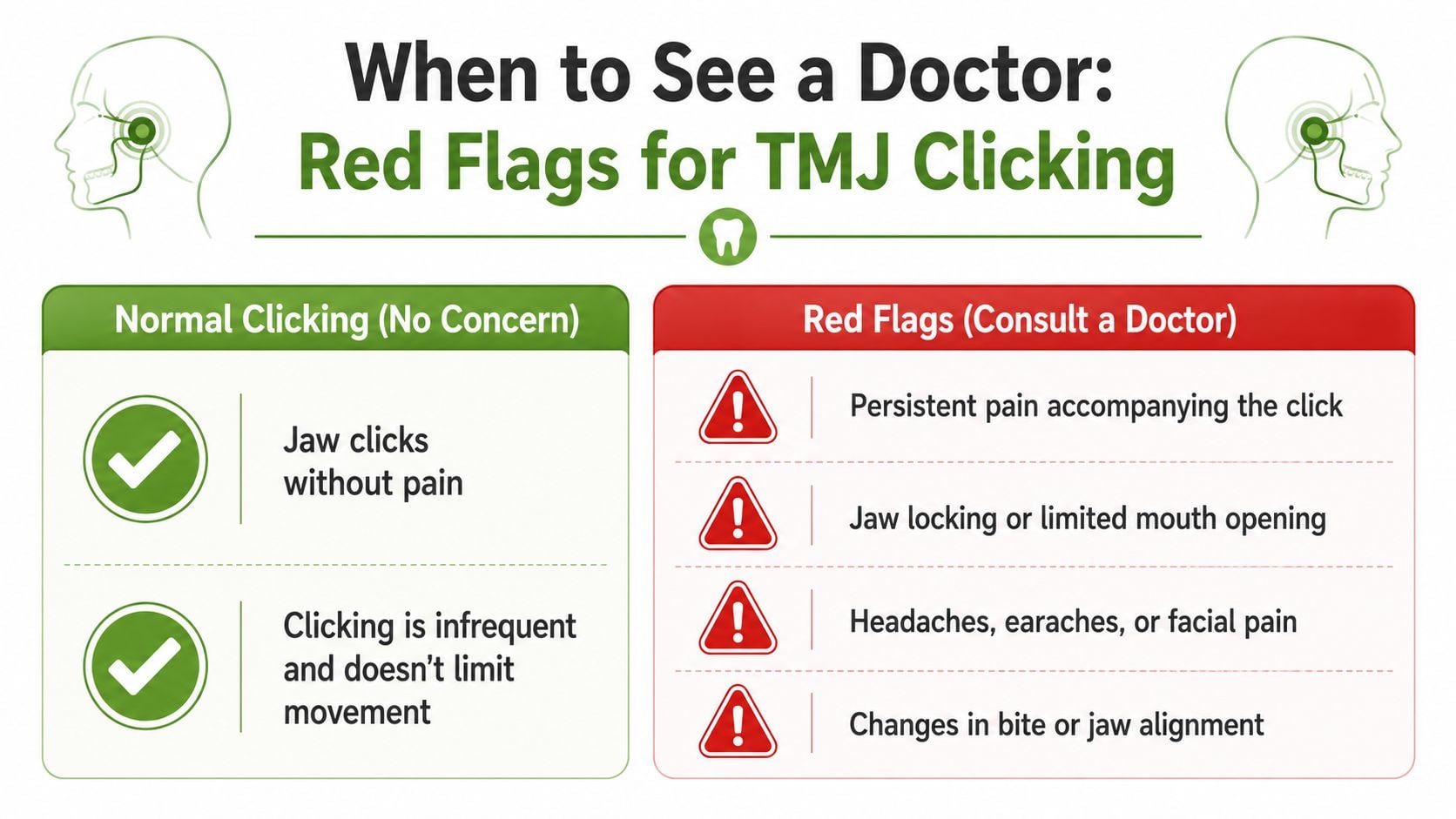
Harmless pop versus warning sign
A simple way to think about it is this:
| Situation | What it usually suggests |
|---|---|
| Clicking without pain | Often a mechanical joint noise that may not need treatment |
| Clicking with pain | Active irritation or internal derangement that needs evaluation |
| Normal opening and closing | Function is preserved |
| Reduced opening or locking | The joint may not be tracking normally |
| No change in bite | Mechanics may be stable enough for observation |
| Bite feels different | The joint or muscles may be shifting position |
According to the NIDCR, TMJ clicking without pain is often considered clinically normal, but clicking paired with pain or reduced mouth opening signals internal derangement, and painful clicking is a red flag for imaging to assess structural damage and inflammation.
Symptoms that shouldn't be brushed off
Seek professional evaluation if your jaw clicking comes with any of the following:
- Pain in front of the ear or in the jaw joint
- Reduced mouth opening
- Jaw locking, whether open or closed
- Facial pain, ear discomfort, or headache patterns
- Stiffness that's getting worse
- A sudden change in how your teeth meet
Here's a helpful walkthrough that visually explains what these warning signs can look like in real life:
If the jaw is noisy but works well and doesn't hurt, watch it. If it hurts, sticks, or limits eating, stop waiting.
Why timing matters
The worst mistake isn't hearing a click. It's continuing to chew through pain, testing the joint, or assuming it will settle while function keeps declining. Once the jaw starts guarding, muscles tighten. Once muscles tighten, movement gets less coordinated. Then the cycle feeds itself.
People often wait because the symptoms fluctuate. One good day doesn't erase a pattern of worsening strain. If your click has turned into pain or the jaw feels less reliable, that's the point to get it assessed.
Simple Home Strategies to Soothe Your Jaw
You wake up, yawn, hear the click, and spend the rest of the morning testing it. That pattern keeps many mild jaw problems irritated. Home care works best when it lowers strain on the joint, calms overworked muscles, and gives the jaw fewer chances to flare.
Start by making the jaw's job easier for a week or two. Choose softer foods, cut meals into smaller pieces, and avoid sandwiches, apples, crusty bread, chewy meats, gum, and oversized bites. Keep your lips together, teeth apart, and tongue resting lightly on the roof of the mouth. That resting posture reduces unnecessary clenching and fits into a broader recovery plan that also looks at airway and tongue function.
A short routine can help:
- Eat strategically: Pick softer textures and smaller bites.
- Avoid provoking the click: Do not keep opening wide to check whether the noise is still there.
- Support the jaw when yawning: A hand under the chin can limit sudden wide opening.
- Chew evenly if comfortable: If one side is clearly painful, do not force it. If both sides feel similar, gentle balanced chewing is usually less irritating than overusing one side.
- Use brief heat for muscle tightness: Warmth can settle guarding in the cheeks and temples.
Neck position matters more than many patients expect. If your head stays forward over a phone or laptop, the jaw muscles often work harder to stabilize the area. That does not mean posture alone caused the click, but poor posture can keep the system tense. I also look at breathing patterns here, because mouth breathing and low tongue posture often travel with forward head posture and jaw overload.
If the soreness feels muscular rather than sharp and joint-specific, gentle massage can help. This guide on how to massage your jaw safely gives a useful starting point. Stop if massage increases joint pain, triggers locking, or makes the click more forceful.
Relief usually comes from reducing irritation and improving coordination, not from stretching harder.
Sleep and stress affect the jaw too. Clenching often spikes during periods of poor sleep, nasal congestion, or high stress, which is one reason TMJ symptoms are rarely just a jaw problem. Some patients want general symptom-support tools while they monitor their pattern at home. In a broader dental pain context, the Toothfairy app for pain relief offers a useful example of self-care guidance.
Skip aggressive stretching, chewing gum to "strengthen" the jaw, and online tricks that promise to pop the joint back into place. Those approaches often increase irritation or instability. If simple home measures settle the area, good. If the click keeps returning with tension, poor sleep, mouth breathing, or neck strain, that usually means the jaw needs a more complete, root-cause plan rather than more force.
Your Path to Relief Modern Diagnosis and Treatment
You may reach the point where the click is no longer just a strange sound. It starts changing how you chew, how wide you open, how you sleep, or how much you trust your jaw. That is usually when a better diagnosis matters.
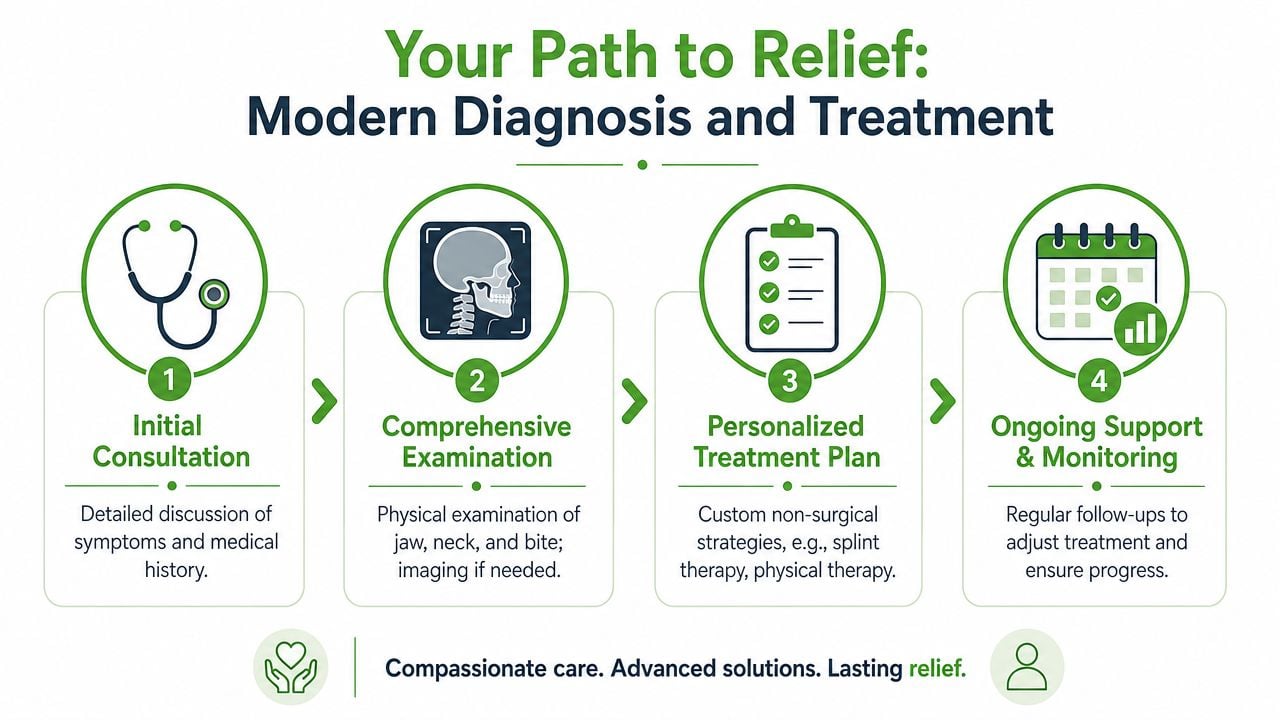
What a modern workup looks for
A useful TMJ evaluation does more than confirm that the joint clicks. It looks for the reason the jaw has lost smooth, stable motion.
At the first visit, I want to know the pattern. Does the click happen early or late in opening? Does it occur on closing too? Is the jaw drifting to one side, tiring with meals, or feeling stuck after sleep? Those details help separate a noisy but stable joint from one that is overloaded, inflamed, or mechanically less reliable.
The exam usually focuses on four areas:
- Joint behavior: timing of the click, tracking of the jaw, and whether motion is smooth or catches
- Range of motion: comfortable opening, restricted opening, or deviation to one side
- Muscle contribution: tenderness in the masseter, temporalis, neck, and shoulder muscles
- Whole-system drivers: airway issues, mouth breathing, low tongue posture, poor sleep, and forward head posture
Imaging has a role when the history and exam suggest more than a simple movement problem. If opening is limited, pain is persistent, or the joint may be structurally irritated, imaging can help clarify what the disc, bone surfaces, and surrounding tissues are doing. The goal is to answer a useful clinical question, not to chase every sound the joint makes.
Treatment usually starts with the least invasive option that fits the problem
Most patients do not need surgery. They need the right sequence of care.
A practical plan may include:
- Occlusal splints: often helpful when clenching, grinding, or nighttime overload is part of the picture
- Physical therapy: useful for muscle guarding, restricted motion, and poor neck-jaw coordination
- Behavioral changes: reducing joint strain, avoiding repeated self-popping, and improving daily jaw habits
- Injection-based care: considered when irritation, inflammation, or instability continues despite conservative treatment
Trade-offs matter here. A splint can reduce overload, but it will not fix poor tongue posture or chronic mouth breathing. Physical therapy can improve motion and muscle balance, but it may not fully stabilize a hypermobile joint on its own. In some cases, injection-based treatment is appropriate, especially when the joint remains inflamed or lax after simpler measures have been tried.
Root-cause treatment goes beyond the joint
Clicking rarely exists in isolation. In many patients, the jaw is reacting to a larger pattern that includes airway strain, postural compensation, sleep disruption, and altered oral function.
Orofacial myofunctional therapy can be valuable when tongue posture, lip seal, swallowing mechanics, or nasal breathing are part of the problem. That matters because a jaw that is constantly adapting to low tongue posture or mouth breathing often stays tense even when the joint itself is treated. Postural retraining can also reduce the constant pull from the neck and upper shoulders that keeps the jaw working harder than it should.
Regenerative medicine has a place in carefully selected cases. If the main issue is joint laxity or hypermobility, treatments such as prolotherapy may help support stability. That decision should come from the exam, the movement pattern, and the patient's goals, not from marketing claims or a one-size-fits-all protocol.
If you want to compare conservative care with advanced, non-surgical approaches, this guide to TMJ treatment options explains how different therapies address pain control, mechanics, and longer-term joint stability.
The best plan restores stable function. It helps the jaw open, close, chew, and rest with less guarding, less compensation, and fewer flare-ups.
Your Questions About TMJ Clicking Answered
Can TMJ clicking go away on its own
Yes, sometimes it can. If the problem is mostly related to temporary overload, muscle tension, or irritated movement patterns, the joint may quiet down with rest, softer foods, and less provocation. If the clicking becomes painful or function worsens, don't rely on time alone.
Is it safe to get dental work if my jaw clicks
Usually, yes, but the dentist should know beforehand if you have jaw symptoms. Long appointments and prolonged mouth opening can aggravate a sensitive joint. Breaks, bite supports, and smaller treatment sessions can make care much easier.
Could my jaw click be causing my headaches or ear pain
It can be related. The jaw joint and surrounding muscles share close connections with the temples, cheeks, and area around the ears. When the muscles overwork or the joint becomes irritated, people often feel symptoms outside the jaw itself.
Should I keep trying to pop it back into place
No. That habit often makes things worse. Repeatedly forcing the click can strain ligaments and keep the joint inflamed. A calmer, less provocative pattern is safer.
Does a clicking jaw always mean surgery
Not at all. Many individuals with TMJ clicking and popping don't need surgery. Non-surgical care is usually the starting point, and many cases improve when treatment addresses the underlying driver, whether that's clenching, hypermobility, airway dysfunction, posture, or muscle imbalance.
If your jaw is clicking, popping, hurting, or starting to feel unreliable, the next step is getting a careful diagnosis instead of guessing. Pain and Sleep Therapy Center in Charlotte provides root-cause care for TMJ disorders, facial pain, and sleep-related breathing issues, with options that include advanced diagnostics, orofacial myofunctional therapy, and non-surgical regenerative treatments. If you're ready for a plan that looks beyond the symptom and focuses on why your jaw is struggling, their team is a strong place to start.