You wake up with a sore jaw, a dull headache behind the temples, and teeth that feel oddly tender. You search online and get buried in conflicting advice. One website says you need a night guard. Another says a TMJ splint will fix the problem. A third promises to “retrain” your jaw permanently.
That confusion is common, and it leads many people to ask the wrong question.
The primary question isn't, “Which appliance should I buy?” It's “What diagnosis explains my symptoms?” A device is only a tool. If the diagnosis is wrong, the tool is wrong too.
A person who grinds their teeth without joint symptoms may do well with a protective guard. A person with clicking, locking, joint pain, headaches, ear pain, or restricted opening may need a very different appliance and a much more careful treatment plan. Those are not small distinctions. They change the goal of treatment entirely.
The Night Guard and Splint Dilemma
A patient sits in front of me after weeks of trying to figure this out alone. They've read reviews, compared prices, and maybe even bought a boil-and-bite guard online. But the symptoms keep shifting. Some nights the teeth feel better. The jaw doesn't. Or the jaw feels tight, the headaches continue, and now the bite feels “off” in the morning.

That pattern matters. Bruxism and TMJ disorders can overlap, but they aren't the same problem. Teeth grinding describes a behavior. TMJ disorder describes dysfunction involving the jaw joint, muscles, or both. If someone treats every jaw symptom like simple grinding, they can miss the actual source of pain.
Why people get stuck
Most online comparisons focus on the device itself. Hard plastic versus soft plastic. Upper arch versus lower arch. Custom versus store-bought. Those details matter, but they matter after the diagnosis is clear.
A better starting point is the symptom pattern:
- Tooth wear and clenching alone often point toward a protective goal.
- Clicking, popping, locking, headaches, ear pain, or pain around the joint point toward a therapeutic goal.
- Morning muscle fatigue may reflect overworked jaw muscles, but that still doesn't tell you whether the joint is involved.
Clinical reality: The same person can have grinding, muscle pain, and a joint disorder at the same time. That's why self-diagnosis often fails.
The device follows the diagnosis
A night guard and a TMJ splint can look similar to a patient because both sit on the teeth. Clinically, they are built for different jobs.
| Question | Night Guard | TMJ Splint |
|---|---|---|
| Main purpose | Protect teeth from grinding and clenching | Influence jaw position, joint loading, and muscle activity |
| Best fit for | Bruxism without joint symptoms | Specific TMD diagnoses with pain, clicking, locking, or deviation |
| Treatment style | Passive protection | Active therapy |
| Diagnostic need | Basic confirmation of grinding risk | Careful functional diagnosis |
When people compare TMJ splint vs night guard as if they're interchangeable products, they miss the central issue. The correct appliance isn't a preference. It's a prescription based on what the jaw system is doing.
Understanding the Standard Night Guard
A night guard is primarily a protective appliance. Its main role is to act as a physical barrier between the teeth so grinding and clenching cause less damage to enamel, restorations, and tooth structure, as described by Jax Dental Studio's explanation of night guards and TMJ guards.
Consider a helmet. A helmet can reduce injury during impact. It does not correct the reason someone fell off the bike. In the same way, a night guard can protect the teeth during clenching or grinding, but it usually doesn't treat the muscles, joints, or ligaments creating a more complex pain problem.
What a night guard does well
For the right patient, a night guard is often enough.
It's the most common dental device prescribed for teeth grinding, and it may be the only treatment needed when someone only clenches or grinds without other TMJ-related symptoms such as joint noise or locking, according to this clinical overview of when a standard night guard is appropriate.
A standard night guard can help with:
- Enamel protection so the teeth don't continue wearing down
- Restoration protection when crowns, veneers, or fillings are at risk
- Reducing direct tooth-to-tooth force during nighttime grinding
- Giving a heavy clencher a protective buffer while broader habit and stress factors are addressed
What a night guard usually cannot do
Many people experience disappointment at this point.
A night guard is typically not designed to treat the muscles, joints, or ligaments. If your main complaint is jaw locking, pain directly over the joint, popping with function, or headaches tied to jaw mechanics, a protective guard may not address the source of the problem.
A guard can protect the teeth while the joint and muscles continue to struggle.
That distinction is the practical core of TMJ splint vs night guard. One device protects surfaces. The other may be selected to change how the jaw system functions.
Custom still doesn't mean therapeutic
A dentist-made night guard is usually better than a generic store version because the fit is more controlled and the material is more durable. But custom doesn't automatically mean therapeutic.
A custom protective guard can still be a protective guard. It may fit beautifully and still not be the right tool for a patient whose primary problem is joint overload or unstable jaw position. That's why “custom-made” should never be mistaken for “solves TMJ.”
Introducing the Therapeutic TMJ Splint
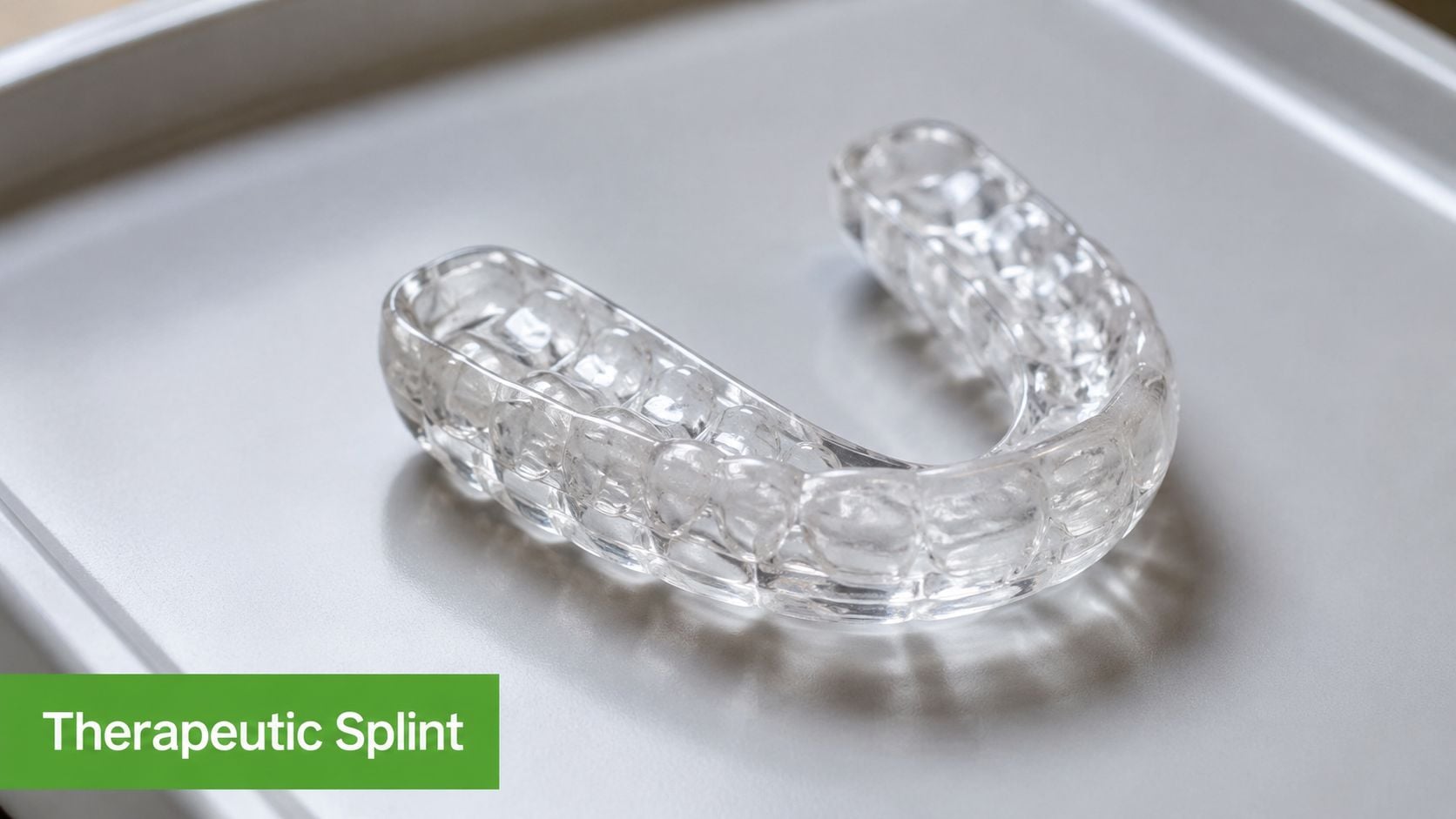
A TMJ splint is a different category of appliance. It is a custom-fabricated therapeutic appliance designed to reposition the jaw into a relaxed, optimal alignment, thereby reducing strain on the joint and musculature, as described by DDTA Dental's clinical comparison of bite splints and night guards.
That wording matters because the goal is not simple tooth protection. The goal is to influence how the jaw functions.
What makes a splint therapeutic
A splint is prescribed for specific TMD presentations involving joint pain, clicking, locking, or deviation. It is designed to influence joint loading and muscle activity, not just sit between the teeth as a passive cushion.
In practical terms, the appliance is trying to create a more stable, less strained relationship between the lower jaw, the muscles that move it, and the temporomandibular joints. That can matter when a patient feels worse with chewing, notices a jaw shift on opening, or reports symptoms that travel into the temples, ears, or neck.
Why a specialist may choose it
A therapeutic splint may be considered when the history and exam suggest the person's symptoms come from more than bruxism alone. If the jaw clicks, locks, deviates, or hurts at the joint itself, the problem may involve mechanics that a standard night guard won't predictably address.
Some clinical sources also describe TMJ splints as more specialized and often more expensive than regular night guards because they are built for a treatment purpose rather than general protection. That's a trade-off many patients need explained clearly. You're not paying for extra plastic. You're paying for a device that is intended to be part of a diagnosis-driven therapy plan.
Practical rule: If the main goal is to protect teeth, think guard. If the main goal is to change joint and muscle mechanics, think splint.
What a splint still does not do
A splint can be very helpful, but it should not be described as magic. It's a tool that may reduce strain and improve function while it's being used. It is not proof that the entire problem has been solved.
That's why the best conversations around TMJ splint vs night guard always come back to diagnosis, symptom pattern, and treatment goals. The appliance matters. The reason for prescribing it matters more.
Comparing Key Differences A Clinical Breakdown
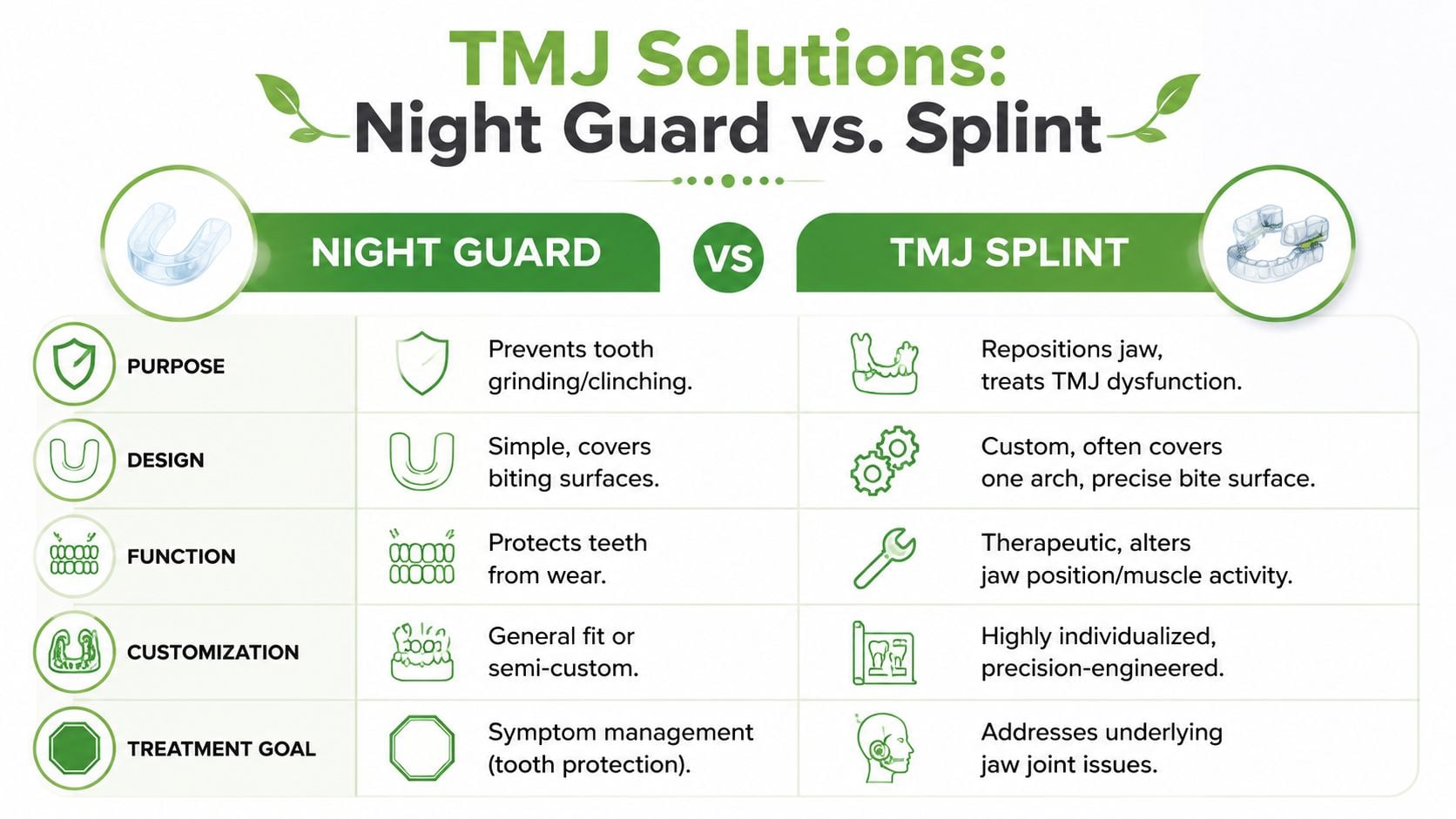
When patients compare these appliances side by side, the clearest answer comes from function, not appearance. Both may be made of acrylic. Both may be worn at night. Both may be called a “guard” in casual conversation. Clinically, they serve different purposes.
Side by side differences
| Clinical factor | Night Guard | TMJ Splint |
|---|---|---|
| Primary goal | Protect teeth from grinding and clenching | Reduce strain on the TMJ system through therapeutic positioning |
| Mechanism | Passive barrier between upper and lower teeth | Active influence on jaw posture, joint loading, and muscle activity |
| Typical candidate | Person with bruxism alone | Person with TMD symptoms such as pain, clicking, locking, or deviation |
| Design philosophy | Protection-focused | Diagnosis-driven and therapeutic |
| Expected benefit | Limits tooth wear and fracture risk | Aims to improve comfort and jaw function in selected cases |
| What it doesn't do | Usually doesn't treat joint or ligament problems | Doesn't permanently retrain the jaw |
The visual summary below helps make those distinctions easier to scan.
Purpose matters more than appearance
A standard guard is built around protection. If someone is wearing down enamel, chipping teeth, or stressing dental work, a guard may do its job very well.
A splint is built around therapy. The appliance is selected because the clinician is trying to alter how force is distributed through the jaw system. That's a different treatment intent from day one.
The indication changes the prescription
The same symptom can confuse patients. For example, a morning headache might come from clenching. It might also come from overworked jaw muscles or a joint problem. A clicking jaw may occur with grinding, but clicking itself suggests that simple tooth protection may not be the whole answer.
Some dental professionals describe the practical dividing line this way: if a patient has headaches, ear pain, neck pain, jaw joint noises, or episodes of locking, a TMJ orthotic is the more appropriate treatment direction, while a standard night guard is better suited when someone only clenches or grinds without those other symptoms, according to this discussion of symptom-based appliance selection.
Customization is not the same as complexity for its own sake
Patients sometimes assume a splint is just a more elaborate version of a night guard. It isn't. The extra detail exists because the clinical problem is different.
A protective appliance answers the question, “How do we protect the teeth?” A therapeutic splint answers the question, “What jaw position or force pattern reduces stress on this patient's system?” That second question requires more diagnostic precision.
How a Specialist Decides Which You Need
The choice starts with symptoms, but it doesn't end there. A specialist listens for patterns that separate simple bruxism from a more complex temporomandibular disorder.
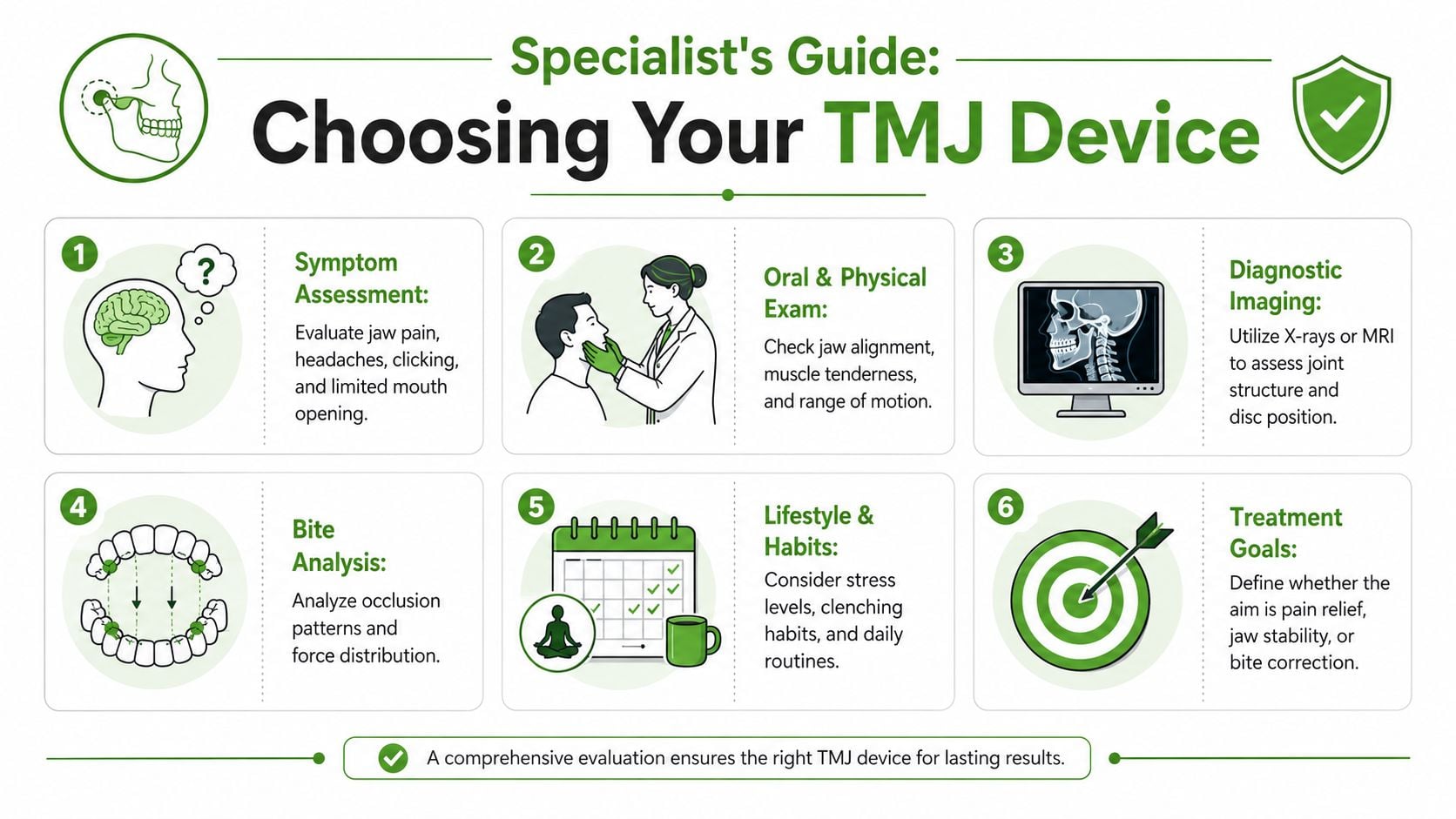
A patient who says, “My teeth feel worn and my partner hears me grind,” may fit a very different path from a patient who says, “My jaw clicks, sometimes catches, and I get pain in front of the ear when I chew.” Those are not interchangeable histories.
The clinical clues that change the plan
A specialist generally pays close attention to findings like these:
- Joint symptoms such as clicking, popping, locking, or pain directly over the TMJ
- Movement changes including limited opening, deviation on opening, or pain with lateral movement
- Muscle findings like tenderness in the masseter or temporalis muscles
- Pain referral patterns involving headaches, ear discomfort, facial pain, or neck tension
- Bite and loading patterns that suggest one part of the jaw system is being overloaded
These details help answer a more useful question than “guard or splint?” The question is, what tissue is likely generating the symptoms? Teeth, muscles, joints, or a mix of all three.
What the evidence supports, and what it doesn't
The evidence around splints is more nuanced than many marketing claims suggest. A review available through the National Library of Medicine on occlusal splints for temporomandibular disorders reports that clinical studies show splints are superior to control groups for short-term pain reduction, while long-term results become inconsequential as efficacy aligns with other therapeutic approaches. The same review notes enhanced jaw mobility during lateral movements at certain intervals, even when long-term pain reduction remains limited. It also cites the 2020 National Academy of Medicine report stating that data on intraoral appliance therapy is generally of poor quality and yields mixed results.
That's exactly why a responsible specialist avoids overselling. A splint can be a strong short-term tool. It is not a guaranteed long-term cure.
These appliances usually work while they are worn. They do not permanently retrain the jaw or create lasting bite changes on their own.
That misconception causes a lot of frustration. Patients are often told a device will “fix” the bite forever, when the more accurate explanation is that the appliance can create a therapeutic environment while the treatment is active.
Why comprehensive care often works better
When symptoms involve muscle tension, joint irritation, airway issues, parafunctional habits, or posture-related strain, an appliance may be only one part of the answer. That's also why many dental practices need systems that help patients get evaluated promptly and routed correctly. For clinics trying to improve responsiveness without losing the human touch, Recepta.ai's AI receptionist solutions for dentists are worth reviewing because they address a common bottleneck in patient communication.
For patients, the practical takeaway is simpler. If someone is discussing a splint, ask what diagnosis it is treating and how progress will be measured. Questions about planning and cost also matter, especially when treatment is more involved, which is why many people review guidance on what affects TMJ splint cost before moving forward.
The Risks of an Incorrect or OTC Device
The wrong appliance can do more than disappoint you. It can confuse the clinical picture and make symptoms harder to sort out.
That risk is highest when people self-treat without knowing whether the primary problem is tooth grinding, muscle overload, joint dysfunction, or all three. A generic device may feel like a safe first step, but if it changes how the jaw contacts at night, the body may respond in ways the patient didn't expect.
Why over the counter options can backfire
Many store-bought guards are chosen because they are fast and inexpensive. The problem is that they are not selected from a diagnosis. They are selected from a shelf.
Common issues include:
- Poor fit that creates uneven contact or encourages the jaw to posture awkwardly
- Soft material that some patients clench into more aggressively, almost like a chew toy
- False reassurance because the person assumes “I'm treating it” while the true joint problem continues
- Delayed diagnosis when locking, joint pain, or worsening headaches should have triggered a proper evaluation
The wrong category of device is still the wrong device
A person with a joint-based disorder may be given a standard guard and find that the teeth are protected while the pain remains unchanged. That does not mean the symptoms are imaginary. It often means the appliance is addressing the wrong target.
By the same logic, not everyone with grinding needs a therapeutic splint. Overtreating simple bruxism can be just as unhelpful as undertreating a joint disorder.
If an appliance is chosen before the diagnosis is clear, the treatment sequence is backwards.
For people exploring non-appliance approaches or trying to understand when another strategy may fit better, it can help to review alternatives to mouth guards for grinding and jaw symptoms. The key is not to avoid appliances entirely. It's to use the right one for the right reason.
Getting the Right Diagnosis for Lasting Relief
If you're stuck in the TMJ splint vs night guard decision, stop shopping for a device and start asking better clinical questions.
The best first step is to ask any provider to define the diagnosis in plain language. Not “You grind.” Not “Your bite is off.” Ask what structure appears to be involved and what findings support that conclusion.
Questions worth asking at your appointment
Bring these questions with you:
- What do you think is causing my symptoms? Teeth, muscles, joint, or a combination?
- Am I dealing with bruxism alone, or do you suspect a TMJ disorder?
- What findings on exam support a splint instead of a standard night guard?
- What is this appliance supposed to change? Tooth protection, muscle activity, joint loading, or jaw position?
- How will we know if it's working?
- If it helps, what comes next? Monitoring, therapy, exercises, or another phase of care?
A good answer should sound specific. If the explanation stays vague, the treatment plan may be vague too.
What a comprehensive evaluation should include
A solid evaluation usually goes beyond impressions for an appliance. It should connect symptoms, movement, muscle response, joint findings, and functional habits into one coherent picture.
That often includes:
- A detailed symptom history with timing, triggers, and morning versus daytime patterns
- An exam of jaw movement including opening, lateral motion, and deviations
- Palpation of muscles and joints to identify tenderness patterns
- Bite analysis to see how force is distributed
- Review of aggravating habits such as daytime clenching, poor sleep, airway strain, or postural load
Relief lasts longer when the plan matches the problem
The most important shift is mental. Don't think of the appliance as the answer. Think of it as one tool that may help create the right conditions for healing, symptom control, and function.
That mindset protects you from two common mistakes. One is expecting a simple guard to solve a joint disorder. The other is expecting a therapeutic splint to permanently retrain the jaw by itself.
When patients understand that difference, they usually make better decisions. They ask sharper questions. They choose treatment with clearer expectations. And they stop confusing a product choice with a diagnosis.
If you're dealing with jaw pain, clicking, headaches, clenching, or you're not sure whether you need a night guard or a therapeutic splint, Pain and Sleep Therapy Center offers diagnosis-focused care that looks beyond the appliance itself. Their team evaluates the root cause of TMJ and facial pain so you can get a treatment plan built around what's driving your symptoms.