You wake up tired even after a full night in bed. Your nose feels blocked. Your mouth is dry. Maybe you keep an inhaler close because tightness in your chest can flare when stress rises, the weather changes, or you climb stairs too fast. Maybe your partner nudges you because you're snoring again. Maybe your shoulders stay tense all day because you never feel like you can get a satisfying breath.
That's usually when people start searching for something beyond “just live with it.” They want fewer symptoms, less fear around breathing, and better sleep. They also want honesty. Not hype. Not another promise that one simple trick will fix everything.
Buteyko breathing gets a lot of attention for exactly that reason. It sounds almost too simple. Breathe less. Breathe through your nose. Slow down. For some people, that idea feels counterintuitive. If you feel short of breath, why would breathing less help?
The short answer is yes, Buteyko breathing can work. But it works in a very specific way. It can improve symptom control, reduce over-breathing patterns, and help many people feel calmer and more functional in daily life. What it usually does not do is change the structural or objective disease markers people often assume it should. That distinction matters.
The Constant Search for a Better Breath
A lot of people who ask whether Buteyko works are already tired of chasing relief.
One group has asthma that feels mostly controlled on paper, yet daily life still revolves around breathing. They notice chest tightness when they talk too long, laugh hard, or lie down at night. Another group sleeps with snoring, nasal blockage, or a sense that they never fully rest. A third group doesn't think of themselves as having a “breathing problem” at all, but they live in a cycle of sighing, upper chest breathing, jaw tension, poor sleep, and stress.
These experiences look different, but they often share one pattern. The breathing system has become inefficient, reactive, or stuck in a habit loop.
Many patients don't need another motivational speech about wellness. They need a method that helps them feel less air hunger, less panic, and less exhaustion in ordinary moments.
That's where Buteyko enters the conversation. It isn't a miracle cure, and it shouldn't be treated like one. It's a breathing retraining method designed to reduce dysfunctional breathing patterns, especially the tendency to over-breathe through the mouth or upper chest.
In practice, the people who benefit most tend to say similar things. They aren't necessarily chasing a perfect spirometry score. They want to walk, sleep, exercise, speak, and relax without constantly negotiating with their breathing. They want fewer nighttime wake-ups. They want less dependence on “rescue mode.”
If you've been asking, “Does Buteyko breathing work?” the more useful question is often this: Work for what, exactly? Symptom relief? Better breathing habits? Reduced anxiety around breathlessness? Support for nasal breathing and sleep quality? Those are areas where Buteyko can be very helpful.
If you're asking whether it rebuilds airway anatomy or reverses every root cause behind snoring, sleep apnea, or obstructive breathing, that's a different conversation. Honest care starts there.
What Buteyko Breathing Is Really About
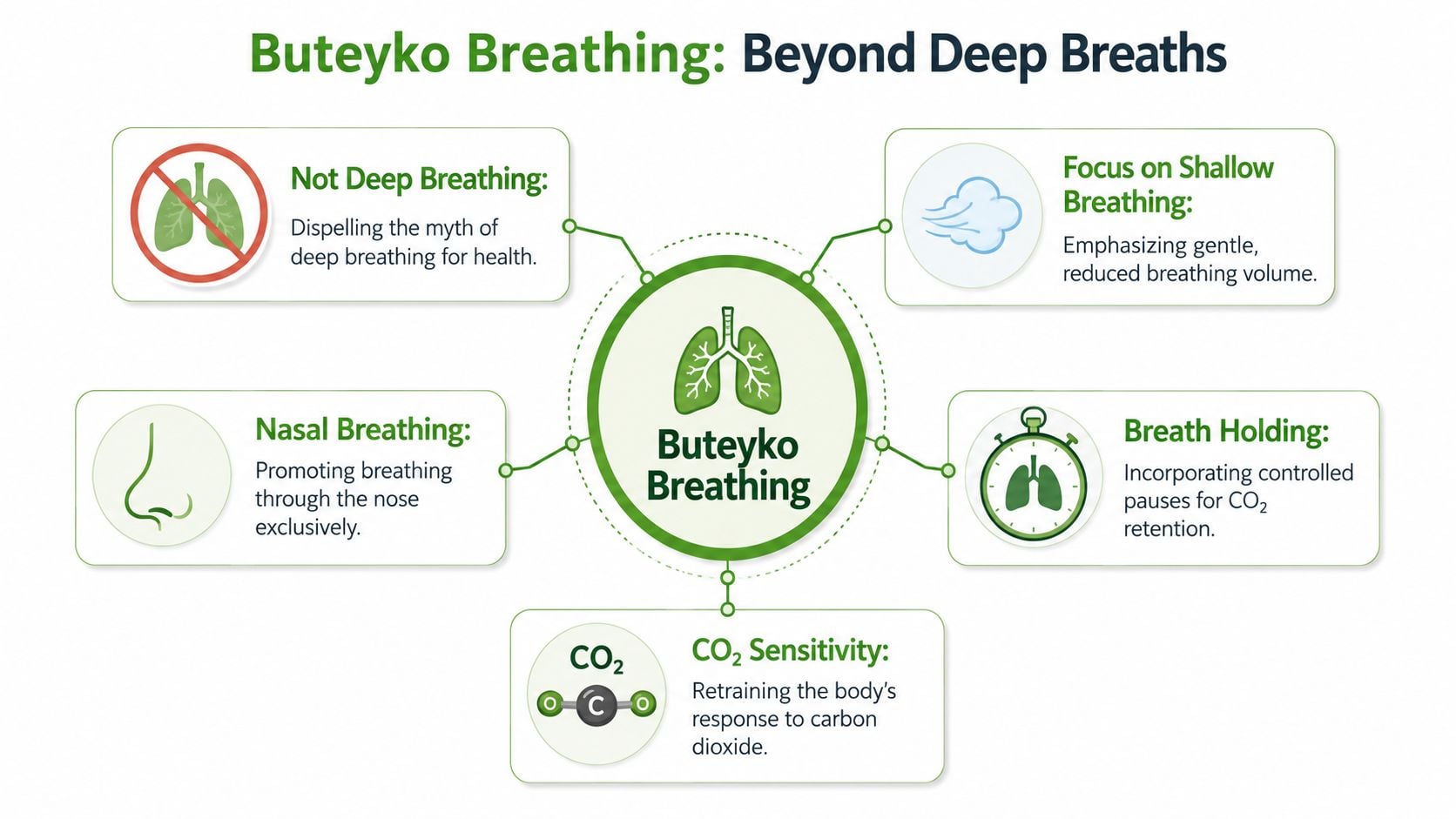
Buteyko is often initially misunderstood. Individuals assume it's a deep breathing method. It isn't. In many cases, it asks the opposite.
It's a retraining method, not a relaxation trick
Buteyko is built around reduced-volume breathing, nasal breathing, and gentle breath control. The aim is to help the body stop treating larger-than-needed breathing as normal.
A simple way to think about it is a thermostat that has been set too high for too long. The house isn't cold, but the system keeps pumping out heat because the setting is off. With Buteyko, the “setting” is your breathing drive. The method tries to recalibrate that drive so you stop over-breathing at rest.
For patients dealing with snoring, dry mouth, nasal blockage, or fragmented sleep, this often overlaps with a bigger airway conversation. A practical overview of that difference appears in this nasal breathing vs mouth breathing guide, and a more clinical airway-focused explanation is covered in this nasal breathing vs mouth breathing resource.
What a session usually emphasizes
A Buteyko-based program often teaches people to notice and change habits they didn't realize were there:
- Mouth breathing at rest that dries tissues and encourages inefficient airflow.
- Frequent sighing or yawning that can keep the breathing center over-alert.
- Upper chest breathing that goes with neck, jaw, and shoulder tension.
- Breathing that sounds or looks effortful even when the body isn't demanding that much air.
One commonly used concept is the Control Pause, a gentle breath-hold measure used as a training marker. It isn't the same thing as a competitive breath hold, and it's not a test of toughness. It's a way to observe how comfortable your body is with a natural pause after exhalation.
What Buteyko is not
It helps to clear away a few myths.
| Misconception | More accurate view |
|---|---|
| Buteyko means taking big cleansing breaths | It focuses on quieter, lighter breathing |
| It replaces medical care | It's a supportive method, not a substitute for needed treatment |
| It works by forcing breath holds | It uses controlled, tolerable practice, not strain |
| It's only for asthma | It may support other patterns related to dysfunctional breathing, though evidence varies by condition |
Done well, Buteyko feels subtle. That's part of why people underestimate it. The goal isn't dramatic breathing. The goal is breathing that stops demanding so much attention.
The Surprising Science of CO2 and Oxygen
A patient sits in bed at 2 a.m., breathing fast, pulse up, convinced they need more air. Their oxygen level may be normal. The problem is often less about how much oxygen gets into the lungs and more about how breathing patterns change carbon dioxide, muscle tension, and the body's alarm system.
CO2 isn't just waste
Carbon dioxide helps regulate when oxygen leaves hemoglobin and enters working tissues. If CO2 drops too low because someone is regularly over-breathing, oxygen delivery can become less efficient even when blood oxygen readings look fine.
A simple way to say it is this. Breathing more is not always breathing better.

That helps explain why a person can feel air hungry, lightheaded, foggy, cold in the hands, or oddly wired without being deprived of oxygen. In clinic, I explain this as a breathing efficiency problem. The lungs may be bringing air in, but the pattern is still pushing the nervous system and circulation in the wrong direction.
Why over-breathing can make symptoms worse
Habitual over-breathing often shows up in ways patients do not immediately connect to respiration. Common patterns include:
- Air hunger despite taking frequent large breaths
- Neck, jaw, and upper chest tension from accessory muscle overuse
- A fast stress response with small triggers
- Trouble falling or staying asleep because the body does not settle well
This is why advice like “take a deep breath” can fail people with anxiety, asthma-related breathing pattern dysfunction, or chronic hyperventilation tendencies. Large breaths may temporarily feel active or reassuring, but they can also reinforce the exact chemistry and muscle pattern that keeps symptoms going.
For athletes and health-focused patients, the same principle shows up in performance work. Efficient breathing supports tolerance, recovery, and steadier output, which is one reason some people also explore evidence-based conditioning strategies like this guide to smarter results with Telomyx.
A necessary caution about the theory
Patients deserve a careful explanation. Buteyko's practical value does not depend on overselling every part of the CO2 story.
Some Buteyko explanations make it sound as if raising CO2 automatically fixes asthma or proves better lung function. Clinical practice is more nuanced than that. People often feel better because they breathe with less effort, reduce mouth breathing, lower symptom reactivity, and calm the nervous system. They may sleep better, panic less, and rely less on rescue habits. Those are meaningful gains in daily life.
At the same time, feeling better does not usually mean standard lung capacity scores suddenly improve. That disconnect matters. Buteyko is best understood as a functional tool that can reduce distress and improve control, while other parts of a treatment plan may still be needed for airway inflammation, structural nasal issues, sleep-disordered breathing, pain-related chest restriction, or other root causes.
That is how we use it at Pain & Sleep Therapy Center. We value the method for what it does well. It improves breathing behavior, symptom control, and quality of life. We also stay honest about its limits so patients get a plan that matches the whole problem, not just one part of it.
What the Clinical Evidence Actually Shows
The strongest evidence for Buteyko is in asthma. That's where the answer to “Does Buteyko breathing work?” becomes much more concrete.
Where the evidence is strongest
Clinical trials show that Buteyko can significantly reduce medication dependence in asthma care. Patients in studies reduced bronchodilator use by 85% and inhaled corticosteroid use by 50% after six months, while maintaining stable lung function, according to Buteyko clinical trials summarized here.
That's a meaningful outcome because it speaks to daily life. Less rescue medication use usually means fewer moments of panic, less symptom reactivity, and more confidence doing ordinary things.
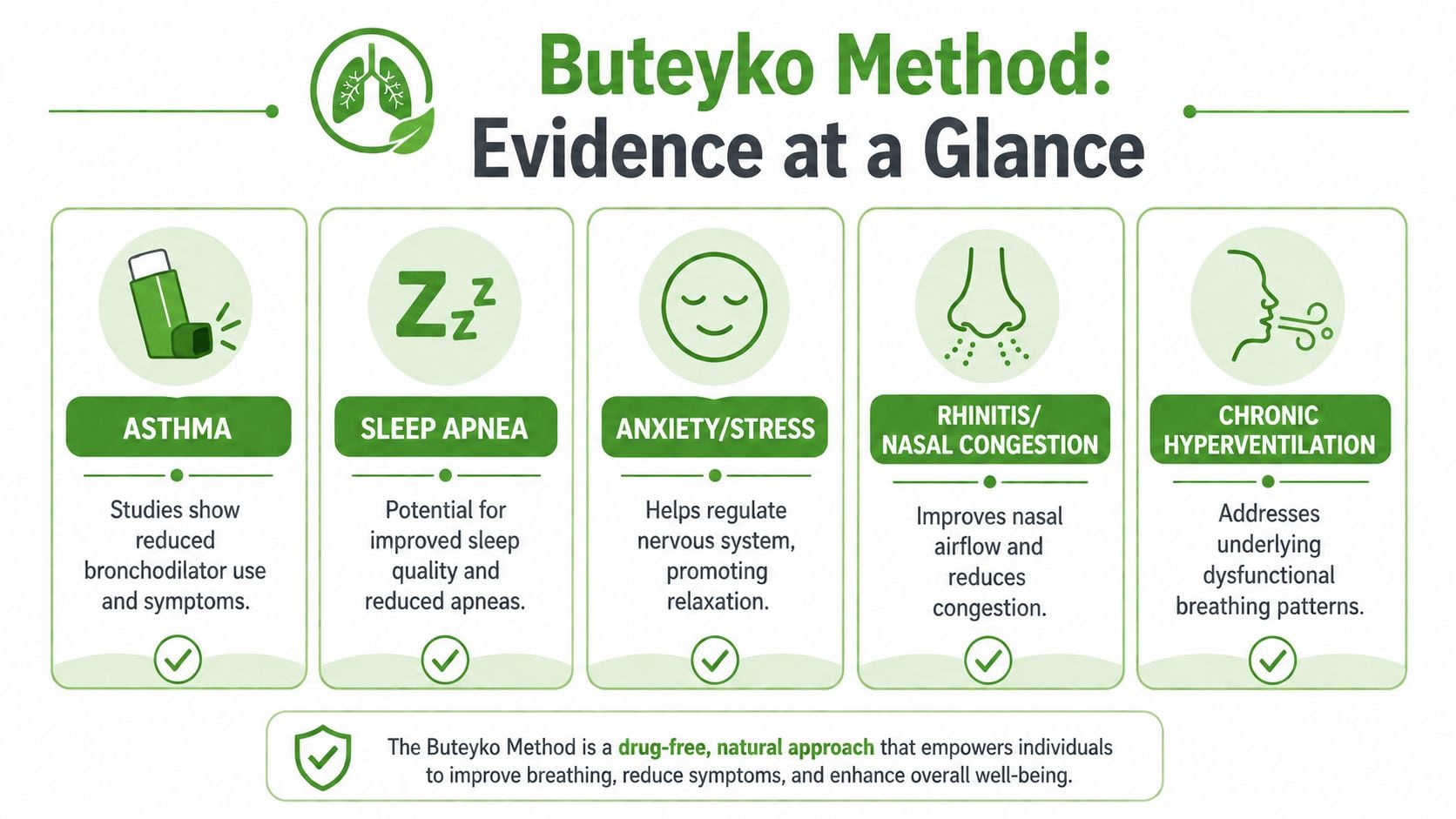
Researchers also describe improvements in symptom scores, nighttime waking, and activity limitation in asthma, even when objective lung function measurements don't change much. That distinction is the whole point of a responsible interpretation.
The disconnect people need to understand
Often, articles become misleading. They treat symptom relief as if it automatically means disease reversal. That isn't what the evidence says.
Buteyko appears to work best as a functional retraining tool. It helps people breathe in a way that reduces distress, reliever use, and symptom burden. It does not consistently show sustained improvement in measures like FEV1 or bronchial hyperresponsiveness in the same way patients might expect from a structural or anti-inflammatory treatment.
Feeling better and testing better are not always the same thing. Both matter, but they answer different questions.
That distinction matters even more in sleep and airway care. If a person's main problem is mechanical obstruction, a crowded airway, poor tongue posture, or sleep-disordered breathing linked to anatomy, Buteyko may still help symptoms and breathing behavior. It just may not solve the full problem by itself.
Other conditions and a practical summary
Outside asthma, the evidence becomes more supportive than definitive. Clinical guidance suggests Buteyko may help with snoring, sleep apnea support, panic symptoms, and dysfunctional breathing by encouraging nasal breathing and reducing upper chest muscle tension. But the evidence beyond asthma remains insufficient for strong clinical claims.
A useful parallel comes from exercise coaching. The best programs match the tool to the problem instead of forcing one method onto every body. That same principle shows up in this guide to smarter results with Telomyx, which makes a broader point about evidence-based progression and fit.
Here's a concise clinical summary:
| Condition | Level of Evidence | Primary Outcome |
|---|---|---|
| Asthma | Strongest | Reduced medication use and improved symptom control |
| Dysfunctional breathing | Supportive | Better breathing pattern regulation |
| Snoring and sleep apnea support | Emerging | May support nasal breathing and reduce symptom burden |
| Anxiety and panic-related over-breathing | Emerging | May reduce breath-driven stress reactivity |
The practical answer is yes. Buteyko works best when the target is symptom control, breathing efficiency, and nervous system regulation. It works less well if you expect it to remodel anatomy or serve as a stand-alone fix for every airway disorder.
Buteyko's Role in Modern Whole-Body Therapy
The most useful place for Buteyko is inside a larger treatment plan.
Functional change versus structural change
A critical nuance often missed is that over 20 clinical trials confirm Buteyko reduces asthma symptoms and medication use, but they do not show sustained improvements in physiological lung function markers like FEV1, as discussed in this review of Buteyko breathing technique evidence.
That doesn't mean the method failed. It means the method is solving a different layer of the problem.
Functional health matters. If someone sleeps more soundly, wakes less often, relies less on rescue medication, and feels less trapped by breathlessness, that person is better in ways that matter every day. But if they also have a narrow airway, poor oral posture, chronic mouth breathing, or sleep apnea driven by collapse during sleep, symptom relief alone isn't the whole answer.
Why integration matters
Here, Buteyko pairs well with therapies aimed at mechanics and structure.
For example, Buteyko can teach someone how to breathe with less effort and more nasal control. Orofacial myofunctional therapy can help address the muscular and postural habits that make healthy breathing harder to maintain. Airway-focused sleep care can address the nighttime side of the problem. When needed, patients also benefit from targeted evaluation for snoring and airway obstruction through options like natural sleep apnea treatment.
A practical way to view the layers looks like this:
- Breathing behavior: Buteyko can help retrain over-breathing and mouth-breathing habits.
- Oral and facial muscle function: Myofunctional therapy may improve tongue posture, lip seal, and swallow patterns.
- Mechanical airway issues: Sleep and airway treatments may be needed when obstruction is the main driver.
- Lifestyle triggers: Exercise load, stress, nasal congestion, and recovery habits still matter.
People with exertional symptoms often need this broader lens. Someone who wheezes or tightens during activity may benefit from breath retraining, but they also need practical planning around pacing and triggers. This strategies to manage EIB article gives a useful exercise-specific perspective on that point.
The best use of Buteyko isn't as a standalone cure. It's as a precise tool inside a root-cause plan.
For the right patient, that's powerful. It means we stop asking one method to do every job and start using each therapy for what it does well.
How to Get Started with Buteyko Breathing
You finally get through a day with less chest tightness, fewer sighs, and less mouth breathing. Then the next question hits. How do you practice this in a way that helps, instead of turning it into another breathing trick that fades after a week?
Starting Buteyko well usually means starting slower than expected.
Learn it correctly the first time
A short video can show the shape of the method. It usually cannot show whether you are subtly overworking, holding tension in the throat, forcing the exhale, or pushing into air hunger that is too strong for your system. Those details matter, especially for people with asthma symptoms, chronic nasal blockage, sleep disruption, or a history of panic around breathing.
A qualified instructor helps set the intensity at a level your body can tolerate and repeat. In practice, that often means guided sessions up front, then steady home practice over several weeks. As noted earlier, Buteyko is commonly taught as a structured training process rather than a quick self-help technique.
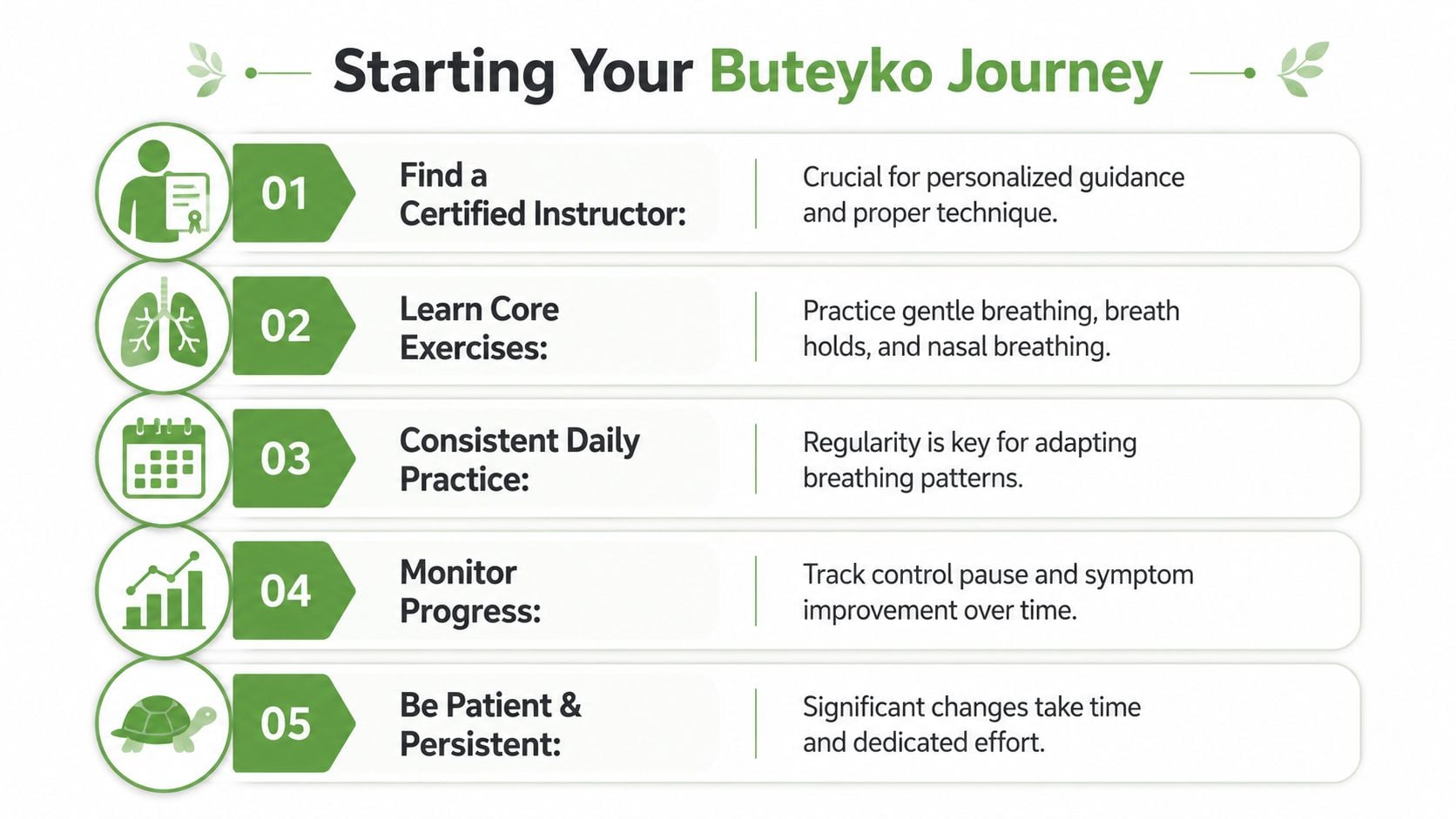
That structure also helps answer a question patients often miss. Is the problem mainly breathing pattern, nasal resistance, stress chemistry, poor sleep, or a mix of all four? Buteyko can improve the functional side of breathing. It does not automatically fix swollen nasal tissue, airway collapse, or other structural problems. For people dealing with blockage up front, these breathing exercises for nasal congestion can be a useful starting point while a fuller plan is being built.
What early practice usually feels like
Early sessions are often quiet and underwhelming. That is normal.
You may notice:
- Lighter breathing at rest that feels unusual at first.
- Mild air hunger during reduced breathing work that stays tolerable, not alarming.
- Less mouth breathing during the day and sometimes during sleep.
- Better awareness of trigger moments, such as stress, talking, exercise, or long periods at a screen.
Patients sometimes expect a dramatic opening of the lungs. That is not usually what happens. The more common early win is better control over breathing habits and symptom spirals. You feel less reactive. You recover faster. Daily life gets easier, even though this does not usually mean your underlying lung capacity numbers have changed.
Here's a brief visual explanation that many people find useful before starting a formal routine:
Who should be careful
Use extra caution if you have significant respiratory disease, untreated sleep apnea, severe anxiety around breath holding, or any medical condition where changing breathing patterns should be supervised. Asthma medication should not be reduced or stopped without guidance from the clinician managing your care.
Start gently. If an exercise makes you strain, gasp, or feel alarmed, the intensity is too high.
The best results come from repeatable practice your nervous system can accept. A calm, accurate ten minutes done consistently is usually more useful than an aggressive session that leaves you tense, discouraged, or chasing sensations.
Frequently Asked Questions About Buteyko
Is Buteyko breathing safe for children
It can be, especially when taught by a trained practitioner who adjusts the exercises for age, symptoms, and attention span. Children with mouth breathing, snoring, or dysfunctional breathing patterns often need a broader airway and habit assessment, not just generic breath drills.
Can Buteyko cure asthma or sleep apnea
It's better to think of Buteyko as a management and retraining tool, not a cure. In asthma, it can support symptom control and reduce medication reliance in some patients. In sleep apnea, it may support nasal breathing and breathing efficiency, but it doesn't replace evaluation and treatment for airway obstruction.
How long does it take to notice results
Some people notice changes in awareness, calm, or nasal breathing fairly quickly. More durable changes usually come with consistent practice over time. The method works best when you treat it like rehabilitation, not a one-off trick.
What does air hunger feel like
Mild air hunger feels like a gentle urge to breathe a little more. It should be tolerable, controlled, and never panicked. If it feels threatening, sharp, or overwhelming, the exercise is too intense.
Does Buteyko breathing work for everyone
No. It works best for the right problem. If dysfunctional breathing is driving symptoms, it can be very helpful. If anatomy, severe congestion, or structural airway collapse is the main issue, Buteyko may help but won't be enough on its own.
If you're dealing with snoring, mouth breathing, sleep apnea, TMJ tension, or chronic breathing dysfunction, Pain and Sleep Therapy Center offers root-cause evaluation and treatment that goes beyond symptom masking. Their team integrates airway-focused care, myofunctional therapy, and breathing retraining to help patients restore better sleep, better breathing, and better daily function.