
You wake up and your jaw already feels tired. Your teeth may not hurt, but the muscles along your cheeks feel heavy, your temples are tight, and breakfast is the first reminder that chewing shouldn't feel like work.
By midafternoon, the tension can spread. Some people notice a headache behind the eyes. Others hear a click when they yawn, or catch themselves pressing their teeth together while reading email, driving, or concentrating. The pattern is common, but it isn't something you should ignore or push through.
Tight jaw muscles usually respond best when you treat two things at once. First, calm the irritated muscles and improve how the jaw moves. Second, figure out why the muscles keep tightening in the first place. For many people, that answer isn't just stress. Breathing, sleep quality, posture, and oral habits often keep the cycle going.
That Familiar Ache Unpacking Your Jaw Pain
A new patient often describes the same sequence. They wake with soreness near the jaw hinge, spend the day rubbing the side of the face, and notice that the pain gets worse when stress rises or sleep was poor the night before. Sometimes the complaint sounds mild at first. "My jaw is just tight." But after a few more questions, there are headaches, neck tension, clenching, ear pressure, or trouble eating tougher foods.
That pattern matters because jaw pain is common, and it usually has a very manageable starting point. TMJ disorders affect approximately 1 out of every 12 people in the United States, or about 35 million Americans, and only an estimated 15 percent develop a chronic condition according to these TMJ prevalence statistics. Early conservative care can make a meaningful difference for many individuals.
Practical rule: A tight jaw isn't always a joint problem. Very often, the muscles are overworking because they're guarding, clenching, or compensating for something else.
The good news is that "how to loosen tight jaw muscles" usually isn't answered by one magic stretch. Relief tends to come from a sequence. Release the overworked chewing muscles. Reintroduce controlled motion. Then clean up the daily habits that keep re-tightening the system.
What patients usually notice first
- Morning soreness: This often points toward nighttime clenching, grinding, or poor sleep quality.
- Pain with chewing: The jaw muscles may be overloaded, especially the masseter and temporalis.
- Headaches and facial pressure: These commonly travel with jaw tension, even when the jaw itself isn't the only area that hurts.
- Clicking with tightness: Noise alone isn't always alarming, but noise plus pain or limited opening deserves more attention.
There's no need to panic. You do need a plan. If your jaw feels tight every day, your body is giving you useful information. The next step is to understand what's driving the tension.
Why Your Jaw Muscles Are So Tight
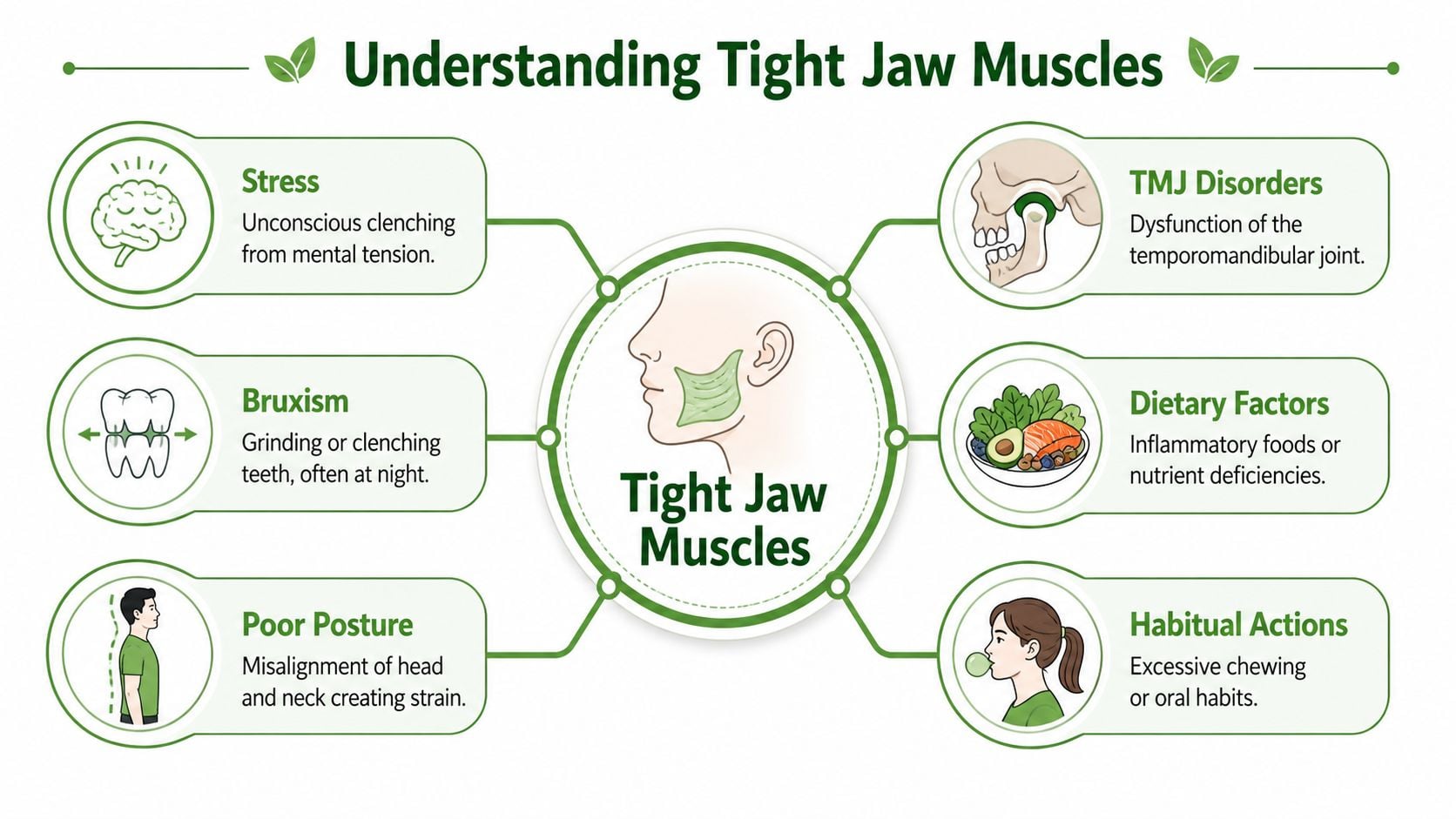
Stress is real, but it's not the whole story. Jaw muscles tighten when they have to work too often, stay partially contracted too long, or brace around an irritated joint. That can happen during the day from concentration and posture, or at night when breathing and sleep become part of the problem.
The usual triggers
Many people know they clench when anxious. Fewer notice the smaller habits that keep the jaw switched on all day.
| Trigger | What it does to the jaw |
|---|---|
| Stress and focus | Increases unconscious tooth contact and muscle guarding |
| Bruxism | Overloads the jaw muscles, especially overnight |
| Forward head posture | Pulls the jaw and neck into a strained position |
| Gum chewing or hard foods | Repeats load on already irritated tissue |
| Joint irritation | Makes muscles tighten to protect the area |
If you're sorting out symptoms, this guide on why your jaw hurts gives a useful overview of how muscle pain, joint strain, and clenching patterns overlap.
The breathing and sleep connection most people miss
This is the part many articles leave out. If you breathe through your mouth, snore, wake unrefreshed, or feel exhausted even after enough time in bed, your jaw may be reacting to poor breathing mechanics during sleep.
Recent data from interdisciplinary clinics shows that 68% of TMJ patients also have co-morbid obstructive sleep apnea, and Buteyko breathing methods aimed at restoring nasal breathing lowered jaw muscle hypertonicity by 40% in four weeks according to this TMJ and sleep breathing report.
Jaw muscles don't only respond to chewing. They also respond to airway stress, poor tongue posture, and the way you breathe when you're asleep.
When nasal breathing is poor, the jaw often drops or braces in ways that increase muscle activity. The tongue may sit low instead of supporting the palate. The neck may tense to help keep the airway open. Over time, the jaw muscles never get a full break. That's one reason a person can stretch faithfully and still keep flaring.
If your jaw is tight and your sleep is poor, treat that as one puzzle, not two separate problems.
A 60-Second Technique for Instant Jaw Release
When your jaw feels hard, achy, and overworked, the masseter is often the first muscle to target. It's the thick chewing muscle on the side of the face, and when it's irritated, you can feel it bulge when you clench.
How to find the muscle
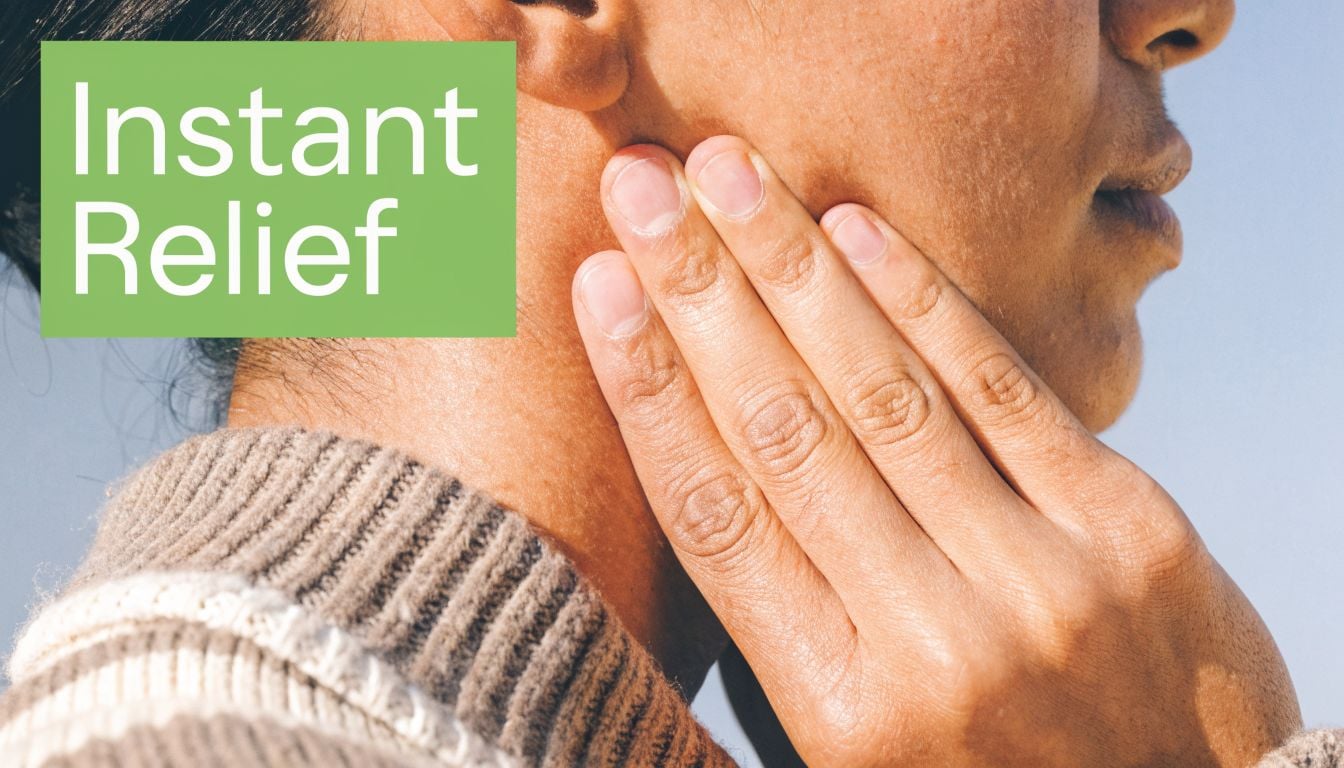
Place your fingers midway between your ear and the corner of your mouth, then gently bite down. You'll feel the masseter tighten under your fingertips. Relax your teeth right away. That softening and re-tightening tells you you're in the right place.
If you want a more detailed walkthrough of hand placement and pressure, this guide on how to massage your jaw is a useful companion.
The 60-second release
Use clean hands. The goal is pressure plus motion, not aggressive digging.
- Locate the masseter. Start at the angle of the jaw and gently feel for the dense muscle belly.
- Apply outside pressure first. Use your fingertips to press into the tight spot with steady, tolerable pressure.
- Add inside access if comfortable. Place a clean fingertip or knuckle inside the cheek over the masseter while the other hand stays outside. This can reach deeper fibers than external massage alone.
- Move the jaw slowly. Open and close gently, or shift side to side in a small controlled range while maintaining pressure.
- Wait for softening. You're looking for reduced resistance under your fingers, not a dramatic pop or a painful release.
- Finish with gentle movement. Open the mouth comfortably, then perform a few easy side glides and small circles.
What makes this technique work
The combination of sustained pressure and light movement helps reduce guarding in a muscle that's used to clenching. Inside-the-cheek access matters because the masseter is thick. Surface rubbing often doesn't reach the most irritated part.
The 60-Second Masseter Release Technique has been clinically observed to produce a 70-80% immediate pain reduction in stress-clenching cases, and daily use yielded sustained relief in 85% of mild TMD patients within two weeks in this masseter release protocol.
Don't force this. The most common mistake is too much pressure. If you bruise the tissue, you've irritated the same muscle you're trying to calm.
When to stop
Stop if you feel sharp pain, marked joint pain near the ear, numbness, or a sense that the jaw is catching. A release technique should feel relieving, intense in a controlled way, or mildly tender. It shouldn't feel alarming.
This method is useful during flare-ups, before meals if chewing is uncomfortable, or before bed if clenching builds through the evening.
Gentle Mobilization and Stretching Routines
Massage alone can relax a muscle, but lasting improvement usually needs movement retraining. The jaw has to open, close, and glide without recruiting every surrounding muscle for help. That's where controlled mobilization makes a difference.
Start with contrast therapy
If your jaw feels inflamed, puffy, or reactive, use temperature first. Warmth helps muscles relax. Cold can calm irritation after movement.
A practical home sequence looks like this:
- Apply a warm compress: Use a towel-wrapped warm pack over the jaw area.
- Switch to wrapped cold: Keep the cold pack wrapped and limit it to a brief calming interval.
- Alternate in cycles: This gives the area a pumping effect that can make movement easier afterward.
Use Goldfish exercises the right way
The partial Goldfish exercise is one of the most useful early movements because it teaches controlled opening without forcing range.
Try it this way:
- Place your tongue on the roof of your mouth, just behind the upper front teeth.
- Put one finger lightly over the jaw joint area in front of the ear.
- Place another finger or thumb on the chin.
- Open only halfway against light resistance, then close slowly.
- Keep the movement smooth and pain-controlled.
The key is restraint. People often try to "get a good stretch" by dropping the jaw too far, too soon. That usually backfires when the joint is already irritated.
A useful target is mild discomfort in the muscle, not sharp pain in the joint. Those are not the same thing.
Research on jaw-opening exercise also supports an idea that surprises many patients. Jaw-opening exercises performed until the point of mild pain produced better outcomes than pain-free exercise, with significant improvements in pain-free unassisted mouth opening (p = 0.006), jaw-opening pain (p = 0.014), chewing pain (p = 0.018), and maximum unassisted mouth opening at T2 (p < 0.001) and T3 (p = 0.003), with no participants withdrawing because of pain in this clinical study on jaw-opening exercise intensity.
That doesn't mean you should push through severe pain. It means a completely symptom-free approach is often too gentle to create change. Mild, controlled discomfort in a guarded muscle can be therapeutic.
A sample home routine
| Time | What to do |
|---|---|
| First | Warm the area, then perform the masseter release if needed |
| Next | Do partial Goldfish repetitions with slow control |
| Last | Finish with easy opening, side glides, and relaxed nasal breathing |
Later in the day, this demonstration can help you visualize pacing and control:
A protocol combining contrast therapy with 6 rounds of Goldfish exercises per day showed a 65% symptom reduction at 4 weeks in non-surgical TMD cohorts, and was about 40% more effective for muscle relaxation than stretching alone in this TMJ home-therapy protocol.
What doesn't work well
Three habits tend to slow progress:
- Forcing a wide opening: This irritates the joint when tissues are already guarded.
- Letting teeth touch during reps: That loads the jaw instead of retraining it.
- Doing exercises without changing daily habits: You may loosen the muscles in the morning and re-clench them all afternoon.
Controlled movement works best when paired with better breathing and better rest posture. Otherwise, the exercises become temporary maintenance for a problem that's still being fed every day.
Building Long-Term Habits for a Relaxed Jaw
Exercises help. Habits decide whether the muscles stay relaxed.

Three habits that change the baseline
The first is posture. If your head spends hours drifting forward over a phone or laptop, the muscles from your neck to your jaw never fully settle. A simple reset helps. Sit tall, lengthen the back of the neck, and gently draw the chin backward instead of tipping it up.
The second is oral rest posture. This should feel almost boring: lips together, teeth apart, tongue resting lightly on the roof of the mouth. If your teeth are touching and you're not swallowing or chewing, your jaw muscles are working when they don't need to.
The third is nasal breathing. This is the habit with the biggest root-cause impact for many people. A closed-mouth, nose-breathing pattern supports a better jaw position and often reduces the body-wide tension that comes with poor sleep and airway stress.
Small cues work better than heroic effort
- Set reminders: A few phone alerts that say "teeth apart" can catch daytime clenching.
- Use transitions: Check jaw tension every time you stop at a red light, open your laptop, or refill your water.
- Build a wind-down routine: Heat, gentle jaw release, and quiet nasal breathing before bed often help more than random stretching during a flare.
Relief usually comes from repetition, not intensity. The jaw responds well to small corrections done often.
Stress still matters, of course. If you carry anxiety in your body, broader calming tools can support the work. Some people like breath practice, meditation, or tactile grounding tools. If that appeals to you, you can discover anxiety relief crystals as one calming ritual alongside more evidence-based jaw care. The key is using stress relief as support, not as a substitute for addressing breathing, sleep, and mechanics.
If symptoms continue despite good home care, a more complete evaluation may need to look at the bite, airway, tongue posture, and nighttime breathing pattern together.
When to Seek Professional TMJ Evaluation
Home care has limits. If your jaw locks, your mouth opening suddenly becomes restricted, chewing is difficult, or popping comes with pain, it's time to move beyond self-treatment. The same is true if jaw tension comes with snoring, unrefreshing sleep, morning headaches, or persistent fatigue.
A proper workup should look at more than the joint itself. Muscle function, airway health, sleep quality, oral posture, and breathing pattern all affect how the jaw behaves. An orofacial pain specialist can help sort out whether you're dealing with mainly muscle tension, joint dysfunction, airway-related clenching, or a combination of all three.
At that point, treatment may include guided exercises, custom oral appliances, myofunctional therapy, or regenerative options such as cold laser therapy or injection-based support when clinically appropriate. Pain and Sleep Therapy Center is one example of a clinic that evaluates TMJ symptoms through both an orofacial pain and sleep-breathing lens.
If your jaw feels tight every day, or your pain seems tied to poor sleep, snoring, or constant clenching, Pain and Sleep Therapy Center offers evaluation for TMJ disorders, facial pain, and sleep-related breathing issues. The goal is to identify what's driving the tension so your treatment isn't just temporary relief, but a plan that helps your jaw stay calmer, move better, and let you sleep more comfortably.