
Living with jaw pain, clicking sounds, and those nagging headaches can feel like you're dealing with it all on your own. But you're definitely not alone. Think of this guide as your starting point for finally understanding Temporomandibular Joint Disorder (TMD) and finding effective tmj treatment in Charlotte NC. We're going to get past the confusing medical jargon and talk about what's really going on with this complex condition.
Your Guide to Overcoming Jaw Pain in Charlotte

If you're dealing with a clicking jaw, chronic headaches, or pain that radiates through your face, you know it's much more than a minor annoyance. These are signals coming from your temporomandibular joint (TMJ)—the intricate hinge connecting your jaw to your skull.
When this system is out of balance, it can throw everything off, from how you eat and speak to whether you get a good night's sleep.
This guide is a clear roadmap to understanding and—more importantly—addressing the root cause of your discomfort. Instead of just masking symptoms with temporary fixes, we'll explore a modern, common-sense approach to TMJ care that focuses on lasting relief. You'll learn how specialists here in Charlotte diagnose the real issues and use advanced, non-surgical therapies to get you back to feeling like yourself.
Understanding the Widespread Impact of TMJ Disorders
Jaw pain is incredibly common. In fact, temporomandibular joint disorders (TMD) are the second-most common musculoskeletal pain condition in the country. It affects roughly 1 in every 12 Americans—or about 10% of the population—with the annual cost of managing it hitting a staggering $4 billion.
This really highlights the need for specialized care, especially in a growing city like Charlotte, where high-stress jobs and "tech neck" posture can make jaw pain even worse. You can learn more about the prevalence of jaw pain on pscharlotte.com.
Our goal is to give you the knowledge you need to navigate your treatment journey with confidence. We'll cover what truly matters:
- Accurate Diagnosis: How experts pinpoint the precise source of your pain.
- Modern Therapies: A look at non-surgical options that help your body heal itself.
- The Airway Connection: Why your breathing and posture are critical to jaw health.
- Choosing a Specialist: What to look for in a qualified TMJ provider.
This guide is your first step toward a life free from jaw pain. By understanding the mechanics of your condition and the effective treatments available, you can finally find a real, sustainable solution.
We'll introduce you to a system of care that looks at the whole person—from muscle function to breathing patterns—to get to the source of your discomfort and help you reclaim your quality of life.
Decoding the Signals of a TMJ Disorder
Why does your jaw click when you chew? And what’s the real story behind those nagging tension headaches that pop up out of nowhere? These aren’t just random frustrations. They are important signals your body is sending, and learning to interpret them is the first step toward getting lasting relief.
Think of your jaw joint as the most complex, hard-working hinge in your entire body. It moves up, down, forward, backward, and side-to-side. When this finely-tuned system gets thrown off balance, the effects don't just stay in your jaw—they ripple outward, creating a web of symptoms that can seriously disrupt your day-to-day life.
Many people who come to us for TMJ treatment in Charlotte NC are surprised to find out just how interconnected their symptoms truly are. Once you understand the ‘why’ behind the pain, a clear path forward finally starts to emerge.
More Than Just a Click: The Common Language of Jaw Pain
A TMJ disorder isn't one single problem but a collection of symptoms all pointing to an underlying issue. The key is to recognize these signals for what they are: clues that your jaw system is under a huge amount of strain.
Some of the most common signs we see include:
- Jaw Clicking and Popping: Those noises often happen when the small disc that cushions the joint slips out of place. While a rare click might be nothing, consistent and painful sounds are a red flag for instability.
- Facial and Jaw Pain: A dull, persistent ache around the jaw, ears, or side of the face is a classic symptom. This discomfort usually gets worse when you chew, yawn, or talk for a while.
- Frequent Headaches or Migraines: Tension headaches, especially those that wrap around your temples or start at the base of your skull, are very frequently tied to jaw muscle strain and clenching.
- Ear-Related Symptoms: Since the jaw joint is right next to the ear canal, TMJ issues can easily disguise themselves as ear problems. This can cause pain, a feeling of fullness, or even ringing (tinnitus).
These are just a handful of examples. For a more complete picture, you can learn more about the diverse symptoms of temporomandibular joint dysfunction on pscharlotte.com and see how they line up with your own experience.
Uncovering the Root Causes of TMJ Dysfunction
Symptoms are the effect, but what's the actual cause? Real, effective treatment depends entirely on figuring out the source of the imbalance. A specialist will dig into several potential culprits that contribute to TMJ disorders.
The goal isn’t just to quiet the noise of a clicking jaw or numb a headache. It's to restore balance to the entire system by addressing the fundamental reason it became dysfunctional in the first place.
This means we have to look beyond the joint itself and investigate the behaviors and conditions that are putting it under so much stress.
Connecting TMJ Symptoms to Their Potential Sources
Understanding these connections helps take the mystery out of your condition. A specialist in Charlotte can help you connect the dots between what you’re feeling and what’s really going on anatomically. This table shows how common symptoms can often be traced back to specific underlying issues.
Connecting TMJ Symptoms to Their Potential Sources
| Symptom | What It Feels Like | Potential Root Cause |
|---|---|---|
| Morning Headaches & Sore Jaw | Waking up with a dull, aching headache and tight, tired jaw muscles that make it hard to open your mouth. | Nighttime Bruxism (Teeth Grinding): Unconscious clenching and grinding during sleep puts immense pressure on the jaw joints and surrounding muscles. |
| Jaw Locking or Sticking | Your jaw gets "stuck" in an open or closed position, making it difficult and painful to move. | Disc Displacement: The cartilage disc inside the joint has slipped out of its proper position, blocking the smooth movement of the jaw. |
| Pain When Chewing Tough Foods | A sharp or aching pain that flares up when you eat things like steak, crusty bread, or chewy candy. | Muscle Inflammation & Fatigue: The primary chewing muscles (masseter and temporalis) are overworked and inflamed from constant strain. |
| Ringing in the Ears (Tinnitus) | A persistent ringing, buzzing, or hissing sound in one or both ears that has no external source. | Airway Obstruction & Muscle Tension: Misaligned jaw posture can affect the Eustachian tube and put pressure on nerves near the ear. |
Recognizing these patterns is a huge step forward. For example, a clicking jaw paired with morning headaches is a strong indicator of bruxism, while a jaw that locks points more toward a mechanical problem inside the joint itself. A thorough diagnosis is absolutely essential to make sure your treatment plan is aimed at the right target—giving you a real solution instead of just another temporary fix.
A Modern Approach to Diagnosing Jaw Pain
Finding a lasting solution for jaw pain isn't about guesswork. It all starts with a precise diagnosis. At our center, we use a detailed, data-driven process to get to the absolute root of your discomfort, ensuring your therapy is aimed at the right target from day one.
The journey begins not with a scan or a test, but simply by listening. A thorough consultation is our first priority, giving you the space to share your story—when the pain started, what it feels like, and how it’s messing with your daily life. This personal history gives us critical clues that guide everything that comes next.
From there, we move to a hands-on physical examination. We'll gently assess your jaw's range of motion, check for those tell-tale clicks or pops, and identify any painful trigger points in your facial muscles. This helps us map out functional limitations and pinpoint specific areas of inflammation or strain.
Seeing Beneath the Surface with Advanced Imaging
To get the full picture, we have to look deeper than standard dental X-rays, which really only show the teeth. Modern diagnostics require a look at the entire system—bone, joint, and soft tissue. This is where advanced imaging technology is a game-changer.
A Cone Beam Computed Tomography (CBCT) scan is the cornerstone of our diagnostic process. Think of it as creating a high-definition, 3D blueprint of your skull and jaw.
- It reveals your unique joint structure: The scan shows the exact position and health of the condyles (the ends of your jawbone) and the discs that cushion them.
- It identifies hidden abnormalities: Things like arthritis, bone spurs, or structural imbalances become crystal clear.
- It assesses your airway space: This is huge. A CBCT scan can measure the dimensions of your nasal and pharyngeal airways, flagging potential obstructions that are often a major contributor to jaw problems.
This level of detail lets us see issues that are completely invisible on a flat, 2D X-ray. It provides the solid, undeniable foundation for an accurate diagnosis.
The diagram below shows how a seemingly simple jaw misalignment can trigger a cascade of symptoms, making a detailed diagnosis absolutely essential.
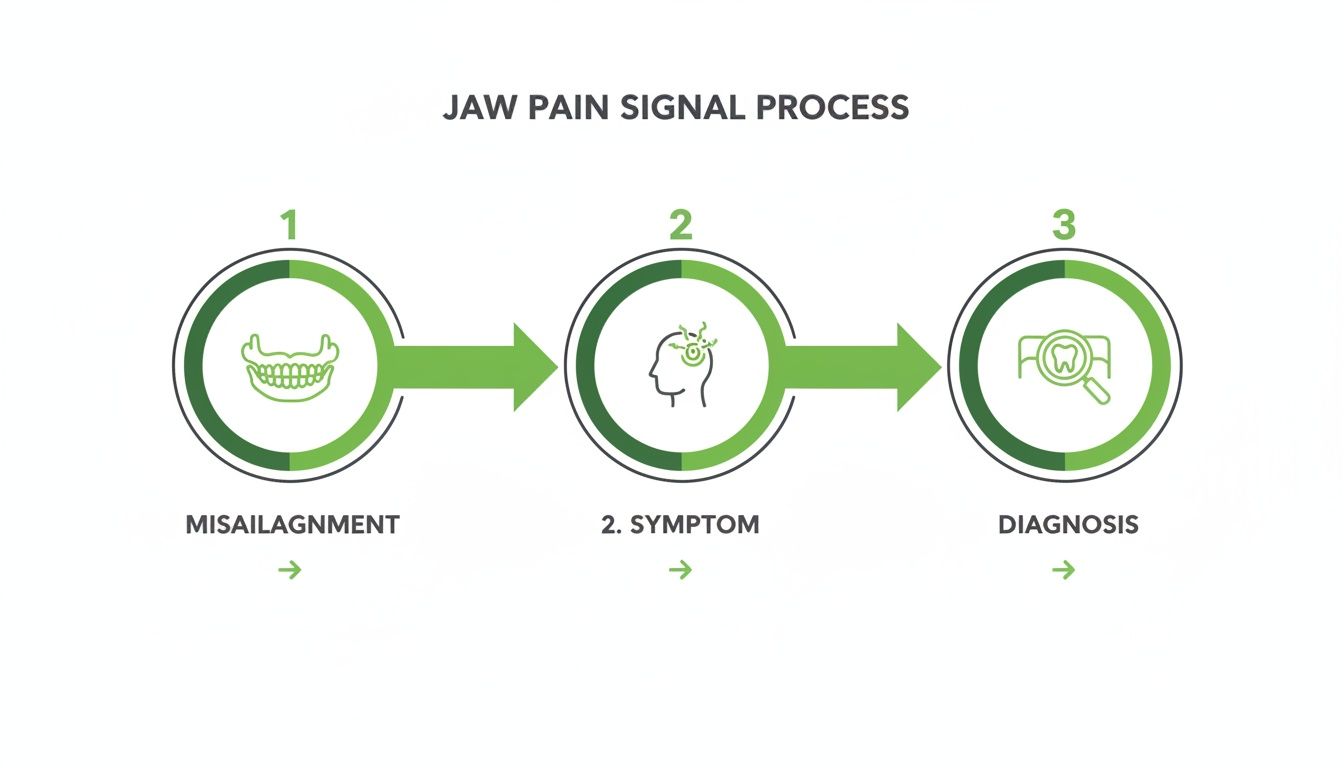
As you can see, symptoms are just the final signal of a deeper issue. That’s why digging deep to find the source is the only way to achieve real relief.
Measuring Muscle Function in Real-Time
Pain often comes from overworked, exhausted muscles. But which ones are firing incorrectly, and why? To get that answer, we use electromyography (EMG), a technology that measures the electrical activity your jaw muscles produce.
Imagine we place tiny sensors on your face that act like little microphones, "listening" to how hard your muscles are working when you bite, chew, or even just rest.
This data gives us objective proof of muscle dysfunction. It shows us if your muscles are stuck in a state of constant tension (what we call hyperactivity) or if they aren’t firing in a coordinated, balanced way.
This information is invaluable. It helps us figure out if the problem is coming from the joint itself or from a muscular imbalance. For patients who clench or grind, EMG can even measure the intensity of the habit, giving us a clear baseline to track your progress.
This data-driven approach takes the uncertainty out of the equation. It shows you exactly what’s going on and gives you the confidence of knowing that the therapy we choose is actually working. By combining your personal story, a hands-on exam, and these advanced diagnostic tools, we build a complete and accurate picture of your condition—paving the way for a truly personalized and effective treatment plan.
Non-Surgical TMJ Therapies That Actually Work

When you're dealing with persistent jaw pain, the idea of surgery can be intimidating. The good news is that surgery is rarely the first or best path forward for TMJ disorders. Modern, forward-thinking TMJ treatment in Charlotte, NC, focuses on conservative, non-surgical therapies that help your body heal itself and correct the root biomechanical issues causing your pain.
Our goal isn't just to mask your symptoms for a little while. It's to retrain your body for long-term stability and comfort. This approach sees your jaw, airway, and facial muscles as a single, interconnected system. By addressing imbalances within that system, we can bring about lasting relief without ever needing an invasive procedure.
Retraining Your Muscles with Orofacial Myofunctional Therapy
Think of Orofacial Myofunctional Therapy (OMT) as physical therapy designed specifically for your mouth, tongue, and facial muscles. It’s a program of simple, targeted exercises that corrects harmful habits you probably don't even realize you have—like the wrong swallowing pattern or poor tongue posture.
So many TMJ issues come from simple muscle imbalances. For instance, if your tongue rests low in your mouth instead of lightly suctioned to the roof, it forces your jaw muscles into a constant state of low-grade tension. OMT helps fix this by teaching you to restore proper function.
A certified therapist guides you through a series of exercises to:
- Establish Correct Tongue Posture: This means training your tongue to rest naturally on the palate, which supports the jaw and helps keep your airway open.
- Promote Nasal Breathing: Many people with jaw pain are chronic mouth breathers, a habit that destabilizes the jaw. OMT helps you get back to healthy, efficient nasal breathing.
- Correct Swallowing Patterns: An improper "tongue thrust" swallow puts a surprising amount of pressure on your jaw and teeth. OMT works to retrain this fundamental movement.
By correcting these foundational functions, OMT takes the strain off your TMJ, allowing overworked muscles to finally relax and recover.
Regenerative Medicine: Deploying Your Body's Own Repair Crew
One of the most exciting areas in non-surgical TMJ care is regenerative medicine. Instead of using drugs to cover up pain, these therapies tap into your body's own powerful healing abilities to repair damaged tissue right inside the jaw joint. Two leading options we offer in Charlotte are Platelet-Rich Fibrin (PRF) and Prolotherapy.
Platelet-Rich Fibrin (PRF)
Imagine your inflamed jaw joint is a construction site that needs urgent repairs. PRF therapy is like sending your body’s own elite repair crew directly to the site.
The process is incredibly simple:
- We draw a small sample of your blood, just like a routine lab test.
- That blood is spun in a centrifuge to separate and concentrate the platelets, white blood cells, and fibrin—all the key players in healing.
- This concentrated PRF solution, which is packed with growth factors, is then injected into the damaged TMJ.
Once injected, the PRF creates a natural scaffold that signals your body to speed up tissue repair, calm inflammation, and even build new, healthy cartilage. It’s a powerful way to kickstart genuine healing from the inside out.
Prolotherapy
Prolotherapy works on a similar principle of stimulating natural healing, but with a slightly different tactic. This therapy involves injecting a natural irritant solution (usually a dextrose mixture) into the weak ligaments and tendons around the TMJ. This targeted irritation creates a mild, controlled inflammatory response. It essentially "tricks" the body into thinking there's a new injury, which triggers a flood of healing growth factors to strengthen and stabilize the joint.
Reducing Pain and Inflammation with Cold Laser Therapy
Cold Laser Therapy, also known as Low-Level Laser Therapy (LLLT), gives us a non-invasive, drug-free way to manage TMJ pain and inflammation. This technology uses specific wavelengths of light that penetrate deep into the tissues of your jaw joint and the surrounding muscles.
Unlike a surgical laser, a cold laser doesn’t cut or burn. Instead, the light energy is absorbed by your cells, giving their mitochondria (the cellular "powerhouses") a boost. This has several key benefits for TMJ sufferers:
- Reduces Inflammation: It helps decrease swelling and fluid buildup in the joint.
- Alleviates Pain: The laser energy can help block pain signals sent by nerves in the area.
- Accelerates Healing: It increases blood flow, delivering more oxygen and nutrients to damaged tissues.
The treatment itself is painless, quick, and can bring immediate relief for acute flare-ups while supporting the long-term goals of your other therapies. It's a fantastic tool for breaking the cycle of pain and inflammation that so often gets in the way of recovery.
Even with the high success rates of these conservative approaches, many people suffer in silence. Shockingly, only about 1 in 3 people with TMJ disorders ever seek professional help. In a healthcare hub like Charlotte, these therapies are the first line of defense, succeeding in 85-90% of patients. Advanced options like PRF push these outcomes even higher, helping 75% of complex cases avoid surgery entirely. You can discover more insights about TMJ treatment success rates on skyviewdentistrycharlotte.com.
The Critical Link Between Airway Health and Jaw Pain
That clicking jaw or relentless headache might feel like a simple mechanical problem. But what if the real issue isn't in your jaw joint at all? What if it all starts with how you breathe?
A growing body of evidence shows a profound connection between airway health and jaw function—a link that’s frequently missed in traditional TMJ treatment.
Think of your head and neck like a finely tuned architectural structure. When your tongue rests correctly on the roof of your mouth, it acts as a natural scaffold, supporting the upper jaw and keeping your airway open. But when things like chronic allergies, a tongue-tie, or just a bad habit lead to mouth breathing, that entire structure is thrown off balance.
The jaw drops, the tongue falls, and the head often thrusts forward to open the airway. This unnatural posture puts constant, low-grade stress on the jaw joints and surrounding muscles, paving the way for pain and dysfunction.
How Breathing Patterns Directly Impact Your Jaw
Breathing through your mouth puts your body in a subtle but constant state of stress. It’s an inefficient way to get oxygen, and it destabilizes your entire craniofacial system. This forces the muscles in your face, jaw, and neck to work overtime, leading to fatigue, inflammation, and chronic pain.
This is especially crucial for a growing child. A kid who is a chronic mouth breather is at risk of developing a narrow palate and a recessed lower jaw. These are physical traits highly associated with future TMJ disorders and obstructive sleep apnea. Tackling these airway issues early isn't just about symptom management; it's a proactive strategy for preventing a lifetime of problems.
A Proactive Approach to Lifelong Health
Here in Charlotte, forward-thinking specialists know you can't truly fix a jaw problem without first looking at the airway. It means looking beyond the immediate site of pain to find and correct the underlying functional issues driving the entire condition.
An unhealthy airway creates an unstable jaw. By restoring proper nasal breathing and correct oral posture, we build a stable foundation that allows the jaw to function without strain, providing a true, lasting solution to the pain.
This modern approach involves therapies designed to get your body back to its natural, intended state. Specialists focus on:
- Restoring Nasal Breathing: Techniques like Buteyko breathing exercises help retrain your body to breathe comfortably and efficiently through the nose, the way it was designed to.
- Correcting Tongue Posture: This is a cornerstone of Orofacial Myofunctional Therapy, which uses targeted exercises to strengthen the tongue and teach it to rest properly against the palate. Learn more about what Orofacial Myofunctional Therapy is in our detailed guide.
- Addressing Physical Restrictions: For infants and children, identifying and releasing a tongue-tie can be a game-changing intervention that sets them up for proper oral development.
By putting the airway first, we do more than just offer TMJ treatment in Charlotte, NC. We help promote better sleep, improved focus, and a stable foundation for lifelong health—proving that the way you breathe is deeply connected to how you feel.
How to Choose the Right TMJ Specialist in Charlotte
Finding the right healthcare partner is probably the most critical step you'll take on your journey to relieve jaw pain. The truth is, not all dentists or doctors have deep, specialized training in the complexities of the temporomandibular joint. Making an informed choice is how you find a practitioner who looks past the symptoms to fix the root cause of your pain.
Think of it like hiring a detective for a really specific, tricky case. You wouldn't hire a generalist; you'd want the expert who lives and breathes that one specialty. For TMJ disorders, you need someone who truly understands the intricate dance between your jaw, airway, muscles, and even your posture. That’s the key to finding a real, lasting solution for your tmj treatment in Charlotte NC.
Look for Advanced Credentials and a Clear Philosophy
Your first move is to check a provider’s qualifications. While plenty of dentists can make a nightguard, a true specialist will have advanced post-graduate training focused entirely on this field.
Here are a few key things to look for:
- Board Certification in Orofacial Pain: This is a big one. It means a dentist has completed years of extra training and passed tough exams focused on complex pain disorders of the head, face, and neck.
- A Focus on Root-Cause Diagnosis: A specialist’s website and initial chat should be all about finding the "why" behind your pain, not just offering a quick-fix appliance.
- An Interdisciplinary Approach: The best clinics understand that TMJ is a team sport. They often work with other experts like ENTs, physical therapists, and myofunctional therapists to see the whole picture.
A provider's treatment philosophy matters more than you might think. Look for a specialist whose goal is to restore normal function and help your body heal itself, not just mask the pain with pills or temporary fixes.
Essential Questions to Ask During Your Consultation
Once you've found a potential specialist, the consultation is your time to see if they're the right fit. Don't ever be afraid to ask detailed questions. This is a partnership, and you need to feel confident in their plan for you. If you need help finding someone, our team can point you to a facial pain specialist near you in the Charlotte area.
Come prepared with a few questions to get the conversation started:
- What diagnostic tools do you use? Ask if they use advanced imaging like CBCT scans. This gives them a 3D view of the joint and airway, which is far more revealing than standard dental X-rays.
- What is your experience with non-surgical therapies? Get a feel for their approach to regenerative options like PRF or prolotherapy. Also ask about therapies like cold laser or orofacial myofunctional therapy.
- How do you look at airway and breathing? A top-tier specialist will always evaluate how your breathing patterns and oral posture might be contributing to your jaw problem.
- What does a typical treatment plan look like? Ask them to walk you through their process, from the first diagnosis to the different phases of therapy and long-term care.
Choosing the right specialist is an investment in your health and your future. By doing a little homework and asking the right questions, you can find a partner who is truly equipped to guide you toward a life without jaw pain.
Your TMJ Treatment Questions, Answered
When you’re dealing with jaw pain, it’s natural to have questions about what treatment looks like, how much it costs, and what to expect. We believe in clear, straightforward answers. Here’s a look at some of the most common questions we hear from patients seeking TMJ treatment in Charlotte, NC.
What Does TMJ Treatment Cost and Will Insurance Cover It?
The cost of your treatment really depends on your specific needs. A simple custom orthotic, for example, is very different from a more comprehensive plan that might include regenerative medicine or myofunctional therapy. There isn't a one-size-fits-all price because there isn't a one-size-fits-all treatment.
While some medical and dental insurance plans might cover a portion of your diagnostics or certain appliances, it's important to know that many of the more advanced, root-cause treatments often aren't covered. We’ll always provide you with a completely transparent breakdown of costs after your diagnosis and can walk you through flexible financing options to make sure you can get the care you need.
How Quickly Will I Start to Feel Better?
This is unique to every person and depends on how severe your condition is and which therapies we use. Many patients feel an initial drop in pain and inflammation within the first few weeks, especially with treatments like custom orthotics or cold laser therapy that provide immediate relief.
For therapies that get to the root cause, like Orofacial Myofunctional Therapy, the improvement is more gradual but built to last. You might feel your jaw working better in the first month, with significant, lasting relief typically taking shape over three to six months of consistent therapy.
Do I Need Surgery for My TMJ Disorder?
For the overwhelming majority of people, the answer is a firm no. It’s a common myth that severe jaw pain automatically leads to surgery, but the reality is that modern, conservative care is incredibly effective.
In fact, over 85% of all TMJ cases are resolved without any invasive procedures. We view surgery as an absolute last resort, only for rare situations involving serious structural joint damage that hasn't responded to anything else. Our first goal is always to explore every effective non-surgical option available to you.
Can Stress Alone Be Causing My TMJ Pain?
While stress isn't usually the single cause of a TMJ disorder, it’s a huge contributor—like pouring gasoline on a fire. When you’re stressed, your body’s "fight or flight" response can kick in, leading to unconscious jaw clenching and teeth grinding, also known as bruxism.
This constant muscle tension puts a massive strain on your jaw joints and facial muscles, which leads directly to inflammation, fatigue, and pain. A truly effective treatment plan has to address the physical symptoms while also giving you tools, like targeted breathing exercises, to manage the stress that’s fueling the problem in the first place.
At the Pain and Sleep Therapy Center, our goal is to give you clear answers and personalized, non-surgical treatment plans that bring lasting relief. If you’re ready to finally understand the root cause of your jaw pain, schedule your comprehensive consultation with our team today.